


Solar Inverter Replacement and the Real 25-Year Cost
Published: 2026-09-08 10:10:20
Updated: 2026-10-06 12:39:33
Panels and inverters don't age at the same rate. Here's why UK solar owners should budget for one mid-life inverter swap and price the whole 25 years.
The Part That Gets Replaced First: Solar Inverters and Whole-Life Cost
If you're asking "does a solar system really last 25 years?", the honest answer is: most of it does, but not all of it at the same rate. Solar panel performance warranties commonly run 25 years or more, while inverter warranties are typically far shorter. That difference is the single most useful thing to understand before you compare quotes, because it means a genuine lifetime cost for a UK home should assume the inverter is replaced once somewhere in the middle, while the array on the roof keeps quietly generating. This article explains why the two components age so differently, what a mid-life inverter swap actually involves, how to read the whole-life cost of a system rather than just its first-day price, and which design decisions make the inverter's working life easier. Nothing here is a scare story — a planned replacement you've budgeted for is simply maintenance. The problem is only ever the replacement nobody mentioned.
"Panels often do. Budget for one inverter replacement mid-life."
Two components, two very different lifespans
A rooftop solar system is often sold as a single object, but it behaves like two. The array is glass, silicon, an aluminium frame and a backsheet, bolted to a roof and left alone. The inverter is power electronics — switching devices, capacitors, control boards and usually a cooling fan — converting DC from the roof into AC your house can use.
The warranty terms reflect that split honestly. Panel manufacturers typically publish long performance warranties measured in decades, guaranteeing that output will still sit above a stated percentage after 25 years or more. Inverter warranties are conventionally much shorter, sometimes with the option to extend them at extra cost. Nobody is being cagey; the numbers simply describe what each device is asked to do.
So when you hear "a solar system lasts 25 years", read it as: the roof-mounted part is designed to still be earning at 25 years, and the box on the wall is a serviceable component within that. One is infrastructure. The other is equipment.
Why the inverter ages faster than the roof
The reason is duty cycle, not build quality. Panels sit passive. They have no moving parts, no switching, no internal heat generation worth speaking of. Weather washes over them, they warm in summer and chill in winter, and they carry on.
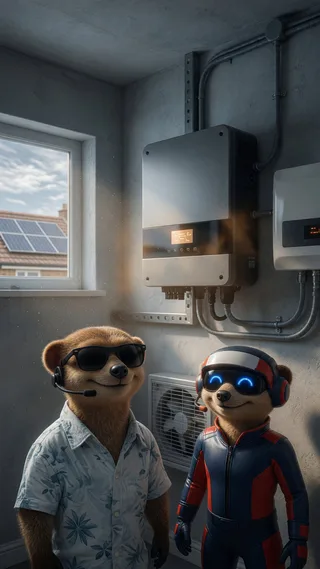
The inverter does the opposite. Every daylight hour it is switching at high frequency, tracking the array's maximum power point as clouds pass, generating heat and shedding it, then cooling down again overnight. Thermal cycling — heating and cooling, over and over — is what quietly ages electronic components. Add a fan in a dusty garage, and you have the classic wear profile of any hard-working power supply.
There's a neat piece of physics hiding in Mo's question, too: solar panels generate more efficiently in cold weather than in hot. A crisp, bright February day can be excellent for panel efficiency. The panels genuinely like the cold; the inverter is the component that has to do the sweating. That asymmetry is why one part of your system is a 25-year asset and the other is a mid-life replacement.
What whole-life cost actually means when you compare quotes
Most quote comparisons are a first-day exercise: install price, estimated annual generation, payback. A whole-life view adds three things the first day ignores.
First, one planned inverter replacement somewhere in the middle of the system's life, including labour and any commissioning work. Second, the small ongoing items — occasional cleaning if your roof needs it, an electrical inspection in line with your installer's guidance, and monitoring subscriptions if the manufacturer charges for them. Third, the value of the years after any finance is repaid, when the roof is still generating and the marginal cost of that electricity is essentially nothing. When you build all three into the picture, cheap installs can look different. A quote that shaves money off the inverter or the mounting hardware may cost more across 25 years than one that specifies a well-ventilated, sensibly sized unit with a longer or extendable warranty. Equally, a system that's expensive on day one isn't automatically better value — you're looking for the lowest honest cost per kilowatt-hour over the whole life, not the flashiest specification. The practical instruction is short: price the whole life, not the first day. Ask each installer to state their assumption about inverter replacement in writing. The ones who answer clearly are usually the ones worth talking to.
Design choices that make the inverter's job easier
You can't stop an inverter working hard, but installation decisions materially affect how hard.
Location matters most. A cool, dry, ventilated position — a garage or utility wall, out of direct sunlight, with the manufacturer's clearances respected around the housing — gives the unit an easier thermal life than an unventilated loft that bakes under a south-facing roof in July. If a loft is the only realistic option, ventilation and mounting height become part of the design conversation, not an afterthought.
Sizing matters next. An inverter permanently running flat out has a different thermal profile from one specified with sensible headroom for your array. A good installer will explain their DC-to-AC sizing logic rather than just quoting a model number. Architecture matters too. String inverters concentrate the electronics in one accessible box on a wall — easy to swap, one point of failure. Microinverters or power optimisers distribute the electronics across the roof, which can help with shading but puts serviceable components up where access costs more. Hybrid inverters that also manage a battery add capability and add complexity; if you're planning to add storage later, say so at survey stage so the wall you build today still makes sense in ten years' time. Finally, tidy work pays off. Clean conduit, labelled isolators and a sensibly laid-out consumer unit turn a future replacement into a straightforward morning's work rather than an excavation.
What a mid-life inverter swap actually involves
It's less dramatic than people imagine. A like-for-like replacement on existing brackets is usually a single-visit job: safe isolation of the AC and DC sides, removal of the old unit, mounting and wiring the new one, commissioning, and reconnecting monitoring. Your installer handles the notification to the network operator where the specification changes require it, and your panels, mounting system, cabling and roof penetrations are untouched.
Crucially, your generation history doesn't disappear because a box changed. Export and generation metering arrangements are separate from the inverter itself, and cumulative generation data lives in your monitoring account and your meter, not solely in the unit on the wall.
Signs the end is approaching are usually gradual rather than sudden: recurring fault codes in the app, a fan that's noticeably louder or running for longer, unexplained daytime dropouts, or output that has drifted below what your monitoring says the weather should be delivering. If your system is old enough that spares are becoming scarce, that's a planning signal too — replacing on your terms is cheaper and less disruptive than replacing in the middle of a bright June week.
A practical checklist before you sign
Use these at survey stage, or when comparing written quotes:
- What is the panel performance warranty, in years, and what output percentage does it guarantee at the end of that term? - What is the inverter warranty as standard, and can it be extended? At what cost, and for how long? - Where exactly will the inverter be mounted, and what ventilation and clearance does the manufacturer require in that position? - How is the inverter sized against the array, and why? - Is this a string, hybrid, microinverter or optimiser design — and what does that mean for future service access? - If I add a battery in five years, does this inverter accommodate it, or would it need replacing early? - What does your quote assume about a mid-life inverter replacement, and is that assumption written down? - Who supports the monitoring platform, is there an ongoing charge, and what happens to my data if the hardware is replaced? - What routine checks do you recommend, and at what interval? - Is the installation certified and documented so a different qualified installer could service it in fifteen years? An installer who answers all ten without flinching is describing an asset. One who only wants to discuss this month's price is describing a transaction.
Common follow-up questions
Do panels stop working at 25 years? No. A performance warranty is a guarantee about output level at a point in time, not an expiry date. Well-installed arrays commonly keep generating beyond their warranted term at gradually reduced output.
Is one inverter replacement guaranteed? Nothing is guaranteed either way. Some units outlast expectations comfortably; some don't. Budgeting for one swap is the prudent middle assumption, and if you never need it, you're pleasantly ahead.
Do microinverters avoid the problem? They change it rather than remove it. The electronics still switch and cycle; they're just distributed across the roof, which affects access and labour costs when something eventually needs attention. Does UK weather make this worse? Not especially. Our overcast climate means panels still produce useful power on grey days, and cool British air is genuinely helpful for both panel efficiency and inverter cooling. Ventilation of the inverter's own enclosure matters more than the national climate. Should I replace the inverter and panels at the same time? Rarely. They're on different clocks by design. Replacing healthy panels to match an inverter swap usually destroys value rather than creating it. Does a battery change the maths? It adds a component with its own warranty terms and its own duty cycle, so it deserves the same whole-life treatment: what's warranted, for how long, and under what usage assumptions.
Video transcript
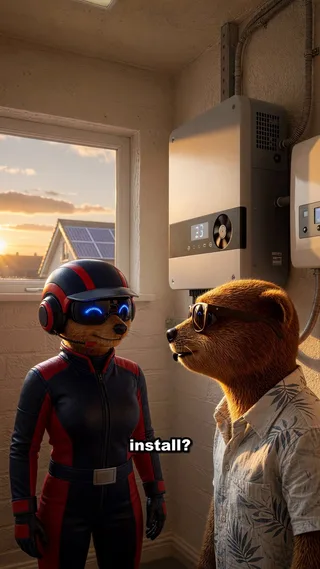
Mo: So the whole system lasts twenty-five years? RoboMo: Panels often do. Budget for one inverter replacement mid-life.
Mo: Why does one part age faster than the other? RoboMo: Panels sit passive in the cold. The inverter switches, heats and cycles every daylight hour.
Mo: So the honest lifetime cost isn't just the install? RoboMo: Correct. One inverter swap, twenty-five years of roof. Price the whole life, not the first day. Mo: So the whole system lasts twenty-five years? RoboMo: Panels often do. Budget for one inverter replacement mid-life. / Mo: Why does one part age faster than the other? RoboMo: Panels sit passive in the cold. The inverter switches, heats and cycles every daylight hour. / Mo: So the honest lifetime cost isn't just the install? RoboMo: Correct. One inverter swap, twenty-five years of roof. Price the whole life, not the first day.
Wrapping up
The most useful mental model for home solar is that you're buying two things at once: a long-life generating surface and a serviceable piece of power electronics. The roof is the 25-year part. The inverter is the part that gets replaced first, because it's the only part doing continuous work every daylight hour. Once you accept that, quote comparison becomes much clearer — you stop hunting for the lowest number today and start asking which system will have cost the least, and generated the most, by the time your panels are in their twenties. Ask about warranty terms, ask where the inverter is going and how it'll breathe, and ask each installer to write down what they assume about the mid-life swap. Good installers will already have thought about it.
Next step
If you'd like a whole-life view of what solar could do on your specific roof — including where the inverter would sit and how the numbers look across 25 years rather than 25 months — a no-obligation survey is the sensible starting point. Have a look at our residential solar installation guidance, or book a survey when you're ready to talk specifics.
Plan, Compare & Buy Renewable Energy Solutions
AI does the thinking.
You get the perfect solar match.
Use RoboMo™ to assess your property, compare available technologies and connect with trusted UK installers, suppliers and manufacturers.
Simply enter your postcode, drop a pin on your roof, create your free account and let RoboMo™ analyse your property to find the best solar panels for your home.

You don't have to think
RoboMo™'s AI analyses your roof and does all the hard work.

Accurate & tailored
AI-powered assessment based on your roof, location, and conditions.

Best options, maximum savings
Compare top solar panels for the best performance and value.

Simple, fast & effortless
Provide a few details, sit back and watch your results unfold.
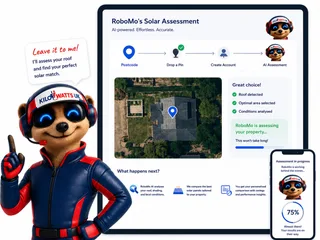
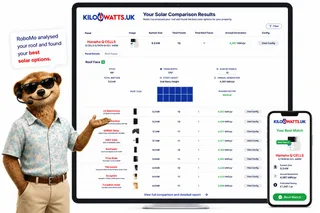
STEP 1
Choose Home, Business or Industrial
Enter your postcode to start your assessment.
STEP 2

Drop a pin on your roof
STEP 3

Create your free account
STEP 4

Sit back and watch RoboMo™ work
RoboMo™ analyses your roof and builds your personalised solar comparison.

Step 1
Enter your postcode
Start designing your wind energy system in seconds.
Are you an installer, distributor or renewable energy business?
Kilowatts UK is expanding the Flower Turbines partner network across the UK.
Become A Flower Turbines PartnerKilowatts UK is an authorised representative
Flower Turbines
Compact vertical-axis turbines built for real UK sites, not just open farmland.
They start in light wind, sit in a small footprint, and are bird-safe by design. Cluster them as a bouquet and the group performs better together than the same turbines standing alone. Enter your postcode for a location-based generation estimate. Figures use area weather data and will differ if buildings, trees or hills sit in the way.
Starts in light UK wind
Built to generate in typical UK wind, not only open farmland.
Small rooftop or ground footprint
Compact towers for roofs, yards and tight sites.
Bird-safe slow rotation
Slow vertical-axis spin, bird-safe by design.
Bouquet clusters raise output
Grouped turbines outperform the same units standing alone.
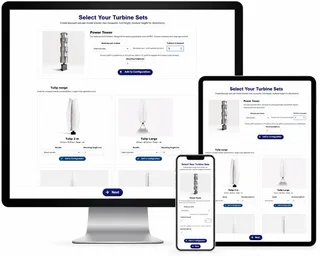

STEP 2

Choose a location
STEP 3

Place your cluster
Tap the map where you want the turbine cluster to go.
STEP 4

Instant generation forecasts
Compare different turbine layouts and see annual generation forecasts instantly.
STEP 5

No commitment required
Explore different configurations before deciding whether to request a quotation.
FAQ
Need Help? RoboMo's Got Answers
Do solar panels really last 25 years?
Many solar panels are designed to keep generating for 25 years or more, but that does not mean output stays exactly the same. A panel performance warranty usually guarantees a minimum output level after a stated period, not an expiry date. The inverter is more likely to need replacement before the panels do.
Should I budget for a solar inverter replacement?
Yes, it is sensible to allow for one inverter replacement during a 25-year view of a home solar system. Some inverters last longer than expected and some do not, so it is not guaranteed either way. Planning for it makes quote comparisons more honest.
Why does the inverter wear out before the panels?
Solar panels are mostly passive, with no moving parts and little internal heat generation. The inverter is power electronics, switching and managing electricity every daylight hour. Heat, cooling cycles and sometimes fans all add wear over time.
What happens during a solar inverter replacement?
A straightforward replacement normally involves isolating the system, removing the old inverter, fitting the new one, commissioning it and reconnecting monitoring. The roof panels, mounting system and most cabling are usually left alone. If the specification changes, your installer should advise what documentation or network operator notification is needed.
Are microinverters better because they avoid one central inverter?
Microinverters change the service issue rather than remove it. The electronics are spread across the roof instead of being in one accessible wall-mounted unit. That can help some shaded or complex roofs, but future access and labour should be considered when comparing designs.
Where should a solar inverter be installed?
A cool, dry and well-ventilated position is usually best, with the manufacturer’s clearances followed. Garages and utility areas often suit better than hot, poorly ventilated loft spaces. If a loft is the only practical option, ventilation should be discussed at survey stage.
Does adding a battery change the 25-year cost calculation?
Yes, a battery adds another major component with its own warranty, duty cycle and replacement assumptions. A hybrid inverter may suit some battery plans, but it can also add complexity. If you may add storage later, tell the installer before the system is designed.
What should I ask installers before accepting a solar quote?
Ask what panel and inverter warranties are included, whether the inverter warranty can be extended, and where the inverter will be mounted. Ask how the inverter has been sized against the array and whether a mid-life replacement is included in their whole-life cost assumptions. Clear written answers make quotes much easier to compare.