


Printed batteries from tree pulp: research, not storage
Published: 2026-09-27 20:55:39
Updated: 2026-09-27 13:57:59
Printed batteries from tree pulp are research, not UK home or EV storage. They may suit sensors and packaging, but full-device biodegradation is unproven.
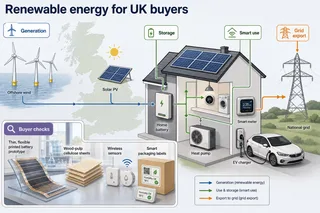
Printed batteries from tree pulp - research, uses and limits
Canadian research into wood-pulp cellulose printed batteries for sensors and packaging: what has been shown to biodegrade, what has not, and why this is not a home or EV battery.
Printed batteries from tree pulp are research, not home storage
Printed batteries from tree pulp are an emerging research area, not a product you can buy for UK home energy storage, solar batteries or electric vehicles today. They use printed battery layers on a cellulose-based substrate derived from wood pulp, mainly for very small, low-power electronics such as smart labels, sensors and disposable test devices.
The key issue is scale. A home battery stores energy at building scale and must be specified for electrical safety, long service life, inverter compatibility and, where relevant, grid connection. A printed cellulose battery is being explored for thin devices that may only need to power a tiny circuit for a short task.
The practical UK relevance is not that tree pulp will replace lithium-ion storage in homes. It is that electronics are being added to packaging, cold-chain labels, logistics tags and temporary sensors. If those products become widespread, their batteries and disposal routes become an environmental and compliance issue.
What the research is actually based on
Several credible research groups have explored paper, cellulose and printed battery concepts, but the results should be read as material and device research rather than proof of a market-ready replacement for conventional batteries. Empa, the Swiss Federal Laboratories for Materials Science and Technology, has reported water-activated paper battery research using a paper substrate and printed functional inks. Linköping University has published work on cellulose-based energy storage using nanocellulose and conductive polymers. Printed electronics research from organisations such as VTT in Finland and academic printed-electronics groups has also helped establish manufacturing methods relevant to thin batteries and sensors.
These references matter because “tree pulp battery” can sound more advanced than it is. In most cases, the main achievement is not that a battery is made only from wood. It is that a cellulose or paper-like layer can support a functional electrochemical device that is thin, printable or potentially lower impact than some plastic-supported alternatives.
Independent end-of-life evidence is the harder part. Standards-based testing of biodegradation, compostability, leaching, toxicity and safe disposal is different from showing that one laboratory component can break down under controlled conditions. UK businesses should distinguish between a published research prototype, a pilot-manufactured device and a fully qualified commercial product.
How a cellulose-based printed battery works
A printed battery is made by depositing functional materials as layers onto a base material, often called a substrate. In this case, the notable feature is a cellulose-based substrate that can be derived from wood pulp, replacing some plastic or synthetic support layers used in small electronics.
The battery still needs more than a wood-derived sheet. It requires electrode materials, a way for ions to move between electrodes, conductive paths for electrons, and some form of protection so the cell survives handling, storage and use. When connected to a small device, chemical reactions inside the cell allow electrons to flow through the external circuit and power the load.
“Printed” usually refers to manufacturing methods such as screen printing, inkjet printing, stencil printing or roll-to-roll coating. These methods can suit low-profile electronics because material is placed where it is needed. Printing does not automatically make a battery high capacity, rechargeable, long-lived, biodegradable or safe to throw away with ordinary paper.
Why wood-pulp cellulose is attractive
Wood-pulp cellulose is interesting because it is abundant, light, flexible and already used at large scale in paper and packaging industries. For a printed battery substrate, the attraction is that it may reduce reliance on some petroleum-derived films where the finished device is intended to be thin, cheap and short-lived.
The waste problem is real even if the technology is early. Small electronics often combine plastic films, metals, adhesives, chips, conductive inks and batteries in a form that is difficult to separate. If a smart label or disposable sensor is too cheap to dismantle and too mixed to recycle, it risks becoming another difficult electronic waste stream.
A cellulose substrate could reduce one part of that material burden. It does not solve the whole battery problem by itself. The environmental case depends on the complete device, including chemistry, coatings, adhesives, collection routes, recovery options and verified behaviour at end of life.
What may biodegrade and what remains uncertain
The safest way to judge this technology is component by component. A cellulose-based substrate is the most plausible biodegradable part because cellulose can break down under suitable biological conditions. That does not mean the complete printed battery can be composted at home, recycled as paper or placed in normal waste.
Public reports on cellulose and paper batteries often highlight biodegradable materials, water activation or low material use. The questions that matter are what was tested, whether the test covered the full device, how long degradation took, what residues remained and whether the conditions resemble real UK waste routes.
This distinction is essential for UK marketing and procurement. A product described as biodegradable or compostable would need clear, specific evidence for the whole item and the conditions required. A favourable substrate does not justify a broad claim about the finished electronic product.
How printed cellulose batteries compare with other batteries
Printed cellulose batteries sit at the smallest end of the battery landscape. They are closer to printed electronics and smart labels than to rechargeable battery packs used in homes or vehicles. A useful comparison is not which battery is “best”, but what each category is designed to do. The table below uses practical capacity classes rather than invented product figures. Exact performance depends on chemistry, design and manufacturer data, so any future procurement should rely on tested datasheets rather than headlines.
Overview
This comparison also explains why “tree pulp battery” headlines can mislead homeowners. The fact that a cell can be printed on a cellulose substrate does not mean it can store enough energy for a house, operate as part of a solar PV system or meet the performance demands of an electric vehicle.
Where printed biodegradable batteries could be useful
The most realistic uses are small, low-power and often short-lived. A printed cellulose battery is better understood as one component in a printed electronics system than as a conventional rechargeable battery. Thinness, flexibility, low material use and low-cost manufacturing may matter more than energy density.
Smart packaging is an obvious candidate. A label used for temperature exposure, tamper evidence, freshness monitoring or stock movement may only need a tiny power source. Environmental and agricultural sensors could also be relevant where a device is deployed temporarily and designed around a clear retrieval or end-of-life route.
For UK businesses, the value would come from whole-system design. The question is not only whether the battery can be printed, but whether the complete product can be manufactured consistently, stored safely, transported legally, used reliably and disposed of without misleading customers or contaminating waste streams.
Where the technology is not suitable
Printed batteries from tree pulp are not suitable for home batteries, electric vehicles, solar storage, portable power stations or building backup power systems. Those applications need high energy capacity, controlled safety systems, predictable life, installation design and proven product support.
A home battery has to operate safely for years in a building, usually alongside an inverter, consumer unit work and sometimes solar PV. An EV battery must deliver high power, withstand demanding charge and discharge cycles, integrate with vehicle controls and meet strict safety expectations. A research-stage printed cell for a tiny sensor is in a completely different category.
This is also where buyers should be cautious about oversimplified environmental claims. A low-power disposable battery may reduce some materials in a label, but it is not automatically a greener answer if it encourages unnecessary electronics, cannot be collected or makes otherwise recyclable packaging harder to process.
What would need testing before real-world use
Before any printed biodegradable battery could be deployed at scale, manufacturers would need to prove more than a promising material concept. The device must perform reliably during manufacture, storage, shipping, use and disposal, including under realistic humidity, temperature and handling conditions.
There is a tension between battery protection and biodegradability. A battery must resist moisture and mechanical damage during its working life, yet many biodegradable materials break down through moisture, microbes and environmental exposure. Protective layers can solve the first problem while making the second problem harder.
For food, pharmaceutical, medical or safety-related applications, the evidence threshold would be higher. The battery may sit close to regulated goods, enter controlled supply chains or influence decisions about product safety, so procurement teams should expect clear documentation rather than a simple sustainability statement.
UK waste, safety and green-claim responsibilities
If this technology became a UK product, it would still sit within the wider rules and expectations around batteries, electronics, packaging, product safety and environmental claims. A biodegradable substrate would not automatically exempt a product from labelling, producer responsibilities, safety evidence or waste handling duties.
Relevant UK compliance areas may include the Waste Batteries and Accumulators Regulations, the Batteries and Accumulators Placing on the Market rules, the Waste Electrical and Electronic Equipment Regulations, product safety duties and packaging waste responsibilities where electronics are embedded into packaging. Businesses should also consider the Competition and Markets Authority Green Claims Code when making claims such as biodegradable, compostable, recyclable or lower impact.
UK waste routes are not designed around consumers composting batteries at home. Even small batteries can create contamination or fire risks if disposed of incorrectly, so any future product would need instructions that match verified collection and treatment routes. If a smart label contains a battery, a retailer or logistics company may need to explain whether it should be removed, returned, recycled separately or handled through a specific commercial waste stream.
Procurement checklist for UK businesses
For businesses considering printed battery labels, sensors or smart packaging, procurement should start with evidence rather than novelty. A supplier’s environmental claim is only useful if it applies to the full device, matches the intended use and can be followed by customers and waste handlers in the real world.
The checklist below is practical. It covers questions that are often missed when a product is presented as paper-based, biodegradable or sustainable before the battery chemistry and disposal route have been fully understood.
Buyers should also ask how claims such as biodegradable, compostable or recyclable are evidenced and qualified. Supplier responsibility matters too, including who is responsible for producer registration, labelling, reporting and customer instructions. A cautious buyer should test a small pilot before rolling out battery-enabled packaging or tags at scale. The pilot should include not just device performance, but staff handling, customer instructions, waste contractor feedback and any effect on existing recycling routes.
Can printed tree-pulp batteries scale commercially?
Printing methods can be scalable in principle, especially where roll-to-roll processes are used for labels, flexible electronics or thin films. Cellulose feedstocks are also widely available. Those two points make the idea commercially interesting, but they do not prove readiness for mass deployment.
The difficult part is consistent manufacture at acceptable quality. Printed layers must be uniform, electrically reliable and stable over time. The product must survive storage and shipping before it powers anything. If manufacturing yields are poor, shelf life is short or encapsulation becomes complex, the apparent simplicity of printing can quickly disappear.
Commercial scale also depends on whether the use case can tolerate limited performance. A smart label for one monitored journey may accept a small, short-lived cell. A medical device, safety sensor or regulated cold-chain product may require much stronger validation, traceability and quality control before buyers will accept it.
What this means for UK homeowners and businesses
For homeowners, this research does not change today’s battery storage decisions. If you are considering solar PV storage, backup power or electric vehicle energy, you still need established systems designed for those duties and specified through the normal electrical route. If cost is part of the decision, review home battery costs and compare solar options rather than relying on early-stage battery headlines.
For businesses, the topic is more relevant if you use packaging, stock tracking, cold-chain monitoring, disposable sensors or connected labels. The sensible next step is not to buy a “tree-pulp battery” on the strength of a headline, but to ask suppliers for chemistry, safety, shelf-life, disposal and whole-device environmental evidence.
The balanced conclusion is that printed cellulose batteries could reduce waste in some low-power electronics if the whole product is designed responsibly. They are not a proven replacement for conventional energy storage, and “biodegradable” should be treated as a specific, testable claim rather than a blanket promise.
Plan, Compare & Buy Renewable Energy Solutions
AI does the thinking.
You get the perfect solar match.
Use RoboMo™ to assess your property, compare available technologies and connect with trusted UK installers, suppliers and manufacturers.
Simply enter your postcode, drop a pin on your roof, create your free account and let RoboMo™ analyse your property to find the best solar panels for your home.

You don't have to think
RoboMo™'s AI analyses your roof and does all the hard work.

Accurate & tailored
AI-powered assessment based on your roof, location, and conditions.

Best options, maximum savings
Compare top solar panels for the best performance and value.

Simple, fast & effortless
Provide a few details, sit back and watch your results unfold.
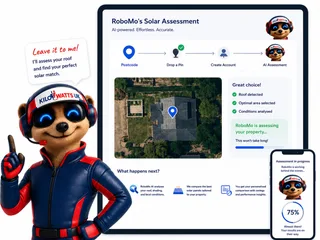
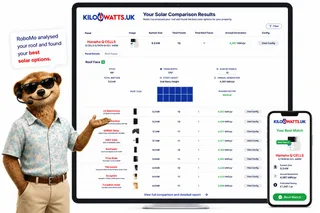
STEP 1
Choose Home, Business or Industrial
Enter your postcode to start your assessment.
STEP 2

Drop a pin on your roof
STEP 3

Create your free account
STEP 4

Sit back and watch RoboMo™ work
RoboMo™ analyses your roof and builds your personalised solar comparison.

Step 1
Enter your postcode
Start designing your wind energy system in seconds.
Are you an installer, distributor or renewable energy business?
Kilowatts UK is expanding the Flower Turbines partner network across the UK.
Become A Flower Turbines PartnerAuthorised UK representative
Flower Turbines
Compact vertical-axis turbines built for real UK sites, not just open farmland.
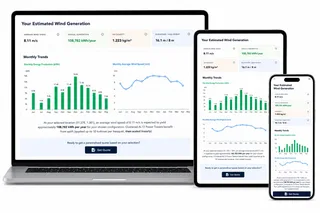
They start in light wind, sit in a small footprint, and are bird-safe by design. Cluster them as a bouquet and the group performs better together than the same turbines standing alone. Enter your postcode for a location-based generation estimate. Figures use area weather data and will differ if buildings, trees or hills sit in the way.
Starts in light UK wind
Built to generate in typical UK wind, not only open farmland.
Small rooftop or ground footprint
Compact towers for roofs, yards and tight sites.
Bird-safe slow rotation
Slow vertical-axis spin, bird-safe by design.
Bouquet clusters raise output
Grouped turbines outperform the same units standing alone.

STEP 2

Choose a location
STEP 3

Build your layout
STEP 4

Instant generation forecasts
Compare different turbine layouts and see annual generation forecasts instantly.
STEP 5

No commitment required
Explore different configurations before deciding whether to request a quotation.
Related articles

FAQ
Need Help? RoboMo's Got Answers
Can I buy a tree-pulp printed battery for home energy storage in the UK?
No. Printed batteries using cellulose from wood pulp are still mainly a research and small-device technology, not a home battery product. UK home storage needs proven capacity, safety systems, inverter compatibility and installer support.
Could printed cellulose batteries replace lithium-ion batteries in solar PV systems?
They are not a realistic replacement for solar battery storage. Printed cellulose batteries are being explored for tiny loads such as smart labels and sensors, while home solar storage works at kilowatt-hour scale. The two technologies are designed for very different jobs.
Are tree-pulp printed batteries fully biodegradable?
Not necessarily. The cellulose substrate may be biodegradable under suitable conditions, but a complete battery also contains electrodes, electrolytes, conductive materials and protective layers. Any biodegradable or compostable claim should be backed by full-device testing, not just evidence about the paper-like layer.
What are printed cellulose batteries likely to be used for?
The most plausible uses are small, thin, low-power electronics. Examples include smart packaging, cold-chain indicators, temporary sensors, logistics tags and some disposable test devices. These applications need tiny amounts of energy, often for a short period.
Can printed batteries go in household recycling or compost?
You should not assume that any battery can go in household recycling, paper recycling or home compost. Even very small batteries may need a specific collection or waste route. If commercial products appear, buyers should follow the manufacturer’s disposal instructions and local waste guidance.
Are printed batteries safer than ordinary batteries because they use wood pulp?
A cellulose substrate does not automatically make a battery safe. Safety depends on the whole design, including the chemistry, leakage risk, protective coating, storage conditions and what happens if it is crushed, cut or overheated. Independent testing would be needed before relying on safety claims.
Why do these batteries matter if they cannot power a home?
They matter because more everyday products are gaining electronics, such as labels, tags and temporary sensors. If these items become widespread, their batteries and disposal routes could create new waste and compliance issues. A lower-impact substrate may help, but only if the complete product is responsibly designed and handled.
What should UK buyers look for in claims about biodegradable printed batteries?
Look for clear evidence covering the complete battery or device, not just one material inside it. Claims should explain the test conditions, timescale, residues, toxicity and correct disposal route. Vague claims such as eco-friendly, compostable or recyclable should be treated cautiously without supporting data.