


Are home batteries safe?
Published: 2026-07-25 16:51:12
Updated: 2026-08-01 07:16:41
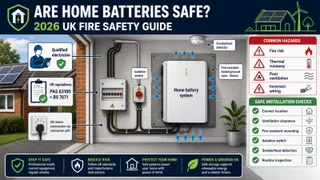
The main safety factors are battery chemistry, product quality, electrical design, siting, ventilation or clearances.
Are home batteries safe?
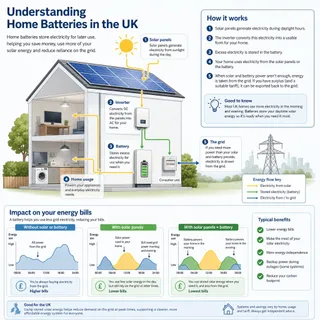
Yes, a home-battery system is generally safe when it is correctly specified, installed by competent professionals, located properly, commissioned thoroughly, and used within the manufacturer’s instructions. The main safety factors are battery chemistry, product quality, electrical design, siting, ventilation or clearances, access for isolation and maintenance, software settings, and homeowner handover. If you are new to the topic, it helps to understand how home batteries work before comparing products.
The risk is not zero. A home battery stores a significant amount of electrical energy, and the associated inverter and cabling form part of a fixed electrical installation. Poor design, unsuitable locations, damaged equipment, DIY wiring, water ingress, blocked clearances, ignored warning alarms, or incorrect backup arrangements can all create avoidable hazards.
For most UK households, the useful question is not “are batteries risk-free?” but “is this proposed system safe for this property, this location, and this intended use?” A good installation should feel uneventful in daily use. It should charge and discharge automatically, be easy to monitor, have reachable isolation points, and come with clear instructions on what to do if something looks wrong.
What makes a home battery safe?
Home battery safety comes from several layers working together. The battery itself is only one part of the system. The inverter, battery management system, monitoring, isolators, cabling, protective devices, earthing arrangements, mounting method, firmware settings, and installation environment all matter. A competent installer should design the battery as part of an electrical energy storage system, not simply as a box added to the wall.
Most modern home batteries include a battery management system, often shortened to BMS. This monitors conditions such as cell voltage, current, temperature, state of charge, and operating limits. If something moves outside the permitted range, the system should reduce output, stop charging, disconnect, shut down, or report a fault depending on the product design.
Safety also depends on ordinary installation discipline. Cable runs should be protected, equipment should be mounted securely, access should be maintained for inspection and isolation, and the battery should not be exposed to conditions it was not designed for. These details are less visible than the battery brand, but they often decide how reliable and safe the system is in practice, especially when you choose a suitable battery.
Suitable location
The battery should be installed where heat, damp, impact damage, access problems, fire separation, and escape-route concerns have been properly considered.Battery management
The control system monitors the battery and helps prevent operation outside safe limits.User understanding
The homeowner should know what normal operation looks like, what warnings mean, and who to contact if a fault appears.Commissioning checks
The installer should test, configure, and document the system before handover.Electrical protection
Correct cable sizing, protective devices, isolation, labelling, and earthing arrangements reduce electrical risk.Product compatibility
The battery, inverter, monitoring equipment, backup equipment, and any existing solar system must be compatible.
The UK safety framework to expect
A home battery is not just a consumer gadget. In the UK it sits within a wider framework of electrical safety, product instructions, certification schemes, grid-connection requirements, and, where relevant, Building Regulations. You do not need to become an electrical designer, but you should expect your installer to be able to explain which standards and requirements apply to your system.
For fixed electrical work in a dwelling, BS 7671, the IET Wiring Regulations, is the core UK electrical installation standard. Battery energy storage installations should also be designed with relevant IET guidance, manufacturer installation manuals, and current industry good practice in mind. PAS 63100 is also relevant to domestic battery energy storage fire-safety considerations, particularly around siting and installation precautions, where it applies to the proposed system.
If the battery is being installed with solar panels, or as part of an MCS-certified renewable installation, MCS requirements and product eligibility may also matter. Separately, systems that can export to the grid or interact with generation may need the correct Distribution Network Operator process, commonly involving G98 or G99 arrangements depending on the equipment and configuration. A competent installer should tell you what is being notified or applied for and provide the relevant paperwork. BS 7671: The main UK standard for electrical installations, covering safe design, protection, isolation, inspection, and testing. IET guidance: The IET publishes guidance for electrical energy storage systems and wiring practice that competent designers use alongside BS 7671. Manufacturer instructions: The installation manual is not optional; it defines permitted locations, clearances, temperature limits, mounting requirements, and fault-response procedures. MCS requirements: Where the installation is MCS-certified, the installer and products should meet the relevant MCS scheme requirements for the work being carried out. DNO requirements: Grid-connected solar, battery, and inverter arrangements may require DNO notification or approval; the installer should manage this rather than leave it unclear. Building Regulations context: Domestic electrical work and associated fire, structural, and access considerations may fall within Building Regulations requirements depending on the nature and location of the work.
Battery chemistry and thermal runaway
Battery chemistry matters because different lithium-ion types have different safety characteristics. Many domestic batteries use lithium iron phosphate, usually called LFP or LiFePO4, while some use nickel manganese cobalt, often called NMC. Both can be safe when engineered, installed, and operated correctly, but they do not behave identically. LFP is widely used in home storage partly because it has a comparatively stable chemistry and a lower tendency towards thermal runaway than many higher-energy lithium-ion chemistries. NMC can offer high energy density, which is useful in some applications, but it generally needs careful thermal management and protection because its thermal runaway characteristics can be less forgiving. This does not mean every LFP battery is automatically safe or every NMC battery is unsafe; product design, testing, installation, and control systems remain essential. Thermal runaway is a severe failure condition where heat generation inside a cell becomes self-sustaining and can spread. It is uncommon in properly designed and installed home systems, but it is one reason manufacturers specify strict rules for temperature, charging limits, spacing, ventilation or clearances, damage inspection, and emergency response.
| Chemistry | Typical domestic relevance | Safety points to understand |
|---|---|---|
| LFP or lithium iron phosphate | Common in many modern home battery systems | Generally more thermally stable than NMC, but still needs correct installation, protection, temperature control, and manufacturer-approved use |
| NMC or nickel manganese cobalt | Used in some lithium-ion storage products and many other battery applications | Higher energy density, but thermal management and protective systems are especially important |
| Lead-acid variants | Less common for new compact domestic smart-battery installations | Different hazards, including weight, ventilation, maintenance, and acid-related risks depending on type |
The main safety risks to understand
The most discussed home battery risk is fire, but it is not the only one. Electrical shock, overheating, physical damage, water ingress, incorrect isolation, software or settings errors, and poor access during maintenance can also matter. These risks are usually managed through product design and good installation practice, but they become more serious when shortcuts are taken. It is also important to separate product risk from installation risk. A well-designed battery installed badly can be unsafe, while a good installation cannot fully rescue a poor-quality, unsupported, incompatible, or damaged product. The safest outcome comes from choosing reputable equipment and having it designed, installed, tested, and handed over as a complete system. Homeowners should be wary of any proposal that treats siting, isolation, cabling, or commissioning as an afterthought. A safe system is not just one that works on the app on day one; it is one that can be inspected, isolated, maintained, and understood throughout its service life.
| Risk area | Why it matters | What to check early |
|---|---|---|
| Fire and overheating | Batteries and power electronics generate heat and store energy | Location, clearances, ventilation where required, manufacturer instructions, fault monitoring |
| Electrical shock | Battery systems can remain energised even when some circuits are switched off | Isolation points, labelling, competent installation, safe access, handover instructions |
| Water ingress | Damp, leaks, flooding, or unsuitable outdoor exposure can damage electrical equipment | IP rating, indoor or outdoor suitability, mounting position, pipework above the unit, flood risk |
| Physical damage | Impact can damage battery casing, cables, terminals, or mounting points | Garage traffic, storage areas, protection from knocks, secure mounting |
| Poor maintenance access | Inaccessible systems are harder to inspect, isolate, repair, or replace | Working space, visibility, safe reach, unobstructed access |
| Incorrect settings | Wrong configuration can affect performance, charging behaviour, export, and protection | Commissioning records, inverter settings, battery compatibility, firmware, user handover |
| Unsafe backup design | Backup systems must not back-feed the grid or energise circuits unexpectedly | Dedicated backup circuits, changeover arrangements, labelling, testing, DNO and installer confirmation |
Where should a home battery be installed?
The safest location depends on the property, the battery model, the manufacturer’s instructions, and the wider electrical design. Common locations include garages, utility rooms, plant rooms, external walls, and dedicated storage areas. A suitable location is dry, accessible, protected from accidental damage, compatible with the product’s temperature limits, and unlikely to obstruct escape routes or normal household use.
Lofts are sometimes suggested because they are out of the way, but they can be a poor choice in many homes. They may become very hot in summer and cold in winter, offer limited access, have awkward working space, and make future inspection or replacement harder. If a loft is proposed, the installer should explain clearly why it is suitable for that specific battery and property, not simply say that other homes have been done that way.
Outdoor installation can be acceptable only where the product is designed for it and the mounting position is appropriate. Weather rating, wall strength, cable routes, direct sunlight, wind-driven rain, flood risk, security, and access for emergency isolation all need to be considered. Outside is not automatically safer if the unit is exposed, inaccessible, or vulnerable to impact.
- Keep the battery away from likely impact areas.
- Maintain the clearances required by the manufacturer.
- Avoid damp, leaking, flood-prone, or poorly controlled spaces.
- Make sure isolation points can be reached safely.
- Do not block escape routes or create awkward access around doors and stairs.
- Do not use the battery as a shelf or storage surface.
Check whether the proposed location affects warranty, service access, or manufacturer support.
Can you install a home battery yourself?
A home battery should not be treated as a DIY appliance. It connects to high-energy electrical equipment and may interact with solar panels, an inverter, a consumer unit, export settings, backup circuits, smart tariffs, and monitoring systems. Incorrect installation can create safety risks and may also cause poor performance, nuisance faults, warranty problems, or equipment damage.
Even if a battery looks modular or “plug and play”, the wider installation still needs proper design. The installer must confirm compatibility with the inverter, assess the existing electrical installation, position the equipment correctly, set operating parameters, test protective functions, and provide handover documents. This is not the same as connecting a small portable power bank, so it is worth knowing how to choose a qualified electrician for fixed electrical work.
There is also a practical aftercare issue. If a system is installed outside the manufacturer’s requirements or without suitable certification, support and warranty routes may become difficult. Homeowners should ask who is responsible for design, installation, commissioning, documentation, DNO handling where relevant, and future fault diagnosis before agreeing to any battery system.
Are batteries safer with solar panels or without?
A home battery can be used with or without solar panels, but the safety principles are similar. With solar, the battery usually stores surplus daytime generation for later use. Without solar, it may charge from the grid under a tariff arrangement or be used for backup purposes if the system is designed for that role.
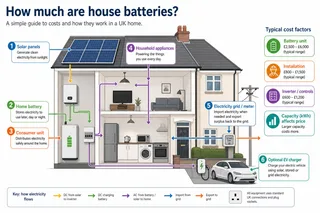
Solar adds extra design considerations because the battery, solar inverter, generation meter, consumer unit, export arrangements, and monitoring platform may all interact. A well-designed solar and battery system can work smoothly, but mismatched equipment or unclear responsibilities between installers can lead to problems. If solar is already installed, the battery designer should assess the existing system rather than assume it is compatible, particularly when adding a battery to older equipment.
Backup power needs separate attention. Not every home battery automatically powers the house during a power cut. Some systems need additional equipment and dedicated backup circuits, while others are designed only for normal grid-connected operation. Safety depends on preventing unsafe back-feeding and ensuring any backup arrangement is deliberately designed, labelled, and tested. If backup is important, check the system’s power cut behaviour before you buy.
What to do if something seems wrong
Most battery systems should run quietly in the background, so alarms, unusual heat, visible damage, burning smells, smoke, repeated shutdowns, water exposure, or unexplained error messages should be taken seriously. Do not keep resetting a battery in the hope that a fault disappears, and do not open covers or touch internal parts.
If there is immediate danger, such as smoke, fire, flames, a strong burning smell, a loud failure event, or suspected toxic fumes, leave the area and call the emergency services. Do not try to move, cool, dismantle, or repair a damaged battery yourself. If it is safe to do so from a normal accessible switch or isolator, and you have been shown how, you may isolate the system, but personal safety comes first.
For non-emergency faults, follow the manufacturer’s user instructions and contact your installer or the manufacturer’s support route. Take photos of the warning screen or app message if it is safe, note the time and conditions, and keep people away from visibly damaged or wet equipment until it has been assessed.
Water exposure
Do not touch wet electrical equipment; keep clear and contact the installer or emergency services depending on the risk.Physical damage
Do not use the battery, do not attempt repairs, and arrange inspection by the installer or manufacturer.Alarms or fault codes
Follow the user manual, record the message, and contact the installer if it does not clear in the approved way.Unusual heat or smell
Keep clear, do not touch the unit, isolate only if safe and instructed, and seek professional advice promptly.Repeated tripping or shutdowns
Do not bypass protection devices; ask the installer to diagnose the cause.Smoke, fire, flames, or immediate danger
Evacuate and call 999.
After a serious incident — Do not recommission the system until a competent person and the manufacturer’s guidance confirm it is safe.
What homeowners often overlook
Many buyers focus on storage capacity and price, then only think about safety once the installation date approaches. In practice, safety and suitability should be considered at the survey stage. A battery that is safe in one property may be awkward or inappropriate in another because of location, access, existing wiring, mounting surface, or how the household uses energy.
The best installations usually come from careful design rather than choosing the largest battery available. Oversizing can increase complexity, cost, and space requirements without necessarily improving usefulness. Undersizing can lead to disappointment because the battery cycles through its stored energy too quickly. The right size depends on electricity use, solar generation, tariff goals, backup needs, and budget, so start with the right battery size rather than the biggest unit available.
Homeowners should also think about the future. If you may add an electric vehicle charger, heat pump, more solar panels, or extra battery capacity later, the design should leave room for sensible expansion where possible. Retrofitting around a cramped or poorly planned installation is rarely ideal. Focusing only on the battery size rather than the whole system design. Accepting an unsuitable location because it is convenient on the day. Assuming every battery provides automatic backup during a power cut. Ignoring access for maintenance, isolation, inspection, and eventual replacement. Choosing equipment without checking compatibility with existing solar or inverter hardware. Forgetting to ask what paperwork, certificates, warranties, and DNO confirmations will be provided. Storing household items around the battery and blocking clearances after the installer leaves.
What to ask before approving an installation
Before you agree to a home battery installation, ask practical questions and expect clear answers. A competent installer should be able to explain the proposed location, the reason for the selected battery size, how the system will be isolated, what happens during a fault, which standards and manufacturer instructions are being followed, and what documentation you will receive after commissioning.
Do not be afraid to challenge vague answers. If the installer cannot explain why a location is suitable, how clearances are handled, how the battery interacts with solar or the grid, or what happens if the battery reports a fault, that is a warning sign. Good design should be understandable to the homeowner, even if the electrical detail behind it is technical.
Location
Why is this position suitable for this battery and this property?Standards
How will the installation be designed and tested in line with BS 7671, relevant IET guidance, manufacturer instructions, and applicable scheme requirements?Protection
What isolation, labelling, electrical protection, and access arrangements will be provided?DNO process
Will the system need DNO notification or approval, and who will handle it?Compatibility
How has compatibility with the inverter, solar system, consumer unit, monitoring platform, and backup equipment been checked?Fire and siting
How have heat, clearances, escape routes, impact risk, and water exposure been considered?
Handover — What documents, settings, warranty information, certificates, and user instructions will I receive? Fault response — What should I do if the battery shows an alarm, unusual smell, heat, noise, water exposure, or visible damage? Future changes — Can the system be expanded or adapted if my electricity use changes? Insurance — Should I notify my home insurer that a fixed battery system has been installed?
When a home battery may not be suitable
A home battery is not the right answer for every property. If there is no sensible installation location, if the existing electrical system needs significant remedial work, or if household energy use is very low, the benefits may not justify the complexity. Safety should not be compromised just to make a battery fit.
Some homes also have practical constraints such as very limited wall space, damp outbuildings, difficult cable routes, weak mounting surfaces, poor access for installers, or exposure to impact and weather. These issues do not always rule out a battery, but they can change the design, cost, disruption, and product choice. A proper survey should identify them before equipment is ordered.
A battery may also be less compelling if the homeowner expects it to do something it cannot do. If the aim is whole-home backup, the system must be designed for that purpose. If the aim is to use more solar energy on site, the solar generation pattern and household demand need to support that. Safe installation is only one part of a good decision; the battery also needs to be useful, maintainable, and appropriate for the home.
Source notes and authoritative references
For a safety-related purchase, it is reasonable to ask an installer which standards, guidance documents, and manufacturer instructions they are using. The homeowner does not need to police every clause, but the installer should be able to provide plain-English answers and final documentation.
Useful UK reference points include the IET for BS 7671 and electrical energy storage guidance, MCS for certified renewable installations, Electrical Safety First for household electrical safety advice, the HSE for general electrical safety principles, and Energy Networks Association guidance for connecting equipment to distribution networks. Product-specific installation and user manuals are also authoritative for the exact battery model being installed.
IET: Electrical standards and guidance MCS: Certified products and installers Electrical Safety First: Electrical safety advice HSE: Electrical safety at work and general electrical hazards Energy Networks Association: Connecting to the networks
The practical answer
Home batteries can be safe, reliable, and useful in UK homes, but they should be treated as fixed electrical energy storage systems rather than simple household gadgets. Safety depends on product quality, battery chemistry, competent design, appropriate siting, correct installation, commissioning, documentation, and sensible use.
The main red flags are unsuitable locations, blocked clearances, damp or impact-prone areas, DIY-style installation, unclear isolation, missing paperwork, vague answers about DNO requirements, unsupported equipment, ignored alarms, and assumptions about backup power. If any of those appear during the survey or quotation stage, pause and ask for a clearer design.
The safest route is to choose a system that suits the property rather than forcing the property to suit a battery. Ask about location, compatibility, isolation, fire-safety considerations, access, backup behaviour, standards, manufacturer instructions, and handover documentation before installation. If those points are handled properly, a home battery can be a practical part of a solar, tariff, or backup power strategy without creating unnecessary risk. If you are considering solar at the same time, you can compare solar options before deciding on the full system design.
Plan, Compare & Buy Renewable Energy Solutions
AI does the thinking.
You get the perfect solar match.
Use RoboMo™ to assess your property, compare available technologies and connect with trusted UK installers, suppliers and manufacturers.
Simply enter your postcode, drop a pin on your roof, create your free account and let RoboMo™ analyse your property to find the best solar panels for your home.

You don't have to think
RoboMo™'s AI analyses your roof and does all the hard work.

Accurate & tailored
AI-powered assessment based on your roof, location, and conditions.

Best options, maximum savings
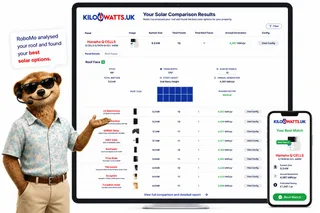
Compare top solar panels for the best performance and value.

Simple, fast & effortless
Provide a few details, sit back and watch your results unfold.
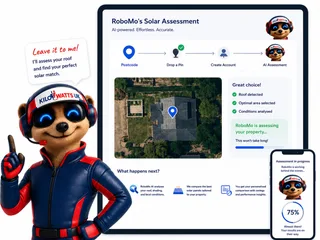
STEP 1
Choose Home, Business or Industrial
Enter your postcode to start your assessment.
STEP 2

Drop a pin on your roof
STEP 3

Create your free account
STEP 4

Sit back and watch RoboMo™ work
RoboMo™ analyses your roof and builds your personalised solar comparison.

Kilowatts UK is an authorised representative
Flower Turbines
Compact vertical-axis turbines built for real UK sites, not just open farmland.
They start in light wind, sit in a small footprint, and are bird-safe by design. Cluster them as a bouquet and the group performs better together than the same turbines standing alone. Enter your postcode for a location-based generation estimate. Figures use area weather data and will differ if buildings, trees or hills sit in the way.
Starts in light UK wind
Built to generate in typical UK wind, not only open farmland.
Small rooftop or ground footprint
Compact towers for roofs, yards and tight sites.
Bird-safe slow rotation
Slow vertical-axis spin, bird-safe by design.
Bouquet clusters raise output
Grouped turbines outperform the same units standing alone.
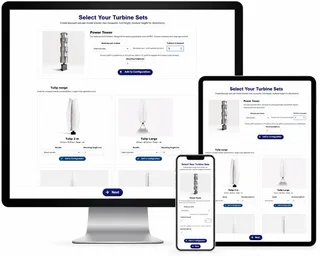
Step 1
Enter your postcode
Start designing your wind energy system in seconds.

STEP 2

Choose a location
STEP 3

Place your cluster
Tap the map where you want the turbine cluster to go.
STEP 4

Instant generation forecasts
Compare different turbine layouts and see annual generation forecasts instantly.
STEP 5

No commitment required
Explore different configurations before deciding whether to request a quotation.
Related articles
Mo's Mission Nominations
FAQ
Need Help? RoboMo's Got Answers
Are home batteries safe for UK homes?
Yes, home batteries are generally safe when they are correctly specified, professionally installed and used in line with the manufacturer’s instructions. They are not risk-free, but the main risks can usually be managed through good design, suitable siting, clear isolation and regular monitoring.
What are the main safety risks with a home battery?
The main risks are electrical faults, overheating, water ingress, physical damage, poor installation and, in rare cases, fire. Modern systems usually include monitoring and battery management controls, but these do not replace proper installation and sensible use. Warning signs such as smoke, swelling, a burning smell or repeated serious fault alerts should never be ignored.
Where is the safest place to install a home battery?
The best location depends on the battery model, the property and the manufacturer’s installation instructions. Common options include garages, utility rooms, plant rooms and suitable external walls, but the area must be dry or correctly weather-rated, accessible and protected from impact. It should not block escape routes or be surrounded by combustible clutter.
Can a home battery catch fire?
Serious battery fires are uncommon in properly designed domestic systems, but they are possible and should be taken seriously. Lithium-ion battery fires can involve intense heat, smoke, gas release or reignition. Good product choice, correct installation, safe siting and keeping the area clear all help reduce the risk.
What should I do if my home battery shows a serious fault or smells of burning?
Do not open the unit, remove covers, move it or attempt a repair. If there is smoke, fire, rapid heating, a strong burning smell or immediate danger, leave the area and call 999. If it is safe and your handover instructions say to do so, you may isolate the system, but only without putting yourself at risk.
What standards or paperwork should I ask about before installation?
Ask the installer which standards, manufacturer instructions and Building Regulations requirements apply to your property. Relevant references may include BS 7671, Part P where applicable, PAS 63100 guidance and the battery manufacturer’s installation manual. You should also ask what certificates, commissioning records, handover documents and any DNO-related confirmation you will receive.
Is a solar battery safer than a standalone battery?
A solar battery is not automatically safer or more dangerous than a standalone battery. Safety depends on the equipment, the electrical design, the installation quality and how the battery works with the inverter and the home’s supply. If storage is being added to an existing solar PV system, compatibility and the condition of the existing installation should be checked first.