


Solar finance for businesses in the UK: the short answer
Published: 2026-09-22 19:42:57
Updated: 2026-09-23 09:15:00
Solar finance for businesses means funding commercial solar panels without always paying the full installation cost upfront.
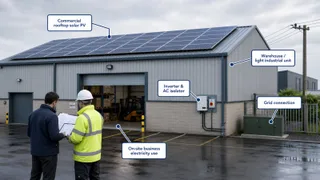
Solar finance for businesses?
Understand solar finance for businesses in the UK, with clear explanations, examples, and practical next steps.
Solar finance for businesses in the UK: the short answer
Solar finance for businesses means funding commercial solar panels without always paying the full installation cost upfront. The main UK routes are outright purchase, asset finance or hire purchase, commercial borrowing, leasing and power purchase agreements. The right choice depends on cashflow, ownership, tax treatment, roof condition, electricity use, lease terms and grid connection requirements. If you are at the early comparison stage, it can help to compare commercial solar options before narrowing the finance route.
The key test is wider than whether the business can afford the panels. It is who owns the system, who receives the electricity benefit, who pays for maintenance, who carries performance risk and what happens if the business relocates, sells the building or changes how it uses electricity.
A financed solar scheme is usually strongest where a business has stable premises, a suitable roof or land area, predictable daytime electricity demand and enough confidence to enter a medium or long-term agreement. It may be weaker where the roof is due for replacement, the lease is short, the site is shaded, the grid connection is constrained or the business cannot use much of the daytime generation.
The main business solar finance options
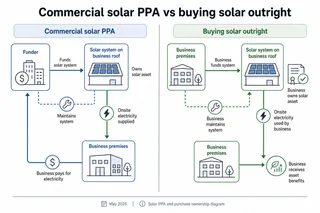
Most finance routes can work for commercial solar panels, but they place commercial and operational risk in different places. Some give the business ownership and the full benefit of reducing grid electricity purchases. Others reduce upfront spend but involve finance repayments, lease payments or buying electricity from a third-party system owner. For a broader explanation of the funding routes, see this guide to commercial solar finance. The label used in a proposal matters less than the contract terms. Maintenance, insurance, metering, export rights, roof access, end-of-term options, early exit provisions and buyout rights can all change the real value of the arrangement.
Overview
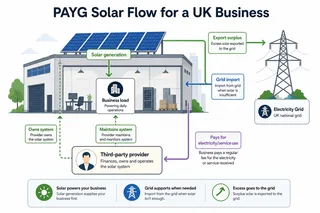
A power purchase agreement is often described as “no upfront cost”, but it should not be treated as free solar. The business is usually committing to buy generated electricity under agreed terms, and the funder expects a return through that contract. That can be attractive, but only if the price mechanism, term, property rights and operational duties fit the business plan.
What installers and funders check before approval
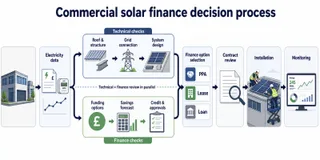
A serious commercial solar proposal starts with the site, not the finance paperwork. Before a lender, lessor or PPA provider is comfortable, the installer normally needs enough technical evidence to show that the system can be installed safely, connected properly and expected to generate useful electricity for that particular business.
One of the most useful documents is half-hourly electricity data where it is available. This shows when the business uses power, which matters because electricity used directly on site usually has a different value from electricity exported to the grid. A factory, cold store, warehouse, office, school or retail unit can all have very different load shapes even if their roof areas look similar.
The roof can be the limiting factor. Survey work may consider roof age, structural capacity, covering type, waterproofing, asbestos risk, safe access, wind loading, ballast on flat roofs, cable routes and whether the building insurer or roof warranty provider has conditions. On leased premises, landlord consent and the remaining lease term can be as important as the engineering.
Electrical checks are central. The installer will review the consumer unit or switchgear, available space, cable runs, metering arrangements, isolation requirements and whether the system needs distribution network operator assessment before connection. Larger business solar arrays may also require more detailed protection and export arrangements than a small domestic installation.
How self-consumption changes the finance case
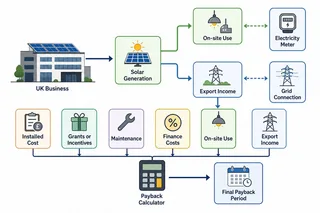
A financed solar project is usually strongest when the business can use a high proportion of the generated electricity during daylight hours. Self-consumed solar reduces electricity bought from the grid, while exported electricity depends on the export arrangement available to the site and may not carry the same value in the model.
The financial model should separate kW and kWh clearly. The kW figure describes system capacity or power at a point in time, while kWh describes energy produced or used over time. For finance decisions, the useful question is how much of the daily and annual generation the business is likely to consume, and what grid electricity cost it avoids by doing so.
A daytime-use warehouse with refrigeration, machinery, charging equipment or steady lighting demand may have a stronger finance case than an office that is lightly occupied, closed at weekends and uses less power when solar generation is highest. Both may have suitable roofs, but the warehouse is more likely to consume generation directly, while the office may rely more heavily on export assumptions or a smaller system size. This is why simple payback claims can mislead. Two buildings with the same solar capacity can produce different financial outcomes because tariff structure, import rates, export terms, standing charges, seasonal trading patterns, operating hours and planned business changes all affect the model. A fuller view of commercial solar ROI should test these assumptions rather than relying on a single headline figure.
Key checks by finance type
Each finance structure has its own risk points. A good proposal should make these visible before the business compares headline monthly payments, PPA rates or payback estimates. If the contract is not clear enough for the finance team, landlord and accountant to review, it is not ready to sign.
The British Business Bank and mainstream UK lenders commonly use terms such as asset finance, hire purchase, leasing and commercial loans, but solar contracts can add technical issues that ordinary equipment finance may not have. Roof rights, export metering, inverter replacement, remote monitoring and performance assumptions all need to be matched to the legal and financial agreement. Comparing asset finance, leases and PPAs can help clarify where those responsibilities sit.
Buyout rights and end-of-term provisions also need careful review. The contract should say whether the business can buy the system later, how the price is calculated and whether the system is removed, transferred, extended or purchased when the agreement ends. These points are not reasons to avoid solar finance. They are the practical checks that stop a superficially attractive proposal becoming difficult later.
Ownership, maintenance and contract risk
Ownership affects more than accounting treatment. The system owner usually has the strongest claim over generation benefits, but may also carry more responsibility for maintenance, insurance, inverter replacement planning and long-term asset management. In a PPA or some lease structures, some of those responsibilities may sit with the funder or operator instead.
The contract should explain what happens if equipment underperforms, access is needed for maintenance, roof works become necessary or the business changes hands. It should also say how metering will verify generation, import and export, because finance payments or PPA billing can depend on accurate measurement.
Moving premises is one of the most overlooked risks. If a business occupies a building under lease, the solar finance agreement needs to work with the property lease, landlord consent, assignment provisions and any break clause. A long solar contract attached to a short or uncertain occupancy can create avoidable risk. Businesses should also check roof repair duties before signing. Removing and reinstating panels for roof works can be disruptive and may have cost implications. If a roof is near the end of its life, replacing or refurbishing it before installing solar can be more sensible than financing an array that may need to be lifted later.
Grid connection and export limits can change the scheme
The distribution network operator position can affect both the technical design and the finance case. Some commercial systems can be handled through relatively simple notification or application routes, while larger, more complex or more export-heavy schemes may need assessment before installation proceeds.
In UK projects, installers often refer to Engineering Recommendations G98 and G99, which are maintained through the Energy Networks Association framework and applied by distribution network operators. In plain English, these processes help determine how small-scale and larger generation connects safely to the local electricity network. The applicable route depends on the system size, phase arrangement, export capacity, equipment configuration and local network requirements, so the installer and DNO should confirm the exact process rather than relying on a generic assumption.
Three-phase commercial sites, export-limited designs and multi-building premises can be more involved than a simple domestic installation. The DNO may require protection settings, export limitation equipment, design changes or confirmation of how the system will behave if site demand drops. None of this automatically makes solar unviable, but it can alter the best system size and the finance assumptions. An export limit does not necessarily undermine the project, especially where the business uses plenty of electricity on site. However, it can reduce the value of oversizing a system beyond the site’s daytime demand. If the model relies on significant export income, the DNO position should be understood early rather than after finance heads of terms have been discussed.
Tax, grants and accounting need separate checking
Solar finance has accounting and tax consequences, but these should be checked with a qualified accountant or tax adviser using current rules and the specific contract. The treatment can differ between owned systems, financed assets, leases and power purchase agreements.
HMRC guidance on capital allowances, VAT and business tax treatment should be checked against the actual structure being proposed. Companies should also consider how the arrangement appears in management accounts, statutory accounts and any lender covenant calculations. The installer can provide technical and generation information, but should not be treated as the final authority on tax or accounting.
Businesses should be cautious with grant assumptions. Local, regional or sector-specific support can exist at certain times, but it is not safe to assume there is a universal UK grant for every commercial solar installation. Eligibility, deadlines, match-funding rules, procurement requirements and permitted costs can change, so any funding claim should be verified before it is built into the business case. VAT recovery, capital allowances, balance sheet treatment and operating expense treatment are not minor details. They can affect cashflow, lender requirements and how the project compares with other investments. A good solar proposal should be clear enough for the accountant to review, rather than leaving the finance team to interpret vague assumptions.
Export income and electricity contracts
Commercial solar proposals should make a clear distinction between avoided import costs and export income. Avoided import cost is linked to electricity the business would otherwise buy from the grid. Export income depends on whether the site has a suitable route to sell or credit surplus generation, and on the terms available from the relevant supplier or export buyer.
Ofgem provides the wider regulatory context for electricity supply and export arrangements, but businesses still need to check the specific commercial terms available to their site. Export value can depend on metering, supplier requirements, contract structure and whether the installation is accepted under the relevant export arrangement.
This matters because a model based mainly on self-consumption is different from a model that depends heavily on exported electricity. Where the business has low daytime demand, seasonal closures or unpredictable operations, the export assumption should be tested carefully. It should not be used as a simple plug number to make the payback look better.
When solar finance may not suit a business
Solar finance is not automatically suitable just because a roof is large. A poor roof, uncertain occupancy, weak daytime electricity demand or restrictive property lease can make a funded installation unattractive even if the headline monthly payment looks affordable.
It may also be unsuitable where the business cannot tolerate long-term contractual commitments. PPAs, leases and some asset finance agreements can run for meaningful periods, and early termination can be expensive or complicated. If the business is planning to relocate, sell the building, redevelop the site or change operations, those plans need to be reflected before signing.
Credit position can matter as well. Funders may consider trading history, affordability, security and the legal right to install equipment. For schools, farms, charities, public-sector sites and landlord-and-tenant arrangements, governance and approval routes can add time even where the engineering is straightforward.
A planned relocation, sale or redevelopment can also weaken the case, especially where the finance term is long. The fair conclusion is that solar finance can be useful, but it is not a shortcut around due diligence. The scheme still needs a technically suitable site, a credible generation model, a contract the business understands and a clear view of who carries each risk.
Decision checklist before requesting quotes
Before approaching commercial solar installers, gather the information that lets them design around the real site rather than guessing from a satellite image. Better data usually leads to better comparisons between finance routes and fewer surprises later in the process.
The most useful starting point is recent electricity usage data, ideally showing when power is used during the day and across the year. Pair that with roof information, lease documents where relevant, and any known plans for expansion, electric vehicles, heat pumps, new machinery or changed operating hours.
Ask your accountant to review tax and accounting treatment before signing, and test the proposal against future changes in site use. A good proposal should explain the technical design, expected generation, self-consumption assumptions, finance structure, maintenance responsibilities and contract risks in plain English. If those points are unclear, ask for clarification before treating any monthly payment, PPA rate or payback estimate as reliable.
The bottom line for UK businesses
Business solar finance can be worthwhile when the site is technically suitable, the business uses enough electricity during daylight hours and the contract fits the organisation’s property, accounting and operational plans. It is usually weakest when the model relies on optimistic export income, uncertain grants or a long agreement on a site the business may not occupy for long.
The strongest projects are built from evidence: real consumption data, a roof survey, a clear DNO strategy, realistic self-consumption assumptions and contract terms that have been checked by the right advisers. If those pieces line up, finance can help a business install solar without tying up all its capital at the start.
Plan, Compare & Buy Renewable Energy Solutions
AI does the thinking.
You get the perfect solar match.
Use RoboMo™ to assess your property, compare available technologies and connect with trusted UK installers, suppliers and manufacturers.
Simply enter your postcode, drop a pin on your roof, create your free account and let RoboMo™ analyse your property to find the best solar panels for your home.

You don't have to think
RoboMo™'s AI analyses your roof and does all the hard work.

Accurate & tailored
AI-powered assessment based on your roof, location, and conditions.

Best options, maximum savings
Compare top solar panels for the best performance and value.

Simple, fast & effortless
Provide a few details, sit back and watch your results unfold.
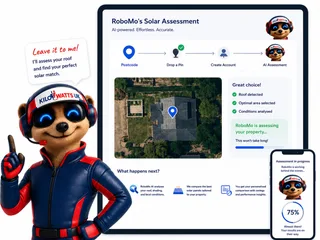
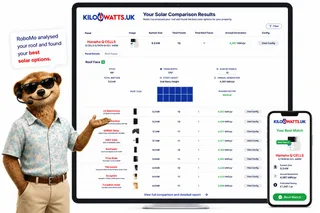
STEP 1
Choose Home, Business or Industrial
Enter your postcode to start your assessment.
STEP 2

Drop a pin on your roof
STEP 3

Create your free account
STEP 4

Sit back and watch RoboMo™ work
RoboMo™ analyses your roof and builds your personalised solar comparison.

Step 1
Enter your postcode
Start designing your wind energy system in seconds.
Are you an installer, distributor or renewable energy business?
Kilowatts UK is expanding the Flower Turbines partner network across the UK.
Become A Flower Turbines PartnerKilowatts UK is an authorised representative
Flower Turbines
Compact vertical-axis turbines built for real UK sites, not just open farmland.
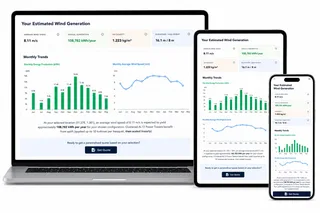
They start in light wind, sit in a small footprint, and are bird-safe by design. Cluster them as a bouquet and the group performs better together than the same turbines standing alone. Enter your postcode for a location-based generation estimate. Figures use area weather data and will differ if buildings, trees or hills sit in the way.
Starts in light UK wind
Built to generate in typical UK wind, not only open farmland.
Small rooftop or ground footprint
Compact towers for roofs, yards and tight sites.
Bird-safe slow rotation
Slow vertical-axis spin, bird-safe by design.
Bouquet clusters raise output
Grouped turbines outperform the same units standing alone.
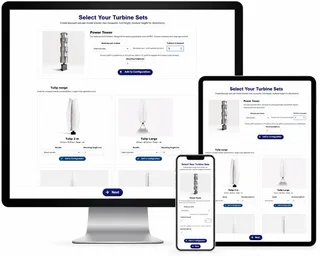
STEP 2

Choose a location
STEP 3

Place your cluster
Tap the map where you want the turbine cluster to go.
STEP 4

Instant generation forecasts
Compare different turbine layouts and see annual generation forecasts instantly.
STEP 5

No commitment required
Explore different configurations before deciding whether to request a quotation.
Related articles
Mo's Mission Nominations
FAQ
Need Help? RoboMo's Got Answers
What solar finance options are available for UK businesses?
Common routes include outright purchase, asset finance or hire purchase, commercial loans, leasing and power purchase agreements. Each option differs in who owns the system, who maintains it and how the business benefits from the electricity generated. The best choice depends on cashflow, site plans, electricity use, tax position and contract terms.
Is a business solar PPA really no upfront cost?
A power purchase agreement may avoid a large upfront installation cost, but it is not free solar. The business usually agrees to buy electricity generated by the system under a long-term contract. It is important to check the unit price, indexation, contract length, exit terms and what happens if the business moves or the property changes hands.
Is it better to buy commercial solar panels outright or finance them?
Buying outright can give the business direct ownership and the full benefit of reduced grid electricity use, but it ties up capital. Finance can spread the cost or reduce upfront spend, but repayments, lease charges or PPA payments affect the overall return. The right answer depends on cashflow, borrowing capacity, tax advice and how long the business expects to stay at the site.
Why does daytime electricity use matter for solar finance?
A solar finance case is usually stronger when the business can use a high proportion of the electricity on site during daylight hours. Self-consumed solar can reduce grid purchases, while exported electricity may have a different value and should not be assumed to carry the same benefit. Good proposals should use real electricity data where possible, such as half-hourly consumption data.
Can a tenant install financed solar panels on leased business premises?
Possibly, but landlord consent is usually a key requirement. The solar agreement also needs to fit with the property lease, roof access rights, break clauses, repair obligations and what happens at the end of the tenancy. A long finance or PPA contract can be risky if the business has only a short or uncertain lease.
What checks are needed before financing commercial solar panels?
The installer and funder will usually need to assess roof condition, structural suitability, shading, electrical infrastructure, metering and expected electricity use. They may also consider the business’s occupancy plans, credit position and legal right to install equipment. Roofs close to replacement can weaken the case because panels may need to be removed and reinstated later.
Can grid connection limits affect a business solar finance proposal?
Yes, the distribution network operator position can affect system size, export assumptions and installation requirements. Some sites may need assessment under the relevant connection process, especially for larger or export-heavy systems. If the financial model relies on exporting significant electricity, the grid position should be checked early.
Are there grants or tax benefits for business solar finance in the UK?
Tax and accounting treatment can vary depending on whether the system is owned, financed, leased or supplied through a PPA. Businesses should ask a qualified accountant or tax adviser to review the current rules and the specific contract. Any grant or incentive claim should be checked against official eligibility criteria before being included in the business case.