


Capital allowances for commercial solar in the UK
Published: 2026-07-18 17:10:32
Updated: 2026-07-25 14:56:08
Understand capital allowances commercial solar in the UK, with clear explanations, examples, and practical next steps.
Do commercial solar panels qualify for capital allowances?
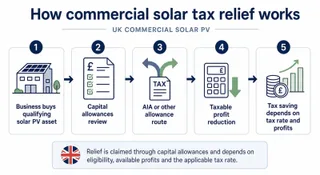
Yes. Commercial solar PV can usually qualify for UK capital allowances where the business buys the system, owns it, and uses it for a qualifying business activity.
In simple terms, capital allowances are tax reliefs for business investment. They are not grants, rebates, or upfront payments from the government. Instead, they let a business deduct qualifying capital expenditure from taxable profits. The benefit depends on the tax the business would otherwise pay.
For many UK businesses buying commercial solar outright, the Annual Investment Allowance is often the key relief. It can provide 100% tax relief on qualifying plant and machinery expenditure in the year of purchase, subject to the rules and the available annual limit. Where AIA is not available, solar PV expenditure is commonly relieved more slowly through the special rate pool. The main points to check are:
- Who owns the solar PV system.
- Whether the business has taxable profits.
- Whether the Annual Investment Allowance is available.
- Whether the asset is used for a qualifying business activity.
- Which costs are part of the solar plant and which are separate roof, building, or grid works.
- Whether the system is bought outright, financed, leased, or supplied under a power purchase agreement.
This guide is for UK commercial solar buyers and finance teams. It is general information, not tax advice. HMRC treatment depends on the facts, so the final claim should be reviewed by the business’s accountant or tax adviser.
Short summary for business owners and finance teams.
Capital allowances can improve the financial case for commercial solar, but they should not be treated as the whole return. The main return from solar usually comes from reducing imported electricity from the grid. Tax relief can reduce the after-tax cost, but it does not make a poor technical project into a good one.
For a quick view:
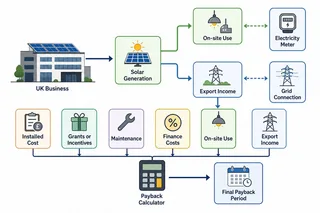
The practical answer is that capital allowances commercial solar claims are often possible, but the outcome depends on the tax facts as much as the engineering design. A system on a warehouse roof, factory, farm building, office, retail site, or trading school entity may be eligible where the purchasing business owns the asset and uses it for taxable business activity. However, a charity, public body, landlord, tenant, or PPA customer may need a more detailed review. A good solar business case should show four things separately: Electricity savings from using solar power on site. Export income assumptions, if surplus power is exported. Project costs, including any roof, structural, or grid works. Tax effects, including capital allowances and timing. Treating tax relief as a guaranteed discount is a common mistake. A profitable company and a loss-making company can install the same system and receive very different short-term tax benefits.
How the main UK capital allowance routes work.
UK capital allowances work by allowing qualifying capital expenditure to be deducted from taxable profits. The main routes for commercial solar are the Annual Investment Allowance, special rate writing down allowances, and, for some companies, the full expensing regime.
The Annual Investment Allowance is often the simplest route. The current AIA limit is £1 million per year, but connected companies and groups may need to share it. The accounting period and timing of expenditure can also affect the available allowance.
Where AIA is available, a business may be able to deduct 100% of qualifying solar PV plant and machinery expenditure in the year the expenditure is incurred. This can be valuable for a profitable company with enough taxable profit to use the deduction. If AIA is not available, or if the AIA limit has already been used on other assets, solar PV expenditure will often fall into the special rate pool. Special rate assets normally receive writing down allowances at 6% per year on a reducing-balance basis. That still provides tax relief, but over a much longer period. Companies may also consider the full expensing rules. Full expensing applies to companies within the corporation tax regime and has its own conditions. It gives 100% first-year relief for qualifying main rate plant and machinery. Special rate assets can qualify for a 50% first-year allowance under the full expensing regime. Because solar PV is usually special rate expenditure, businesses should not assume that the panels automatically qualify for 100% full expensing. Two older reliefs should not be used for new solar projects: The super-deduction ended on 31 March 2023. The old Enhanced Capital Allowances scheme for energy-saving technologies has ended. If a solar proposal for a new project relies on either of those reliefs, the figures should be checked carefully.
A simple tax example.
The easiest way to understand capital allowances is to separate the project cost from the tax saving.
A company spends £100,000 on a qualifying commercial solar PV system. It owns the system, uses it for its trade, and can claim the Annual Investment Allowance.
If the full £100,000 qualifies for AIA, the company may be able to deduct £100,000 from taxable profits in the year of purchase. If the company pays corporation tax at 25%, that deduction could produce a tax saving of £25,000. This does not mean the installer gives a £25,000 discount. It means the company’s corporation tax bill may be £25,000 lower than it would otherwise have been, assuming the business has enough taxable profit and the claim is valid. The real saving depends on:
- The company’s actual tax rate.
- Available taxable profits.
- The accounting period.
- Whether the AIA limit has already been used.
- Whether any connected companies share the AIA limit.
- Whether all project costs qualify as plant and machinery.
If the company has little or no taxable profit, the benefit may be delayed. If the expenditure exceeds available AIA, the balance may go into the special rate pool and receive relief over time. This is why “cost after tax relief” figures in solar proposals should be treated with caution. A profitable trading company and a loss-making business can buy the same solar system and have very different tax outcomes.
Which solar project costs may qualify?
The core solar PV equipment is usually the clearest part of the capital allowances claim. The more difficult questions normally involve the roof, building, structure, grid connection, and any additional technologies installed at the same time.
Costs that may form part of a plant and machinery claim can include:
Solar PV modules. Inverters. Mounting systems. DC cabling. AC cabling linked to the solar system. Generation meters. Some electrical integration costs and professional fees directly related to installing the plant may also be relevant. However, the invoices should separate different types of work wherever possible. A single bundled “solar project” total is harder for an accountant to review. Costs that may need separate tax treatment include: Some building and structural costs may fall under the Structures and Buildings Allowance, which gives relief at 3% per year for qualifying non-residential structures and buildings. Land does not qualify for capital allowances. A simple way to think about the cost split is: Battery storage and EV chargers should also be reviewed separately. They may qualify for capital allowances if used for the business, but their classification can depend on the asset, installation, ownership, and use case. The safest approach is to ask the installer for an itemised quotation and ask the accountant to review the categories before the purchase is approved. Monitoring equipment. Design and installation labour. Commissioning costs. Roof repairs. Roof replacement. Structural strengthening. Asbestos removal. Planning applications. Grid upgrades. Switchgear upgrades. New buildings. Major building alterations. Access roads. Land.
Why ownership and funding route matter.
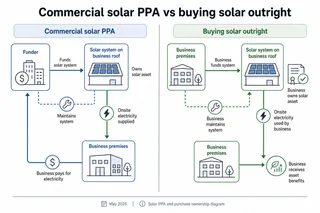
The business normally needs to own the solar PV system to claim capital allowances. If the company buys the system outright, the position is usually more straightforward. If the system is financed, leased, or supplied through a power purchase agreement, the answer can change.
This is a common source of confusion. A business may have solar panels on its roof but still not be the party entitled to claim capital allowances if a third party owns the system.
For example, under many PPA arrangements, the solar provider funds, owns, and maintains the panels. The site occupier buys the electricity generated by the system at an agreed rate. In that case, the site occupier usually cannot claim capital allowances on the panels because it has not bought them. Ownership should be checked before signing finance, lease, or PPA documents. Waiting until after installation can make it harder to correct the tax and accounting position.
When capital allowances make commercial solar more attractive.
Capital allowances are most helpful where the business:
- Owns the solar PV system.
- Uses it for a qualifying business activity.
- Pays tax on profits.
- Has enough taxable profit to use the relief.
- Has available AIA or can benefit from the relevant allowance route.
- Has clear records showing what was bought and when.
They can reduce the after-tax cost of the project and improve effective payback. Capital allowances are particularly relevant for owner-occupiers with long-term site control, businesses with high daytime electricity use, and companies that already expect to invest in plant and machinery during the same accounting period. Farms, manufacturers, warehouses, offices, retail sites, and commercial landlords can all have viable cases where the property and tax structure work. However, the tax relief should sit alongside the energy case, not replace it. Commercial solar tends to perform best financially where electricity is consumed on site during the day. Self-consumed electricity is usually worth more than exported electricity because it offsets imported grid power. Export income can help, but export-heavy projects are more exposed to export tariff assumptions. A well-modelled project should consider: A tax-efficient solar system on a poor roof or a badly matched load profile can still be a weak investment. The strongest projects usually have both a sound technical case and a clear tax position. Roof size. Roof condition. Structural capacity. Half-hourly electricity consumption. Import tariff. Export tariff. DNO requirements. Maintenance access. Insurance conditions. Ownership and lease terms. Capital allowances and tax timing.
When the relief may be limited or delayed.
Capital allowances are not equally useful for every organisation.
The relief may be limited or delayed where:
The business has low taxable profits. The business is loss-making. The organisation is a charity or non-taxpaying body. The AIA has already been used on other assets. Connected companies share the AIA limit. The business does not own the solar PV system. A charity, academy trust, public body, or non-taxpaying organisation may not benefit from capital allowances in the same way as a profitable trading company. There may still be a strong energy-saving case for solar, but the tax assumptions should be different. A tenant with a short lease also needs caution. Even if the tax treatment is technically favourable, the commercial risk may be high if the tenant cannot use the system for long enough to recover the investment. Common mistakes include: These mistakes can lead to overstated payback projections and tax risk. Part of the project cost is roof, building, structural, or land expenditure. The site has mixed business and non-business use. The project includes residential elements. A landlord and tenant arrangement affects ownership. The system is later sold or removed. Assuming every commercial solar project gets 100% tax relief automatically. Treating capital allowances as a grant or installer discount. Ignoring ownership under a PPA. Assuming full expensing gives 100% relief for solar PV. Putting roof works into the same tax category as the PV equipment. Using headline tax savings without checking taxable profits. Failing to separate battery, EV charger, grid, and roof costs. Signing finance documents before checking who owns the asset.
Practical checks before approving a solar project.
Before committing to a commercial solar PV installation, the finance and property teams should review the tax position alongside the technical survey.
The most reliable projects are usually those where the accountant, installer, landlord, and client agree the key assumptions before the order is placed.
Useful checks include:
- Confirm who will legally own the solar PV system.
- Confirm whether the site use is a qualifying business activity.
- Check whether AIA is available for the accounting period.
- Review whether connected companies share the AIA limit.
- Confirm whether the business has enough taxable profit to use the relief.
- Split PV equipment costs from roof and building works.
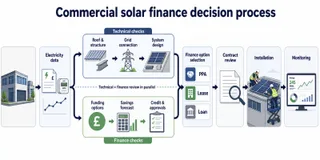
A simple approval flow is: 1. Check the energy case using consumption data. 2. Check roof, structure, access, and grid constraints. 3. Confirm ownership and funding route. 4. Split the project costs into clear categories. 5. Ask the accountant to review the capital allowances position. 6. Approve the project using both energy and tax assumptions. The installer’s quotation should be detailed enough for cost allocation. A single line saying “solar project” may be convenient for sales, but it is less useful for tax review. Clear invoices, contracts, commissioning certificates, and O&M documents make the capital allowances claim easier to support. Separate battery storage and EV charging costs if included. Check whether grid or switchgear works need separate treatment. Review hire purchase, lease, or PPA documents before signing. Check landlord consent if the site is leased. Keep finance agreements and asset ownership documents. Keep DNO approval and commissioning paperwork. Keep evidence of business use and installation costs. Ask the accountant to review the final cost split before filing the claim.
How solar design affects the financial result.
Capital allowances improve the after-tax cost, but solar performance depends on design. A system should be sized around real electricity use, not just roof area. Half-hourly data is usually the best starting point for commercial sites because it shows when electricity is actually consumed.
UK commercial solar typically generates around 800 to 1,100 kWh per kWp per year, depending on location and design. Southern England sites often achieve higher output than northern sites, but shading, orientation, tilt, roof layout, and maintenance can matter as much as geography.
For example, a 100 kWp system may generate around 80,000 to 110,000 kWh per year. The value of that generation depends on how much is used on site. Installer-level design issues can materially affect returns. Flat roofs may need ballasted systems, which can exceed load limits. Standing seam and trapezoidal roofs need compatible fixings. Fragile roofs require extra access planning. Inverters need ventilation and maintenance access. Poor DC cable management can create fire safety issues. Monitoring should be configured at commissioning so underperformance is detected early. The tax calculation should therefore sit beside a realistic generation model. It should not replace it. If the solar array is oversized, heavily exported, shaded, installed on a weak roof, or connected under restrictive export conditions, capital allowances may not rescue the business case.
Documentation to keep for a capital allowances claim.
Good records matter because the tax claim should match the accounts and the actual project. The business should keep documents that show what was bought, who owns it, when it was installed, and how it is used.
Key records include:
Installer quotations. Itemised invoices. Contracts and order forms. Finance agreements. Hire purchase, lease, or PPA documents. Commissioning certificates. Where possible, separate: This gives the accountant a clearer basis for deciding which costs qualify for plant and machinery allowances and which may need different treatment. Tax rules can change, and HMRC treatment depends on the facts. Before filing a claim, the business should ask its accountant or tax adviser to review the project documents, cost split, ownership route, and available allowances. DNO approval documents. Structural reports. Roof condition surveys. Permitted development or planning evidence. O&M manuals. Generation meter records. Monitoring records. Insurance correspondence. Internal approval papers. Evidence of business use. Solar PV equipment. Solar installation labour. Battery storage. EV chargers. Roof repairs. Roof replacement. Structural works. Grid upgrades. Switchgear upgrades. Professional fees.
Next steps for a UK business considering commercial solar.
Start with the energy case, then test the tax position.
The best commercial solar projects usually combine:
Suitable roof space. Strong daytime electricity demand. Clear ownership. Available tax relief. Good project records. A sound roof and structure. Ask any installer for a design based on consumption data, not only an indicative roof layout. Ask the accountant whether AIA is available, whether the business has enough taxable profit, and whether any connected companies affect the claim. If the site is leased, check landlord consent and the lease position before assuming capital allowances are available. Capital allowances can make commercial solar more attractive, but they are only one part of the decision. A robust project should still work on practical fundamentals: a sound roof, suitable grid connection, sensible system size, realistic self-consumption, clear ownership, and documentation that stands up to tax review. A realistic grid connection. Sensible system sizing. Realistic self-consumption assumptions.
Plan, Compare & Buy Renewable Energy Solutions
AI does the thinking.
You get the perfect solar match.
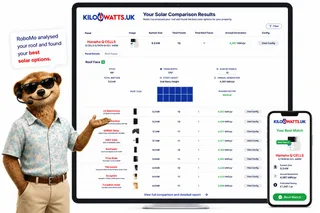
Use RoboMo™ to assess your property, compare available technologies and connect with trusted UK installers, suppliers and manufacturers.
Simply enter your postcode, drop a pin on your roof, create your free account and let RoboMo™ analyse your property to find the best solar panels for your home.

You don't have to think
RoboMo™'s AI analyses your roof and does all the hard work.

Accurate & tailored
AI-powered assessment based on your roof, location, and conditions.

Best options, maximum savings
Compare top solar panels for the best performance and value.

Simple, fast & effortless
Provide a few details, sit back and watch your results unfold.
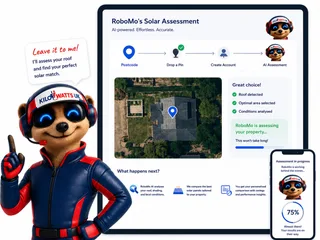
STEP 1
Choose Home, Business or Industrial
Enter your postcode to start your assessment.
STEP 2

Drop a pin on your roof
STEP 3

Create your free account
STEP 4

Sit back and watch RoboMo™ work
RoboMo™ analyses your roof and builds your personalised solar comparison.

Step 1
Enter your postcode
Start designing your wind energy system in seconds.
Are you an installer, distributor or renewable energy business?
Kilowatts UK is expanding the Flower Turbines partner network across the UK.
Become A Flower Turbines PartnerKilowatts UK is an authorised representative
Flower Turbines
Compact vertical-axis turbines built for real UK sites, not just open farmland.
They start in light wind, sit in a small footprint, and are bird-safe by design. Cluster them as a bouquet and the group performs better together than the same turbines standing alone. Enter your postcode for a location-based generation estimate. Figures use area weather data and will differ if buildings, trees or hills sit in the way.
Starts in light UK wind
Built to generate in typical UK wind, not only open farmland.
Small rooftop or ground footprint
Compact towers for roofs, yards and tight sites.
Bird-safe slow rotation
Slow vertical-axis spin, bird-safe by design.
Bouquet clusters raise output
Grouped turbines outperform the same units standing alone.
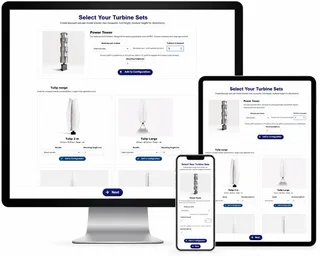
STEP 2

Choose a location
STEP 3

Place your cluster
Tap the map where you want the turbine cluster to go.
STEP 4

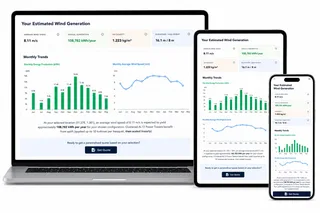
Instant generation forecasts
Compare different turbine layouts and see annual generation forecasts instantly.
STEP 5

No commitment required
Explore different configurations before deciding whether to request a quotation.
Related articles
Mo's Mission Nominations
FAQ
Need Help? RoboMo's Got Answers
Do commercial solar panels qualify for capital allowances in the UK?
Yes, commercial solar PV systems can usually qualify for capital allowances if the business buys and owns the system and uses it for a qualifying business activity. The claim depends on the facts, including ownership, taxable profits, funding method, asset use, and how project costs are split between solar equipment, roof works, building works, and grid works.
Are capital allowances the same as a solar grant?
No. Capital allowances are not a grant, rebate, or upfront government payment. They reduce taxable profits, which can lower the tax a business pays. The value of the relief depends on the business’s tax position, tax rate, available profits, and whether the expenditure qualifies.
Can the Annual Investment Allowance be used for commercial solar?
Often, yes. The Annual Investment Allowance can provide 100% tax relief on qualifying plant and machinery expenditure up to the available annual limit, currently £1 million per year. For many businesses buying commercial solar outright, AIA is the most useful route, but connected companies may need to share the limit and the business must have enough taxable profit to benefit immediately.
Is commercial solar treated as plant and machinery?
The core solar PV system is generally treated as plant and machinery for capital allowances purposes. This can include panels, inverters, mounting systems, solar cabling, monitoring equipment, installation labour, and commissioning costs. However, related works such as roof repairs, structural strengthening, grid upgrades, and building alterations may need separate tax treatment.
Does commercial solar qualify for 100% full expensing?
Businesses should not assume that commercial solar qualifies for 100% full expensing. Full expensing gives 100% first-year relief for qualifying main rate plant and machinery, but solar PV is commonly treated as special rate expenditure. Special rate assets may qualify for a 50% first-year allowance under the full expensing regime, subject to the rules.
What happens if the business cannot use the Annual Investment Allowance?
If AIA is not available, has already been used, or does not cover the full qualifying cost, solar PV expenditure may be relieved through the special rate pool. Special rate writing down allowances are normally given at 6% per year on a reducing-balance basis, so the tax relief is spread over a much longer period.
Can a business claim capital allowances if the solar panels are installed under a PPA?
Usually not. Under many power purchase agreement arrangements, the solar provider funds, owns, and maintains the system, while the site occupier buys the electricity generated. If the customer does not own the solar PV system, it will usually not be the party entitled to claim capital allowances on the panels.
Can tenants claim capital allowances on solar panels?
A tenant may be able to claim in some cases, but the position depends on who owns the system, the lease terms, landlord consent, end-of-lease rights, and the nature of the expenditure. Tenants should check the tax and legal position before committing to the project, especially if the lease term is short.
Do roof repairs and structural works qualify with the solar system?
Not automatically. Roof repairs, roof replacement, structural strengthening, asbestos removal, and building alterations may need different tax treatment from the solar PV equipment. Some costs may be repairs, some may be capital building works, and some may fall under other allowance rules such as the Structures and Buildings Allowance. An itemised quotation helps the accountant review the correct treatment.
Can battery storage and EV chargers qualify for capital allowances?
Battery storage and EV chargers may qualify for capital allowances where they are bought, owned, and used for qualifying business purposes, but they should be reviewed separately from the solar PV system. Their treatment can depend on the asset, installation method, ownership structure, and how they are used by the business.
How much tax could a business save with capital allowances on solar?
The tax saving depends on the qualifying cost, the allowance claimed, the business’s tax rate, and whether the business has enough taxable profit. For example, if a company spends £100,000 on qualifying solar PV and can claim 100% AIA, a 25% corporation tax rate could produce a tax saving of £25,000. This is not an installer discount; it is a potential reduction in the company’s tax bill.
Can a loss-making business benefit from solar capital allowances?
A loss-making business may not receive an immediate tax saving because capital allowances reduce taxable profits. If there are no taxable profits to offset, the benefit may be delayed or depend on wider tax rules for losses. Solar can still be financially worthwhile through electricity savings, but the short-term tax benefit may be lower than for a profitable company.
What documents should be kept for a capital allowances claim?
Businesses should keep itemised quotations, invoices, contracts, finance agreements, commissioning certificates, DNO approval documents, structural reports, roof surveys, O&M manuals, monitoring records, and evidence of business use. Clear records help show what was bought, who owns it, when it was installed, and which costs relate to solar plant rather than roof, building, grid, or structural works.
Should an accountant review a commercial solar capital allowances claim?
Yes. Commercial solar capital allowances depend on the business’s tax position, ownership route, funding agreement, available AIA, cost split, and use of the asset. The installer can provide project information and itemised costs, but the final claim should be reviewed by the business’s accountant or tax adviser before filing.