


Sleeved PPA vs private wire: UK business guide
Published: 2026-09-28 23:47:58
Updated: 2026-09-30 15:51:30
A sleeved PPA needs a UK supplier that will sleeve volume on the public network. A private wire needs an adjacent cable, land rights and a lawful supply.
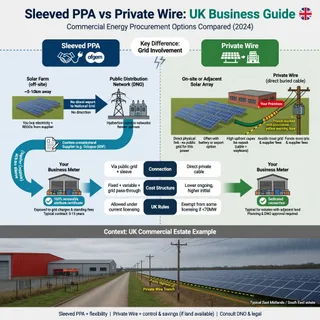
Sleeved PPA vs private wire - UK business guide
UK business guide B Solar sleeved vs private wire
Sleeved PPA vs private wire UK: what the contract actually does
The choice is between a commercial contract and a physical cable. A sleeved PPA sells an agreed volume at an agreed price through a licensed supplier on the public network. That supplier settles the volume, manages imbalance and keeps supplying the site. A private wire is a cable to the customer off the public distribution network, usually only on the same site or next door. The sleeve does not deliver that generator’s electrons to the buyer’s meter. Adjacency, land rights, the legal customer and whether a supplier will sleeve decide which route is available.
System power is pooled. The sleeved contract allocates volume and, where the paperwork says so, renewable attributes. It does not lay a dedicated path from a named solar farm to the buyer’s meter. A private wire does the opposite in physical terms, but it does not wipe out the import supply, grid-related charges or the need to know who is allowed to sell to whom.
This is a business contracting question, not a domestic panel quote. Warehouse, office and retail-park solar can sit beside either structure. They are not automatic substitutes for it. Published prices, sleeving fees and cable costs are not quoted below, because comparable UK ranges are commercially confidential and site-specific.
How a sleeved PPA is settled through a supplier
A sleeved power purchase agreement still needs a licensed supplier that will sleeve the volume. Not every supplier will. The supplier passes the agreed volume through the public network, settles it, and continues to supply whatever the generator does not cover. On larger sites, half-hourly metering is the usual basis for that settlement. The meters have to produce the data the supplier requires. If they do not, the commercial idea cannot be billed in the way the contract assumes.
The generation price is not the delivered cost. Network and policy costs, plus the supplier’s sleeving and shaping charges, sit on top. Forecast error, volume tolerance and the shape of demand drive those charges. A tidy annual total can still be an awkward winter-evening shape. If the buyer wants the renewable attribute, commonly documented with a Renewable Energy Guarantee of Origin (REGO), that transfer has to be written into the contract. Naming the generator does not move the attribute by itself.
A sleeve can suit a buyer with enough demand to interest both a generator and a supplier, especially where the plant cannot sit next to the load or the estate is spread across sites. It is a weak fit for a very small load, a short lease, or a buyer that needs a free hand to change supplier each year. Sale of the building, and exit of the sleeving supplier, should be agreed before the deal is treated as secured. There is no single UK standard term. Length is negotiated.
When a cable counts as a private wire
A private wire is the cable. It carries the generator’s output to the customer without using the public distribution network for that unit of electricity. That needs a buildable route, rights over the land, and a design that stays safe if the site still runs in parallel with the grid. Planning, highways and third-party land can stop the job even where the energy case looks sound. Wayleaves and easements can be refused or later ended, so the model should not assume permanent rights.
Power used by the occupier of the same building, behind the same meter, is self-consumption. It is not a private wire to a third party. The distinction appears as soon as a landlord, a tenant or a neighbour is a different legal entity. Supply to that other entity can fall under the Electricity Act 1989 and may need a licence or a class exemption. Exact exemption limits have to be taken from the current exemptions order. They should not be copied from an old project or from a contractor’s rule of thumb.
If the generator operates in parallel with the network, protection, fault level and backfeed risk remain even when most of the energy never leaves the site. Works at the boundary can still involve the local distribution network operator (DNO). Surplus needs an export agreement, or the design has to curtail it. A cable route chosen before those points are settled often has to be redrawn.
Who still supplies the site, and who can switch
On a sleeve, the licensed supplier remains the supplier of the site. The business cannot treat the generator as its supplier and shop the import contract independently each year. The sleeve and the import sit together. Supplier willingness is a gate, not a detail for later. If the preferred supplier will not sleeve that generator, the structure does not exist, however attractive the generation price looks on a term sheet.
On a private wire, the cable does not replace import power. Nights, winter weeks and generator outages still have to be covered, normally through the site’s import MPAN, the supply-point identifier on the electricity account, and a supplier contract. A landlord can own the wire and still be unable to bill a tenant if the landlord does not control that contract. On multi-tenant offices and retail parks, the harder question is often who the customer is, who holds the MPAN, and how shortfall is billed.
Third-party supply is not an unregulated activity. A private wire does not, by itself, create a right to sell electricity to a neighbour or a tenant. Billing a different company needs a settled supply structure before the private network is built. That position should be read against the Electricity Act 1989 and the current class exemptions order, not assumed from the fact that the cable never uses the public road.
What you still pay for besides the generation price
Neither route is generator price only. On a sleeve, the delivered cost is the generation price plus sleeving, imbalance, shaping, and the network and policy charges that still apply to import. Those adders move with the site’s shape and with the supplier’s willingness to take forecast error. Comparing two generation prices without the sleeving and import stack is not a comparison of what the business will pay. On a private wire, build cost rises with route length, voltage, trenching, crossings and consent risk. A pounds-per-metre figure would be invented, so none is given. Using fewer imported kWh does not automatically remove every grid-related cost. Charging rules have moved much residual network charging away from a simple charge per kWh, so standing and residual charges can remain. How DUoS, TNUoS, BSUoS and residual or capacity-band charges treat private-wire volumes versus sleeved import should be checked on current Ofgem and network charging statements. The useful screen is what remains, and what can stop the structure, rather than a headline energy price.
Overview
If the generator is not adjacent, the private-wire column is usually closed before anyone draws a trench. If no supplier will sleeve, the PPA column is closed before price negotiation is worth the time. Either way, the import that remains has to be in the model.
Which businesses suit a sleeve, and which suit a wire
A sleeved PPA fits a business with enough demand to interest a generator and a supplier, and a buyer that can live with one sleeving supplier for a negotiated term. It is the practical route where the generator cannot sit next to the load, or where the estate is spread across sites and a cable would cross land the buyer does not control. It fits poorly where the load is small, the occupation is short, or annual supplier switching is a firm requirement.
A private wire fits adjacent generation and load, large and fairly steady daytime demand, long occupancy and land rights the parties actually control. It fits poorly over a long public route, across scattered small shops, or where the parties cannot sit inside a licence exemption or a licensed supply arrangement. Many warehouses and offices are better served by their own rooftop array than by either structure. That is self-consumption on the occupier’s meter, a different project from a cross-boundary wire.
On a warehouse, commercial solar panel cost for UK warehouses turns on roof condition, structure and the connection. It is a different budget from a sleeve or a neighbour’s cable, and it is too site-specific to quote as a national figure. A tired roof can make the on-site array the wrong project even when the daytime load looks ideal. The same judgement applies to a private wire whose route depends on a wayleave the neighbour can refuse.
How this differs from rooftop solar, a green tariff and a virtual PPA
A supplier’s green tariff, a virtual PPA and rooftop solar behind one meter are often treated as the same purchase. They are not. A green tariff is a supplier product. A virtual PPA is mainly a financial contract. It does not build a cable, and it does not by itself sleeve physical volume through the site’s supplier. Same-site solar used by the occupier reduces import. It does not create a private wire, and it does not need a sleeve unless another person is buying the power.
Commercial rooftop solar for UK offices is usually bounded by lease length and by who holds the meter. Solar for UK retail parks and shops raises a sharper version of the same problem, because a landlord, several occupiers and more than one MPAN may all sit on one estate. Commercial solar vs grid electricity for UK businesses, on a single occupier meter, is about how much of the load the array can cover and what happens to surplus. It becomes a supply-law question only when another legal entity is being sold the power.
Where a commercial generator connects in scope of that process, a commercial solar G99 DNO connection is the usual assessment route. That can apply to on-site generation running in parallel with the network, including private-wire layouts that still have a grid boundary. G99 is not a substitute for a licence check, and a sleeve does not remove the generator’s own connection process at the generating site. Export, where it is allowed, still needs an agreement. Otherwise the design curtails.
What to lock down before design or equipment orders
Treat the licence position, the import MPAN and the export spill as gates, not as paperwork to add after a route is chosen. Those three points decide whether a tenant or neighbour can be billed at all, who contracts the shortfall, and whether surplus has a lawful route. If any of them is open, ordering cable or generating equipment is premature. Protection and backfeed still have to be designed where the generator runs in parallel with the DNO network, even if most of the energy stays on site.
On a sleeve, the equivalent gates are supplier willingness, the meters the settlement needs, and the volume tolerance the fee assumes. The contract should say who carries mismatch when generation and demand do not line up. Operation, access and performance risk have to sit with a named party for the life of the deal. A landlord who owns the wire, but not the tenant’s supply contract, can be left with an asset they cannot use as planned.
O&M access across a landlord-tenant boundary, or across a neighbour’s land, belongs in the legal pack. It should not be left for the installer to negotiate after commissioning. Assignment on a sale of the building, and what happens if the sleeving supplier exits, matter as much as cable size. A wire the buyer cannot assign, or a sleeve that dies with the supplier, is not a long-term supply.
What to check before you treat a price as comparable
Start with the layout, not the brochure price. Mark whether the generator and the load are the same legal entity, the same MPAN, or a neighbour. Ask the supplier, in writing, whether it will sleeve that generator and on what volume tolerance. Ask the connection question once you know the generator will operate in parallel and whether surplus will export. Ask someone who understands electricity supply whether the layout is self-supply, distribution or supply to another person, and have them read the current exemptions order rather than a summary.
Tax and rating treatment is a separate check. Climate Change Levy, VAT and business-rates treatment of generation and private cables should come from current HMRC and Valuation Office guidance, or from advisers using that guidance. This article does not state an outcome. The treatment depends on the facts and on rules that change. Network charging should be read from current statements for the same reason.
If the parties are not adjacent and no supplier will sleeve, neither structure is available. The practical renewable option is then usually on-site generation for the occupier’s own use, sized to the roof, the load and the connection. If they are adjacent, still price the import that remains, the consent risk on the route, and the exit terms, before setting a generation price against a cable quote. Neither structure guarantees the volume assumed in the model.
Plan, Compare & Buy Renewable Energy Solutions
AI does the thinking.
You get the perfect solar match.
Use RoboMo™ to assess your property, compare available technologies and connect with trusted UK installers, suppliers and manufacturers.
Simply enter your postcode, drop a pin on your roof, create your free account and let RoboMo™ analyse your property to find the best solar panels for your home.

You don't have to think
RoboMo™'s AI analyses your roof and does all the hard work.

Accurate & tailored
AI-powered assessment based on your roof, location, and conditions.

Best options, maximum savings
Compare top solar panels for the best performance and value.

Simple, fast & effortless
Provide a few details, sit back and watch your results unfold.
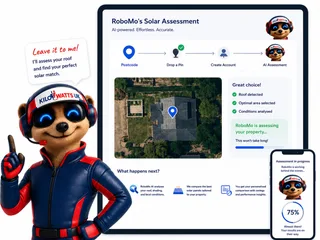
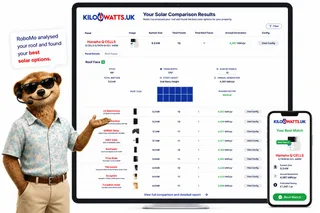
STEP 1
Choose Home, Business or Industrial
Enter your postcode to start your assessment.
STEP 2

Drop a pin on your roof
STEP 3

Create your free account
STEP 4

Sit back and watch RoboMo™ work
RoboMo™ analyses your roof and builds your personalised solar comparison.

Kilowatts UK is an authorised representative
Flower Turbines
Compact vertical-axis turbines built for real UK sites, not just open farmland.
They start in light wind, sit in a small footprint, and are bird-safe by design. Cluster them as a bouquet and the group performs better together than the same turbines standing alone. Enter your postcode for a location-based generation estimate. Figures use area weather data and will differ if buildings, trees or hills sit in the way.
Starts in light UK wind
Built to generate in typical UK wind, not only open farmland.
Small rooftop or ground footprint
Compact towers for roofs, yards and tight sites.
Bird-safe slow rotation
Slow vertical-axis spin, bird-safe by design.
Bouquet clusters raise output
Grouped turbines outperform the same units standing alone.
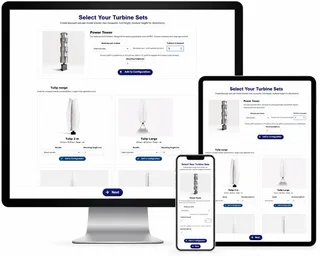
Step 1
Enter your postcode
Start designing your wind energy system in seconds.

STEP 2

Choose a location
STEP 3

Place your cluster
Tap the map where you want the turbine cluster to go.
STEP 4

Instant generation forecasts
Compare different turbine layouts and see annual generation forecasts instantly.
STEP 5

No commitment required
Explore different configurations before deciding whether to request a quotation.
Related articles
Mo's Mission Nominations
FAQ
Need Help? RoboMo's Got Answers
What is the difference between a sleeved PPA and a private wire?
A sleeved PPA is a commercial contract that sells an agreed volume at an agreed price through a licensed supplier on the public network. It does not deliver that generator’s electrons to the buyer’s meter; renewable attributes, commonly a Renewable Energy Guarantee of Origin (REGO), transfer only if the contract says so. A private wire is a cable that carries the generator’s output to the customer without using the public distribution network for that unit, and it is usually only practical on the same site or next door. Adjacency, land rights, the legal customer and whether a supplier will sleeve decide which route is available.
Who supplies the site if generation falls short, and can the business switch supplier?
On a sleeve, the licensed supplier remains the supplier of the site. It settles the agreed volume, manages imbalance and continues to supply whatever the generator does not cover, so the business cannot shop the import contract independently each year. If the preferred supplier will not sleeve that generator, the structure does not exist. On a private wire, the cable does not replace import power: nights, winter weeks and outages are still covered through the site’s import MPAN, and the import supplier may still change. Selling electricity across the wire is a separate legal question from changing that import supplier.
When is on-site solar self-consumption rather than a private wire?
Power used by the occupier of the same building, behind the same meter, is self-consumption. It is not a private wire to a third party. The distinction appears as soon as a landlord, a tenant or a neighbour is a different legal entity. A private wire needs a buildable route and rights over the land, and planning, highways or third-party land can stop it even where the energy case looks sound. Wayleaves and easements can be refused or later ended, so the model should not assume permanent rights.
Can a landlord or generator sell power to a tenant or neighbour over a private wire?
A private wire does not, by itself, create a right to sell electricity to a neighbour or a tenant. Supply to another legal entity can fall under the Electricity Act 1989 and may need a licence or a class exemption. Exact exemption limits have to be taken from the current exemptions order, not from an old project or a contractor’s rule of thumb. A landlord can own the wire and still be unable to bill a tenant if the landlord does not control the supply contract. That supply structure should be settled before the private network is built.
Is the generation price the full cost of a sleeved PPA or a private wire?
No. On a sleeve, network and policy costs, plus sleeving, imbalance and shaping charges, sit on top of the generation price, and they move with demand shape and forecast error. A tidy annual total can still be an awkward winter-evening shape. On a private wire, build cost depends on route length, voltage, trenching, crossings and consent risk, and using fewer imported kilowatt-hours does not automatically remove standing or residual network charges. How DUoS, TNUoS, BSUoS and related charges treat the volumes should be checked on current Ofgem and network charging statements.
Which businesses suit a sleeved PPA, and which suit a private wire?
A sleeve can suit a buyer with enough demand to interest both a generator and a supplier, especially where the plant cannot sit next to the load or the estate is spread across sites. It is a weak fit for a very small load, a short occupation, or a buyer that needs a free hand to change supplier each year. A private wire fits adjacent generation and load, large and fairly steady daytime demand, long occupancy and land rights the parties actually control. Many warehouses and offices are better served by their own rooftop array, used as self-consumption on the occupier’s meter, than by either structure.
How do these differ from a green tariff, a virtual PPA and rooftop solar?
A green tariff is a supplier product. A virtual PPA is mainly a financial contract: it does not build a cable, and it does not by itself sleeve physical volume through the site’s supplier. Same-site solar used by the occupier reduces import. It does not create a private wire, and it does not need a sleeve unless another person is buying the power. The position becomes a supply-law question only when another legal entity is being sold the electricity.
What should be locked down before design or equipment orders?
On a private wire, the licence position, the import MPAN and any export spill are gates, not paperwork to add after a route is chosen. If the generator operates in parallel with the network, protection and backfeed risk remain, and works at the boundary can still involve the distribution network operator. Where that connection is in scope, G99 is the usual assessment route, but it is not a substitute for a licence check, and a sleeve does not remove the generator’s own connection process. On a sleeve, confirm in writing that a supplier will sleeve the volume, that the meters can produce the settlement data, and who carries mismatch. Assignment on a sale, supplier exit and access for maintenance should be agreed before the deal is treated as secured.