


Corporate PPA vs on-site solar: UK business guide
Published: 2026-09-28 22:54:00
Updated: 2026-09-30 07:52:21
A corporate PPA is a multi-year contract for volume you still buy. On-site solar cuts import at one UK meter when generation and load coincide.
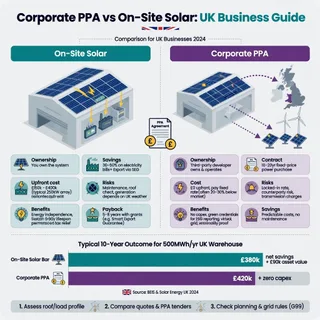
Corporate PPA vs on-site solar - UK business guide
UK business guide B Solar virtual vs on-site
Corporate PPA vs on-site solar UK
A corporate power purchase agreement is a multi-year contract to buy electricity, or a financial equivalent, from a renewable generator at an agreed price structure. On-site solar is photovoltaic generation on a roof, car park or land the business controls, used at that site first, with only surplus exported. One is a supply contract. The other is a behind-the-meter asset. The choice depends on whether you need fewer imported units at a specific meter, a price structure on volume you will still buy, or contractual evidence for a renewable electricity claim.
Those three outcomes are often folded into one "green power" brief. They do not move together. A bill cut at the meter depends on generation coinciding with site load, and on which tariff lines self-consumption actually avoids. A wholesale hedge depends on volume, contract shape and how the deal is settled. A renewable attribute depends on the evidence included, commonly REGOs or an equivalent contractual instrument in Great Britain, not on the word PPA alone. A business that already knows it has usable roofs is further along than one asking whether a corporate contract can stand in for plant it has not surveyed.
You do not have to pick only one route. On-site solar can cover roofs that work. A corporate PPA can cover residual volume those sites will still import. What does not work is treating a virtual contract as the answer to a warehouse roof question, or treating one rooftop array as a hedge for the rest of a multi-site portfolio.
What a corporate PPA buys in Great Britain
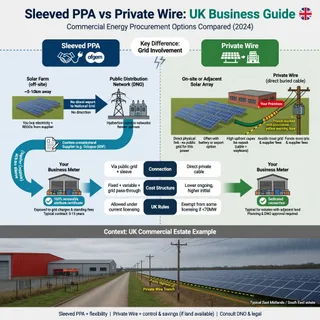
A corporate PPA does not usually mean the buyer owns a solar farm. In Great Britain the offtake is normally arranged with a licensed supplier. A physical, or sleeved, PPA routes output from a named generator through that supplier, which balances and shapes delivery. Shaping and balancing costs sit on top of the generator's price. They are part of the product, not a detail to discover after signature. A virtual PPA settles against a market reference price and does not deliver power to the buyer's meters. The existing supply contract stays in place. Most non-commodity bill lines are unchanged. A site agreement for panels on the occupier's own roof is a third arrangement, and it is easy to misname. Power is behind the meter, but price, term, maintenance access and what happens if the roof must be replaced sit in that site contract. That is not a remote corporate PPA, even if the funder uses the same label. Matching an annual contract volume to annual consumption also does not mean the generator supplies the site in each hour. If the power is not there when the site uses it, the supplier still has to buy it. Northern Ireland's wholesale and retail arrangements differ from Great Britain, so this sleeving description should not be applied there without a separate check. Within Great Britain, the questions that change the deal are whether it is physical or virtual, which price it references, who carries shape and volume risk, and whether the certificates needed for a claim are actually transferred.
How on-site solar changes one site's bill
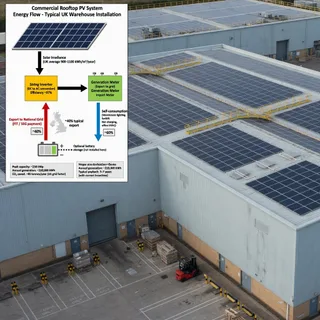
On-site solar cuts import only at the meter it is connected to, and only while the array is producing and the site is using power. It does not remove the electricity bill. Night demand, winter peaks and any export limit remain on the supply contract. A roof filled to its maximum can export heavily and save less than a smaller array matched to daytime load. Exported surplus is a different value from an avoided import. Export does not offset the same bill lines.
Comparing commercial solar with grid electricity for a UK business by using one blended rate misstates both products. Non-domestic import charges are not only the wholesale energy price. Which non-energy lines fall when import falls depends on the tariff, the connection voltage and the charging rules then in force. Read those lines from the bill rather than assume them. Export should be valued on its own: what the current supply contract pays, or allows, and whether an export MPAN or equivalent metering exists. Storage can move some surplus into later site use, but it is a separate specification, with its own losses and space needs. It does not make an unconstrained export assumption safe.
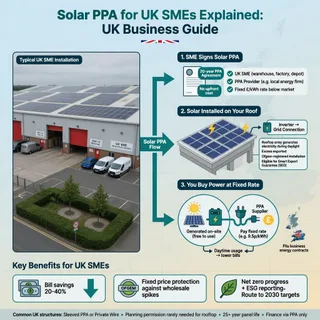
Who owns the array is separate from whether the roof should have one. The occupier, the landlord or a third-party funder may own it. Third-party funding can suit a business that wants on-site power without paying for the plant, but term, access and roof works all move into the contract. The roof still has to carry the array, and the site still has to use a meaningful share of generation while it is producing. Specific yield has to come from a site model. Location, tilt, orientation and shading decide output. Southern Britain generally receives more solar radiation than northern Scotland, but that is a design input, not a savings figure.
Where cost, claims and control diverge
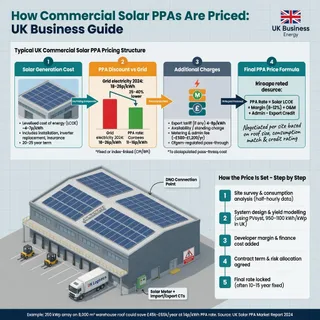
Cost is the question most boards ask first, and it is the one this guide will not answer with a figure. Installed prices, PPA strike prices, sleeving fees and payback periods move with equipment, roof type, connection works and wholesale markets. Many corporate prices are confidential. A single commercial solar panel cost for UK warehouses would hide structure, access, electrical works and any network reinforcement. Treat a national average, if you are offered one, as a prompt to survey the site, not as a budget. The comparison that still holds is about the product. On-site solar is an asset, or a site contract for an asset, that can change import at one meter. A corporate PPA is a multi-year contract that may or may not change what that meter imports. Ownership, renewable evidence and the work your team must administer diverge in the same way. A strike price set against a full retail tariff, or an on-site cost set against wholesale energy only, will not stand up once finance separates the energy price from the rest of the bill.
Overview
Read that as a filter, not a ranking. A large roof with poor daytime coincidence can still be a weak on-site project. A large portfolio with no credible demand forecast is a weak PPA, because shape and sleeved volume have to be forecast before a price means anything.
Which commercial roofs are worth surveying
Site control often decides an on-site project before irradiance does. Owner-occupier warehouses and factories, with a clear roof and a daytime process load, are the usual fit. An office is a different survey. Plant, vents and safe access often consume the area a satellite image still shows as empty. Summer occupancy can be low even when the annual bill is large. Multi-let offices, shops and retail parks add a tenure problem. The landlord often holds the roof, and more than one occupier may share the building. Metering and who benefits from avoided import have to be agreed before a layout is useful.
Lease length has to cover the period needed to justify the asset, whether the occupier funds it or a third party does. Landlord consent, the remaining roof warranty, and who pays if the cover fails under the array, matter as much as orientation. Asbestos cement, a failed membrane, or a roof already scheduled for replacement will stop the scheme or force the roof works first. Planning consent is separate from the grid connection. Rooftop schemes are often simpler than ground-mount or car-park canopies, but they still fail on structure, listing or conservation constraints. A neighbouring building with panels is not evidence that this roof will be allowed, or that it can carry the load.
A roof survey is what changes the quote, not a desktop area take-off. Structure, cover type, edge protection, fire-safety routes, inverter location, switchroom space and the building insurer's conditions all move cost, and some of them rule the array out. If those points are open, a corporate PPA conversation is not a substitute survey. It is a different procurement question.
When a corporate PPA fits better than more roofs
A corporate PPA fits organisations that can commit a volume a generator and a supplier will actually contract, want a multi-year price structure, and need a route across sites they do not control. It is a weak fit for a small single site that wants a simple cut in imported units, and for a team that cannot manage credit support, accounting treatment and contract administration. There is no universal public floor for the smallest volume the market will accept. If a counterparty will not contract your volume, the product is not available, however tidy the sustainability case looks.
On a physical deal, the points often missed are shape and volume risk, plus sleeving and imbalance costs. On a virtual deal, the missed point is basis risk. The reference price used to settle the contract may not match the price in the buyer's supply agreement. The hedge can leave a gap even when the annual totals look aligned. Credit support, change-of-law terms, site closure and supplier failure need legal review before the headline price is treated as the whole cost. If the purpose is a renewable electricity claim, the certificates have to be in the contract. A PPA does not provide that evidence unless they are included, and holding REGOs does not by itself show that the deal caused new plant to be built.
The physical supply agreement remains either way. A warehouse closure, a change in shift pattern or a tenant leaving still moves the volume you have committed. Accounting for a virtual PPA is not something a general energy article can settle. It needs a qualified accountant looking at the actual terms. Current common contract length, beyond the fact that these deals are multi-year, should be taken from the offer in front of you, not from a supposed market standard.
Connection, load profile and the supply contract
Annual consumption hides the case for on-site solar. Half-hourly data, where the site has it, show whether generation will be used or exported. Inverter sizing, string layout and any export cap should follow that profile and the usable roof zones, not a nameplate set against the annual bill. Summer weekends and winter peaks are where simple models go wrong. An office that is quiet in August, or a shop whose demand is evening-weighted, will export more than a weekday average suggests.
Commercial generation outside the small-scale notification route needs a distribution connection in Great Britain, commonly under G99. Export limits, reinforcement and timescales are specific to the site and the network. They are not a standard extra that can be priced from roof area. Open the connection question before the array size is fixed, because a cap or a long lead time can force a redesign. Where surplus is to be sold, an export MPAN or equivalent metering is required, and the design has to be checked against the current supply contract. Export should not be assumed payable if the contract is silent.
Manufacturer warranties are often marketed at around 25 years. That is not a guarantee of site life, inverter life or annual output. Keep equipment warranty separate from how long the business will control the roof, and from the connection programme, which can dominate the calendar even when the roof itself is straightforward.
What neither route guarantees
Neither route removes the need for a credible demand forecast. On-site solar sized to a nameplate ambition can look busy on a roof and still export through the hours that would have saved the most. A corporate PPA sized to last year's annual total can look hedged and still leave the buyer exposed where contract shape, or a virtual reference price, does not match how the sites buy power. Using both can be coherent: roofs that pass a survey, and a contract only for volume you can still defend. Using both does not let you count the same megawatt-hour as an avoided import and as PPA volume.
Business rates on on-site photovoltaics, VAT on commercial installations, and the treatment of on-site generation, REGOs and PPAs in SECR and related reporting should come from current official guidance and from your advisers. They are not safe to infer from a sales proposal, or from how a project was treated a few years ago. This article does not state rates, thresholds or reporting outcomes. Where those points affect tax or accounts, they need a qualified adviser and a dated source.
If a proposal cannot say whether the deal is virtual or sleeved, whether certificates transfer, what happens to export, and who pays for connection works, it is not ready to set against the other route. Ask for those points in writing, with half-hourly load and the current supply contract beside them. Then decide whether the next spend is a roof and connection survey, a supply-contract review, or both.
Plan, Compare & Buy Renewable Energy Solutions
AI does the thinking.
You get the perfect solar match.
Use RoboMo™ to assess your property, compare available technologies and connect with trusted UK installers, suppliers and manufacturers.
Simply enter your postcode, drop a pin on your roof, create your free account and let RoboMo™ analyse your property to find the best solar panels for your home.

You don't have to think
RoboMo™'s AI analyses your roof and does all the hard work.

Accurate & tailored
AI-powered assessment based on your roof, location, and conditions.

Best options, maximum savings
Compare top solar panels for the best performance and value.

Simple, fast & effortless
Provide a few details, sit back and watch your results unfold.
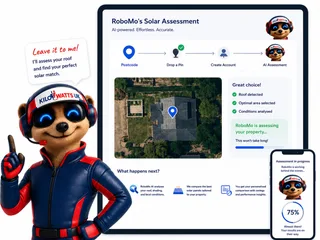
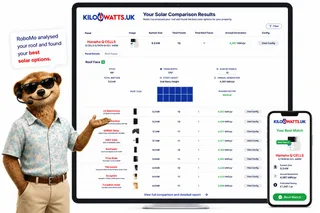
STEP 1
Choose Home, Business or Industrial
Enter your postcode to start your assessment.
STEP 2

Drop a pin on your roof
STEP 3

Create your free account
STEP 4

Sit back and watch RoboMo™ work
RoboMo™ analyses your roof and builds your personalised solar comparison.

Kilowatts UK is an authorised representative
Flower Turbines
Compact vertical-axis turbines built for real UK sites, not just open farmland.
They start in light wind, sit in a small footprint, and are bird-safe by design. Cluster them as a bouquet and the group performs better together than the same turbines standing alone. Enter your postcode for a location-based generation estimate. Figures use area weather data and will differ if buildings, trees or hills sit in the way.
Starts in light UK wind
Built to generate in typical UK wind, not only open farmland.
Small rooftop or ground footprint
Compact towers for roofs, yards and tight sites.
Bird-safe slow rotation
Slow vertical-axis spin, bird-safe by design.
Bouquet clusters raise output
Grouped turbines outperform the same units standing alone.

Step 1
Enter your postcode
Start designing your wind energy system in seconds.

STEP 2

Choose a location
STEP 3

Place your cluster
Tap the map where you want the turbine cluster to go.
STEP 4

Instant generation forecasts
Compare different turbine layouts and see annual generation forecasts instantly.
STEP 5

No commitment required
Explore different configurations before deciding whether to request a quotation.
Related articles
Mo's Mission Nominations
FAQ
Need Help? RoboMo's Got Answers
What is the difference between a corporate PPA and on-site solar?
A corporate power purchase agreement is a multi-year contract to buy electricity, or a financial equivalent, from a renewable generator at an agreed price structure. On-site solar is generation on a roof, car park or land the business controls, used at that site first, with only surplus exported. The choice depends on whether you need fewer imported units at a specific meter, a price structure on volume you will still buy, or contractual evidence for a renewable electricity claim, and those outcomes do not move together. A funded array on the occupier's own roof is a site contract, not a remote corporate PPA, even if the funder uses the same label.
Does a virtual PPA reduce the electricity a site imports?
No. A virtual PPA settles against a market reference and does not deliver power to the buyer's meters, so it does not by itself cut imported units or remove most non-commodity bill lines. A physical, or sleeved, PPA in Great Britain routes named output through a licensed supplier, with shaping and balancing costs on top of the generator's price. Matching an annual contract volume to annual consumption does not mean the generator supplies the site in each hour. Northern Ireland's wholesale and retail arrangements differ, so that sleeving description should not be applied there without a separate check.
Will on-site solar remove a business electricity bill?
No. On-site solar cuts import only at the meter it is connected to, and only while the array is producing and the site is using power. Night demand, winter peaks and any export limit remain on the supply contract. A larger array can export heavily and save less than a smaller one matched to daytime load. Exported surplus does not offset the same bill lines as an avoided import, and which non-energy charges fall depends on the tariff, the connection voltage and the rules then in force, so those lines should be read from the bill.
Can a business use on-site solar and a corporate PPA together?
Yes. On-site solar can cover roofs that work, and a corporate PPA can cover residual volume those sites will still import. The two routes do not do the same job. A virtual contract is not the answer to a warehouse roof question, and one rooftop array is not a hedge for the rest of a multi-site portfolio. The supply agreement remains either way, so a site closure, a change in shift pattern or a tenant leaving can still move volume you have committed.
Does a corporate PPA or a rooftop array automatically support a renewable electricity claim?
No. A renewable attribute depends on the evidence included, commonly REGOs or an equivalent contractual instrument in Great Britain, not on the word PPA alone. A PPA does not provide that evidence unless the certificates are actually transferred. Holding REGOs does not by itself show that the deal caused new plant to be built. Panels on a roof do not automatically provide the reporting evidence a claim needs, so that requirement should be confirmed separately.
When is a corporate PPA a better fit than more on-site solar?
A corporate PPA fits organisations that can commit a volume a generator and a supplier will actually contract, want a multi-year price structure, and need a route across sites they do not control. It is a weak fit for a small single site seeking a simple cut in imported units, or for a team that cannot manage credit support, accounting treatment and contract administration. There is no universal public floor for the smallest volume the market will accept. On a virtual deal, the settlement reference may not match the buyer's supply price, so a gap can remain even when annual totals look aligned. Contract length should be taken from the offer in front of you, not from a supposed market standard.
Which commercial roofs are worth surveying for solar?
Site control often decides an on-site project before irradiance does. Owner-occupier warehouses and factories with a clear roof and a daytime process load are the usual fit, while a short lease, missing landlord consent, a roof due for replacement or very low daytime load is weaker. Lease length, the remaining roof warranty and who pays if the cover fails under the array matter as much as orientation. Asbestos cement, a failed membrane or a roof already scheduled for replacement can stop the scheme or force the roof works first. A roof survey changes the quote, and the distribution connection should be opened before the array size is fixed, because an export cap or a long lead time can force a redesign.
Is there a single UK price for a corporate PPA or commercial solar?
No single figure in this comparison should be treated as a budget. Installed prices, PPA strike prices, sleeving fees and payback periods move with equipment, roof type, connection works and wholesale markets, and many corporate prices are confidential. A national average, if you are offered one, hides structure, access, electrical works and any network reinforcement. Treat it as a prompt to survey the site, not as a cost. A strike price set against a full retail tariff, or an on-site cost set against wholesale energy only, will not stand up once the energy price is separated from the rest of the bill.