


Why Solar Output Drops In Full Sun: Grid Voltage Rise
Published: 2026-09-20 10:45:47
Updated: 2026-10-06 12:21:03
Your panels are fine. On bright midday exports, street voltage climbs toward its legal ceiling and inverters back off. Here's how to spot it and what helps.

Why Solar Output Drops In Full Sun: The Voltage At The Top Of The Street
You walk past the inverter on a cloudless June lunchtime, expect to see the system at full tilt, and instead the figure has flattened off — or stepped down hard. Nothing has changed outside. No cloud, no shading, no dust. If that sounds familiar, the most likely explanation is not a failing panel or a dying inverter. It is the voltage at the top of your street. UK mains is nominally 230V, with a statutory allowance of +10% and −6% — an upper limit of roughly 253V. When a whole street exports solar at once, local voltage on the shared cable rises, and inverters are designed and required to reduce output or disconnect before that ceiling is breached. It is a network condition, not a fault, and it usually clears itself as the afternoon goes on. This article explains why it happens, why some houses on the same street are affected before others, how to tell voltage-related clipping apart from a genuine equipment problem, and the one thing that reliably helps: using or storing the energy on site rather than pushing it up the road.
"No. Street-wide export lifted voltage to its legal ceiling; inverters back off."
What is actually happening when output drops on a cloudless day
Think of the low-voltage cable running from your local substation down the street as a pipe. When your inverter exports, it has to push energy into that pipe, and to push it must sit at a slightly higher voltage than the cable it is pushing into. One house doing this makes a small difference. Twenty houses on the same cable all exporting at the same midday moment makes a much larger one, because each contribution nudges the whole local voltage upward.
Every grid-connected inverter in the UK is fitted with protection that watches the voltage at its own terminals. As that reading climbs toward the statutory upper limit, the inverter is obliged to respond — first by reducing output, and if the voltage keeps rising, by disconnecting altogether and waiting before reconnecting. That behaviour is defined by the connection standards small generators are installed under, and it is deliberate: it protects everything else plugged into the same network from over-voltage.
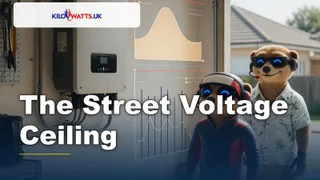
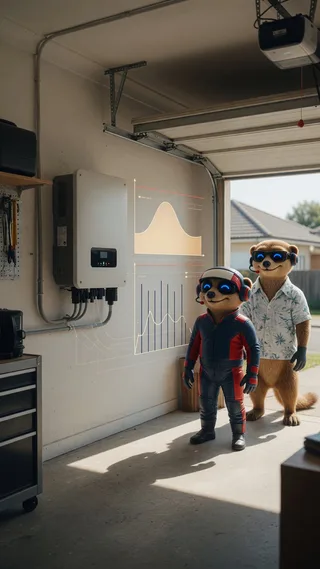
So the graph you see is a flawless bell curve that suddenly flat-tops and steps down while the light through the window is unchanged. The panels are still producing. The inverter is choosing, correctly, not to deliver all of it.
Why your house backs off before your neighbour's
This is the detail that makes the phenomenon feel personal and unfair, and it has a very ordinary explanation. Voltage does not sit at one value along the whole street. It rises as you move away from the substation during export, because the further the energy has to travel back along the cable, the more the voltage at the far end has to lift to move it.
The practical consequence is that the house furthest from the substation sees the highest reading, so it reaches the ceiling first and clips first. A neighbour three doors closer to the transformer may be running at full output at exactly the same moment, on an identical system, with identical panels facing the same way. Nothing about your kit is worse. Your position on the cable is simply less forgiving.
It also explains why this tends to appear only after a street has become solar-dense. A system that behaved perfectly for two summers can start clipping in its third, not because it has aged, but because four more households joined the same shared line.
What genuinely brings the voltage back down
useful part. Energy that is consumed or stored inside your own property never enters the street cable at all. It does not need to be pushed anywhere, so it contributes nothing to voltage rise. The moment you load the system locally — hot water, a battery accepting charge, an EV on a home charger, the washing machine, the dishwasher — the amount you are exporting falls, the voltage at your terminals eases back from the ceiling, and the inverter returns to its natural curve.
You can watch the same thing happen without lifting a finger, too. As the afternoon goes on, neighbouring export fades, offices and shops draw more, and the voltage bar drops away from the limit. Output lifts back onto the curve and the inverter settles. That recovery, with no site visit and no parts changed, is itself the strongest evidence that nothing was broken. The design lesson is simple: on a solar-dense street, self-consumption is not just an economic strategy for reducing imported units. It is also the mechanism that keeps a system delivering its full output at the exact hours it is most capable.
A checklist for telling voltage clipping apart from a real fault
Before assuming a panel or optimiser has failed, work through this. It takes ten minutes and costs nothing.
- Check the time of day. Voltage clipping clusters around bright late-morning and midday periods, particularly at weekends and during holidays when local daytime demand is low. A drop at 8am or 5pm points elsewhere.
- Check the weather honestly. Thin high cloud and haze can knock output back without looking dramatic from a kitchen window. Voltage clipping shows a distinctive flat top or sharp step, not a gentle wobble. 3. Look at the shape, not just the number. A genuine string or panel problem usually shows a proportional reduction all day, or a repeating shading dip at the same clock time. Voltage events flat-top the peak and leave the morning and afternoon slopes intact. 4. Read the grid voltage on your inverter or app. Most systems display it. Readings creeping into the high 240s and above during the drop, and falling back afterwards, are the signature. 5. Check your inverter's event or fault log. Over-voltage and grid-protection events are normally recorded with timestamps. Match them against the dips. 6. See whether the system recovers on its own. If full output returns in the afternoon with no intervention, hardware is almost certainly healthy. 7. Note whether it is seasonal and new. First appearing in a sunny spell after neighbours installed systems is a strong pointer to the shared cable, not your roof. 8. If it is persistent and prolonged, document it. Dates, times, voltage readings and screenshots give your installer and your Distribution Network Operator something concrete to assess. Network operators are responsible for keeping supply voltage within statutory limits and can investigate a properly evidenced report.
Design choices that reduce how often it bites
There is no household-level switch that lowers a whole street's voltage, and you should be wary of anyone who claims otherwise. What you can influence is how much of your generation ever needs to leave the building.
Battery storage is the most direct lever, because it absorbs the midday peak precisely when export pressure is highest and releases it in the evening when the street is importing again. Timing matters: a battery set to charge from the grid overnight and sit full by 10am has no capacity left to help at noon. On solar-dense streets, charging behaviour should be biased toward soaking up the midday surplus. Hot water diversion is the low-complexity option, converting surplus into stored heat rather than exported units. EV charging at home during daylight, where a working pattern allows it, is the largest single load most households have and an extremely effective one. Shifting flexible appliance cycles into the middle of the day helps at the margins. When a system is being designed, the position of the property on its street, the number of existing installations nearby and the intended pattern of daytime use are all worth discussing at survey. It is much easier to plan storage and load-shifting into a design than to retrofit a solution after two frustrating summers. If you are weighing options, our guide to comparing residential solar approaches walks through how storage and self-consumption change the result.
Follow-up questions people ask
Does clipping damage the panels or the inverter? No. Backing off is normal, designed behaviour. The panels simply operate at a different point on their curve and the inverter is doing the job it was specified to do.
Am I losing money every time it happens? You lose the export value of the units that were not delivered during the event. On most homes this affects a limited number of very bright hours, and self-consumption recovers a good share of it. It is worth quantifying from your own data rather than assuming the worst.
Can the inverter's voltage limits just be raised? Protection settings are defined by the connection standards, not by preference, and they exist to protect the wider network. This is not a DIY adjustment, and any change is a matter for a qualified installer working within those standards. Why is it worse in summer if panels prefer cold? Both things are true at once. Solar panels are actually more efficient in cold conditions than in heat, which is why a crisp bright spring day can outperform a sweltering July afternoon. Summer still produces more total energy because of longer days and higher sun angles — which is exactly when whole streets export simultaneously and voltage rise becomes visible. Is this a sign my street cannot take more solar? Not necessarily. It indicates the local network is working close to its limit at peak export, which is information worth having, but it is a condition that varies with season, time of day and neighbourhood demand. Should I contact my installer or the network operator? Start with your installer, who can confirm the diagnosis from the inverter logs. If readings are persistently at or above the statutory limit, that evidence is what the network operator needs.
Video transcript
Mo: Full sunshine, output dropped. Is a panel faulty? RoboMo: No. Street-wide export lifted voltage to its legal ceiling; inverters back off.
Mo: Why does mine back off before my neighbour's? RoboMo: Voltage climbs along the shared cable. The house furthest from the substation reads highest, so it clips first.
Mo: So what actually lifts it back up? RoboMo: Local use. Energy consumed or stored on site never travels the street, so voltage falls and full output returns. Mo: Full sunshine, output dropped. Is a panel faulty? RoboMo: No. Street-wide export lifted voltage to its legal ceiling; inverters back off. / Mo: Why does mine back off before my neighbour's? RoboMo: Voltage climbs along the shared cable. The house furthest from the substation reads highest, so it clips first. / Mo: So what actually lifts it back up? RoboMo: Local use. Energy consumed or stored on site never travels the street, so voltage falls and full output returns.
Wrapping up
A solar system that flat-tops at noon on a cloudless day and recovers by mid-afternoon is telling you something about the street, not about your roof. Voltage rises along a shared cable during export, the house furthest from the substation feels it first, and every inverter on that line is required to step back before the statutory ceiling is reached. Diagnosing it properly matters, because the wrong conclusion leads to unnecessary call-outs and replaced components that were never faulty. The right conclusion leads somewhere more useful: design and habits that keep more of your generation inside the building, where it never has to travel up the street at all.
Next step
If you are planning a system, or trying to understand why an existing one behaves this way at midday, it is worth having the conversation before the next sunny spell. Our team can talk through storage, self-consumption and how your position on the local network affects a design — no pressure, just the engineering.
Plan, Compare & Buy Renewable Energy Solutions
AI does the thinking.
You get the perfect solar match.
Use RoboMo™ to assess your property, compare available technologies and connect with trusted UK installers, suppliers and manufacturers.
Simply enter your postcode, drop a pin on your roof, create your free account and let RoboMo™ analyse your property to find the best solar panels for your home.

You don't have to think
RoboMo™'s AI analyses your roof and does all the hard work.

Accurate & tailored
AI-powered assessment based on your roof, location, and conditions.

Best options, maximum savings
Compare top solar panels for the best performance and value.

Simple, fast & effortless
Provide a few details, sit back and watch your results unfold.
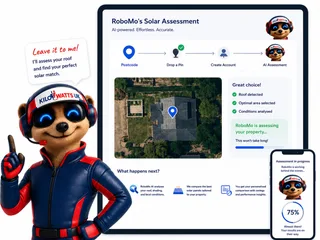
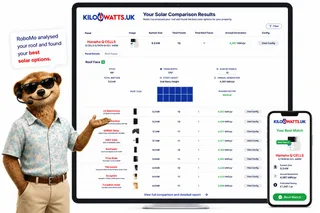
STEP 1
Choose Home, Business or Industrial
Enter your postcode to start your assessment.
STEP 2
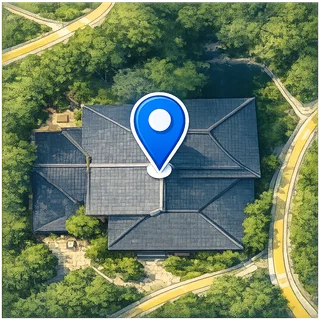
Drop a pin on your roof
STEP 3

Create your free account
STEP 4

Sit back and watch RoboMo™ work
RoboMo™ analyses your roof and builds your personalised solar comparison.

Kilowatts UK is an authorised representative
Flower Turbines
Compact vertical-axis turbines built for real UK sites, not just open farmland.
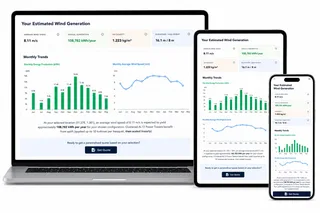
They start in light wind, sit in a small footprint, and are bird-safe by design. Cluster them as a bouquet and the group performs better together than the same turbines standing alone. Enter your postcode for a location-based generation estimate. Figures use area weather data and will differ if buildings, trees or hills sit in the way.
Starts in light UK wind
Built to generate in typical UK wind, not only open farmland.
Small rooftop or ground footprint
Compact towers for roofs, yards and tight sites.
Bird-safe slow rotation
Slow vertical-axis spin, bird-safe by design.
Bouquet clusters raise output
Grouped turbines outperform the same units standing alone.

Step 1
Enter your postcode
Start designing your wind energy system in seconds.
STEP 2

Choose a location
STEP 3

Place your cluster
Tap the map where you want the turbine cluster to go.
STEP 4

Instant generation forecasts
Compare different turbine layouts and see annual generation forecasts instantly.
STEP 5

No commitment required
Explore different configurations before deciding whether to request a quotation.
FAQ
Need Help? RoboMo's Got Answers
Why does my solar output drop in full sun?
A common cause is grid voltage rise on your local street cable. When many nearby homes export solar at the same time, the voltage can climb and your inverter may reduce output or disconnect to stay within its protection limits. This is usually a network condition rather than a fault with the panels.
Is voltage clipping harmful to my panels or inverter?
No, it should not damage the panels or the inverter. The inverter is designed to reduce output or stop exporting when grid voltage gets too high. It is doing this to protect the wider electrical network and connected equipment.
Why does my system clip before my neighbour’s?
Voltage is not identical at every house on a street. Homes further from the local substation can see a higher voltage during export, so their inverters may reach the limit first. Two identical solar systems can therefore behave differently on the same sunny day.
How can I tell if the problem is grid voltage rather than a faulty panel?
Voltage clipping often appears as a flat top or sudden step down around late morning or midday, then recovers later without intervention. Check your inverter app or display for grid voltage readings and any over-voltage events in the log. A panel fault is more likely to reduce output consistently or repeat in a pattern linked to shading.
What voltage is too high for UK homes?
UK mains electricity is nominally 230V, with a permitted range that allows up to roughly 253V. Solar inverters monitor the voltage at their own terminals and must respond if it approaches or exceeds their protection settings. If you see repeated high readings, record the dates, times and screenshots before speaking to your installer.
Can my installer simply raise the inverter voltage limit?
No, this is not a setting to change casually or as a DIY fix. Inverter protection settings are there to meet connection requirements and protect the network. If there is a genuine voltage issue, it should be assessed by a qualified installer and, where appropriate, the Distribution Network Operator.
What can reduce voltage clipping at home?
Using more solar electricity on site can help because less power is pushed back onto the street cable. Battery charging, hot water diversion, daytime EV charging and shifting flexible appliances into sunny hours can all reduce export. The best option depends on your home, usage pattern and existing equipment.
Should I contact my installer or the Distribution Network Operator?
Start with your installer, especially if you can provide inverter logs, voltage readings and screenshots showing when the output dropped. They can check whether the inverter is reporting over-voltage or whether another fault is more likely. If the evidence points to persistent supply voltage issues, the Distribution Network Operator can investigate the local network.