


Commercial battery storage for UK businesses: UK business
Published: 2026-09-28 21:15:25
Updated: 2026-09-29 19:51:52
Commercial battery storage for UK businesses stores kWh behind the meter. Fit depends on load, tariff, connection and a lawful place to site it.
Commercial battery storage for UK businesses - UK business guide
UK business guide B Solar C&I batteries
Commercial battery storage for UK businesses
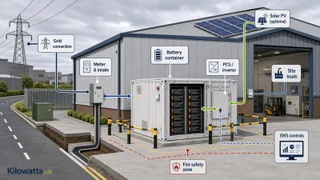
Most new commercial and industrial systems use lithium iron phosphate cells in cabinets or outdoor containers, with an inverter, controls, protection and switchgear. Lead-acid is largely a legacy choice. Flow batteries and other chemistries exist, but they are uncommon on ordinary UK warehouses, factories, offices and shops. This is behind-the-meter storage, sized around that site's load. A front-of-the-meter, grid-scale battery is a different asset: it trades with the electricity system rather than serving a building.
The useful question is which duty the quote is designed for. Bill management, holding solar that would otherwise be exported or clipped, and keeping selected circuits alive in an outage are three different jobs. A system bought only to manage bills may shut down when the grid does. Approvals, fire strategy and who is allowed to alter the site sit around that choice. They can remove a pattern that looked sound on a spreadsheet.
When is a commercial battery a plausible buy?
Storage is more plausible where generation and demand do not line up, where the tariff actually rewards shifting or peak reduction, where an export limit would otherwise clip solar, or where resilience has been specified as its own requirement. Daytime industrial load, some warehouses and larger offices are the usual candidates, particularly when the roof is being assessed for solar in the same project. The result is set by that site, not by a national average.
It is a weak fit for very low users, for flat tariffs with no capacity-related charge the battery can actually cut, and for sites with nowhere lawful to put the equipment. It is also a weak fit where the lease is too short for the occupier's own case unless the landlord will host the plant, where the network cannot accept the intended pattern in a time the business can wait, or where the only attraction is unverified income from a flexibility market. Those services have eligibility rules and availability duties, and they can conflict with using the battery for the site. Treat them as items to verify, not as revenue to pencil in.
Solar for UK retail parks and shops is often a different decision from a warehouse with a large roof and a daytime process load. Roof area may be modest, the landlord may control both the roof and the intake, and trade can sit in the evening after the array has fallen away. If the roof cannot host meaningful generation, and the supply contract does not price the peaks a battery could cut, storage is unlikely to be the first project to instruct.
What do kilowatts and kilowatt-hours each decide?
Power and stored energy answer different questions, and neither number means the site stays on during a power cut. Kilowatts describe how fast the system can charge or discharge. Kilowatt-hours describe how long that rate can be sustained. A high power rating can cover a short spike. A large energy rating can cover a longer shift in demand. A high kilowatt figure with little stored energy misses long peaks. A large kilowatt-hour figure with too little power sits idle during short spikes.
Backup is a separate specification. Islanding means disconnecting selected circuits from the grid and supplying them from the battery. The design has to say which circuits remain live, what those circuits draw, and for how long the stored energy is expected to cover that load. Fridges, servers or a process line are not covered by a battery quoted only for solar self-consumption. Most commercial systems stay grid-connected. If an existing generator is meant to support the same circuits, the two sources need a coordination note so they are not both trying to form the supply.
There is no meaningful typical size without a sector and a load shape. Domestic units of a few kilowatt-hours are the wrong comparison. Projects are specified from measured data and may span tens to thousands of kilowatt-hours. That span describes the category. It is not a recommended size, and it is not a cost range.
Does the business need solar before it adds storage?
No. A battery can charge from the grid, if the connection allows it, and discharge to offset import. Solar is not a technical prerequisite. A battery also does not increase annual solar output. It only shifts the time of use, and the shift is not free of losses. Round-trip efficiency is below 100% because of conversion and auxiliary loads. Any percentage used in a savings model should come from the proposed equipment and duty, not from a national rule of thumb.
The site still imports whatever the array and the battery cannot cover, and it may still pay standing charges and charges linked to agreed capacity. Commercial solar versus grid electricity for UK businesses is a generation and tariff question first. Storage tidies the timing. It does not replace the supply, and "free electricity" misstates what behind-the-meter storage does. Many stronger cases appear when solar and storage are designed together, because the battery then absorbs generation that would otherwise be exported or clipped. A grid-only battery has to justify itself entirely from the tariff and from any external service that has actually been confirmed. That is a narrower case.
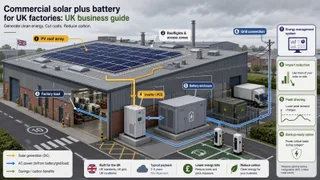
Commercial rooftop solar for UK offices often lines up with weekday occupation, so storage is not automatic just because an office roof can take modules. It earns a place if an evening residual, an export cap or a real peak charge remains after the array is modelled. A warehouse with process load through the day may self-consume more of its generation. Commercial solar panel cost for UK warehouses still has to be built from structure, access, usable area and connection. It cannot be inferred from a battery rate, and this guide does not state one. Where the array is still being chosen, start with a commercial solar comparison that treats layout, roof and connection as one decision, rather than adding storage to an unfixed solar guess. How the battery couples to the array should be visible on the single-line diagram. A shared inverter and a separate conversion stage imply different losses, different cable routes and sometimes a different connection application. Leaving that as a single word on the cover of the quote is how two apparently similar bids describe different plants.
What does the network connection change?
In Great Britain, export-capable solar and storage are taken to the host distribution network operator, and G99 is the recommendation businesses hear. Export limitation is sometimes part of the same discussion. Northern Ireland has a different network operator and a different process. Forms, thresholds and timescales are not uniform. They must not be copied from a domestic solar guide, and this article does not state a power threshold. Whether a battery that does not export still has to be notified is a question for the host operator on that site.
A commercial solar G99 DNO connection is part of the storage decision, not a form to file after the equipment is ordered. Co-located solar and storage are often one connection study. Adding a battery to an existing array, changing the inverter, or allowing the battery to charge from the grid can be treated as a different proposal. In a constrained area the offer can be delayed or capped. That cap can remove the charge and discharge pattern the savings model assumed, so the case has to be rerun rather than merely postponed.
On higher-voltage sites the storage may sit on the low-voltage side of the customer's transformer, or it may need its own interface. That choice affects protection, metering and who does the jointing. The cable route from roof array to battery to main intake can dominate both cost and programme, especially where the yard, the intake room and the plant location were never planned as one route. Spare ways on the switchboard, metering space and a safe isolation point are survey items, not details to discover on the week of delivery.
Why is there no national price for a commercial battery?
Installed cost, a rate per kilowatt-hour, payback and bill reduction are not figures this guide can state. They move with the power-to-energy ratio, indoor cabinets versus an outdoor container, groundworks, switchgear, trenching, operator works and whether solar sits in the same contract. A domestic price per kilowatt-hour is not a commercial budget. A brochure number is unusable until the scope, the date and the exclusions are written down.
Read any quote as four layers: equipment, installation, distribution network operator works, and operating cost. Exclusions that often arrive late include the base and barriers, intake alterations, planning costs, fire-related building work, and reinforcement the operator has not yet priced. Two systems with the same energy rating can be different projects. On a larger system, monitoring, spares and a stated response time are part of the cost. If they are missing, the savings model is incomplete.
Tax treatment is not a reason to stretch the technical case. VAT, capital allowances and business rates need an accountant or a cited official position. Discussions of domestic zero-rating do not transfer automatically to a business installation. If public funding exists for this technology in that nation, it has to be read from a current official source. It is not assumed here, and an old project sheet is not evidence that it still applies.
How should commercial battery quotes be compared?
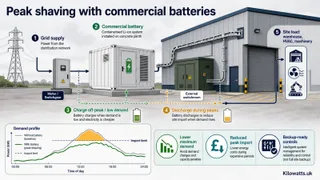
Quotes are comparable only when they describe the same duty, the same site data and the same inclusions. A lower headline rate can hide a smaller power rating, no islanding, no base, and a connection that has not been applied for. A payback copied from another sector is not evidence for this site. Annual consumption alone cannot show a peak-shaving saving, because that saving exists only if the contract prices the peak the battery can actually cut. Larger UK supplies are often half-hourly metered. Bills may include time-varying unit rates, standing charges, and charges linked to agreed import capacity or network use. Those elements differ by supplier, region and voltage. Older guides that present storage as a way to avoid triad-style network charges need checking against the present contract. Charging arrangements have changed, and not every supply still has a charge that a short discharge can avoid. Peak-shaving value is tariff-specific.
Overview
Use that order as a reading check, not as a score. If duty, connection and operating life are missing, the remaining numbers are not ready to compare. If the operator later caps export or import, ask for the model to be rerun. A capped pattern is a different project.
What can stop a scheme that looks fine on a drawing?
The equipment has to fit the site before the electrical design is worth refining. A container needs space, a suitable base, a cable route and access for delivery and later replacement. An indoor system needs a room that can meet fire, ventilation and structural requirements. Those requirements are not a domestic method statement scaled up. Fire separation should come from cited guidance and the insurer for that scheme, not from a rule of thumb. This article does not give a setback distance.
Planning is not covered by the permitted-development assumptions people use for household equipment. The route is not identical in England, Scotland, Wales and Northern Ireland. A yard container, a plant-room cabinet and roof-mounted equipment can each be treated differently. Confirm the position for that nation and that layout before the programme assumes consent is unnecessary. A fire risk assessment, the insurer's conditions and, on some larger schemes, environmental controls sit beside the electrical design. Insurance conditions can move the layout after the single-line diagram looks finished. Household wall batteries being familiar does not make commercial fire risk negligible, and it is not a reason to invent incident rates either.
On offices, retail parks and tenanted warehouses, landlord consent, lease length and who holds the meter can stop a technically sound scheme. A tenant should not assume a right to alter the intake, the roof or the yard. If the landlord is the electricity customer, the tenant may not be the party who can agree the connection or capture the bill effect. Reinstatement, and who removes the equipment at the end of the lease, belong in the same conversation as the warranty. Access for maintenance is worthless if the occupier does not actually hold that right.
What should the sizing model contain?
Sizing starts from half-hourly or finer import data, and from export data where solar is already metered. Annual kilowatt-hours hide the shape the battery has to follow. The useful inputs are how high the peaks are, how long they last, how often they occur, the solar shape across the year, and the agreed supply capacity. Without interval data, a size is a guess. A supplier download or a temporary logger is a reasonable step before anyone is asked to stand behind a saving.
The balance of plant is where these jobs leave domestic practice. Expect a power-conversion system, protection, metering and a monitoring link, and often a container, barriers and a base. Motor starts, power factor and harmonic limits can exclude some loads or force different power electronics. Existing power-factor correction should be on the drawing, because it can interact with the new conversion equipment. Clients rarely see the warranty envelope at quote stage. Allowed state of charge, temperature limits, annual throughput, and who monitors the system and applies firmware all change what the battery is allowed to do. Degradation is expected. A warranty that mixes years, cycle counts and retained capacity is not the same thing as field life under the site's duty and temperature.
A model that ignores round-trip losses, standing losses and degradation overstates value. An aggregator window can clash with on-site peak shaving, because the battery cannot be fully available to both duties at once. If external revenue is part of the story, both duties belong in one model, with the eligibility rules attached. Capacity Market or balancing-service income should stay out of the case until those rules are confirmed. Module replacement, augmentation and end-of-life removal need a contract, including access if the plant stands on a landlord's land. Whether MCS, or another scheme, is relevant at the proposed size should be checked. Domestic certification practice does not define commercial storage quality, and the lack of a household certificate does not by itself set the standard the contract should use.
What should you confirm before you commit?
The decision should reduce to a short set of written answers. If those answers are still open, the quote is not ready to accept, even when the equipment list looks complete. The point is to put duty, data, connection and operating responsibility in the same document, so bidders can be compared on the project rather than on a headline rate.
Interval import, and export if solar is already on the meter, will change the next meeting more than another brochure. Confirm who the electricity customer is, how long the occupier can rely on the site, and whether the landlord has been asked. Then put the technical questions in writing.
If the replies show that the network, the lease or the tariff cannot support the modelled pattern, the honest outcome may be a smaller battery, solar without storage, or no project yet. That is cheaper than installing a system whose savings depended on a connection or a charge the site does not have.
Plan, Compare & Buy Renewable Energy Solutions
AI does the thinking.
You get the perfect solar match.
Use RoboMo™ to assess your property, compare available technologies and connect with trusted UK installers, suppliers and manufacturers.
Simply enter your postcode, drop a pin on your roof, create your free account and let RoboMo™ analyse your property to find the best solar panels for your home.

You don't have to think
RoboMo™'s AI analyses your roof and does all the hard work.

Accurate & tailored
AI-powered assessment based on your roof, location, and conditions.

Best options, maximum savings
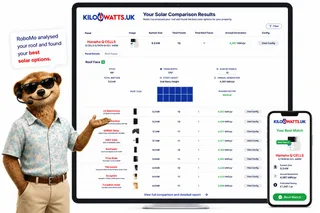
Compare top solar panels for the best performance and value.

Simple, fast & effortless
Provide a few details, sit back and watch your results unfold.
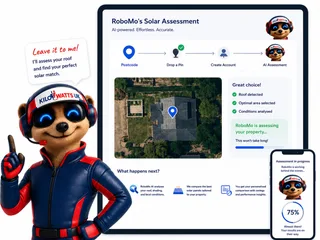
STEP 1
Choose Home, Business or Industrial
Enter your postcode to start your assessment.
STEP 2

Drop a pin on your roof
STEP 3

Create your free account
STEP 4

Sit back and watch RoboMo™ work
RoboMo™ analyses your roof and builds your personalised solar comparison.

Kilowatts UK is an authorised representative
Flower Turbines
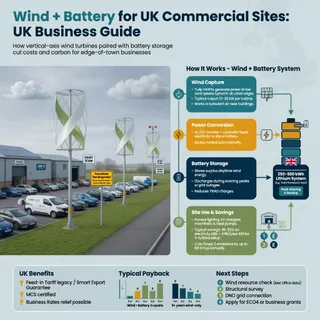
Compact vertical-axis turbines built for real UK sites, not just open farmland.
They start in light wind, sit in a small footprint, and are bird-safe by design. Cluster them as a bouquet and the group performs better together than the same turbines standing alone. Enter your postcode for a location-based generation estimate. Figures use area weather data and will differ if buildings, trees or hills sit in the way.
Starts in light UK wind
Built to generate in typical UK wind, not only open farmland.
Small rooftop or ground footprint
Compact towers for roofs, yards and tight sites.
Bird-safe slow rotation
Slow vertical-axis spin, bird-safe by design.
Bouquet clusters raise output
Grouped turbines outperform the same units standing alone.
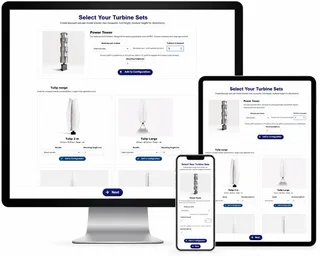
Step 1
Enter your postcode
Start designing your wind energy system in seconds.

STEP 2

Choose a location
STEP 3

Place your cluster
Tap the map where you want the turbine cluster to go.
STEP 4

Instant generation forecasts
Compare different turbine layouts and see annual generation forecasts instantly.
STEP 5

No commitment required
Explore different configurations before deciding whether to request a quotation.
Related articles
Mo's Mission Nominations
FAQ
Need Help? RoboMo's Got Answers
What is commercial battery storage, and does it take a site off the grid?
Commercial battery storage is a fixed system on the customer side of the meter. It stores electricity in kilowatt-hours and charges or discharges at a power rating in kilowatts. It does not generate power, and it does not by itself take a site off the grid. Most new commercial systems use lithium iron phosphate cells in cabinets or outdoor containers, with an inverter, controls, protection and switchgear.
When is a commercial battery a plausible buy?
Storage is more plausible where generation and demand do not line up, where the tariff rewards shifting or peak reduction, where an export limit would otherwise clip solar, or where resilience has been specified as its own requirement. It is a weak fit for very low users, flat tariffs with no capacity-related charge the battery can cut, and sites with nowhere lawful to put the equipment. A short lease, a connection that cannot accept the intended pattern in time, or unverified flexibility-market income can also undermine the case. The result is set by that site, not by a national average.
What do kilowatts and kilowatt-hours each decide?
Kilowatts describe how fast the system can charge or discharge. Kilowatt-hours describe how long that rate can be sustained. A high power rating with little stored energy can miss long peaks, while a large energy rating with too little power can sit idle during short spikes. Neither figure means the site stays on during a power cut. There is no meaningful typical size without a sector and a load shape, and domestic units are the wrong comparison.
Does a business need solar before it adds storage?
No. A battery can charge from the grid, if the connection allows it, and discharge to offset import. Solar is not a technical prerequisite, and a battery does not increase annual solar output. It only shifts the time of use, and that shift is not free of losses because round-trip efficiency is below 100%. A grid-only battery has to justify itself from the tariff and from any external service that has actually been confirmed.
Will a commercial battery keep circuits alive in a power cut?
Only if backup has been specified as its own requirement. A system bought only to manage bills may shut down when the grid does. Islanding means disconnecting selected circuits from the grid and supplying them from the battery, and the design has to state which circuits remain live, what they draw and for how long. Fridges, servers or a process line are not covered by a battery quoted only for solar self-consumption. If a generator is meant to support the same circuits, the two sources need a coordination note.
What does the network connection change?
In Great Britain, export-capable solar and storage are taken to the host distribution network operator, and G99 is the recommendation businesses hear. Northern Ireland has a different operator and process, and forms, thresholds and timescales must not be copied from a domestic guide. A later cap on export or import can remove the pattern a savings model assumed, so the case has to be rerun rather than merely postponed. Whether a battery that does not export still has to be notified is a question for the host operator on that site.
Why is there no national price for a commercial battery?
Installed cost, a rate per kilowatt-hour, payback and bill reduction are not figures this guide can state. They move with the power-to-energy ratio, indoor cabinets versus an outdoor container, groundworks, switchgear, trenching, operator works and whether solar sits in the same contract. A domestic price per kilowatt-hour is not a commercial budget. Read any quote as equipment, installation, distribution network operator works and operating cost, including exclusions such as the base, intake alterations and reinforcement that has not yet been priced.
What can stop a scheme that looks fine on a drawing?
The equipment has to fit the site before the electrical design is worth refining. A container needs space, a suitable base, a cable route and access for delivery and later replacement, and an indoor system needs a room that can meet fire, ventilation and structural requirements. Those requirements should come from cited guidance and the insurer for that scheme, not from a domestic method statement. Planning is not covered by the permitted-development assumptions used for household equipment, and the route is not identical in England, Scotland, Wales and Northern Ireland.