


Peak shaving with commercial batteries: UK business guide
Published: 2026-09-28 21:38:23
Updated: 2026-09-29 23:51:59
See when peak shaving with commercial batteries can cut UK capacity and excess charges, and why kVA, half-hourly data and reserve energy decide the result.
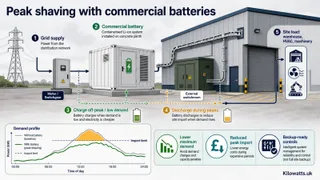
Peak shaving with commercial batteries - UK business guide
UK business guide B Solar MD charges and peak shaving
Can a commercial battery cut the import peak?
Peak shaving with commercial batteries is a controlled discharge of on-site storage so that power imported from the grid stays under a set threshold during the highest-demand periods. It targets the peak, in kilowatts and often in kilovolt-amperes, not energy stored for its own sake. It only changes a bill if the site is settled on half-hourly data, the contract prices that demand or capacity, the battery can cover both the height and the length of the excess, and the business that pays the network charge is the one that benefits.
The battery sits behind the meter and covers the slice of site load above the cap for as long as its state of charge and power rating allow. If it is empty, limited by temperature, or offline, import rises again and any excess-capacity charge can still apply. Export income is a different mechanism from a lower import peak. A battery in front of the meter does not reduce that site's own import.
In practice the first documents to read are the MPAN, a year of half-hourly import, the supply contract, and the agreed import capacity. Floor area and annual spend do not tell you whether the supply is half-hourly, or whether a short spike is even priced. A non-half-hourly supply, or a fixed contract that does not pass distribution charges through, may show no saving until renewal.
Which parts of the bill can move
On many half-hourly UK business bills, energy charges sit apart from network charges. Peak shaving is aimed at the network side: distribution use-of-system time bands, the charge for agreed import capacity, and any excess-capacity charge if the site goes over that limit. Transmission charges may also appear. The exact names vary by supplier. Maximum demand describes the peak. It is not a single national tariff.
Distribution charges are regional. Red, amber, and green periods, capacity charges, and excess-capacity arrangements differ by distribution network operator and by connection voltage. A low-voltage warehouse and a higher-voltage factory are not the same study, even when the load shape looks similar. Read the supplier's invoice and the network operator's charging method together before anyone chooses a cap. The bill layout may not match the way excess capacity is measured.
Ofgem's Targeted Charging Review moved a large part of residual network charging away from the old triad-style peak signal and towards fixed charges. That weakened triad avoidance for many demand customers. Some time-of-use network signals remain. Take them from the current charging statement for that network and voltage, not from an older project model. Nothing in a battery quote recreates a retired charging signal.
How power, energy, and kVA are sized apart
The kilowatts required are set by how far the peak sits above the chosen cap. The kilowatt-hours required are set by how long that excess lasts, plus conversion losses and any reserve you refuse to spend. Matching the inverter nameplate to the height of a spike is not enough. State of charge, temperature, warranty power limits, and other site loads decide whether the cap still holds at the moment that matters.
Kilowatts are not kilovolt-amperes. Agreed import capacity is often a network limit in kVA. A poor power factor can leave kVA high after the kilowatt peak has been cut, so the capacity or excess charge may barely move. Not every inverter will correct power factor. Reactive power, harmonics, earthing, and switchgear fault rating need a proper electrical check, not a software setpoint.
Round-trip losses mean more energy is imported to charge the battery than is later discharged. Outdoor plant in a UK winter may also use parasitic heating. Equipment life and efficiency are product-specific. Warranties are usually tied to years, cycles, or throughput. A peak-shaving duty is not the same as a full cycle every day. Use the proposed equipment data. There is no safe national figure for installed cost, annual saving, or payback. Each depends on the half-hourly profile, the network region, the voltage, the contract, and the shape of the peak.
Why one battery cannot do every job at once
Peak shaving is not time-shifting, price arbitrage, or backup. Time-shifting moves a block of use from one period to another. Arbitrage charges when electricity is cheap and discharges when it is expensive. Backup is energy held for an outage. One battery can be configured for more than one of these, but each duty needs its own reserve of energy and its own control rule. Energy reserved so the site peak can be covered cannot be assumed free for a grid service at the same time. The useful comparison is what has to be kept back, not which product name is on the enclosure.
Overview
If the control strategy is not written down, the battery will follow whichever objective was commissioned last. That is a common reason a system charges through the peak it was bought to cut, or arrives at the peak already empty because an earlier service call used the same kilowatt-hours.
How the peak shape decides the storage
A process spike, a building-services peak, and coincident tenant load do not need the same storage. Warehouses often see short, sharp demand from plant starts, dock equipment, or a shift change. Offices more often see a building-services rise that can last through the morning. Retail parks and shops can see several units peaking together, especially where landlord and tenant supplies are not the same meter. Annual kilowatt-hours describe none of this. They do not give the height of the peak, or how long it stays above a cap.
A short excess can be a power problem with a modest energy requirement, provided the interval data actually shows it. Settlement is half-hourly, so a spike shorter than that interval can be missing from the billing file even when it stresses switchgear or a local limit. A long plateau is the opposite problem. The power gap may be moderate, but the energy required grows for every half hour the load stays above the cap, and losses add to that. A flat site, or a bill that is mostly unit rate and standing charge, has little network peak for a battery to remove.
New load changes the test. Electric vehicle chargers, electrified heat, or an extra shift can push a site through its agreed import capacity or towards reinforcement. Storage can be relevant there, but only if the design still leaves a credible path for cold starts and for days when the battery is unavailable. Holding import down on paper, then removing the headroom, is how a later operational change becomes an excess-capacity charge.
Where solar helps, and where it does not
Rooftop solar lowers daytime import while it is generating. It does not cap a winter morning peak, an evening process run, or a cloudy-day spike unless something else covers that interval. Treating solar yield as a peak-shaving control is a category error. PV output follows weather and the array, not the site's maximum demand. The question of whether rooftop generation is a better fit than buying every unit from the grid is a separate study from setting a battery threshold.
Where both are proposed, keep two sizing logics. One is array yield, self-consumption, and the generation connection. The other is peak height and duration. A battery that can export is normally taken through the distribution network operator's generation connection process, commonly G99 for commercial plant. Import-only charging can still affect the network. The correct notification route has to be confirmed for the site. Do not assume a domestic threshold applies. Do not treat an export limit as a setting someone can change after commissioning without agreement.
Shared inverters and a single curtailment order need to be written down. If solar export is limited first, or the battery is told to charge from PV during the site peak, one objective silently cancels the other. Panel cost, battery cost, and any effect on business rates or tax relief are site-specific. Take them from current quotes and current guidance. None of those figures can be borrowed from a national average, and no grant should be assumed.
What happens if agreed capacity is reduced
Agreed import capacity is a network limit, not a number the business can rewrite on the invoice. Holding import under a lower level can support a request to reduce that capacity, which may cut ongoing capacity charges. It also removes headroom for cold starts, extra shifts, vehicle charging, or a battery that is empty or offline. The fail-safe case is the design case. If the store cannot discharge, the site still has to live with the cap or take the excess charge.
Export limitation and any import limit have to be agreed and commissioned, not left as a laptop setting. Connection, planning, and fire strategy can dominate the programme. The rules differ by nation, capacity, and insurer. There is no single permitted-development answer to quote here. Spacing and rates treatment should be checked rather than assumed. Reducing capacity after commissioning should wait until a full seasonal cycle shows the cap holds, including a winter period if outdoor plant uses heating or if the peak is a heating load.
The controller needs a trustworthy site-load signal. Current-transformer placement, unmetered existing generation, and a gap between the battery meter and the settlement meter are common reasons a system misses the peak. The network operator's method for capacity may also differ from the supplier's bill presentation. Those two documents, plus the single-line diagram, should agree before the threshold is fixed.
Where peak shaving with commercial batteries UK sites usually fails
The case is weak where demand is flat, where the bill is mostly unit rate and standing charge, or where the peak lasts longer than a realistic battery can cover at the required power. It is also weak if there is no year of interval data, no room for plant, or an expectation that storage will recreate triad-era savings. Landlord and tenant supplies often fail a simpler test. The party that pays the capacity charge is not the party that would own the battery, so the saving does not land where the investment does.
A usable design starts from the interval file, the contract, and the maximum import capacity, not from an annual total and not from a solar layout. Ask whoever is modelling the site to show the cap on the half-hourly profile, the state of charge at the start of each peak, and what the import does if the battery is unavailable. Ask which bill lines are assumed to move, and whether that assumption survives until the current contract ends.
Before a threshold is chosen, the pack of evidence is short and specific.
If those five items are missing, a kilowatt-hour price for storage is not yet a business case. Model the saving from this site's own half-hourly data and its own contract. Treat warranty terms, round-trip losses, and fire and insurance conditions as part of that model, not as footnotes added after the order.
Plan, Compare & Buy Renewable Energy Solutions
AI does the thinking.
You get the perfect solar match.
Use RoboMo™ to assess your property, compare available technologies and connect with trusted UK installers, suppliers and manufacturers.
Simply enter your postcode, drop a pin on your roof, create your free account and let RoboMo™ analyse your property to find the best solar panels for your home.

You don't have to think
RoboMo™'s AI analyses your roof and does all the hard work.

Accurate & tailored
AI-powered assessment based on your roof, location, and conditions.

Best options, maximum savings
Compare top solar panels for the best performance and value.

Simple, fast & effortless
Provide a few details, sit back and watch your results unfold.

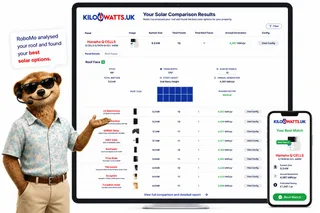
STEP 1
Choose Home, Business or Industrial
Enter your postcode to start your assessment.
STEP 2

Drop a pin on your roof
STEP 3

Create your free account
STEP 4

Sit back and watch RoboMo™ work
RoboMo™ analyses your roof and builds your personalised solar comparison.

Kilowatts UK is an authorised representative
Flower Turbines
Compact vertical-axis turbines built for real UK sites, not just open farmland.
They start in light wind, sit in a small footprint, and are bird-safe by design. Cluster them as a bouquet and the group performs better together than the same turbines standing alone. Enter your postcode for a location-based generation estimate. Figures use area weather data and will differ if buildings, trees or hills sit in the way.
Starts in light UK wind
Built to generate in typical UK wind, not only open farmland.
Small rooftop or ground footprint
Compact towers for roofs, yards and tight sites.
Bird-safe slow rotation
Slow vertical-axis spin, bird-safe by design.
Bouquet clusters raise output
Grouped turbines outperform the same units standing alone.
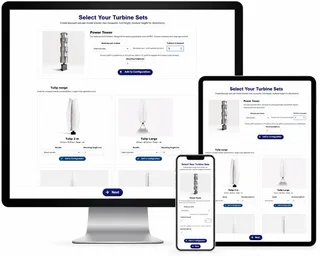
Step 1
Enter your postcode
Start designing your wind energy system in seconds.
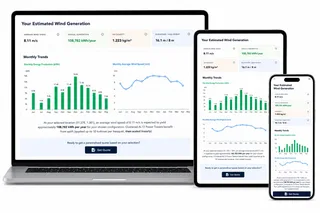
STEP 2

Choose a location
STEP 3

Place your cluster
Tap the map where you want the turbine cluster to go.
STEP 4

Instant generation forecasts
Compare different turbine layouts and see annual generation forecasts instantly.
STEP 5

No commitment required
Explore different configurations before deciding whether to request a quotation.
Related articles
Mo's Mission Nominations
FAQ
Need Help? RoboMo's Got Answers
Can a commercial battery cut a site's import peak?
Peak shaving is a controlled discharge of on-site storage so that power imported from the grid stays under a set threshold during the highest-demand periods. It targets the peak, in kilowatts and often in kilovolt-amperes, rather than energy stored for its own sake. It only changes a bill if the site is settled on half-hourly data, the contract prices that demand or capacity, and the battery can cover both the height and the length of the excess. If the battery is empty, limited by temperature, or offline, import rises again. A battery in front of the meter does not reduce that site's own import.
Which parts of a UK business electricity bill can peak shaving affect?
On many half-hourly bills, energy charges sit apart from network charges, and peak shaving is aimed at the network side. That can include time-banded distribution charges, the charge for agreed import capacity, and any excess-capacity charge if the site goes over its limit. Transmission charges may also appear, but the exact names vary by supplier. Distribution charges are regional and differ by network operator and connection voltage, so the invoice and the current charging statement should be read together. A non-half-hourly supply, or a fixed contract that does not pass those charges through, may show no saving until renewal.
Does peak shaving still avoid triad charges?
Ofgem's Targeted Charging Review moved a large part of residual network charging away from the old triad-style peak signal and towards fixed charges. That weakened triad avoidance for many demand customers. Some time-of-use network signals remain, but they should be taken from the current charging statement for that network and voltage, not from an older project model. Nothing in a battery quote recreates a retired charging signal.
How should kilowatts, kilowatt-hours, and kVA be sized?
The kilowatts required depend on how far the peak sits above the chosen cap. The kilowatt-hours required depend on how long that excess lasts, plus conversion losses and any reserve you will not spend. Matching the inverter nameplate to the height of a spike is not enough, because state of charge, temperature, warranty limits, and other site loads decide whether the cap still holds. Agreed import capacity is often a network limit in kVA, so a poor power factor can leave that charge barely changed after the kilowatt peak has been cut. There is no safe national figure for installed cost, annual saving, or payback.
Can one battery also do backup, time-shifting, and price arbitrage?
Peak shaving is not the same as moving a block of use between periods, charging when electricity is cheap and discharging when it is dear, or holding energy for an outage. One battery can be set up for more than one of these, but each duty needs its own energy reserve and its own control rule. Energy kept back so the site peak can be covered cannot be assumed free for another service at the same time. If the strategy is not written down, the battery may charge through the peak it was bought to cut, or arrive at that peak already empty.
Will rooftop solar cover the peak without a battery?
Rooftop solar lowers daytime import while it is generating. It does not cap a winter morning peak, an evening process run, or a cloudy-day spike unless something else covers that interval. Array yield and peak height should be sized as two separate studies. Where both are proposed, the control order has to be written down so that charging from solar, or an export limit, does not cancel the import cap. A battery that can export is normally taken through the distribution network operator's generation connection process, and a domestic threshold should not be assumed.
Can agreed import capacity be reduced after a battery is installed?
Agreed import capacity is a network limit, not a figure the business can rewrite on the invoice. Holding import under a lower level can support a request to reduce that capacity, which may cut ongoing capacity charges, but it also removes headroom for cold starts, extra shifts, vehicle charging, or a battery that is empty or offline. Any import or export limit has to be agreed and commissioned, not left as a laptop setting. Reducing capacity should wait until a full seasonal cycle shows the cap holds, including winter if outdoor plant uses heating or the peak is a heating load. Connection, planning, and fire strategy differ by nation, capacity, and insurer, and there is no single permitted-development answer.
When is commercial peak shaving a weak fit?
The case is weak where demand is flat, where the bill is mostly unit rate and standing charge, or where the peak lasts longer than a realistic battery can cover at the required power. It is also weak without a year of half-hourly import, without room for plant, or where the party that pays the capacity charge would not own the battery. A short spike can be missing from half-hourly settlement data even when it stresses switchgear. No grant should be assumed. Model any saving from this site's own interval data and contract, and treat losses, warranty limits, and fire and insurance conditions as part of that model.