


Renewable energy uk: what UK buyers should know
Published: 2026-09-27 21:39:02
Updated: 2026-09-27 14:40:57
Singapore’s printed zinc paper battery is laboratory research, not a UK solar battery you can buy for home energy storage today.
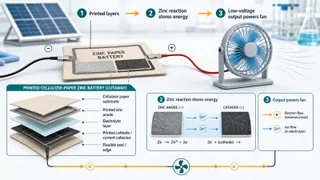
Singapore’s printed cellulose-paper zinc battery
How renewable energy work, typical output, costs and limits, and whether they have a future for UK homes, balconies and businesses.
Singapore’s printed zinc paper battery in plain terms
Singapore’s printed zinc paper battery is laboratory research, not a UK solar battery you can buy for home energy storage today. NTU Singapore demonstrated a small printed battery on hydrogel-reinforced cellulose paper, using zinc-based anode ink and manganese- or nickel-based cathode ink. The main limits are scale, tested performance, certification, warranty evidence and inverter compatibility.
The work matters because it points towards thinner, lighter and potentially lower-impact batteries for small electronics. It should not be read as proof that paper batteries can already replace lithium home batteries, EV batteries or commercial battery storage systems.
A common confusion is worth clearing up. This was not an ordinary sheet of paper that somehow became a household battery. The cellulose paper was engineered and reinforced, then used as part of a printed electrochemical device.
Key facts from the NTU demonstration
The best way to assess this technology is to separate what was demonstrated from what would be needed for a product. NTU’s November 2021 announcement described a small printed battery made using hydrogel-reinforced cellulose paper, with battery inks printed onto opposite sides.
The widely cited demonstration was a 4 cm × 4 cm prototype powering a small electric fan for at least 45 minutes. That is a valid proof-of-concept demonstration for low-power electronics, but it is not a specification for household energy storage. NTU also reported that the spent battery broke down in soil within a month.
These facts explain why the research attracted attention. They are not enough to make procurement decisions for a home, business, solar PV system or grid-connected storage project.
Sources and evidence to check
The core evidence trail is NTU Singapore’s 2021 public announcement, the associated peer-reviewed research paper, and later patent-publication records for related paper-battery and separator technology. Those sources should be checked directly when making technical claims, because press coverage often compresses the difference between a lab demonstration, a material result and a commercial product.
This article does not rely on claims about UK retail availability, grant eligibility, installed performance or payback. Those would need current product documentation, installer guidance, warranty terms and UK market evidence.
The safest approach is to quote only what the source proves. If a public article says “paper battery”, that does not automatically mean every component is paper, biodegradable, rechargeable, certified or commercially available.
How the printed zinc paper battery was made
The NTU design used hydrogel-reinforced cellulose paper as the flexible base of the cell. Functional battery inks were printed on opposite sides: a zinc-based anode ink on one side and a manganese- or nickel-based cathode ink on the other. In practical terms, the paper was part of the device architecture rather than simple outer packaging.
That makes the concept different from a conventional cylindrical, prismatic or pouch battery, where active materials are assembled with separators, current collectors and casings in a more rigid format. Printed batteries are interesting because they can potentially be thin, flexible and integrated into small devices where space and disposal impact matter.
For UK energy users, the manufacturing concept is not the same as being ready to install. A research cell can prove a chemistry or structure without proving long-term cycling, product safety documentation, transport classification, storage stability, warranty terms or compatibility with solar inverters.
What the biodegradability claim does and does not prove
NTU reported that the spent battery broke down in soil within a month. That is an important research claim, but it needs careful wording. The public claim should not be expanded into “the whole battery has zero environmental impact” unless each material, by-product and test condition supports that conclusion.
Batteries are chemical systems. Even if a substrate biodegrades, the full environmental picture also depends on electrode materials, manufacturing energy, electrolyte behaviour, packaging, transport, storage, use conditions and disposal routes.
For a UK buyer, biodegradability should be treated as a promising research direction rather than a finished waste-management answer.
Technical limitations that matter
The public demonstration gives useful headline information, but it does not provide the same type of technical evidence that a UK installer, designer or specifier would need for an energy system. The known public figures include the 4 cm × 4 cm prototype and the small-fan demonstration lasting at least 45 minutes. Those figures do not translate into household usable capacity.
Important technical questions remain either application-specific or not ready for procurement from the public information alone. These include available voltage under different loads, areal capacity, charge and discharge rates, cycle life, self-discharge, operating temperature range, short-circuit behaviour, storage stability and safety testing.
For installed battery systems, the datasheet is only the start. A specifier also needs the installation manual, inverter compatibility information, warranty terms, electrical protection requirements, commissioning procedure and evidence that the product is suitable for the intended country and application. The NTU printed zinc paper battery should not be judged as a failed home battery. It should be judged as early-stage research aimed at different possible uses.
Why this is not a UK solar battery today
This technology is not a current substitute for a domestic solar battery in the UK. A home battery must store meaningful energy, charge and discharge predictably, communicate with an inverter or battery inverter, operate safely indoors or outdoors as specified, and be backed by installation documentation and warranty support. For solar PV and commercial storage projects, practical decisions usually involve usable capacity in kWh, power output in kW, depth of discharge, round-trip efficiency, temperature limits, warranty conditions, fault handling and connection arrangements with the local Distribution Network Operator where required. The NTU fan demonstration does not establish those points.
Overview
The likely near-term relevance is small electronics, sensing, printed circuits and specialist devices, not whole-home energy storage.
Common mistakes when reading paper battery claims
The first mistake is assuming that “paper battery” means the device is made only from ordinary paper. In this case, the paper was hydrogel-reinforced and combined with printed battery materials. That is materially different from a simple biodegradable sheet.
The second mistake is scaling the demonstration too far. A small fan running from a 4 cm × 4 cm prototype is a useful laboratory demonstration, but it does not show suitability for evening solar self-consumption, backup power, heating loads, EV charging or commercial demand management.
Several checks help keep the claim in proportion before comparing it with UK renewable-energy products.
Those checks mirror how real projects are assessed. Interesting chemistry is only one part of a safe, documented and maintainable electrical system.
Patent status and commercial ownership
Based on the source trail considered for this article, the specific 2021 NTU printed zinc paper battery study should not be described as having a confirmed granted patent unless a direct patent record supports that exact claim. Scientific authorship, commercial development, patent applications and product ownership are separate matters.
A later related patent application, US20250219246A1, concerns a hydrogel-reinforced cellulose-paper battery separator and paper battery. It is listed as pending and names Madebyflint Pte Ltd as assignee and Carlo Emmanuel Charles as inventor. That makes it relevant to the wider technology area, but it should not be presented as NTU’s granted patent for the original 2021 research.
This distinction matters because inaccurate ownership claims can mislead readers about maturity, exclusivity and commercial availability. A company may be inspired by a university paper or work on related technology without that proving ownership of the original academic result.
Where the technology could fit in the wider energy picture
The strongest current relevance is materials innovation. Renewable energy systems depend on storage and sensing at many scales, from grid-level batteries down to tiny devices used to monitor buildings, equipment, temperature, weather and distributed assets. A thin printed battery with a lower-impact substrate could be valuable at the small-device end if future testing proves performance and disposal benefits.
For UK homes and businesses, procurement decisions remain much more practical. If the aim is to store solar electricity today, the discussion should focus on established battery systems, usable capacity, inverter compatibility, installation environment, warranty terms, safety documentation and DNO requirements where applicable. This can also overlap with smart energy management where homes or businesses want better visibility and control over generation, storage and use.
The NTU work is still worth following because it shows how battery design can move beyond rigid formats. The honest conclusion is that Singapore’s printed zinc paper battery is a promising research direction, not a current UK installation option.
What UK readers should do next
Treat printed zinc paper batteries as an emerging battery-materials story rather than a buying recommendation. The available evidence does not support claims about UK retail pricing, grants, installed payback, product lifespan, home-solar compatibility or commercial grid-connection suitability.
If you are evaluating a research battery, ask what was demonstrated, under what test conditions, and what remains unproven. If you are evaluating an installed battery system, ask for the datasheet, installation manual, warranty, safety documentation, inverter compatibility information and any grid-connection requirements that apply to the project.
The practical takeaway is simple. Do not dismiss the NTU work, but do not confuse it with a ready-made UK solar battery. It is a useful signpost towards more sustainable small batteries, while today’s renewable-energy projects still need proven, documented and installable storage equipment. If your next step is solar rather than research batteries, you can compare home solar options or book a free survey to discuss a practical installation.
Plan, Compare & Buy Renewable Energy Solutions
AI does the thinking.
You get the perfect solar match.
Use RoboMo™ to assess your property, compare available technologies and connect with trusted UK installers, suppliers and manufacturers.
Simply enter your postcode, drop a pin on your roof, create your free account and let RoboMo™ analyse your property to find the best solar panels for your home.

You don't have to think
RoboMo™'s AI analyses your roof and does all the hard work.

Accurate & tailored
AI-powered assessment based on your roof, location, and conditions.

Best options, maximum savings
Compare top solar panels for the best performance and value.

Simple, fast & effortless
Provide a few details, sit back and watch your results unfold.
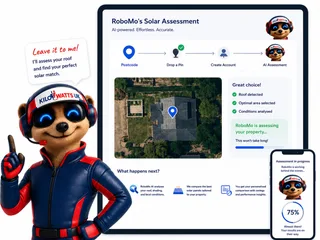
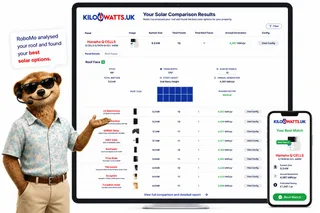
STEP 1
Choose Home, Business or Industrial
Enter your postcode to start your assessment.
STEP 2

Drop a pin on your roof
STEP 3

Create your free account
STEP 4

Sit back and watch RoboMo™ work
RoboMo™ analyses your roof and builds your personalised solar comparison.
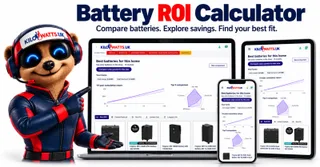
BATTERY ROI TOOL
See what a battery saves on your bill
Enter the day rate, off-peak rate and export rate. The calculator ranks batteries in the Kilowatts shop over 10 years.
Home batteries also suit offices and small commercial sites. Industrial batteries are listed on their own calculator.

Step 1
Enter your postcode
Start designing your wind energy system in seconds.
Are you an installer, distributor or renewable energy business?
Kilowatts UK is expanding the Flower Turbines partner network across the UK.
Become A Flower Turbines PartnerKilowatts UK is an authorised representative
Flower Turbines
Compact vertical-axis turbines built for real UK sites, not just open farmland.
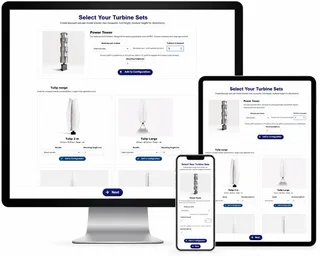
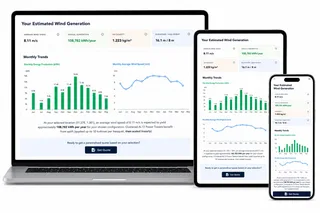
They start in light wind, sit in a small footprint, and are bird-safe by design. Cluster them as a bouquet and the group performs better together than the same turbines standing alone. Enter your postcode for a location-based generation estimate. Figures use area weather data and will differ if buildings, trees or hills sit in the way.
Starts in light UK wind
Built to generate in typical UK wind, not only open farmland.
Small rooftop or ground footprint
Compact towers for roofs, yards and tight sites.
Bird-safe slow rotation
Slow vertical-axis spin, bird-safe by design.
Bouquet clusters raise output
Grouped turbines outperform the same units standing alone.
STEP 2

Choose a location
STEP 3

Place your cluster
Tap the map where you want the turbine cluster to go.
STEP 4

Instant generation forecasts
Compare different turbine layouts and see annual generation forecasts instantly.
STEP 5

No commitment required
Explore different configurations before deciding whether to request a quotation.
Related articles
Mo's Mission Nominations
FAQ
Need Help? RoboMo's Got Answers
Can I buy Singapore’s printed zinc paper battery for my UK home solar system?
No. The NTU Singapore printed zinc paper battery is research-stage technology, not a UK home battery product. It has not been shown, from the public information, to offer household-scale capacity, inverter compatibility, installer documentation or warranty support.
What did NTU Singapore actually demonstrate?
NTU reported a small printed battery made on hydrogel-reinforced cellulose paper, with zinc-based anode ink and manganese- or nickel-based cathode ink. A widely cited 4 cm × 4 cm prototype powered a small electric fan for at least 45 minutes. That is a useful laboratory demonstration, but it is not a specification for storing solar electricity in a home.
Is a paper battery made from ordinary paper?
Not in this case. The device used engineered, hydrogel-reinforced cellulose paper as part of the battery structure. It also contained printed electrochemical materials, so it should not be described as just a normal sheet of paper acting as a battery.
Is the battery biodegradable and environmentally harmless?
NTU reported that the spent battery broke down in soil within a month, which is a promising research claim. However, that does not automatically prove zero environmental impact or suitability for every disposal route. A real product would still need clear evidence on all materials, by-products, packaging and end-of-life handling.
Could printed zinc paper batteries replace lithium home batteries?
There is no public evidence that this technology can currently replace established home battery systems. A UK solar battery needs usable kWh capacity, predictable charge and discharge behaviour, safety documentation, inverter integration and warranty terms. The NTU work is better viewed as early research for small, low-power applications.
What might this technology be useful for in future?
Its likely near-term relevance is in small electronics, printed sensors, low-power devices and flexible circuits. Thin printed batteries could be useful where weight, size and disposal impact matter. Larger uses such as home storage, EVs or commercial batteries would need much more evidence.
What should UK buyers check before trusting paper battery claims?
Check whether the source describes a lab cell, a prototype module or a certified product. Look for figures on voltage, capacity, cycle life, safety testing, temperature limits and test conditions. For any installed energy system, also ask for the datasheet, installation manual, warranty and inverter compatibility information.