


Retractable solar awnings: what UK buyers should know
Published: 2026-09-24 08:27:48
Updated: 2026-09-29 11:21:28
How retractable solar awnings work, typical output, costs and limits, and whether they have a future for UK homes, balconies and businesses.
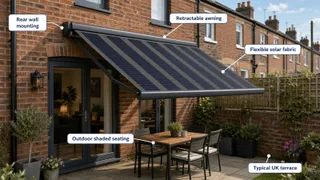
Retractable solar awnings - what UK buyers should know
How retractable solar awnings work, typical output, costs and limits, and whether they have a future for UK homes, balconies and businesses.
Retractable solar awnings in the UK are promising but still niche
Retractable solar awnings can make sense in the UK where a property already needs shade and has no straightforward route for conventional rooftop solar. They are not a like-for-like replacement for roof-mounted PV because output depends on orientation, shading, wind conditions, how often the awning is extended, the electrical connection route and whether the structure can safely support a moving outdoor product.
German company SolarMarkise lists retractable photovoltaic awnings rated at 1.35 kWp (M) and 1.8 kWp (L). These are the peak ratings of the PV material, not promises of continuous electrical output. Actual AC output depends on the specified inverter and connection design. The company also lists shorter M kurz (0.9 kWp) and L kurz (1.2 kWp) versions. It estimates up to 1,200 kWh a year for the M and 1,600 kWh a year for the L under its stated south-facing, unshaded assumptions. Those figures should not be treated as UK generation forecasts: a UK assessment must account for location, shading, inverter capacity and how often the awning is extended.
For UK buyers, the key question is not whether the awning can generate electricity. It is whether the product can be fixed safely, connected legally, kept open when sunlight is useful, serviced over time and supported with documents that satisfy the installer, Distribution Network Operator, insurer, landlord and energy supplier where relevant. UK availability, UK certification, installed price, warranty cover and measured UK performance have not been verified from the public product material.
Quick answer for UK buyers
A retractable solar awning is worth considering if you need shading anyway, have a sunny south-facing or south-west-facing outdoor space, and cannot use a better fixed PV location. It is less likely to be the best option if your main aim is maximum annual generation at the lowest complexity, because a conventional rooftop array or fixed canopy is usually easier to model and keep exposed to daylight.
The main checks are structural, electrical and contractual. The wall and fixings must be suitable for a projecting awning in UK weather, the inverter and wiring must be installed as a proper generating system, and the route for DNO notification or application must be clear before work starts. If export payments matter, do not include them in a quote until the proposed product, installer, certification route and meter have been checked with the tariff provider.
Treat a solar awning as two products in one. It is both a mechanical awning exposed to wind and rain, and a photovoltaic generator connected to the building’s electrical installation.
How a retractable solar awning actually works
A solar awning uses photovoltaic material integrated into the awning surface instead of mounting rigid glass panels on a fixed roof. When the awning is extended, the PV surface receives daylight and sends DC electricity to an inverter, which converts it into AC electricity for use on the property or export to the grid if the system is designed and approved for export.
The moving fabric or membrane is the defining difference. A rooftop array is fixed in place, with cables clipped and protected around a static mounting system. A retractable awning has a roller, articulated arms, hinges, fabric tension, changing cable positions and repeated movement. That creates design questions around strain relief, abrasion, water ingress and long-term durability.
In practice, the awning should be assessed as both a solar generator and a structural shading product. The PV surface has to tolerate UV exposure, rain, dirt, flexing and rolling, while the brackets and wall fixings have to resist the loads created by a projecting awning. Adding PV raises the consequences of poor fixing, poor cable routing or unsuitable siting.
How much electricity could a solar awning generate?
The published SolarMarkise sizes of 1.35 kWp and 1.8 kWp put these products above many very small balcony solar kits but below many UK domestic rooftop PV systems. In bright conditions, a well-positioned 1.8 kWp awning could contribute to daytime loads, but annual generation is likely to be lower than an equivalent fixed array if the awning is often retracted. The manufacturer’s “up to 1,200 kWh” and “up to 1,600 kWh” a year figures are marketing estimates for an unshaded south-facing site, not measured UK yields.
UK solar yield depends on region, orientation, pitch, shading, inverter design and losses. A fixed PV system is easier to model because the panels remain exposed throughout daylight hours. A retractable awning needs an extra assumption that is easy to miss: how often it will actually be open during useful sunlight, including time spent retracted for wind or when the terrace is not in use.
A simple worked comparison is to imagine two 1.8 kWp systems on the same property. The roof array is fixed, unshaded and available whenever daylight reaches it. The awning has the same nameplate rating but is extended only when the terrace is in use and wind conditions allow. Even before considering angle, soiling, inverter capacity or cable losses, the awning misses every useful solar period when it is closed, so its annual kWh cannot be assumed to match the roof array.
A responsible supplier should model the awning separately from any fixed PV option. The assumptions should state orientation, shading, expected extension pattern, inverter choice and whether the estimate is for self-consumption, export or both.
Where solar awnings could make sense
The strongest case for a retractable solar awning is when the property already needs shade and cannot easily use conventional rooftop solar. In that situation, part of the awning’s value comes from comfort, glare reduction, cooling of a glazed façade or making an outdoor space usable, rather than electricity generation alone.
For a home, this could mean a south-facing terrace where summer shading is already planned and daytime electricity use is reasonably high. For a café or restaurant, it could mean an outdoor trading area where the awning gives customer shade during opening hours while producing some electricity. For a balcony, it may only work where the orientation is good, the structure is suitable and the lease or freeholder permits the installation.
It is less likely to suit exposed coastal sites, shaded courtyards, north-facing façades or buyers who want the lowest-cost generation. If a roof is structurally sound, unshaded and available for standard PV, rooftop solar will usually remain the more established route with more predictable design, installation and performance modelling.
How solar awnings compare with rooftop PV and other options
A solar awning sits between several categories: rooftop PV, balcony solar, fixed canopies and solar pergolas. The best option depends on whether the buyer mainly wants electricity, shade, architectural integration, a removable feature or a fixed outdoor structure. The comparison is about more than panel area. Fixed systems tend to win on simplicity and yield predictability, while retractable systems may win where shade control matters or where fixed structures are not acceptable. The moving parts are useful, but they also add failure points, servicing needs and weather-related restrictions.
Overview
For many UK homes, the sensible first question is still whether rooftop PV is viable. If it is not, then a solar awning may be one of several alternatives worth considering alongside a canopy, pergola or smaller wall-mounted arrangement.
UK weather and wind loading are not minor details
Awnings are exposed to wind uplift in a way that fixed roof-mounted panels are not. A wide fabric surface projecting from a wall can act like a sail, so the manufacturer’s wind rating, bracket design, wall substrate and automatic retraction controls all matter. A PV-integrated awning may also be heavier, more complex and more expensive to repair than a conventional fabric awning.
Rain and dirt are practical considerations as well. The awning needs controlled water run-off, suitable electrical protection and a surface that can tolerate repeated wet and dry cycles. Coastal locations add salt exposure, while urban sites may see grime that reduces light reaching the PV material.
A UK installer would need to assess the building rather than just the solar specification. Brickwork condition, render, external wall insulation, lintels, fixing depth, access for maintenance and the cable route back to the electrical installation can all affect whether the job is sensible. In some cases, the limiting factor will be the wall or fixing method rather than the photovoltaic material.
Electrical connection in the UK needs proper design
The German plug-in arrangement shown on SolarMarkise’s product page — a household socket with a maximum 800 W AC feed-in — must not be copied for a UK installation. In Great Britain a defined plug-in solar route exists only for products that meet the UK Plug-in Solar Device Interim Product Specification and are listed as compliant. A German product page is not that approval. A UK installer must establish a compliant connection under the rules in force at installation.
Small generation systems may fall under Engineering Recommendation G98 where the equipment is fully type-tested and the aggregate generation at the premises is no more than 16 A per phase (about 3.68 kW on a single-phase supply). Larger systems, sites with existing solar, battery inverters or more complex export arrangements may need G99 assessment before connection. The 1.35 kWp and 1.8 kWp awning ratings sit below that G98 size on their own, but the DNO considers the aggregate connection, not the new awning in isolation.
The electrical work also needs to be designed around the current UK wiring rules and the actual property. An installer should consider inverter location, DC cable movement, AC cable route, isolation, earthing arrangements, RCD protection, surge protection where applicable, labelling, metering and safe maintenance access. BS 7671 is relevant to the electrical installation, and the equipment documentation should be suitable for UK solar installation use. Only a UK-listed IPS kit may be used if a socket plug-in is actually proposed; otherwise the connection should be fixed wiring with the correct G98 or G99 process.
Export tariffs and paperwork should be checked early
Generating electricity is not the same as automatically qualifying for an export tariff. Smart Export Guarantee suppliers set evidence requirements, and buyers should check those requirements before ordering if export payments form part of the financial case.
SEG eligibility involves certification of the installation and installer through MCS or an accredited equivalent, plus suitable export metering. A niche or imported awning product may create extra questions if the documentation does not match the evidence a UK supplier normally asks for. Export payments should not be included in a quote until the proposed product, installer, certification route and meter have been checked with the tariff provider.
This is not a reason to dismiss the technology, but it is a reason to be cautious. Before committing, ask who will provide the DNO notification or application, what documentation will be issued at handover, what inverter certificates are available, and whether the proposed system has already been accepted for similar UK installations. It is also worth understanding what MCS means before assuming an unusual product will fit a supplier’s evidence process.
Planning, leasehold and commercial permissions can decide the project
A domestic awning may look simpler than roof solar, but it can still raise planning and consent questions. An awning attached to a house may fall under permitted development, depending on the circumstances. The answer depends on the building, location, visibility of the installation and whether it changes the external appearance materially. Listed buildings, conservation areas, flats and properties with restrictive covenants need particular care.
For leasehold flats, the practical barrier is often permission rather than technology. Fixing into a shared wall, changing the external appearance, routing cables through communal areas and connecting to the correct electrical supply can all require freeholder or managing agent approval. Fire safety and building management rules may also affect what is allowed on balconies.
Commercial settings add further layers. A café or restaurant may need to consider landlord consent, pavement licensing, outdoor seating rules, access routes, insurance, maintenance responsibilities and whether the awning affects public areas. A solar awning over customers or passers-by must be specified as a safe outdoor structure first and a generator second.
Costs and payback are still uncertain for UK buyers
No reliable UK installed cost should be assumed for SolarMarkise-style retractable solar awnings without current UK supplier evidence. The company publishes German self-install list prices of €4,449 for the M and €5,449 for the L (M kurz from €3,999, L kurz from €4,999). Montage and accessories can cost extra. Those are not UK installed prices.
The product is not a solar panel or a standard awning. It combines specialist PV material, a moving awning mechanism, structural fixings, electrical equipment, installation labour and long-term service support. That makes simple payback claims risky. A conventional rooftop PV quote can often be assessed against established UK installation practice, expected generation modelling and known equipment categories. A retractable solar awning needs extra assumptions about extension time, wind retraction, mechanical lifespan, fabric wear, cleaning, servicing and any future replacement of moving parts.
The fairest way to assess the economics is to separate the shade value from the electricity value. If a buyer already intends to install a high-quality awning for comfort or commercial use, the extra cost of adding PV may be easier to justify. If the buyer only wants low-cost kWh, a fixed PV system will often be the benchmark to beat. Businesses considering solar shade structures should compare them with commercial solar options before relying on awning output alone.
What to ask before specifying a solar awning
The right questions are practical rather than futuristic. A buyer should ask whether the product can be installed safely on the building, whether it has a clear UK electrical route, and whether the expected use pattern makes generation worthwhile.
A competent supplier should be able to explain both the awning side and the solar side of the system. If they can only answer one half, the proposal may not be developed enough for a real UK site. Planning, landlord, freeholder, insurance and maintenance responsibilities should also be clarified before ordering.
If any of these answers are vague, it is better to pause than to treat the product as a normal awning purchase. The risks are manageable only when the mechanical, electrical and permission issues are dealt with together.
Common mistakes to avoid
The most common error is judging the awning only by its rated power. Capacity matters, but a retractable product also depends on hours extended, weather controls, shading, angle and whether the occupants actually want shade at the same times the PV surface could generate well.
Another mistake is assuming that a product suitable for one European market can be installed in the same way in the UK. Grid connection processes, export tariff evidence, electrical installation practice and building permissions all need checking against the UK site.
A well-specified solar awning may be a useful product in the right place. A poorly specified one can become an expensive awning that is rarely extended, difficult to maintain and awkward to certify.
Do retractable solar awnings have a future in the UK?
Retractable solar awnings could have a UK future, but probably as a niche product rather than a mainstream rooftop solar replacement. The most credible uses are places where shading already has value: south-facing patios, permitted balconies, garden rooms, cafés, restaurants, terraces and some commercial buildings with daytime demand.
The technology is interesting because it can use space that would otherwise provide shade only. It may appeal where roof-mounted PV is blocked by roof condition, heritage constraints, poor orientation, landlord control or limited roof area. It could also fit well with daytime self-consumption if loads are running while the awning is extended.
The bottom line is cautious. If you have a good roof, fixed PV will usually be the first option to investigate. If you need a durable shading system anyway and rooftop solar is not suitable, a retractable solar awning may be worth exploring, provided the structural assessment, electrical design, DNO route, permissions, warranty and servicing support are all clear before you buy.
Plan, Compare & Buy Renewable Energy Solutions
AI does the thinking.
You get the perfect solar match.
Use RoboMo™ to assess your property, compare available technologies and connect with trusted UK installers, suppliers and manufacturers.
Simply enter your postcode, drop a pin on your roof, create your free account and let RoboMo™ analyse your property to find the best solar panels for your home.

You don't have to think
RoboMo™'s AI analyses your roof and does all the hard work.

Accurate & tailored
AI-powered assessment based on your roof, location, and conditions.

Best options, maximum savings
Compare top solar panels for the best performance and value.

Simple, fast & effortless
Provide a few details, sit back and watch your results unfold.
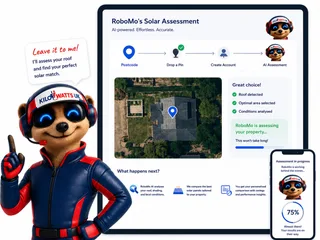
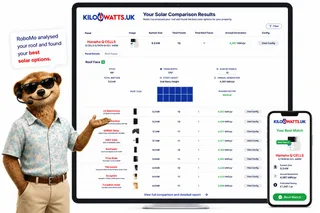
STEP 1
Choose Home, Business or Industrial
Enter your postcode to start your assessment.
STEP 2
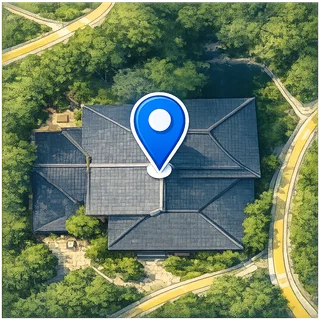
Drop a pin on your roof
STEP 3

Create your free account
STEP 4

Sit back and watch RoboMo™ work
RoboMo™ analyses your roof and builds your personalised solar comparison.
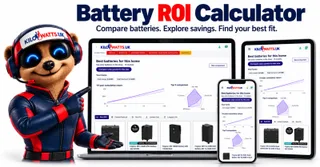
BATTERY ROI TOOL
See what a battery saves on your bill
Enter the day rate, off-peak rate and export rate. The calculator ranks batteries in the Kilowatts shop over 10 years.
Home batteries also suit offices and small commercial sites. Industrial batteries are listed on their own calculator.

Step 1
Enter your postcode
Start designing your wind energy system in seconds.
Are you an installer, distributor or renewable energy business?
Kilowatts UK is expanding the Flower Turbines partner network across the UK.
Become A Flower Turbines PartnerKilowatts UK is an authorised representative
Flower Turbines
Compact vertical-axis turbines built for real UK sites, not just open farmland.
They start in light wind, sit in a small footprint, and are bird-safe by design. Cluster them as a bouquet and the group performs better together than the same turbines standing alone. Enter your postcode for a location-based generation estimate. Figures use area weather data and will differ if buildings, trees or hills sit in the way.
Starts in light UK wind
Built to generate in typical UK wind, not only open farmland.
Small rooftop or ground footprint
Compact towers for roofs, yards and tight sites.
Bird-safe slow rotation
Slow vertical-axis spin, bird-safe by design.
Bouquet clusters raise output
Grouped turbines outperform the same units standing alone.
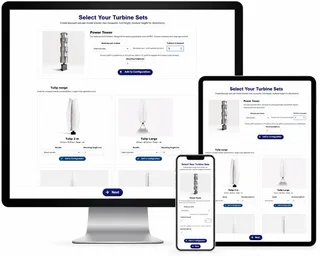
STEP 2

Choose a location
STEP 3
Place your cluster
Tap the map where you want the turbine cluster to go.
STEP 4

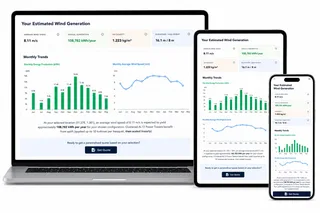
Instant generation forecasts
Compare different turbine layouts and see annual generation forecasts instantly.
STEP 5

No commitment required
Explore different configurations before deciding whether to request a quotation.
Related articles
Mo's Mission Nominations
FAQ
Need Help? RoboMo's Got Answers
Are retractable solar awnings a good alternative to rooftop solar panels?
They can be useful where you already need shade and do not have a suitable roof for standard solar panels. They are not usually a like-for-like replacement because they only generate when extended and their angle, shading and wind controls can reduce annual output. If your main aim is predictable electricity generation, rooftop PV or a fixed solar canopy is usually easier to assess.
How much electricity can a retractable solar awning generate in the UK?
Output depends on the awning’s kWp rating, orientation, shading, pitch, inverter design and how often it is open in daylight. A 1.8 kWp awning will not necessarily produce the same annual kWh as a fixed 1.8 kWp roof system. SolarMarkise publishes manufacturer estimates of up to 1,200 kWh a year for the M and 1,600 kWh a year for the L under south-facing, unshaded assumptions; those are not verified UK yields. Ask for a site-specific estimate that states extension hours, inverter capacity and shading.
Do solar awnings work when they are retracted?
No, a retractable solar awning will normally generate only when the photovoltaic surface is exposed to daylight. If it is closed during sunny periods, it will miss that generation. Automatic wind retraction can also reduce output, even on bright days.
What UK electrical checks are needed for a solar awning?
A grid-connected solar awning needs proper electrical design, suitable inverter equipment, safe wiring, isolation and protection. The German plug-in arrangement, including an 800 W household-socket feed, must not be copied for a UK installation. The installer should confirm whether the project falls under G98 (fully type-tested microgenerators up to 16 A per phase, considering generation already on site) or needs G99. Only a UK-listed plug-in kit meeting the Interim Product Specification may use a socket connection; otherwise the connection should be fixed wiring under the rules in force at installation.
Can I get paid for exporting electricity from a solar awning?
Possibly, but export payments are not automatic. Smart Export Guarantee eligibility involves certification of the installation and installer through MCS or an accredited equivalent, plus suitable export metering. Do not include export payments in a quote until the proposed product, installer, certification route and meter have been checked with the tariff provider.
Do retractable solar awnings need planning permission?
It depends on the property, location and how the awning changes the building’s appearance. An awning attached to a house may fall under permitted development, depending on the circumstances. Listed buildings, conservation areas, flats and properties with restrictive covenants need particular care. If in doubt, check with the local planning authority, freeholder or managing agent before ordering.
What makes UK weather important for solar awnings?
A projecting awning can catch the wind like a sail, so the wall, brackets, fixings and wind controls are critical. Rain, dirt, salt exposure and repeated movement can also affect durability and performance. The structure should be assessed as both an outdoor awning and an electrical generating system.
What should I ask a supplier before buying one?
Ask whether the product is sold, warranted and supported for a UK site; what inverter and connection route will be used; who handles structural assessment, DNO notification or G99 application, commissioning paperwork and aftercare; and whether MCS or an accredited-equivalent route plus a suitable export meter is proposed. Also ask for a UK yield model that includes hours the awning will be extended, and for a UK installed price rather than the German self-install list.