


Compare solar ayrshire?
Published: 2026-07-19 18:38:07
Updated: 2026-08-04 12:23:13
A well-sited Ayrshire solar PV system can work effectively, but output, cost, and payback depend heavily on roof direction, shading, electricity use.
Compare solar Ayrshire in the UK
To compare solar in Ayrshire properly, look beyond the cheapest headline price and compare the full design: roof suitability, system size, panel and inverter specification, battery need, scaffolding, DNO paperwork, warranties, predicted generation, and aftercare. A well-sited Ayrshire solar PV system can work effectively, but output, cost, and payback depend heavily on roof direction, shading, electricity use, export arrangements, and whether a battery is genuinely useful.
For many homes in North Ayrshire, South Ayrshire, and East Ayrshire, the most useful comparison is not simply “which panel is best?” but “which design gives the best usable generation for this property?” A lower-cost quote may be poor value if it assumes no shading, excludes scaffolding, uses vague product descriptions, or does not include the DNO process. A higher-cost quote may be justified if the roof is complex, the property is coastal and exposed, or the system includes battery storage, better monitoring, and more detailed aftercare.
A sensible shortlisting process is to compare at least a few like-for-like quotes, check installer credentials, and make sure each proposal uses the same assumptions. The quote should state the kWp system size, estimated annual kWh generation, panel model, inverter model, battery usable capacity if included, roof orientation, shading assumptions, warranty terms, and all installation extras. You can also compare home solar options before narrowing down specific Ayrshire quotes. This guide is written for Ayrshire homeowners comparing domestic solar PV quotes. It is not a substitute for a property survey, structural assessment, DNO decision, or financial advice. Solar figures should always be treated as estimates, not guarantees.
What makes Ayrshire different for solar PV
Ayrshire is in south-west Scotland, so annual solar generation is usually lower than in sunnier parts of southern England. That does not mean solar is unsuitable. Solar panels generate from daylight, not only direct sunshine, and many Scottish homes still produce useful electricity across the year. The important point is that the design and financial estimate should be based on Ayrshire conditions, not a generic UK best-case example.
As a broad planning guide, a well-sited Ayrshire solar PV system may generate around 800 to 950 kWh per kWp per year. A 3 kWp system may therefore generate around 2,400 to 2,850 kWh per year, a 4 kWp system around 3,200 to 3,800 kWh per year, and a 5 kWp system around 4,000 to 4,750 kWh per year. These figures are indicative only. Roof angle, roof direction, shading, panel layout, inverter design, local weather exposure, and system losses all change the result.
Coastal Ayrshire homes can need extra attention to wind exposure and salt exposure. Rural homes may have room for ground-mounted arrays, but planning, cable routes, security, trenching, ground conditions, and grid connection then become part of the comparison. Older stone properties, slate roofs, conservation areas, listed buildings, and homes with shared roof ownership also need more careful assessment before any price is treated as firm. The strongest solar quotes for Ayrshire should show that the installer has considered local conditions. That means modelling the actual roof planes, checking likely shade from chimneys and neighbouring buildings, and being realistic about winter output. A quote that uses a generic annual generation figure without explaining the roof assumptions should be queried.
Compare Ayrshire solar quotes by specification, not headline price
A good solar quote should be specific enough that another competent installer could understand the design. If one quote says “premium panels” and another lists the exact panel make, model, output, inverter, mounting system, battery capacity, and warranty, they are not equally transparent.
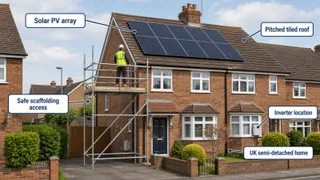
When comparing quotes, check whether each installer has included the same practical items. Scaffolding is a common difference. One company may include full scaffolding, bird protection, DNO paperwork, commissioning, monitoring setup, and electrical upgrades, while another may treat some of these as extras. On a straightforward concrete tile roof, this may be less dramatic. On a slate roof, a tall property, or a coastal site with more difficult access, it can change both cost and installation risk.
The quote should clearly include these items.
Avoid comparing two quotes only by the final price. A slightly dearer system may be better designed if it deals properly with shade, uses a suitable inverter, includes safer cable routing, and provides a clearer workmanship warranty. Equally, a more expensive quote is not automatically better if it relies on optimistic savings assumptions or adds a battery that the household will not use effectively. A useful comparison method is to create a simple table with each installer’s system size, annual generation estimate, battery capacity, total price, included extras, warranty length, DNO approach, and estimated savings assumptions. This makes it easier to see whether one quote is genuinely better value or simply less complete.
Typical solar costs in Ayrshire and what changes the price
Typical UK solar-only pricing gives a useful starting point for Ayrshire, but the final installed price depends on the property, equipment, roof access, and electrical work required. As a broad domestic market guide, a 3 kWp to 4 kWp solar-only system commonly costs around £5,000 to £7,500. A 4 kWp to 5 kWp system commonly costs around £6,500 to £9,000. A 5 kWp to 6 kWp system commonly costs around £8,000 to £11,000. A domestic battery commonly adds around £3,000 to £7,000, and a combined solar and battery system commonly costs around £9,000 to £15,000. For wider context, compare these figures with a current UK solar price guide before judging an Ayrshire quote.
Those ranges are not fixed prices. They can move if the roof is difficult, scaffolding is complex, the consumer unit needs work, cable runs are long, the property has multiple roof planes, or the system needs export limitation equipment. Slate roofs often take longer than concrete tile roofs because the fixing and weatherproofing details are more involved. Exposed coastal homes may need careful mounting design for wind loading.
Domestic solar panels and batteries currently benefit from 0% VAT under UK energy-saving materials rules, with the relief scheduled to run until 31 March 2027 under current rules. Installers should make the VAT treatment clear in the quote. Homeowners should also check the latest official UK Government position before signing, as tax rules can change. Cost comparison should also separate the solar system from the financial assumptions. Export payments, electricity prices, and self-consumption levels can change. A quote that appears to have the fastest payback may simply be using more optimistic assumptions. Ask each installer to show the assumed import tariff, export tariff, self-consumption percentage, battery behaviour, panel degradation, and annual generation estimate. Be cautious about any quote that suggests solar is “free”, guarantees bill elimination, or relies on a grant or incentive without explaining eligibility and current rules. In most domestic cases, the financial case is based on reduced grid imports, possible export payments, and long-term energy use, not a guaranteed government subsidy.
Solar-only or solar with battery in Ayrshire
A battery is not essential for every solar installation. Solar-only systems can work well where the household uses a reasonable amount of electricity during the day or has flexible loads such as appliances, immersion heating controls, EV charging, or home working. A battery becomes more attractive when much of the household electricity use happens in the evening.
Ayrshire’s seasonal pattern matters. Winter output is much lower than summer output, so a battery does not make a home independent from the grid. In summer, a battery may help capture excess daytime generation, but it can fill quickly if the system is large and the household has low daytime use. In winter, there may be less spare solar to store.
Compare battery options by usable capacity, power rating, warranty, installation location, chemistry, operating temperature range, and compatibility with the inverter. The headline battery capacity is not always the usable capacity. The power rating affects how many appliances it can support at once. Backup power is also not automatic; it usually requires extra design and equipment, and some systems only provide limited backup circuits. It is worth checking typical solar battery costs separately from the solar array so you can see whether storage is adding real value.
Solar-only system
Often best where daytime use is high, budget is tighter, or export arrangements are acceptable.Solar with battery
Often best where evening use is high, export rates are low, or a time-of-use tariff is part of the plan.Battery with backup
Only suitable where the system has been specifically designed for backup operation, not just standard storage.Battery-ready design
Useful where a battery may be added later, but compatibility should be checked before choosing the inverter.
Do not add a battery just because it is included in a package. Add one because the household’s load pattern, tariff choice, and budget make it useful. A smaller, well-used battery can be better value than an oversized battery that rarely cycles effectively.
Roof suitability should come before brand comparison
Panel brand matters, but roof suitability usually matters more. A high-efficiency panel on a shaded, poorly oriented roof can underperform a standard panel on a cleaner roof plane. In Ayrshire, a south-facing roof is usually strongest, but east-facing and west-facing roofs can still be viable and may spread generation across the day.
A roof pitch of around 30 to 40 degrees is often effective, but installers should model the actual property rather than rely on a rule of thumb. Shading from chimneys, dormers, trees, aerials, rooflights, and neighbouring buildings can reduce output. Low winter sun angles can make shading worse than it appears during a quick summer visit. If you are unsure how much orientation matters, review the basics of roof direction before comparing panel brands.
A proper survey should check the roof covering, rafters, loft access, mounting points, cable routes, inverter location, earthing, and consumer unit. Satellite imagery is useful for an initial estimate, but it should not replace a final site survey where the roof is older, complex, shaded, or slate-covered. Solar may be less suitable if the roof needs replacement soon, if there is heavy shading, if the household uses very little electricity, or if planning, title, or landlord restrictions prevent installation. Flats and tenements can be more complicated because roof ownership and maintenance responsibilities may be shared. Before signing, ask whether the roof has enough remaining life for the panel system. Removing and reinstalling panels for roof repairs later can be expensive. If the roof covering is near the end of its life, it may be better to repair or replace the roof before installing solar PV.
Comparing panels, inverters, and mounting choices
Most new UK domestic solar installations use monocrystalline panels. They are usually more efficient than older polycrystalline panels, while thin-film panels are uncommon on UK homes. Higher-efficiency panels can help where roof space is limited, but they are not always better value where there is plenty of suitable roof area.
Inverter choice is more dependent on roof layout than many buyers realise. A simple, mostly unshaded roof can often use a string inverter. Roofs with several orientations, chimneys, dormers, or patchy shade may benefit from microinverters or power optimisers, although these usually add cost. Optimisers can help reduce the effect of some panel-level shading, but they are not a cure for a badly shaded roof.
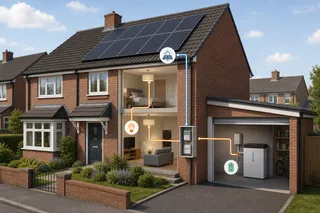
A hybrid inverter is usually considered where a battery is being installed or may be added later. However, not every hybrid inverter works with every battery. If battery storage might be added in future, the quote should confirm compatible battery options rather than simply saying “battery ready”. Mounting is just as important as the visible equipment. Slate roofs need suitable hooks and flashing methods. Concrete tiles, rosemary tiles, metal roofs, and flat roofs all need different fixing approaches. Cable routing should avoid water ingress risks and unnecessary exposure. Inverters need ventilation and accessible locations. Loft installations can suffer from high summer temperatures, while damp or poorly ventilated locations can be unsuitable for some batteries. Ask the installer to explain why the chosen panel, inverter, and mounting system suit the property. The best answer should refer to roof space, orientation, shading, battery plans, warranty support, monitoring, and access for maintenance.
Installer checks for Ayrshire homeowners
The installer should be MCS certified for solar PV and should use suitable approved products. MCS certification is important for quality assurance and is often required for export tariff eligibility. For a clearer explanation of why it matters, read what MCS certification means for UK solar installations. The installer should provide the MCS certificate after installation, along with electrical certificates, warranties, product datasheets, shutdown instructions, and DNO notification or approval evidence.
Consumer protection matters too. Many reputable installers are members of a consumer code such as RECC or HIES. The contract should set out the equipment, payment schedule, cancellation rights, workmanship warranty, insurance-backed warranty details if offered, and what happens if DNO approval changes the design.
Local installers may understand Ayrshire roof types, coastal conditions, and access issues well. National installers may offer broader coverage and standardised processes. Either can be suitable. The better comparison is whether the survey is thorough, the design is specific, the quote is transparent, and the aftercare is credible.
Aftercare
Ask who deals with monitoring faults, inverter issues, roof concerns, and warranty claims after installation.Insurance
Ask whether workmanship warranties are backed by suitable insurance or only by the installer’s own promise.Paperwork
Confirm who handles DNO notification or approval, MCS certification, electrical certificates, and handover information.Certification
Check MCS status, consumer code membership, and whether the installer issues the documents needed for export tariffs.Subcontracting
Ask whether the company uses its own installers, subcontractors, or a mix, and who is responsible if a defect appears.Survey quality
Expect checks on roof condition, structure, shading, access, cable routes, earthing, and the consumer unit.
Be cautious with pressure selling, vague savings claims, very large discounts that expire immediately, or quotes that avoid naming the main components. A reputable installer should be comfortable giving you time to compare written proposals.
DNO, export limits, and planning issues in Ayrshire
The local electricity network operator for most Ayrshire homes is usually SP Energy Networks. The installer should explain whether the system is likely to fall under G98 notification or need G99 approval. G98 usually applies to small single-phase generation up to 3.68 kW per phase. Larger or more complex systems usually need G99 approval before connection.
This matters because export limits can affect the final design. If the local network is constrained, the DNO may limit how much electricity can be exported to the grid. In some cases, export limitation equipment may be required. A large array is not always better if much of the generation cannot be used on site or exported effectively.
For Ayrshire properties, homeowners can check general network information with SP Energy Networks. The installer should still manage the technical DNO process for a domestic installation and should confirm whether approval is needed before installation begins. Many domestic roof-mounted solar installations in Scotland are permitted development, but conditions apply. Listed buildings, conservation areas, flats, tenements, and ground-mounted systems need closer checks. The installation still needs to meet building standards and electrical safety requirements, including appropriate wiring standards and MCS installation practices. If your property is unusual, start with a general guide to planning permission for solar before relying on a standard quote. Do not leave DNO and planning questions until after signing if the system is large, the property is unusual, or the home is in a restricted area. These issues can change both timing and design.
How to judge savings and payback realistically
Solar savings come mainly from using your own generated electricity instead of buying it from the grid. Exported electricity can provide income through the Smart Export Guarantee, but exported units are usually worth less than imported units cost. That means self-consumption is central to the financial case.
Homes with higher daytime electricity use often benefit more from solar-only systems. Homes with high evening use may benefit more from a battery. Electric vehicles and heat pumps can improve the case for solar if charging and heating patterns are managed intelligently, but they also change system sizing and tariff decisions.
When comparing projections, ask what electricity import price, export tariff, self-consumption level, battery assumptions, panel degradation, and maintenance expectations have been used. SEG rates vary by supplier, and some tariffs require a smart meter, MCS certification, or importing electricity from the same supplier. Ofgem provides general information on the Smart Export Guarantee, but suppliers set their own export rates and terms. A realistic solar comparison should include uncertainty. Electricity prices can change, export rates can change, household habits can change, and equipment such as inverters may need replacement before the panels reach the end of their life. For a more grounded view, compare installer projections with an independent guide to break-even on solar. For a more reliable comparison, ask each installer to show:
Treat very short payback claims with caution unless the assumptions are clearly explained. Solar can be a good long-term investment, but it should not be sold using unrealistic bill-saving promises.
A practical comparison checklist before choosing
Before choosing a solar installer in Ayrshire, reduce each quote to the same key information. If a quote does not provide the details, ask for clarification before comparing it with others.
The best choice is usually the installer who gives a well-evidenced design, not the one with the most optimistic savings figure. For Ayrshire homes, careful attention to roof condition, shading, coastal exposure, electrical suitability, and export limits is often more valuable than chasing the highest advertised panel efficiency.
Bottom line on comparing solar in Ayrshire
Solar PV can be a strong option in Ayrshire, but it should be compared on design quality, not just price. Expect Ayrshire output to be property-specific, with roof direction, shading, system size, and electricity use making a major difference to savings.
A good quote should explain what will be installed, how much it is expected to generate, what assumptions have been used, what paperwork is included, and what risks remain. It should also make clear whether scaffolding, DNO work, monitoring, warranties, and aftercare are included.
If the roof is shaded, ageing, restricted by planning, or likely to need replacement soon, solar may not be the right first step. If the roof is sound and the household can use a good share of the electricity generated, a well-designed solar PV system can be a practical long-term investment. If you want a property-specific next step, you can book a free home energy survey.
Plan, Compare & Buy Renewable Energy Solutions
AI does the thinking.
You get the perfect solar match.
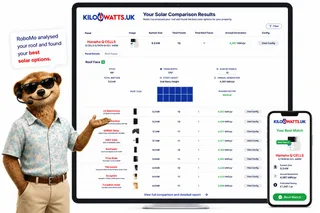
Use RoboMo™ to assess your property, compare available technologies and connect with trusted UK installers, suppliers and manufacturers.
Simply enter your postcode, drop a pin on your roof, create your free account and let RoboMo™ analyse your property to find the best solar panels for your home.

You don't have to think
RoboMo™'s AI analyses your roof and does all the hard work.

Accurate & tailored
AI-powered assessment based on your roof, location, and conditions.

Best options, maximum savings
Compare top solar panels for the best performance and value.

Simple, fast & effortless
Provide a few details, sit back and watch your results unfold.
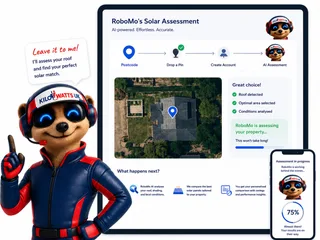
STEP 1
Choose Home, Business or Industrial
Enter your postcode to start your assessment.
STEP 2
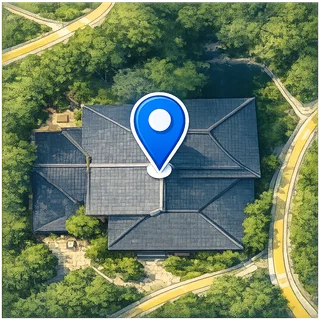
Drop a pin on your roof
STEP 3

Create your free account
STEP 4

Sit back and watch RoboMo™ work
RoboMo™ analyses your roof and builds your personalised solar comparison.

Kilowatts UK is an authorised representative
Flower Turbines
Compact vertical-axis turbines built for real UK sites, not just open farmland.
They start in light wind, sit in a small footprint, and are bird-safe by design. Cluster them as a bouquet and the group performs better together than the same turbines standing alone. Enter your postcode for a location-based generation estimate. Figures use area weather data and will differ if buildings, trees or hills sit in the way.
Starts in light UK wind
Built to generate in typical UK wind, not only open farmland.
Small rooftop or ground footprint
Compact towers for roofs, yards and tight sites.
Bird-safe slow rotation
Slow vertical-axis spin, bird-safe by design.
Bouquet clusters raise output
Grouped turbines outperform the same units standing alone.

Step 1
Enter your postcode
Start designing your wind energy system in seconds.

STEP 2

Choose a location
STEP 3

Place your cluster
Tap the map where you want the turbine cluster to go.
STEP 4

Instant generation forecasts
Compare different turbine layouts and see annual generation forecasts instantly.
STEP 5

No commitment required
Explore different configurations before deciding whether to request a quotation.
Related articles
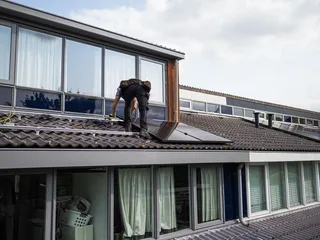
Solar panels
Mo's Mission Nominations
FAQ
Need Help? RoboMo's Got Answers
Is solar worth considering in Ayrshire?
Yes, solar can be worth considering in Ayrshire if the roof is suitable, shading is limited, and the household can use a good share of the electricity generated. Ayrshire receives less annual solar irradiation than southern parts of the UK, but solar panels generate from daylight as well as direct sunshine. The financial case depends on system size, roof direction, electricity use, export payments, installation cost, and whether a battery is useful.
How much electricity can solar panels generate in Ayrshire?
As a broad planning guide, a well-sited solar PV system in Ayrshire may generate around 800 to 950 kWh per kWp per year. That means a 4 kWp system might produce roughly 3,200 to 3,800 kWh annually, depending on roof pitch, direction, shading, weather exposure, inverter design, and system losses. Any quote should provide a property-specific generation estimate rather than relying on a generic UK average.
How should I compare solar quotes in Ayrshire?
Compare quotes by specification, not just the headline price. Each quote should state the system size in kWp, estimated annual generation in kWh, panel make and model, inverter model, battery usable capacity if included, roof orientation, shading assumptions, scaffolding, DNO paperwork, monitoring, warranties, and any exclusions. A cheaper quote may not be better value if it leaves out important installation costs or uses unrealistic savings assumptions.
How much do solar panels cost in Ayrshire?
As a broad UK domestic guide, a 3 kWp to 4 kWp solar-only system commonly costs around £5,000 to £7,500, while a 4 kWp to 5 kWp system may cost around £6,500 to £9,000. Larger 5 kWp to 6 kWp systems may cost around £8,000 to £11,000. Adding a domestic battery commonly adds around £3,000 to £7,000. Final prices vary depending on roof type, scaffolding, electrical work, access, equipment choice, and whether export limitation is required.
Should I choose solar panels with a battery in Ayrshire?
A battery can be useful, but it is not essential for every home. It is usually more attractive where electricity use is higher in the evening, export rates are low, or the household plans to use a time-of-use tariff. Solar-only may be better value where daytime electricity use is already high. Because winter solar output in Ayrshire is much lower than summer output, a battery should not be viewed as a way to become fully independent from the grid.
What roof direction is best for solar panels in Ayrshire?
A south-facing roof is usually strongest for total annual generation, but east-facing and west-facing roofs can still work well and may better match morning or afternoon electricity use. Roof pitch, shading, roof condition, available space, and mounting options are also important. A high-efficiency panel on a shaded or poorly suited roof may perform worse than a standard panel on a clearer roof plane.
Do solar panels work on cloudy days in Ayrshire?
Yes, solar panels still generate electricity on cloudy days because they use daylight, not only direct sunlight. Output will be lower in dull weather and much lower in winter than in summer. A realistic quote should reflect Ayrshire’s local conditions and seasonal generation pattern rather than assuming constant high output throughout the year.
Do I need DNO approval for solar panels in Ayrshire?
Many smaller domestic solar installations are handled under G98 notification, while larger or more complex systems usually need G99 approval before connection. For most Ayrshire homes, the local electricity network operator is usually SP Energy Networks. Your installer should confirm whether G98 or G99 applies, handle the relevant paperwork, and explain whether any export limit could affect the system design.
Do I need planning permission for solar panels in Ayrshire?
Many domestic roof-mounted solar panel installations in Scotland fall under permitted development, but restrictions can apply. Listed buildings, conservation areas, flats, tenements, shared roofs, and ground-mounted systems may need closer planning checks. You should confirm requirements before signing if the property is unusual, protected, shared, or in a restricted area.
What installer credentials should I check?
Check that the installer is MCS certified for solar PV and that the products are suitable for MCS certification. This is important for quality assurance and is often required for Smart Export Guarantee tariff eligibility. It is also sensible to check consumer code membership, workmanship warranty terms, insurance-backed warranty arrangements, electrical certification, handover documents, and who will support the system after installation.
What affects solar payback in Ayrshire?
Solar payback depends on installation cost, annual generation, how much electricity you use on site, your import tariff, your export tariff, battery use, maintenance costs, and future electricity prices. Using solar electricity directly usually saves more than exporting it, because export payments are often lower than import prices. Be cautious of very short payback claims unless the assumptions are clearly shown.
Are slate roofs or coastal homes more difficult for solar installation?
They can be. Slate roofs often require more careful fixing and weatherproofing than standard concrete tile roofs. Coastal Ayrshire properties may also need closer attention to wind exposure, salt exposure, mounting design, and access. These factors can affect installation cost, equipment choice, scaffolding, and survey requirements.
Can I add a battery later?
Yes, in many cases a battery can be added later, but only if the original system has been designed with future compatibility in mind. A “battery-ready” quote should name compatible battery options and explain whether the inverter can support them. Not every hybrid inverter works with every battery, so compatibility should be confirmed before installation.
What should be included in a solar quote?
A good solar quote should include the system size, estimated annual generation, panel quantity and model, inverter model, mounting method, scaffolding, cable routes, electrical works, DNO process, monitoring, warranties, handover documents, and exclusions. If a battery is included, the quote should state usable capacity, power rating, warranty, installation location, and whether backup power is included or not.
Will solar panels eliminate my electricity bill?
Usually not. Solar panels can reduce grid electricity use, but most homes still need grid electricity at night, during winter, and during periods of high demand. A battery can reduce imports further, but it does not guarantee independence from the grid. Any quote promising to eliminate bills should be treated with caution unless the assumptions are clearly explained.