


How to Compare Solar Quotes in the UK (2026 Guide) guide
Published: 2026-08-23 16:01:34
Updated: 2026-08-23 15:54:39
A cheap installation that underperforms or fails early will cost you far more in the long run than a fairly priced system built with quality components.
How to Compare Solar Quotes in the UK (2026 Guide) guide
A cheap installation that underperforms or fails early will cost you far more in the long run than a fairly priced system built with quality components.
Overview
If you want to compare solar quotes like a pro, you need to look beyond the bottom-line figure. A cheap installation that underperforms or fails early will cost you far more in the long run than a fairly priced system built with quality components. This guide walks you through the entire process, from understanding what separates a good quote from a poor one, to using comparison sites effectively, to knowing exactly what happens on installation day. It is written for UK homeowners, businesses, and landowners who are ready to cut through the noise and make a confident, informed decision in 2026.
Overview
The solar market has matured rapidly, and the tools available to you are better than ever. But choice brings complexity. Three million UK households are expected to install panels in the next five years, and with that surge in demand comes a flood of installers, all competing for your attention. Some offer genuine value; others rely on high-pressure tactics and vague promises. Learning to compare solar quotes properly is your single best defence against overpaying or ending up with a system that does not deliver.
Why Comparing Solar Quotes Matters in 2026
Energy price instability remains the number one reason UK households are turning to solar. When your electricity bill swings unpredictably, generating your own power stops being a lifestyle choice and becomes a financial strategy. But the cost of getting there is not fixed. A 4kW system, the most common size for a three to four person household, can range from £5,000 to £7,000 depending on who you ask. That is a £2,000 spread for essentially the same headline specification.
The difference lies in the details. Panel efficiency, inverter quality, warranty length, and the installer’s own workmanship standards all affect what you pay and what you get back over the system’s 25 to 30 year lifespan. A proper comparison is not a race to the lowest number. It is a methodical check of equipment, credentials, and aftercare.
Most comparison platforms, including Uswitch and MoneySuperMarket, offer free, no-obligation quotes from MCS-certified installers. That certification is non-negotiable: without it, you cannot access Smart Export Guarantee payments, and many finance options disappear. Using these sites gives you a safe starting pool, but you still need to know what questions to ask. Comparing multiple quotes also protects you from cowboy builders. When you have three or four detailed proposals side by side, inconsistencies and red flags become much easier to spot.
What to Look for When You Compare Solar Quotes
System Size and Output
The first figure you will see on any quote is the system size in kilowatts. A 2kW system suits a small flat or a one-person household with modest daytime usage. A 4kW system covers the needs of a typical family of three or four. A 6kW system is the right territory for large families or anyone charging an electric vehicle at home.
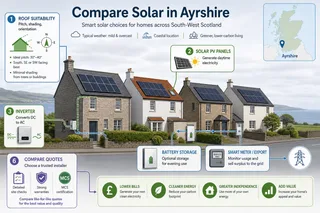
But the kW rating only tells you the panel capacity under ideal laboratory conditions. What matters more is the estimated annual kWh generation the installer calculates for your specific roof. This number accounts for your location, roof orientation, pitch, and any shading. A quote that lists only the panel count without a tailored generation estimate is incomplete. Be wary of installers who push a system size that feels wrong, either undersized to win on price or oversized to inflate their margin. Your household’s actual consumption data, available from your smart meter or energy bills, should anchor this decision. If the figures are hard to interpret, it helps to understand how much panels generate before you compare the projections.
Panel and Inverter Brands
Not all solar panels are equal, and the efficiency rating is the number to watch. A panel with 22 percent efficiency converts more sunlight into electricity than one rated at 18 percent, meaning you need less roof space for the same output. Ask each installer to specify the exact make and model of the panels they are quoting. Brands like SunPower, LG, and REC have strong track records in the UK market, but there are many solid mid-range options too.
The inverter is just as critical. This device converts the direct current your panels produce into alternating current your home can use. A premium panel paired with a cheap inverter is a mismatch that will drag down system performance. Inverter brands like SolarEdge and Huawei appear frequently in quality UK installations. Expect an inverter lifespan of 10 to 15 years, after which a replacement will be needed. When you compare solar quotes, check whether the inverter warranty matches or exceeds that period, and factor a replacement into your long-term budget if it does not.
Warranties and Guarantees
Panel warranties in the UK market run from 25 to 30 years, covering both the physical product and a performance guarantee that the panels will still produce a specified percentage of their original output decades later. Read the fine print: a 25-year performance warranty might guarantee 85 percent output at year 25, while another might promise 90 percent. Small differences compound over time.
The installer’s workmanship warranty is separate and typically spans five to ten years. This covers the roof mounting, wiring, and any issues caused by the installation itself. If a roof leak develops around the mounting brackets in year three, this is the warranty that protects you. Some comparison partners offer additional leverage. Glow Green, available through MoneySuperMarket, has a "beat any quote by £100" guarantee. If you find a cheaper like-for-like quote, you can use it to negotiate.
Battery Storage Options
Adding a battery can double your annual savings compared to panels alone. During sunny hours, your panels often generate more electricity than you can use immediately. Without a battery, that surplus flows to the grid for a modest SEG payment. With a battery, you store it and use it during the evening peak, when grid electricity is most expensive.
When you compare solar quotes, the battery should be itemised separately from the panels. This lets you see exactly what you are paying for each component and decide whether the upfront cost justifies the additional savings. Ask about the battery chemistry: lithium-ion is the modern standard, offering longer life and better depth of discharge than older lead-acid types. Also confirm the usable capacity, not just the total capacity. A 10kWh battery might only allow 9kWh of usable storage to protect its lifespan, and that distinction matters for your calculations.
Average Solar Panel Costs in the UK (2026)
Price ranges have stabilised somewhat, but the spread remains wide enough to make comparison essential. For a 2kW system, expect to pay between £4,600 and £5,800. This size suits small households with low daytime electricity use. A 4kW system, the workhorse of UK residential solar, runs from £5,000 to £7,000. A 6kW system, appropriate for larger families or homes with an EV, ranges from £6,000 to £8,000.
The Energy Saving Trust puts the average domestic solar panel system cost, including installation, at approximately £7,000. That figure aligns with a well-specified 4kW setup from a reputable installer. Several factors push the final solar price up or down. Roof type matters: slate roofs are more fragile and time-consuming to work with than standard concrete tiles. Roof accessibility affects scaffolding costs. A steep, three-storey roof on a terraced house with limited side access will cost more to scaffold than a shallow bungalow roof. And whether you add a battery, of course, transforms the total.
How Solar Panels Save You Money (The Three Mechanisms)
The first and most direct saving comes from reduced grid reliance. Every kilowatt-hour you generate and use yourself is a kilowatt-hour you do not buy from your supplier. For a typical household, this cuts the electricity bill by 50 to 70 percent. The exact figure depends on how well your consumption aligns with generation hours, which is where battery storage and small habit shifts, like running the washing machine at midday, make a difference.
The second mechanism is the Smart Export Guarantee. Under this government scheme, energy suppliers pay you for surplus electricity you export to the grid. Rates vary by supplier, typically ranging from 4p to 15p per kilowatt-hour. While not as lucrative as self-consumption, SEG payments still contribute meaningfully to your return. Some installers bundle an export tariff with the installation, simplifying the setup.
The third mechanism is battery storage, which amplifies the first. By time-shifting your solar energy into the evening, you maximise self-consumption and minimise expensive peak-time grid draw. The combined effect of these three mechanisms produces a payback period of 9 to 15 years, depending on your location, energy usage, and the system cost you secure. When you compare solar quotes, ask each installer for a personalised payback estimate based on your postcode and current electricity tariff. A reputable installer will provide this without hesitation.
The Installation Process: What to Expect
Most comparison sites explain how solar panels work, but few describe what actually happens on your roof. Knowing the sequence helps you spot gaps in a quote and ask the right questions before signing.
Step one is the survey and design. An installer visits your property to assess roof orientation, pitch, shading from trees or neighbouring buildings, and structural integrity. Some firms, like Heatable, offer a 3D drawing tool that generates an initial design remotely using satellite imagery and roof modelling. This can speed up the quoting process significantly, though a physical survey usually follows before installation.
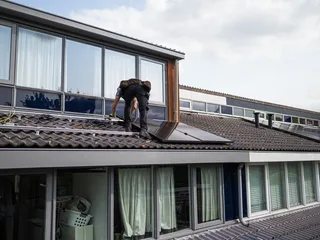
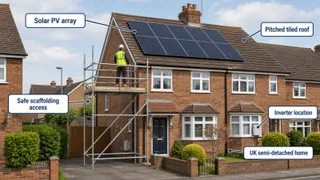
Step two is scaffolding and mounting. Scaffolding is erected around the relevant roof sections, typically taking a day. Roof anchors are then fixed to the rafters, and aluminium mounting rails are attached to these anchors. The rails form the framework that holds the panels. Step three is panel and inverter installation. The panels are lifted onto the roof, clipped onto the rails, and wired together in series. The DC cable runs down to the inverter, which is usually mounted in a loft, garage, or utility room. This stage takes one to two days for a standard residential system. Step four is electrical connection and DNO paperwork. The inverter connects to your consumer unit via a dedicated circuit. The installer then notifies your Distribution Network Operator, the company that manages your local electricity network. This notification is a regulatory requirement, and a good quote will confirm that the installer handles all DNO paperwork on your behalf. Once the DNO gives the green light, your system is commissioned and you can start generating. Most installations complete within four to six weeks of placing your deposit, though some partners claim turnaround times as short as two weeks.
Common Pitfalls When Comparing Solar Quotes
The most frequent mistake is fixating on the cheapest price. A low quote often hides budget panels with efficiency ratings around 18 percent, or a no-name inverter with a short warranty. The savings you thought you were getting evaporate over time through lower generation and earlier replacement costs.
Ignoring the inverter is another trap. The inverter is the brain of your system, and it works hard for a decade or more. Ask for the specific brand and model. If a quote omits this detail or lists something you cannot research independently, treat that as a warning sign.
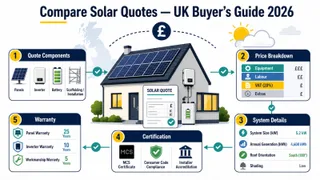
MCS certification is essential, not optional. It is your assurance that the installer meets the industry standard for renewable energy installations. Without it, you cannot claim SEG payments, and many lenders will not offer green finance. Check every installer against the MCS register before proceeding. After-sales support is easy to overlook when you are focused on the upfront numbers. If a panel fails in year three, who do you call? Does the installer have a UK-based support team, or are you chasing an email address? A clear support pathway should be part of the quote. Finally, scope varies. One quote may include scaffolding, DNO paperwork, and VAT. Another may quote a lower headline figure but add these as extras later. Always ask for a full, itemised breakdown so you are comparing like with like.
How to Use Solar Comparison Sites Effectively
Comparison sites are the fastest way to build a shortlist, but each has its own strengths. Uswitch takes a "zero pressure" approach, letting you compare quotes in your own time without aggressive sales follow-ups. This suits you if you want to gather information before speaking to anyone.
MoneySuperMarket connects you with partners like Heatable, whose 3D drawing tool produces an online quote without a home visit, and Glow Green, which offers a price-beat guarantee. If you have a competitive quote already, this is a useful place to test it.
CompareMySolar offers a unique feature: you select your own roof on Google Maps to refine the quote by roof size and orientation. This interactive step gives you more control over the initial estimate and can surface issues like shading that a generic postcode-based tool might miss. GoSolarCompare is the only major platform that handles commercial solar alongside residential. If you are a farmer, warehouse operator, or manage an apartment block, this is where you will find quotes tailored to larger-scale installations. Best practice is to use two or three comparison sites to maximise your coverage. Then cross-reference the installer names and quotes you receive. If the same installer appears on multiple platforms with different pricing, ask why. If an installer only appears on one site, check their independent reviews before engaging. For a more personalised starting point, an AI-powered solar assessment can help you understand your roof's potential before you even request quotes, giving you a baseline to measure proposals against.
Frequently Asked Questions
Do I need planning permission for solar panels in the UK? In most cases, no. Domestic solar panels fall under Permitted Development rights, provided they do not protrude excessively from the roof plane or face a highway in a conservation area. Listed buildings and some conservation areas do require permission, so check with your local planning authority if you are unsure.
How long do solar panels last? Quality panels generate useful power for 25 to 30 years. Their output degrades slowly, typically around 0.5 percent per year. The inverter has a shorter lifespan of 10 to 15 years and will need replacing at least once during the panel lifetime. Budget for this when calculating your long-term return.
What is the Smart Export Guarantee? The SEG is a government-mandated scheme requiring energy suppliers with over 150,000 customers to offer an export tariff. You are paid for each kilowatt-hour you send to the grid. Rates vary, so shop around. You do not have to use the same supplier for export as you do for import. Can I get a solar panel quote without a home visit? Yes. Several comparison partners now use 3D roof modelling and satellite data to produce accurate online quotes. This speeds up the process and reduces the number of visits you need to schedule. A physical survey typically follows before installation to confirm the design. Are solar panels worth it in 2026? With energy prices remaining volatile and payback periods of 9 to 15 years, most UK households see a positive return over the system's lifetime. When you factor in the 25 to 30 year panel warranty, you are looking at a decade or more of near-zero electricity bills after the system has paid for itself. For many, that is a compelling proposition.
Final Checklist Before You Choose a Quote
Before you sign anything, run through this checklist. Confirm the installer's MCS certification by checking the MCS register directly. Get the panel and inverter brands specified in writing, including model numbers. Verify warranty details: panel performance warranty of 25 to 30 years, and a workmanship warranty of at least five years. Demand a full cost breakdown covering panels, inverter, scaffolding, DNO paperwork, and VAT. Request the battery storage quote separately if you are considering adding one now or in the future. Research SEG tariffs: some installers offer a bundled export tariff that simplifies the setup. Finally, check Trustpilot or Google Reviews for the specific installer, not just the comparison site that connected you. A strong rating on the platform means little if the installer's own reviews tell a different story.
Plan, Compare & Buy Renewable Energy Solutions
AI does the thinking.
You get the perfect solar match.
Use RoboMo™ to assess your property, compare available technologies and connect with trusted UK installers, suppliers and manufacturers.
Simply enter your postcode, drop a pin on your roof, create your free account and let RoboMo™ analyse your property to find the best solar panels for your home.

You don't have to think
RoboMo™'s AI analyses your roof and does all the hard work.

Accurate & tailored
AI-powered assessment based on your roof, location, and conditions.

Best options, maximum savings
Compare top solar panels for the best performance and value.

Simple, fast & effortless
Provide a few details, sit back and watch your results unfold.
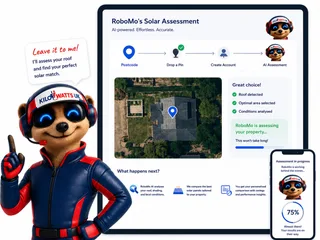
STEP 1
Choose Home, Business or Industrial
Enter your postcode to start your assessment.
STEP 2

Drop a pin on your roof
STEP 3

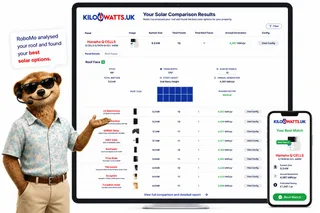
See your comparison
STEP 4

Sit back and watch RoboMo™ work
RoboMo™ analyses your roof and builds your personalised solar comparison.
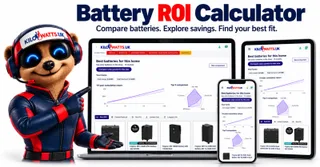
BATTERY ROI TOOL
See what a battery saves on your bill
Enter the day rate, off-peak rate and export rate. The calculator ranks batteries in the Kilowatts shop over 10 years.
Home batteries also suit offices and small commercial sites. Industrial batteries are listed on their own calculator.

Step 1
Enter your postcode
Start designing your wind energy system in seconds.
Are you an installer, distributor or renewable energy business?
Kilowatts UK is expanding the Flower Turbines partner network across the UK.
Become A Flower Turbines PartnerKilowatts UK is an authorised representative
Flower Turbines
Compact vertical-axis turbines built for real UK sites, not just open farmland.
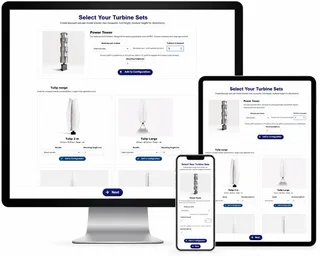
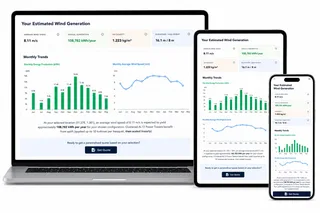
They start in light wind, sit in a small footprint, and are bird-safe by design. Cluster them as a bouquet and the group performs better together than the same turbines standing alone. Enter your postcode for a location-based generation estimate. Figures use area weather data and will differ if buildings, trees or hills sit in the way.
Starts in light UK wind
Built to generate in typical UK wind, not only open farmland.
Small rooftop or ground footprint
Compact towers for roofs, yards and tight sites.
Bird-safe slow rotation
Slow vertical-axis spin, bird-safe by design.
Bouquet clusters raise output
Grouped turbines outperform the same units standing alone.
STEP 2

Choose a location
STEP 3

Place your cluster
Tap the map where you want the turbine cluster to go.
STEP 4

Instant generation forecasts
Compare different turbine layouts and see annual generation forecasts instantly.
STEP 5

No commitment required
Explore different configurations before deciding whether to request a quotation.
Related articles
Mo's Mission Nominations
FAQ
Need Help? RoboMo's Got Answers
How many solar quotes should I compare before choosing an installer?
Aim to compare at least three detailed quotes from different installers. This makes it easier to spot unusually low prices, missing items, or unrealistic savings claims. Make sure each quote is based on the same system size, roof details, and whether a battery is included.
What should a good solar quote include?
A good quote should list the panel and inverter make and model, system size, estimated annual generation, battery details if included, scaffolding, installation, warranties, and VAT treatment. It should also explain any assumptions about roof orientation, shading, and your electricity use. If key details are missing, ask for a revised written quote before comparing it with others.
Is the cheapest solar quote usually the best option?
Not necessarily. A cheaper quote may use lower-efficiency panels, a shorter inverter warranty, or exclude items such as scaffolding or monitoring. Compare the total specification, expected output, workmanship warranty, and aftercare rather than choosing on price alone.
Why does MCS certification matter when comparing UK solar quotes?
MCS certification is important because many Smart Export Guarantee tariffs require an installation by an MCS-certified installer. It also gives you a recognised standard to check against when comparing companies. Always verify the installer on the official MCS register rather than relying only on sales material.
Should I include a battery in my solar quote comparison?
A battery can help you use more of your own solar electricity in the evening, but it adds to the upfront cost. Ask installers to itemise the battery separately so you can compare panels-only and panels-plus-battery options. Check the usable capacity, warranty, and whether the savings estimate is based on your real electricity use.
What warranties should I check in a solar quote?
Check the panel product warranty, panel performance warranty, inverter warranty, battery warranty if applicable, and the installer’s workmanship warranty. These cover different things, so a long panel warranty does not automatically protect you against installation faults. Ask who handles warranty claims if a component fails in future.
Do solar installers handle DNO paperwork in the UK?
A reputable installer should explain what Distribution Network Operator notification or approval is needed for your system and whether they will handle it for you. This is especially important for larger systems, battery storage, or export arrangements. Make sure the responsibility is stated clearly in the quote or contract.
How can I tell if a solar savings estimate is realistic?
A realistic estimate should use your postcode, roof orientation, shading, system size, electricity usage, and current tariff assumptions. Be cautious if the quote promises exact savings without explaining the calculation. Ask for estimated annual generation in kWh and how much electricity they expect you to use at home versus export to the grid.