


What is kwp in solar panel?
Published: 2026-07-18 15:28:25
Updated: 2026-07-26 18:36:40
Understand what is kwp in solar panel in the UK, with clear explanations, examples, and practical next steps.
What does kWp mean in solar panels?
kWp stands for kilowatt peak. In solar panels, it means the rated maximum output of a solar PV panel or complete solar array under standard test conditions. A 4 kWp solar system is rated at 4,000 watts peak, but that does not mean it will produce 4 kW continuously on a UK roof.
The “p” in kWp means peak. It is measured in controlled test conditions, not in normal British weather. Real output depends on roof direction, pitch, shading, location, panel temperature, inverter design, cable losses, system layout, and component quality.
The simplest way to think about kWp is that it tells you the size of the solar panel array. It is useful for comparing quotes and estimating likely generation, but it is not the same as annual electricity production. For example, a 400 Wp solar panel has a peak rating of 0.4 kWp. Ten 400 Wp panels make a 4 kWp system. Twelve 430 Wp panels make a 5.16 kWp system. A good solar proposal should use kWp to describe the installed panel capacity, then show a separate estimate for how much electricity the system is expected to generate in kWh per year.
kWp, kW and kWh are not the same thing
The most common confusion is between kWp, kW and kWh. They are connected, but they measure different things.
kW
The power being produced or used at a specific moment.kWh
The amount of electricity produced or used over time.kWp
The peak rated capacity of the solar panels under standard test conditions.
For example, if a solar system produces 4 kW for one hour, it generates 4 kWh. If it produces 2 kW for two hours, it also generates 4 kWh. The kWp rating stays the same unless panels are added or removed, while live kW output changes throughout the day. Battery capacity is different again. A 5 kWh battery stores energy, while a 5 kWp solar array describes peak panel capacity. Battery charge and discharge power is usually measured in kW, not kWp. This distinction matters when judging quotes. A system advertised as 5 kWp is not guaranteed to produce 5 kW at all times, and it does not mean it will generate 5 kWh every hour.
How is solar kWp calculated?
Solar kWp is calculated by adding up the peak wattage of all the panels in the array and dividing by 1,000.
The formula is:
Number of panels × panel wattage ÷ 1,000 = system size in kWp Examples: Ten 400 Wp panels make 4 kWp. Twelve 425 Wp panels make 5.1 kWp. Twelve 430 Wp panels make 5.16 kWp. Sixteen 450 Wp panels make 7.2 kWp. A system with fewer high-wattage panels can have a similar kWp rating to a system with more lower-wattage panels. This is why panel efficiency matters most when roof space is limited. A more efficient panel can fit more kWp into the same roof area, but it does not automatically mean the best overall value. A quote should make the calculation transparent. If an installer states the system is 4.3 kWp, the quote should show the panel count and individual panel rating that produce that total.
What are standard test conditions?
Solar panel kWp ratings are measured under standard test conditions, often shortened to STC. These are laboratory-style conditions used so that panels can be compared consistently.
Standard test conditions usually include:
- Solar irradiance of 1,000 W/m².
- Cell temperature of 25°C.
- A defined air mass of 1.5.
These conditions are useful for comparing panels, but they do not represent typical year-round roof conditions in the UK. On a real roof, panels are affected by changing sunlight, cloud cover, wind, roof temperature, shading, dirt, cable losses, inverter efficiency, and the angle of the sun. This is why kWp is best treated as the rated size of the system, not a promise of everyday output.
How much electricity does each kWp generate in the UK?
A typical UK solar PV system may generate around 850 to 1,050 kWh per kWp per year. A well-sited south-facing system in southern England may be near the upper end of that range. A shaded, poorly oriented, or more northerly system may be below it.
Using that broad UK range, common domestic systems may produce roughly:
3 kWp: Around 2,550 to 3,150 kWh per year. 4 kWp: Around 3,400 to 4,200 kWh per year. 5 kWp: Around 4,250 to 5,250 kWh per year. 6 kWp: Around 5,100 to 6,300 kWh per year. These figures are estimates, not guarantees. Installer calculations should account for your postcode, roof aspect, roof pitch, shading, panel layout, inverter choice, system losses, and grid export limits. Annual generation matters more than peak rating when estimating savings. kWp tells you system size, but kWh tells you how much electricity the system actually produces over time.
Why a 4 kWp system does not produce 4 kW all day
A 4 kWp system may reach around 3 kW to 4 kW at midday in good summer conditions, especially when the sun is strong and panels are cool. In winter, during cloud, or when the sun is low, output can be much lower. At night, the system produces no useful electricity.
Solar panels work from daylight rather than heat. Cold bright days can produce strong output, while very hot conditions can reduce efficiency. This is one reason peak output is not the best way to judge real-world performance.
UK generation is also seasonal. Summer output is much higher than winter output. A larger kWp system can improve annual production, but it will not remove the need for grid electricity at night or during low-generation periods unless it is paired with suitable battery or backup equipment. The practical question is not whether the system can briefly reach its kWp rating. It is how much usable electricity it generates across the year and how well that generation matches your household demand.
What system size is typical for a UK home?
Many UK domestic solar systems are between 3 kWp and 6 kWp. Smaller homes may use around 2 kWp to 3 kWp, while larger homes, electric vehicle owners, and heat pump households may consider 5 kWp to 8 kWp or more where roof space, budget, and grid connection rules allow.
As a rough guide, modern domestic panels are commonly around 400 Wp to 450 Wp each. A 3 kWp system usually needs about 7 to 8 panels. A 4 kWp system usually needs about 9 to 10 panels. A 5 kWp system usually needs about 12 to 13 panels.
Usable roof area is often the limiting factor. Modern panels are commonly about 1.7 m² to 2.2 m² each, so a 4 kWp system may need roughly 18 m² to 22 m² of usable roof space. Roof windows, chimneys, dormers, vents, access margins, fire access requirements, and awkward roof shapes can all reduce the capacity that can sensibly be installed. The best kWp size is not always the largest system that fits. It should be matched to electricity use, daytime demand, future plans, export limits, roof quality, component choice, and budget.
How to estimate the right kWp size for your home
A proper solar design should be completed by a competent installer using your roof layout and electricity data. However, homeowners can make a sensible first estimate before requesting quotes.
Use this step-by-step approach.
- Check your annual electricity use
Start with your electricity bill or smart meter data. Look for your annual consumption in kWh. Many UK homes use several thousand kWh per year, but the right figure is your actual usage, not an average.
If you expect your electricity use to increase, include that in the calculation. Common reasons include:
- Buying an electric vehicle.
- Installing a heat pump.
- Working from home more often.
- Adding air conditioning or electric heating.
- Planning a home extension.
- Switching appliances from gas to electric.
- Estimate the solar generation needed
Decide whether you want to cover part of your electricity use or maximise generation from available roof space. Solar does not have to match annual use exactly, because generation and demand happen at different times.
As a broad estimate, divide your target annual solar generation by expected generation per kWp.
For example, if you want around 4,000 kWh per year and your roof is likely to generate about 950 kWh per kWp per year: 4,000 ÷ 950 = about 4.2 kWp This is only a starting point. A shaded or north-facing roof may need more kWp to produce the same annual kWh, while a very good south-facing roof may need less.
- Check usable roof space
Estimate how many panels can fit on the suitable roof areas. Do not count every square metre of roof as usable. Allow for:
- Roof edges and mounting zones.
- Chimneys and flues.
- Roof windows and dormers.
- Vents, aerials, and satellite dishes.
- Shading from trees or neighbouring buildings.
- Safe access and maintenance considerations.
If a 430 Wp panel is used, each panel adds 0.43 kWp. Ten panels would be 4.3 kWp, while fourteen panels would be 6.02 kWp. Different roof planes facing different directions.
- Consider roof direction and pitch
South-facing roofs usually provide the highest annual output in the UK, but east and west roofs can still be worthwhile. East-west systems often produce more in the morning and evening, which can suit households that use more electricity outside midday.
Roof pitch also matters. Many pitched roofs perform well, but very steep, shallow, or awkward roof angles can reduce generation or complicate mounting.
A good quote should estimate performance for each roof plane separately rather than treating the entire roof as ideal.
- Assess shading properly
Shading can make a major difference to generation. Chimneys, trees, dormers, parapets, neighbouring buildings, aerials, and vents can all reduce output.
The effect depends on when the shading happens, how the panels are connected, and what inverter technology is used. Morning or evening shading may have less impact than shading around solar noon, but it should still be modelled.
Where shading is unavoidable, installers may consider optimisers, microinverters, or alternative string layouts. These can help in the right circumstances, but they add cost and complexity, so they should be justified rather than included automatically.
- Match the system to daytime use and battery plans
A larger kWp system may export more electricity if nobody is home during the day. Export can still have value under Smart Export Guarantee tariffs in Great Britain, but export rates vary and are usually lower than the price of imported electricity.
Self-used solar electricity is usually more valuable because it reduces electricity bought from the grid. A battery can increase self-consumption, but it also adds cost and should be sized carefully.
If you have an EV, heat pump, immersion diverter, or high daytime use, a larger system may make more sense. If your daytime use is low and you do not want a battery, a slightly smaller system may provide a better balance.
- Check DNO and inverter constraints
Solar panel capacity is not the same as export capacity. In the UK, many single-phase domestic installations use inverters limited to 3.68 kW per phase under G98 rules. Larger export capacities may require prior Distribution Network Operator approval under G99.
This does not always prevent a larger kWp array, but it can affect inverter choice, export limitation, and financial modelling. A quote should explain whether the system is G98-notified, requires G99 approval, or uses export limiting.
- Compare estimated kWh, not just kWp
Once you receive quotes, compare:
Total kWp. Estimated annual kWh. Panel count and panel rating. Inverter size and type. Shading assumptions. Battery size, if included.
The best system is not necessarily the quote with the highest kWp. It is the system that gives the most reliable long-term generation and value for your specific property. Export assumptions. Product warranties. Workmanship warranty. MCS documentation. Roof and electrical upgrade requirements.
What affects how much a kWp actually produces?
Two solar systems with the same kWp rating can generate different amounts of electricity. This is normal because kWp is a laboratory rating, while real output depends on site conditions and design choices.
Important factors include:
Roof direction: South-facing roofs usually produce the highest annual output in the UK, but east and west roofs can still work well. Roof pitch: Pitches around 30 to 40 degrees are common and effective, although other angles can still be viable. Shading: Chimneys, trees, dormers, neighbouring buildings, aerials, and vents can reduce output. Location: Southern England generally receives more solar irradiance than northern Scotland. System design: Inverter sizing, cable runs, panel layout, MPPT configuration, and optimisation all affect performance. Panel temperature: Hot panels are usually less efficient than cool panels. East-west systems can be useful because they often produce more in the morning and evening than a purely south-facing system. That can better match household use, even if annual generation per kWp is sometimes lower than an ideal south-facing roof. Shading deserves particular care. A small shaded area can have a larger effect if panels are connected in a string without suitable design. Good survey work and electrical design are essential. Component quality — Panels, inverters, mounting systems, connectors, and installation workmanship all affect long-term output. Maintenance and cleanliness — Heavy dirt, debris, bird fouling, or damaged components can reduce generation.
Why solar panel quality matters
The kWp rating tells you the peak capacity of the panels, but it does not tell you everything about quality. Two systems with the same kWp rating can perform differently over time if the panels, inverter, mounting system, and installation standards are different.
Panel quality can affect:
Degradation rate: Solar panels slowly lose output over time. Better panels often have stronger long-term performance warranties. Temperature performance: Panels with better temperature coefficients lose less output in hot conditions. Product durability: Glass, frame, encapsulation, junction box, and backsheet quality affect resistance to weathering. Warranty support: A long warranty is only useful if it is clear, credible, and backed by a stable manufacturer or supplier route. Real-world yield: Good low-light performance and consistent manufacturing quality can help annual generation. Roof suitability: Panel dimensions, weight, and mounting compatibility matter on constrained or older roofs. Do not choose a system on kWp alone. A cheap high-kWp quote using lower-grade components may not be better than a slightly smaller system with stronger equipment, better design, and better installation standards. For UK homeowners, it is sensible to ask: The inverter also matters. Inverters typically have shorter lifespans than panels, so warranty length, monitoring, location, ventilation, and replacement cost should be considered. Mounting quality is just as important because the system must remain secure and weatherproof for decades. What panel brand and model is being installed? What is the product warranty? What is the performance warranty? What is the expected annual degradation? Are the panels suitable for coastal, exposed, or high-wind locations if relevant? Are the mounting components appropriate for the roof covering? Is the installer MCS certified? What workmanship warranty is provided? Who handles warranty claims if a product fails?
Is kWp the same as inverter size?
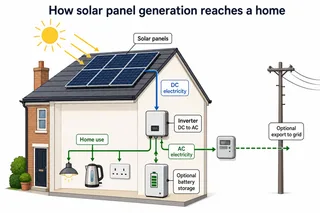
No. Solar panel capacity is usually stated in kWp, while inverter capacity is usually stated in kW or kVA. The panels produce DC electricity, and the inverter converts it into AC electricity for the home.
It is common to see a system with more panel kWp than inverter kW. For example, a property might have 4 kWp of panels and a 3.68 kW inverter. This does not automatically mean the system is badly designed.
Some inverter clipping can be acceptable. Clipping happens when the panels could produce more power than the inverter can output at that moment. A modest amount may be outweighed by better performance during lower-light conditions. Excessive oversizing, however, can waste potential output or breach equipment and grid connection limits. UK grid rules also matter. Many UK homes have single-phase electricity supplies, and small domestic inverters are often limited to 3.68 kW per phase under G98 rules. Larger systems may need prior approval from the local Distribution Network Operator under G99. Three-phase properties can often support larger export capacities, subject to approval. A quote should show panel kWp and inverter capacity separately. If it does not, ask for clarification before comparing it with another proposal.
How does kWp affect cost and payback?
kWp is one of the main factors affecting solar installation cost, but it is not the only one. A larger array usually costs more overall, although the cost per kWp can sometimes fall as system size increases.
Solar costs vary by property, roof type, access, equipment specification, battery choice, and electrical work required. Because pricing changes with product availability, labour, scaffolding, and market conditions, homeowners should compare current quotes rather than rely on a single headline figure.
Costs are affected by: Roof type and access. Scaffolding requirements. Slate, tile, metal, or flat roof mounting. Panel brand, wattage, and warranty. Inverter type and warranty. Battery storage and backup features. Payback depends on how much solar electricity you use yourself, your import tariff, export tariff, installation cost, usage pattern, and whether you add a battery. Self-used solar electricity is usually more valuable than exported electricity because it offsets electricity bought from the grid. For buyer comparisons, ask each installer to show the estimated annual generation, expected self-consumption, assumed export rate, assumed import tariff, and payback calculation. If those assumptions are not shown, the payback estimate is difficult to trust. Consumer unit and electrical upgrade needs. Cable routes and inverter location. DNO export requirements. Monitoring and smart controls. Workmanship standards and aftercare.
What should a solar quote show about kWp?
A good solar quote should not stop at the headline kWp number. It should explain how that kWp rating was calculated and what the system is expected to generate in kWh each year.
Look for the following details:
Panel count: The quote should state the number of panels and the Wp rating of each panel. Total array size: The total kWp should match the panel count and panel rating. Panel model: The exact panel make, model, efficiency, and warranty should be listed. Inverter size: The inverter capacity should be shown separately from panel kWp. Inverter model: The quote should name the inverter and explain monitoring and warranty cover. Annual generation estimate: The quote should estimate yearly kWh, not just peak capacity. Be cautious if a quote implies that kWp is annual production, or if it assumes ideal conditions without explaining shading and roof orientation. Two 4 kWp systems can have different costs and outputs depending on roof layout, installation complexity, and component quality. Assumptions — The estimate should make clear how roof direction, pitch, shading, and location were treated. Roof layout — The proposal should show where panels will be placed on each roof plane. Shading treatment — Any optimisers, microinverters, or string design decisions should be explained. Battery details — If included, battery capacity should be shown in kWh and charge/discharge power in kW. DNO position — The quote should explain whether G98 notification or G99 approval applies. MCS paperwork — The installer should explain certificates, handover documents, and export requirements. Warranties — Product, performance, inverter, battery, mounting, and workmanship warranties should be clear. Exclusions — Scaffolding, roof repairs, consumer unit upgrades, or monitoring subscriptions should not be hidden.
When might a higher kWp system not be the best choice?
A higher kWp system usually generates more electricity if the roof conditions are similar, but bigger is not always better.
If daytime household use is low, a large system may export more power rather than reduce imports. Export can still have value under Smart Export Guarantee tariffs in Great Britain, but export rates vary and are usually a separate part of the financial calculation.
A smaller system may be more sensible where the best roof area is limited, shading is significant, or the roof needs repair. It may also be better where DNO export limits restrict the usable output of a larger system. A larger system can make more sense for homes with high electricity use, daytime occupancy, electric vehicle charging, immersion diverters, or future heat pump plans. Even then, winter output will be much lower than summer output, so a large solar array should not be treated as a complete replacement for grid electricity. The right answer is usually the best-designed system for the property, not simply the highest kWp figure on the page.
Practical checks before choosing a kWp size
Before deciding on system size, the installer should check more than the roof area. Real projects often depend on details that are easy to miss at quote stage.
Important checks include roof condition, rafter strength, roof covering, safe scaffolding access, cable routes, consumer unit capacity, earthing, meter position, inverter location, and whether the property has a single-phase or three-phase supply.
Inverters are often fitted in lofts, garages, utility rooms, or external locations. Loft installations can be convenient, but high summer temperatures can affect performance and lifespan, so ventilation and access matter. Flat roofs need careful wind loading assessment, suitable mounting frames, and ballast or fixings. Coastal and exposed rural properties may need extra attention to wind loading and corrosion resistance. Older properties may also need checks for asbestos risk before work begins. Planning is usually straightforward for many domestic roof-mounted systems, but restrictions can apply to listed buildings, conservation areas, National Parks, Areas of Outstanding Natural Beauty, World Heritage Sites, flats, leasehold homes, and shared roofs. You should also consider roof lifespan. If the roof is likely to need major repair or replacement soon, it may be better to complete that work before installing solar panels. Removing and reinstalling panels later can add cost and disruption.
The key takeaway on kWp
kWp is the peak rated size of a solar PV array. It helps compare systems, estimate likely output, and understand quotes, but it is not a guarantee of daily or annual generation.
For UK homeowners, the useful question is not only “how many kWp can I fit?” but “how many kWh will this system realistically generate, and how much of that electricity will I use?” The right answer depends on roof conditions, shading, inverter design, export limits, electricity use, future plans, component quality, and budget.
A clear solar proposal should show panel kWp, inverter capacity, estimated annual kWh, roof assumptions, panel and inverter models, warranties, and any DNO requirements. If those details are missing, the kWp number alone is not enough to judge whether the system is well designed.
Plan, Compare & Buy Renewable Energy Solutions
AI does the thinking.
You get the perfect solar match.
Use RoboMo™ to assess your property, compare available technologies and connect with trusted UK installers, suppliers and manufacturers.
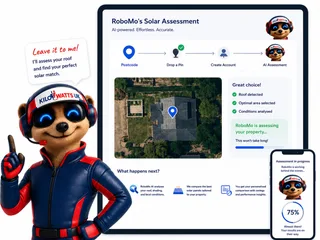
Simply enter your postcode, drop a pin on your roof, create your free account and let RoboMo™ analyse your property to find the best solar panels for your home.

You don't have to think
RoboMo™'s AI analyses your roof and does all the hard work.

Accurate & tailored
AI-powered assessment based on your roof, location, and conditions.

Best options, maximum savings
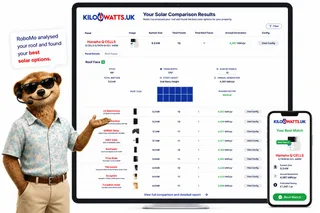
Compare top solar panels for the best performance and value.

Simple, fast & effortless
Provide a few details, sit back and watch your results unfold.
STEP 1
Choose Home, Business or Industrial
Enter your postcode to start your assessment.
STEP 2

Drop a pin on your roof
STEP 3

Create your free account
STEP 4

Sit back and watch RoboMo™ work
RoboMo™ analyses your roof and builds your personalised solar comparison.

Step 1
Enter your postcode
Start designing your wind energy system in seconds.
Are you an installer, distributor or renewable energy business?
Kilowatts UK is expanding the Flower Turbines partner network across the UK.
Become A Flower Turbines PartnerKilowatts UK is an authorised representative
Flower Turbines
Compact vertical-axis turbines built for real UK sites, not just open farmland.
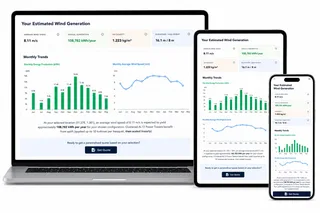
They start in light wind, sit in a small footprint, and are bird-safe by design. Cluster them as a bouquet and the group performs better together than the same turbines standing alone. Enter your postcode for a location-based generation estimate. Figures use area weather data and will differ if buildings, trees or hills sit in the way.
Starts in light UK wind
Built to generate in typical UK wind, not only open farmland.
Small rooftop or ground footprint
Compact towers for roofs, yards and tight sites.
Bird-safe slow rotation
Slow vertical-axis spin, bird-safe by design.
Bouquet clusters raise output
Grouped turbines outperform the same units standing alone.

STEP 2

Choose a location
STEP 3

Place your cluster
Tap the map where you want the turbine cluster to go.
STEP 4

Instant generation forecasts
Compare different turbine layouts and see annual generation forecasts instantly.
STEP 5

No commitment required
Explore different configurations before deciding whether to request a quotation.
Related articles
Mo's Mission Nominations
FAQ
Need Help? RoboMo's Got Answers
What does kWp mean in solar panels?
kWp means kilowatt peak. It is the rated maximum output of a solar panel or solar array under standard test conditions. For example, ten 400 Wp panels make a 4 kWp system. The kWp rating helps describe the size of the solar array, but it does not mean the system will produce that amount of power continuously on a UK roof.
Is kWp the same as kW?
No. kWp is the peak rated capacity of the solar panels under test conditions, while kW is the actual power being generated or used at a specific moment. A 4 kWp solar system might produce close to 4 kW briefly in strong sunlight, but its live output will rise and fall throughout the day depending on weather, season, roof orientation, shading and system design.
Is kWp the same as kWh?
No. kWp measures the peak capacity of the solar panel system, while kWh measures the amount of electricity generated or used over time. If a system produces 3 kW for two hours, it generates 6 kWh. Solar quotes should show both the installed capacity in kWp and the estimated annual generation in kWh.
How do you calculate solar kWp?
Solar kWp is calculated by multiplying the number of panels by the wattage of each panel, then dividing by 1,000. For example, 12 panels rated at 430 Wp each would be 12 × 430 ÷ 1,000 = 5.16 kWp. A clear solar quote should show the panel count, the panel wattage and the total kWp.
How much electricity does 1 kWp of solar generate in the UK?
As a broad guide, 1 kWp of solar panels in the UK may generate around 850 to 1,050 kWh per year. The exact figure depends on location, roof direction, roof pitch, shading, panel layout, inverter efficiency and installation quality. A south-facing, unshaded roof in southern England will usually generate more per kWp than a shaded or poorly oriented roof further north.
How much electricity can a 4 kWp solar system generate?
A typical 4 kWp solar system in the UK might generate roughly 3,400 to 4,200 kWh per year, depending on roof conditions and location. This is an annual estimate, not a guarantee. The system will generate much more in summer than winter and will produce no electricity at night.
Why does a 4 kWp system not produce 4 kW all day?
A 4 kWp system is rated at 4 kW peak under controlled test conditions, not normal day-to-day roof conditions. Real output changes with sunlight, cloud cover, panel temperature, roof angle, shading and the time of year. In good summer conditions it may approach its peak output for a short period, but in winter, cloudy weather or early morning and evening, output will be much lower.
What size solar system is typical for a UK home?
Many UK homes have solar systems between 3 kWp and 6 kWp. Smaller homes may suit around 2 kWp to 3 kWp, while larger homes, electric vehicle owners or households planning a heat pump may consider 5 kWp to 8 kWp or more if roof space, budget and grid connection rules allow. The right size depends on electricity use, roof space, shading, export limits and future energy needs.
How many solar panels do I need for 4 kWp?
The number of panels depends on the wattage of each panel. With 400 Wp panels, a 4 kWp system needs 10 panels. With 450 Wp panels, it would need around 9 panels for approximately 4.05 kWp. Higher-wattage panels can reduce the number of panels needed, which can help when roof space is limited.
How much roof space is needed for a 4 kWp solar system?
A 4 kWp solar system will often need roughly 18 m² to 22 m² of usable roof space, depending on the size and wattage of the panels used. Not all roof space is usable because chimneys, roof windows, dormers, vents, shading, access requirements and roof edges can reduce the area available for panels.
What affects how much electricity each kWp produces?
The main factors are roof direction, roof pitch, shading, location, panel temperature, inverter design, cable losses, panel layout and component quality. Two systems with the same kWp rating can produce different annual kWh if one has a better roof position, less shading or a more suitable design.
Is a higher kWp solar system always better?
Not always. A higher kWp system will usually generate more electricity if installed in similar conditions, but it may not provide the best value if much of the extra generation is exported at a lower rate. The best system size depends on your electricity use, daytime demand, battery plans, roof quality, shading, budget and any Distribution Network Operator export limits.
Is kWp the same as inverter size?
No. Solar panel capacity is usually shown in kWp, while inverter capacity is usually shown in kW or kVA. It is common for the solar panel array to have a higher kWp rating than the inverter’s kW rating. For example, a 4 kWp array may be paired with a 3.68 kW inverter. This can be normal, but the quote should explain the design and any expected clipping or export limitation.
What are standard test conditions for solar panels?
Standard test conditions, often called STC, are controlled laboratory conditions used to rate and compare solar panels. They typically include solar irradiance of 1,000 W/m², a cell temperature of 25°C and an air mass of 1.5. These conditions are useful for comparison, but they do not represent normal year-round UK roof conditions.
What should a solar quote show about kWp?
A good solar quote should show the number of panels, the wattage of each panel, the total kWp, the inverter size, the expected annual generation in kWh, the roof layout, shading assumptions, panel and inverter models, warranties and any grid connection requirements. The quote should make clear that kWp is the installed peak capacity, not guaranteed annual generation.
How does kWp affect solar panel cost?
Larger kWp systems usually cost more overall because they use more panels and mounting equipment, but the cost per kWp can sometimes be lower on larger installations. The final cost also depends on roof type, scaffolding, access, inverter choice, battery storage, electrical upgrades, cable routes, product quality and workmanship standards.
Should I size my solar system to match my annual electricity use?
Not necessarily. Solar generation and household demand do not always happen at the same time, so matching annual kWh use exactly may not give the best result. A better approach is to consider your annual electricity use, daytime consumption, roof potential, battery plans, export tariff, future EV or heat pump plans and the estimated annual generation from each proposed system.