


How much power from a solar panel?
Published: 2026-07-19 16:48:39
Updated: 2026-08-01 07:12:50
2kWh per day across the year, or roughly 300 to 440kWh per year on a reasonably unshaded roof.
How much power does one solar panel produce?
A typical new domestic solar panel in the UK is rated at about 400W to 450W peak. In real use, one 400W panel might average around 0.8 to 1.2kWh per day across the year, or roughly 300 to 440kWh per year on a reasonably unshaded roof. For more context on how these figures scale across a roof, see our guide to annual UK generation.
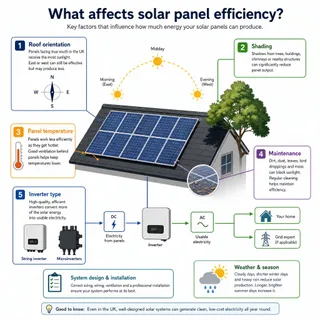
The exact output depends on roof direction, pitch, shading, location, inverter design, weather, season and system losses. The key distinction is that watts describe instant output, while kilowatt-hours describe energy over time.
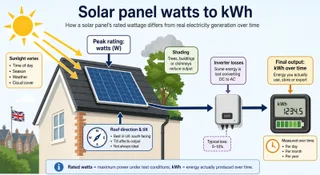
A 400W panel does not produce 400W all day. It may get close to its rated output briefly in strong sun, particularly on a bright cool day, but output rises and falls with sun angle, cloud cover and panel temperature. At night it produces nothing, and in dull winter conditions it may produce only a small fraction of its rating. For electricity bills, the yearly kWh figure is usually more useful than the panel wattage. A panel’s watt rating tells you its peak capacity under test conditions. The kWh figure tells you how much electricity it is likely to generate over a day, month or year.
Watts and kilowatt-hours are not the same thing.
“Power from a solar panel” can mean two different things. It can mean the panel’s instant power in watts, or the total energy it generates in kilowatt-hours. UK electricity bills are measured in kWh, so both terms matter.
A watt is a measure of power at a moment in time. A kilowatt-hour is a measure of energy produced or used over time. If a 400W panel could run at full output for one hour, it would generate 0.4kWh.
The basic terms are straightforward once separated.
W
A watt is a unit of instant power.Wh
A watt-hour is energy produced or used over time.Wp
Watt peak is a panel’s rated output under test conditions.kW
A kilowatt is 1,000 watts.kWh
A kilowatt-hour is 1,000 watt-hours.kWp
Kilowatt peak is the combined rated output of a solar panel array.
For example, ten 400W panels make a 4kWp solar array. That does not mean the system produces 4kW continuously. It means the panels have a combined peak test rating of 4kW under standardised laboratory conditions. If that term is unfamiliar, this guide explains kWp in solar in more detail.
Typical solar panel ratings in the UK.
Most new domestic solar panels installed in the UK are around 350W to 450W each, with some higher-output domestic panels around 450W to 500W. Older systems often use panels rated around 250W to 330W.
A “400W solar panel” means the panel has been rated at 400W under Standard Test Conditions. These laboratory conditions use strong light, a 25°C cell temperature and ideal positioning. Real roofs rarely match those conditions for long, especially in the UK where light levels and weather change throughout the day.
Higher-wattage panels are useful where roof space is limited because they can provide more peak capacity from the same roof area. They do not remove the effect of shade, poor orientation or winter weather. A lower-wattage panel on an excellent unshaded roof can sometimes outperform a higher-wattage panel on a shaded or awkward roof. Modern domestic panels are commonly around 1.7m to 1.9m tall and around 1.0m to 1.2m wide. One panel often covers about 1.8m² to 2.2m², although the usable roof area is reduced by edges, ridges, hips, valleys, roof windows, chimneys and access margins. When comparing panels, do not judge by wattage alone. Look at the manufacturer, product warranty, performance warranty, degradation rate, dimensions, weight, fire rating, mounting compatibility and whether the panel suits the proposed inverter and roof layout.
How much energy can one panel generate in a year?
As a practical UK estimate, a 400W panel on a reasonably unshaded roof might generate around 300 to 440kWh per year. A 350W panel might generate around 260 to 385kWh per year, while a 450W panel might generate around 340 to 495kWh per year.
Those ranges assume a sensible roof position rather than a heavily shaded or badly orientated installation. A south-facing roof is usually toward the higher end. A roof affected by trees, chimneys, dormers or neighbouring buildings may sit below the range.
The UK also has a strong regional effect. Southern England generally receives more solar irradiation than northern Scotland, but local shading can matter more than the broad region. An unshaded roof in northern England or Scotland can still be a good solar site, while a shaded roof in the south can perform poorly. The yearly figure also depends on system downtime, inverter efficiency, cable losses, dirt, bird fouling and long-term panel degradation. These details are less exciting than the panel wattage, but they are often what separates a well-performing installation from a disappointing one. For a deeper look at the variables behind output, see our guide to panel efficiency factors. For a trustworthy estimate, ask the installer what assumptions have been used. A credible quote should be based on roof orientation, pitch, location, shading and system design, not simply the number printed on the panel datasheet.
How much does one panel produce per day?
Across a full UK year, one 400W panel may average around 0.8 to 1.2kWh per day. That average hides a large seasonal swing. A good summer day may produce around 1.5 to 2.5kWh from one 400W panel, while a poor winter day may produce less than 0.2kWh.
This is why daily output can feel inconsistent even when the system is working correctly. June and July are usually among the strongest months, while December and January are usually the weakest. Around 70% of annual solar generation often occurs from March to September.
Solar panels need light, not hot weather. Bright cold days can be productive because high temperatures reduce panel efficiency. In summer, panels may receive strong sunlight but also run hotter, which slightly reduces output compared with the same sunlight at a cooler cell temperature. A single day’s monitoring data should be treated cautiously. Cloud, rain, haze, grid export limits, temporary shading and inverter behaviour can all affect the live figure. Weekly, monthly and annual trends are much better indicators of whether a system is performing as expected.
What does this mean for a full home solar system?
A single panel is useful for understanding the numbers, but most UK homes install several panels as a system. A small home system may be around 2kWp to 3kWp. A common domestic system is around 3kWp to 5kWp. Larger domestic roofs may fit around 6kWp to 8kWp, subject to roof space, electrical design and Distribution Network Operator requirements.
A system with ten 400W panels is a 4kWp array. In the UK, solar systems commonly produce around 750 to 1,100kWh per kWp per year, so a 4kWp system might generate around 3,000 to 4,400kWh per year.
A medium-use UK household is often around 2,700kWh of electricity use per year, so a well-sited 4kWp system can generate a similar amount of electricity over a year. That does not mean the home will use all of it directly. Solar generation is highest during daylight and in summer, while household demand is often higher during evenings and winter. If your real question is whether solar could cover your home’s annual demand, our guide to whole-house solar sizing explains the difference between annual generation and real-time use. Without a battery, some daytime surplus is usually exported to the grid. With a battery, more of the solar generation can be stored for evening use, but the battery does not increase the amount produced by the panels themselves. The useful question for a buyer is not only “How much will the panels generate?” but also “How much of that generation will I use at home?” Self-consumption, export tariff, battery size, EV charging habits and daytime occupancy can all affect the value of the same solar output.
Why a 400W panel rarely gives 400W.
The 400W figure is a peak laboratory rating, not a promise of constant output. On a real UK roof, the panel’s instant output changes minute by minute.
Several conditions affect the live power reading.
- Sun angle changes from morning to evening.
- Cloud can reduce output sharply.
- Heavy rain and dark skies reduce available light.
- Hot panels lose efficiency.
- Shading from chimneys or trees can reduce generation.
- Inverter and cable losses reduce usable AC output.
A panel may briefly approach its rated output in strong sun and cool conditions. It may produce useful electricity under light cloud. Under heavy cloud or in winter low light, it may produce much less. This is normal and does not automatically indicate a fault. If you are checking performance, compare annual generation against a proper yield estimate rather than expecting the system to sit near its peak rating. Monitoring trends over weeks and months is more useful than judging performance from one cloudy afternoon. It is also worth checking whether the monitoring app is showing DC panel output, AC inverter output, household consumption, battery charging or export. Different apps present these figures differently, which can make a healthy system look confusing at first glance. Export limits can curtail surplus generation in some systems.
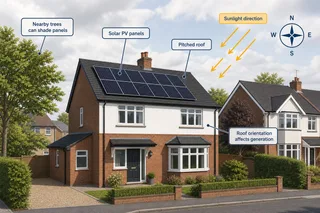
Roof direction, pitch and shading matter.
Roof orientation is one of the biggest practical factors. In the UK, south-facing roofs usually give the highest annual output. South-east and south-west roofs are often still very effective. East-facing roofs generate more in the morning, while west-facing roofs generate more in the afternoon and early evening. The best roof direction depends on whether you want the highest annual output or a generation pattern that better matches when you use electricity.
East-west systems can be a sensible design even if their peak output is lower than a south-facing array. They spread generation across more of the day, which can suit homes that use electricity in the morning and late afternoon.
Roof pitch also matters. A pitch around 30° to 40° is often close to ideal for annual UK output. Lower pitches can favour summer output, while steeper pitches can help winter capture. Flat roofs can work well but usually need mounting frames, ballast or fixings, and enough row spacing to avoid one row shading the next. Shading is often the deciding issue. Chimneys, dormers, trees, nearby buildings, aerials and vent pipes can all reduce output. Even partial shade on one panel can affect a string of panels. Optimisers or microinverters can reduce some shade losses, but they do not remove the shade itself. A good survey should consider shade at different times of day and year. Winter shade is particularly easy to underestimate because the sun is lower in the sky, so objects that barely matter in summer can have a larger effect in December and January.
Inverters, batteries and export affect usable power.
Solar panels produce DC electricity. UK homes use AC electricity, so an inverter converts the power into a usable form. Inverter efficiency is commonly around 95% to 98%, so a small amount of energy is lost during conversion.
The inverter size also affects peak AC output. In some designs, the panel array can be larger than the inverter rating. This may lead to clipping when panel output exceeds inverter capacity, but limited clipping is not always a design fault. Slight inverter undersizing can be a normal way to improve overall system value, depending on the roof and usage pattern.
Batteries change how solar electricity is used. They do not make the panels generate more electricity. Instead, they store surplus daytime generation for later. Common UK home batteries are often around 5kWh to 15kWh, and round-trip losses mean not every kWh stored is returned as usable electricity. If storage is part of the plan, compare expected usage with realistic battery costs before assuming it is essential. Export is another part of the calculation. Surplus solar can be sent to the grid, with payments available through Smart Export Guarantee tariffs. Export rates vary, and export usually needs a smart meter or suitable metering arrangement. In some cases, the Distribution Network Operator may set an export limit, which can affect inverter sizing and system design. Before ordering, ask whether the proposed system requires a G98 notification or G99 application, how export will be controlled, and whether the inverter and battery are compatible with the intended tariff or operating mode. These details do not change the panel’s rating, but they can change how useful the generated electricity is in practice.
Can one panel run household appliances?
One 400W panel cannot usually run a whole home, and it will not normally run high-power appliances by itself in real time. A kettle may use around 2kW to 3kW while boiling, so several panels in strong sun would be needed to cover that instant load.
Smaller or intermittent appliances are different. A fridge may average much less energy over a day than its short running power suggests. A washing machine’s power draw changes during the cycle, with higher demand when heating water. An immersion heater needs much more energy than most small appliances, although a solar diverter can send surplus generation to hot water when available.
This is why self-consumption matters. Using washing machines, dishwashers, EV charging or water heating during daylight can increase the amount of solar electricity used on site. Without a battery, a home with little daytime demand may export a larger share of its generation. It is also why solar should be sized around the whole property, not one appliance. A good design considers annual electricity use, daytime demand, future EV or heat pump plans, roof area, export limits and whether battery storage is likely to be added now or later.
Common mistakes when estimating solar panel power.
The biggest mistake is treating the panel rating as if it were continuous output. A 400W panel is not a 400W generator running all day. It is a panel with a 400W peak test rating, with real output shaped by the roof and weather.
Another mistake is multiplying panel wattage by daylight hours. This overestimates generation because the panel does not receive peak sunlight all day. Output is low in the early morning, rises towards the middle of the day, then falls again.
Homeowners also sometimes focus only on panel wattage and ignore roof layout. A high-output panel squeezed into a shaded section of roof may be less useful than a slightly lower-rated panel in a clean, unshaded position. There are a few practical checks that make estimates more realistic.
- Look at annual kWh, not just peak watts.
- Check shading at different times of day.
- Consider winter sun angles as well as summer sun.
- Match panel strings to similar roof faces.
- Allow for inverter losses and possible export limits.
- Think about when the home actually uses electricity.
A good installer will model the roof, shade, orientation and system design rather than quoting output from panel wattage alone. The estimate should be clear enough that you can see the assumed panel capacity, annual generation, expected self-consumption, export assumptions and any battery effect separately.
What affects whether solar panels are suitable?
Solar panels are often suitable for UK homes with unshaded south, south-east, south-west, east or west-facing roofs. They can be especially useful where there is daytime electricity use, an EV that can charge during daylight, a heat pump, or a plan to add battery storage.
They may be less suitable where the roof is heavily shaded, steeply north-facing, in poor condition, or likely to need replacement soon. Flats, leasehold homes, listed buildings and properties in sensitive planning areas can also be more complex.
Suitability is not just about generation. It also depends on how much electricity the property uses, when it uses it, what export tariff is available, whether a battery is included, and how long the owner expects to remain in the property. A single extra panel is rarely priced simply by dividing the full system cost by the number of panels. Scaffolding, design, certification, inverter equipment, electrical work and labour are shared system costs. That is why a one-panel roof installation is usually uneconomic for a standard house, even though one panel can generate a measurable amount of electricity. For buyer protection, check that any installer explains the design assumptions, product warranties, workmanship warranty, handover documents, electrical certification, monitoring setup and route to export payments. If an installer claims unrealistic output or guaranteed bill savings without looking at the roof and consumption pattern, treat that as a warning sign. If you are ready to look at real designs, you can compare home solar options based on your property rather than panel wattage alone.
The practical answer for UK homeowners.
For most UK homeowners, the simple answer is that one modern solar panel is usually rated around 400W to 450W peak, but a typical 400W panel is more realistically thought of as producing around 300 to 440kWh per year on a reasonably good roof.
A full system is easier to judge in kWp and annual kWh. Ten 400W panels make a 4kWp system, which might generate around 3,000 to 4,400kWh per year in the UK. How valuable that electricity is depends on how much is used at home, how much is exported, whether there is a battery, and how well the system is designed around the roof.
If you are comparing options, ask for an annual generation estimate, a shade assessment, the assumed panel rating, inverter size, export arrangement and expected self-consumption. Those details will tell you far more than the wattage printed on the panel datasheet. For a property-specific starting point, you can book a survey.
Plan, Compare & Buy Renewable Energy Solutions
AI does the thinking.
You get the perfect solar match.
Use RoboMo™ to assess your property, compare available technologies and connect with trusted UK installers, suppliers and manufacturers.
Simply enter your postcode, drop a pin on your roof, create your free account and let RoboMo™ analyse your property to find the best solar panels for your home.

You don't have to think
RoboMo™'s AI analyses your roof and does all the hard work.

Accurate & tailored
AI-powered assessment based on your roof, location, and conditions.

Best options, maximum savings
Compare top solar panels for the best performance and value.

Simple, fast & effortless
Provide a few details, sit back and watch your results unfold.
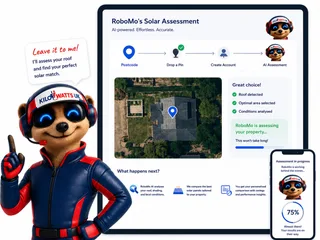
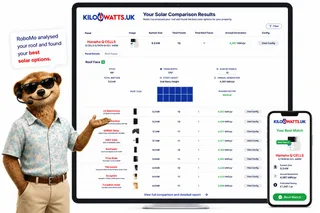
STEP 1
Choose Home, Business or Industrial
Enter your postcode to start your assessment.
STEP 2

Drop a pin on your roof
STEP 3

Create your free account
STEP 4

Sit back and watch RoboMo™ work
RoboMo™ analyses your roof and builds your personalised solar comparison.

Kilowatts UK is an authorised representative
Flower Turbines
Compact vertical-axis turbines built for real UK sites, not just open farmland.
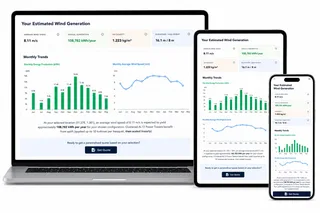
They start in light wind, sit in a small footprint, and are bird-safe by design. Cluster them as a bouquet and the group performs better together than the same turbines standing alone. Enter your postcode for a location-based generation estimate. Figures use area weather data and will differ if buildings, trees or hills sit in the way.
Starts in light UK wind
Built to generate in typical UK wind, not only open farmland.
Small rooftop or ground footprint
Compact towers for roofs, yards and tight sites.
Bird-safe slow rotation
Slow vertical-axis spin, bird-safe by design.
Bouquet clusters raise output
Grouped turbines outperform the same units standing alone.

Step 1
Enter your postcode
Start designing your wind energy system in seconds.
STEP 2

Choose a location
STEP 3

Place your cluster
Tap the map where you want the turbine cluster to go.
STEP 4

Instant generation forecasts
Compare different turbine layouts and see annual generation forecasts instantly.
STEP 5

No commitment required
Explore different configurations before deciding whether to request a quotation.
Related articles
Mo's Mission Nominations
FAQ
Need Help? RoboMo's Got Answers
How much power does one solar panel produce in the UK?
A typical modern domestic solar panel in the UK is rated at around 400W to 450W peak. This is its maximum rated output under standard test conditions, not what it will produce continuously on a roof. In real UK conditions, a 400W panel might produce roughly 250W to 380W in strong daylight, much less in cloud, and almost nothing at night. Over a year, one 400W panel on a reasonably suitable roof often generates around 300kWh to 440kWh of electricity.
Does a 400W solar panel produce 400W all day?
No. A 400W solar panel is rated at 400W peak, which means it can reach that output only under ideal test-style conditions. Actual output rises and falls throughout the day as the sun angle changes, clouds pass, the panel warms up, and shading affects the roof. In the UK, annual generation in kilowatt-hours is usually a more useful figure than the panel’s peak wattage.
What is the difference between watts and kilowatt-hours for solar panels?
Watts measure instant power at a specific moment, while kilowatt-hours measure energy produced or used over time. For example, if a 400W panel could run at full output for one hour, it would generate 0.4kWh. Solar panel ratings are given in watts or kilowatts peak, but electricity bills and annual generation estimates are usually measured in kilowatt-hours.
What does watt peak mean on a solar panel?
Watt peak, often written as Wp, is the rated maximum output of a solar panel under standard laboratory test conditions. A 400Wp panel has been tested and rated to produce 400W in those conditions, but real roof output is usually lower and constantly changing. For a full system, panel ratings are combined into kilowatt peak, or kWp, so ten 400W panels make a 4kWp solar array.
How much electricity does one solar panel generate per year?
One modern 400W solar panel may generate roughly 300kWh to 440kWh per year on many suitable UK roofs. The exact figure depends on roof direction, pitch, shading, location, inverter losses, weather, system design, and installation quality. A strong south-facing roof in a sunnier part of the UK may sit toward the upper end, while a shaded or awkward roof may produce less.
How much electricity does one solar panel generate per day?
Across a full UK year, one 400W panel may average around 0.8kWh to 1.2kWh per day. This average hides a large seasonal difference: a good summer day may produce around 1.5kWh to 2.5kWh from one panel, while a dull winter day may produce less than 0.2kWh. Monthly and annual generation figures are usually more reliable than judging performance from a single day.
Can one solar panel power a house?
One solar panel will not normally power a whole home by itself. It can help cover small daytime loads such as a router, laptop, LED lighting, phone chargers, or part of a fridge-freezer’s running demand, but it will not reliably run high-power appliances such as kettles, ovens, electric showers, tumble dryers, or washing machines at full load. Most homes need a multi-panel solar system to make a meaningful reduction in grid electricity use.
What can a 400W solar panel run?
In good daylight, a 400W solar panel can help run smaller electrical loads such as a broadband router, laptop, phone chargers, LED lights, or some of a fridge-freezer’s demand. If an appliance needs more power than the panel is producing at that moment, the home imports the difference from the grid. If the panel produces more than the home is using, the surplus may be exported to the grid or stored in a battery if one is installed.
Can one solar panel run a kettle or oven?
Usually not by itself. A kettle may use around 2kW to 3kW while boiling, and an electric oven can also draw far more than one panel can provide in real time. A 400W panel can still contribute to the home’s total electricity use, but high-power appliances normally need support from the grid, a battery, or a larger solar array.
Do solar panels work on cloudy days?
Yes, solar panels work on cloudy days because they use daylight rather than heat. However, output is much lower when light levels are poor. A panel may still produce a useful amount in bright overcast conditions, but generation will fall significantly in heavy cloud, rain, fog, or dull winter weather.
Why does solar panel output vary so much in the UK?
Solar panel output varies because UK daylight changes significantly by season, weather, roof direction, roof pitch, shading, and location. Panels usually generate much more electricity in spring and summer than in winter because days are longer and the sun is higher. Shading from trees, chimneys, dormers, neighbouring buildings, aerials, or roof features can also reduce output, especially when the sun is low.
Which roof direction is best for solar panels in the UK?
A south-facing roof usually gives the highest annual solar generation in the UK. South-east and south-west roofs can also perform very well, while east and west-facing roofs can be useful because they spread generation into the morning and afternoon. North-facing roofs generally produce less and need careful assessment before installation.
What roof pitch is best for solar panels in the UK?
A roof pitch of around 30 to 40 degrees is often close to ideal for annual solar generation in the UK, but good results are possible outside that range. Shallower roofs can favour summer generation, while steeper roofs can capture more low winter sun. Flat roofs can work well if the panels are mounted safely with the right angle, spacing, ballast or fixings, and shading control between rows.
How many solar panels does a typical UK home need?
Many UK homes install a system of around 3kWp to 5kWp, which might mean roughly 7 to 12 modern panels depending on the panel rating. Larger homes, higher electricity users, EV owners, or heat pump households may benefit from a 5kWp to 8kWp system if the roof, budget, electrical design, and grid connection allow it. The right number of panels depends on usable roof area, shading, electricity use, inverter sizing, export arrangements, and whether battery storage is included.
Is a higher-wattage solar panel always better?
Not always. Higher-wattage panels can be useful where roof space is limited, but the overall system design is more important than the wattage of one panel. Roof layout, shading, inverter choice, panel orientation, ventilation, mounting quality, and installation workmanship all affect real-world generation. A well-designed system using slightly lower-wattage panels can outperform a poorly designed system using higher-wattage panels.
How much electricity does a 4kWp solar system generate?
A 4kWp solar system on a suitable UK roof typically generates about 3,000kWh to 4,400kWh per year. The exact figure depends on location, orientation, pitch, shading, inverter performance, system losses, and design quality. A 4kWp system commonly uses around 9 to 11 modern panels, depending on the wattage of each panel.
Does a solar battery increase panel output?
No. A solar battery does not increase how much electricity the panels generate. It stores unused solar electricity so it can be used later, usually in the evening or overnight. A battery can improve how much of the solar energy a home uses itself, but it does not change the amount of daylight reaching the panels or increase the panel output.
What happens to solar electricity I do not use?
If your solar panels produce more electricity than your home is using at that moment, the surplus can usually be exported to the grid, stored in a battery, or diverted to another load such as hot water if suitable equipment is installed. Export payments may be available through a Smart Export Guarantee tariff, but rates and eligibility vary. The value of a solar system depends not only on how much it generates, but also on how much you use on site and how much you export.
Do inverters affect solar panel output?
Yes, inverters affect the usable AC electricity from a solar system because they convert the panels’ DC electricity into AC electricity for the home. Inverter efficiency is commonly around 95% to 98%, so a small amount of energy is lost during conversion. Inverter sizing can also affect peak output, and some systems are designed with a panel array larger than the inverter rating, which may cause limited clipping at peak times but can still be a sensible design choice.
Can one solar panel charge an electric car?
One solar panel can make only a small contribution to EV charging. A 400W panel generating around 300kWh to 440kWh per year may provide a limited amount of annual driving energy, but it will not be enough for most EV charging needs by itself. A larger solar system, smart charger, battery, or time-of-use tariff is usually needed to make solar EV charging more effective.
Can solar panels run a heat pump?
Solar panels can help reduce the electricity imported by a heat pump, but they should not be expected to cover winter heating demand on their own. Heat pump electricity use is highest in winter, when solar generation is lowest. Solar can still reduce annual electricity costs, but the system should be modelled carefully if it is being installed alongside a heat pump.
How can I estimate solar panel output for my roof?
A rough UK estimate is that one 400W panel may generate about 300kWh to 440kWh per year on a suitable roof. For a more accurate estimate, the calculation should include postcode, roof direction, pitch, shading, roof condition, usable area, inverter choice, panel specification, and expected system losses. A professional survey should also consider consumer unit suitability, mounting requirements, cable routes, DNO requirements, and expected self-consumption.
What should I compare when looking at solar quotes?
Compare the total system size in kWp, expected annual generation in kWh, panel and inverter specifications, roof orientation and pitch assumptions, shading assumptions, battery recommendations, monitoring options, warranties, export arrangements, and any DNO requirements. It is also important to check whether the quote explains how much electricity you are likely to use on site rather than simply how much the system may generate.
Why is annual kWh more useful than panel wattage?
Annual kWh is more useful because it estimates how much electricity the system will actually generate over time. Panel wattage only tells you the peak test rating of the equipment. Two systems with the same panel wattage can produce different annual kWh if one roof is shaded, poorly orientated, badly designed, or affected by inverter limitations.
How do I know if my solar panels are performing properly?
The best way to check performance is to compare actual generation with the installer’s expected annual or monthly yield estimate, allowing for weather differences. A low output reading on a cloudy afternoon is not automatically a fault. Monitoring over weeks and months is more meaningful, and it is important to understand whether the app is showing panel output, inverter output, household consumption, battery charging, or grid export.