


Can solar panels power a whole house
Published: 2026-02-26 23:03:05
Updated: 2026-02-26 23:35:04
Find out can solar panels power whole house uk in the UK, including costs, what affects price, and how to choose an installer.
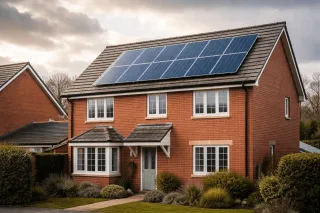
Can solar panels power a whole house in the UK
In the UK, powering a whole house usually means covering most or all annual electricity use with solar generation. It rarely means going fully off grid. Most homes stay connected to the grid even with large solar and batteries. If you want a quick way to compare panel options and assumptions, use the solar PV comparison tool. [cta: solar]
What powering a whole house actually means
The following points summarise the most important takeaways:
Fully off grid
You rely on oversized solar and batteries, and often a generator, which is uncommon in UK towns and suburbs.Whole house every day
Your home can run on solar and storage most days, but still needs the grid in winter and at night.Whole house on an annual basis
Your solar system generates about as many kWh over a year as your home uses.
Typical UK electricity use to compare against
The following points summarise the most important takeaways:
Higher use homes
Often 5,000 to 8,000 kWh per year if you have an EV, more occupants, or higher daily use.Average household use
Around 2,700 to 3,500 kWh per year for electricity.Electric heating impact
Electric heating loads can exceed 10,000 kWh per year, which is hard to cover with typical roof space.
Typical UK solar output ranges
For more context on how output varies by roof and location, see how many solar panels a UK home needs.
4 kWp Scotland
Roughly 2,800 to 3,500 kWh per year.Larger roof systems
6 kWp to 8 kWp can generate about 5,000 to 7,500 kWh per year in good southern locations.4 kWp southern England
Roughly 3,400 to 4,200 kWh per year.Typical domestic system size
3.5 kWp to 5 kWp is common for UK homes.
Roof and site factors that decide whether it works
The following points summarise the most important takeaways:
Shading
Chimneys, trees, and nearby buildings can reduce performance by 5 to 30 percent or more.East west roofs
Lower peak output but generation is spread more evenly across the day.Regional daylight
The same system can produce materially different annual kWh between southern England and Scotland.North facing roofs
Usually poor output unless the roof is very shallow and unshaded.Orientation and tilt
South facing at around 30 to 40 degrees usually produces the best yield in the UK.

Daytime generation vs evening use
Solar panels generate electricity in daylight hours. Peak generation is typically late morning to mid afternoon. Evening demand often exceeds solar output without a battery. This is why a system can meet annual kWh but still import electricity at night. For the basics, see how solar panels work in the UK.
How battery storage changes the answer
If you are focused on resilience and using stored energy in the evening, see residential backup systems.
Typical battery sizes
5 kWh to 15 kWh usable is common for homes.Higher self sufficiency
Larger homes with EVs or heat pumps may need 15 kWh to 30 kWh for more coverage.What batteries do not do
They do not increase annual solar generation, only how much is used on site.Self consumption with a battery
A 5 kWh to 10 kWh battery can push self use to roughly 60 to 80 percent.Self consumption without a battery
Many UK homes use about 30 to 50 percent of their solar directly.
Why most UK homes still need the grid in winter
UK solar output in December and January can be 70 to 90 percent lower than peak summer months. Even large systems may not cover winter demand without oversizing the array and storage. This is why most households use the grid as seasonal backup rather than trying to eliminate it entirely.
Typical UK costs and what moves the price
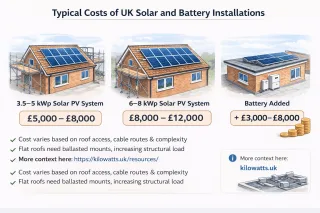
A typical 3.5 to 5 kWp system is often around £5,000 to £8,000 installed depending on specification. A larger 6 to 8 kWp system is often around £8,000 to £12,000 or more. Adding a battery often adds roughly £3,000 to £8,000 depending on size and brand. Prices move based on roof access, scaffold requirements, cabling routes, and site complexity. Flat roofs can need ballasted mounting which increases structural load and can add complexity. If you want broader context on cost drivers and assumptions, see are solar panels worth it in the UK in 2026.
Practical design details homeowners often do not hear early
The following points summarise the most important takeaways:
Inverter sizing
Inverters are sometimes sized slightly below panel capacity to improve real world efficiency.Export limitation
Export can be capped to meet network limits without reducing generation.Shading mitigation
Microinverters or optimisers can reduce shading losses compared to a single string inverter.DC to AC oversizing
Ratios around 1.1 to 1.3 are common in system design.Electrical constraints
Consumer unit capacity, earthing, and cable runs can affect what is practical.
UK permissions and grid rules that can affect system size
Planning permission is not usually required for typical roof mounted solar under permitted development. Listed buildings and conservation areas may have additional restrictions. DNO notification is required for most installations. Systems above 3.68 kW per phase typically require a G99 application approval before installation. Export may be limited depending on local network capacity. Three phase properties can make larger system designs easier than single phase in some cases.
Who this is suitable for
The following points summarise the most important takeaways:
Best fit households
Homes with predictable electricity use and enough unshaded roof area.Harder to cover fully
Homes with high electric heating loads or limited roof space.Strong fit with a battery
Homes that are empty during the day and use more energy in the evening.Strong fit without a battery
Homes that use more electricity during the day.
Common UK misconceptions that affect decisions
The following points summarise the most important takeaways:
Going off grid is normal
Most UK systems remain grid connected due to winter shortfall and reliability needs.A battery makes more solar
A battery increases self consumption but does not increase generation.Solar does not work in cloud
Solar generates from daylight, not heat, but output is lower in winter.You need to match peak demand
Annual generation vs annual usage is usually the key comparison for grid connected homes.
How to compare installers and quotes like for like
If you want to shortlist providers, you can browse the electrical company and electrician directory and filter for solar and battery experience.
Battery scope
Confirm usable kWh, warranty terms, and whether the battery is sized for your evening load.System size basis
Confirm the quoted kWp and expected annual kWh are based on your roof and location.Export constraints
Ask whether export will be limited and how that impacts the proposed design.Shading assumptions
Check whether shading has been assessed and how it is handled in the design.Access and scaffolding
Confirm whether scaffolding, roof works, and cable routes are included in the price.
Ready to compare your options?
Get tailored comparisons and connect with trusted installers in under a minute.
Plan, Compare & Buy Renewable Energy Solutions
AI does the thinking.
You get the perfect solar match.
Use RoboMo™ to assess your property, compare available technologies and connect with trusted UK installers, suppliers and manufacturers.
Simply enter your postcode, drop a pin on your roof, create your free account and let RoboMo™ analyse your property to find the best solar panels for your home.

You don't have to think
RoboMo™'s AI analyses your roof and does all the hard work.

Accurate & tailored
AI-powered assessment based on your roof, location, and conditions.

Best options, maximum savings
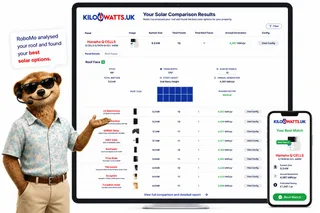
Compare top solar panels for the best performance and value.

Simple, fast & effortless
Provide a few details, sit back and watch your results unfold.
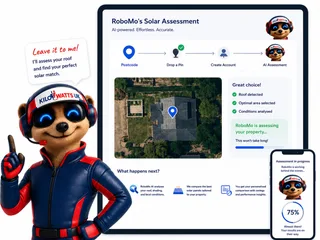
STEP 1
Choose Home, Business or Industrial
Enter your postcode to start your assessment.
STEP 2
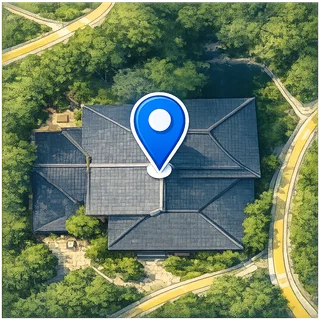
Drop a pin on your roof
STEP 3

Create your free account
STEP 4

Sit back and watch RoboMo™ work
RoboMo™ analyses your roof and builds your personalised solar comparison.

Step 1
Enter your postcode
Start designing your wind energy system in seconds.
Are you an installer, distributor or renewable energy business?
Kilowatts UK is expanding the Flower Turbines partner network across the UK.
Become A Flower Turbines PartnerKilowatts UK is an authorised representative
Flower Turbines
Compact vertical-axis turbines built for real UK sites, not just open farmland.
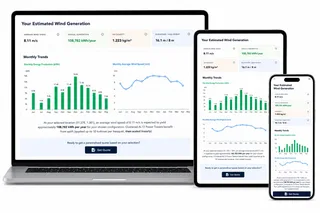
They start in light wind, sit in a small footprint, and are bird-safe by design. Cluster them as a bouquet and the group performs better together than the same turbines standing alone. Enter your postcode for a location-based generation estimate. Figures use area weather data and will differ if buildings, trees or hills sit in the way.
Starts in light UK wind
Built to generate in typical UK wind, not only open farmland.
Small rooftop or ground footprint
Compact towers for roofs, yards and tight sites.
Bird-safe slow rotation
Slow vertical-axis spin, bird-safe by design.
Bouquet clusters raise output
Grouped turbines outperform the same units standing alone.

STEP 2

Choose a location
STEP 3
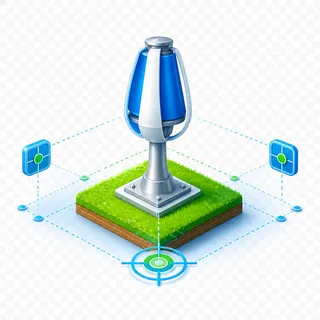
Place your cluster
Tap the map where you want the turbine cluster to go.
STEP 4

Instant generation forecasts
Compare different turbine layouts and see annual generation forecasts instantly.
STEP 5

No commitment required
Explore different configurations before deciding whether to request a quotation.
Related articles

Mo's Mission Nominations
FAQ
Need Help? RoboMo's Got Answers
Can solar panels power a whole house in the UK?
In the UK, powering a whole house usually means covering most or all annual electricity use with solar generation rather than going fully off grid. Most homes remain connected to the grid even with large solar systems and batteries, because generation and demand do not always line up during the day or across seasons.
How much electricity does a typical UK home use?
An average UK household uses roughly 2,700 to 3,500 kWh of electricity per year, although this can rise to 5,000 to 8,000 kWh or more if you have an electric vehicle, higher occupancy, or electric heating. Matching solar output to annual consumption is the key comparison for most grid-connected homes.
How much can a typical UK solar system generate?
A common 3.5 to 5 kWp system can generate around 3,000 to 4,500 kWh per year depending on location, roof orientation, and shading. In southern England output is usually higher than in Scotland, and larger 6 to 8 kWp systems can exceed 5,000 kWh per year in favourable conditions. For more detail on sizing, seehow many solar panels a UK home needs.
Why does a home still import electricity at night?
Solar panels only generate electricity in daylight hours, with peak production typically between late morning and mid afternoon. Evening demand often exceeds solar output without storage, so homes import from the grid even if annual generation roughly matches annual use. For a technical overview, seehow solar panels work in the UK.
Do I need a battery to power my whole house?
A battery is not required to match annual electricity use, but it increases how much of your solar you can use in the evening. Without a battery, many UK homes directly use around 30 to 50 percent of what they generate, whereas adding storage can significantly increase self-consumption and resilience. For systems designed with backup in mind, seeresidential backup systems.