


What is kWp in solar panels?
Published: 2026-09-22 20:05:09
Updated: 2026-09-24 01:14:59
kWp means kilowatt peak. In solar PV, it is the rated maximum DC output of a solar panel or array under standard test conditions.
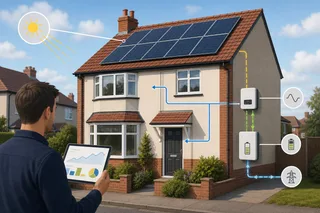
What is kwp?
Understand what is kwp in the UK, with clear explanations, examples, and practical next steps.
What is kWp in solar panels?
kWp means kilowatt peak. In solar PV, it is the rated maximum DC output of a solar panel or array under standard test conditions. It is not the amount of electricity the system will produce all the time. If you see kWp on a UK solar quote, treat it as the system’s capacity label, not a promise of constant generation.
A 4 kWp solar PV system has a laboratory-rated peak panel capacity of 4 kilowatts. Real output rises and falls through the day and year. Sunlight, temperature, shading, roof direction, roof pitch, inverter design and local weather all affect it.
kWp helps you compare solar system sizes. On its own, it does not tell you annual generation, bill savings or payback. For those, you need a site-specific generation estimate in kWh, realistic self-consumption assumptions, export assumptions and a design that suits the property.
What standard test conditions mean.
Solar panel manufacturers rate kWp under standard test conditions, often shortened to STC. These are controlled laboratory conditions used to compare panels consistently on datasheets. The usual STC reference is 1,000 W/m² solar irradiance, 25°C cell temperature and an AM1.5 light spectrum.
Those conditions are useful for comparing panels, but a UK roof rarely behaves like a test bench. Irradiance changes with clouds, season, time of day and roof angle. Panel cell temperature is often above 25°C in bright sun, which can reduce output compared with the datasheet rating. Shading, soiling and electrical design also affect the result, so it helps to understand what affects solar output.
This is why kWp is best read as a standardised rating, not a forecast. A higher kWp array has more rated capacity, but useful output depends on how that capacity is installed and modelled.
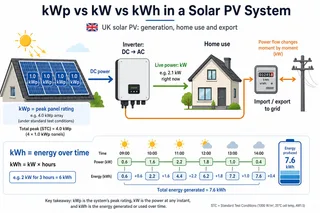
kWp, kW and kWh are not the same thing.
Solar quotes can be confusing because similar-looking units describe different parts of the system. The distinction matters. Panel capacity, inverter power and energy generation are not interchangeable. kWp is the peak DC rating of the solar panels under standard test conditions. kW is a unit of instantaneous power, often used for inverter output, appliance load or export capacity. kWh is a unit of energy over time. It appears on electricity bills, generation estimates and smart meter data.
Overview
A proposal might show a 4 kWp panel array with an inverter rated below 4 kW. That is not automatically wrong. Panels do not run at peak output for most of the year, so a sensibly matched inverter can still be suitable. The key is whether the design, export assumptions and expected clipping are explained clearly.
How panel ratings add up to system kWp.
Each solar panel has its own watt peak rating, usually written as Wp. The total kWp of the array is the sum of the panel ratings divided by 1,000, because 1 kWp equals 1,000 watts peak.
For example, a 400 Wp panel is 0.4 kWp. Ten panels of that rating make a 4 kWp solar array. The arithmetic is simple, but good design is not just a matter of filling the roof with as many panels as possible.
Roof shape often decides the usable kWp before budget does. Chimneys, dormers, roof windows, valleys, roof edges, access requirements and shaded areas can all reduce how many panels can be installed neatly and safely. A useful quote should show the total kWp, panel count, panel model and proposed layout.
How much electricity does 1 kWp generate in the UK?
There is no single guaranteed UK figure for 1 kWp of solar because generation depends on the site. As a broad early-stage estimate, UK solar output is often discussed at around 750 to 1,100 kWh per kWp per year. A final proposal should use site-specific modelling rather than a national average, especially when estimating how much panels generate.
A south-facing, largely unshaded roof in a sunnier part of the UK will usually produce more than the same kWp array on a shaded or less favourably oriented roof. East-west systems can still work well, especially where household use is spread across morning and afternoon. Their daily and seasonal generation profile will differ from a south-facing roof.
A simple illustrative example is a 4 kWp system. Using the broad early-stage range above, it might be discussed at around 3,000 to 4,400 kWh per year before site-specific modelling. That does not mean the household will use all of that electricity on site. Some may be used directly, some may charge a battery if one is fitted, and some may be exported.
A worked example for reading a quote.
Imagine a UK homeowner is comparing a quote for ten 400 Wp panels. The panel calculation is ten multiplied by 400 Wp, giving 4,000 Wp, or 4 kWp. That tells you the rated panel capacity. It does not yet tell you whether the proposal is good value or well designed.
The next step is to look at the annual generation estimate in kWh and the assumptions behind it. A credible estimate should reflect the roof orientation, roof pitch, location, shading and system losses. If the quote uses a generic output figure without explaining the site inputs, the kWp headline may be doing too much of the selling.
Self-consumption is the next practical issue. A household that uses electricity during the day may consume more solar generation directly than a household that is usually empty until evening. A battery can shift some surplus daytime generation into later use, but it does not increase the array’s kWp or create winter sunlight.
Why the same kWp system can perform differently.
Two homes can both have a 4 kWp solar PV system and still see different annual generation. The kWp label does not include roof orientation, shading pattern, local weather, cable routes, inverter settings or how the household uses energy during the day.
Installers should look at the whole site before treating kWp as meaningful. A roof with partial shade from a chimney may need a different string design from an open roof. A roof split across east and west elevations may have a flatter generation curve than a south-facing roof. That can be useful for some households, even if the annual total differs.
The main factors that change real-world output are usually practical and visible during survey.
This is why a site survey, roof plan and generation estimate are more useful than kWp alone. If a quote only highlights the biggest possible system size without explaining the assumptions, ask for more detail.
UK references that help make kWp estimates credible.
For UK solar quotes, kWp should be connected to recognised estimating methods and documentation rather than treated as a claim by itself. Manufacturer datasheets normally state panel power ratings under standard test conditions, which is why Wp and kWp can be compared across panel models.
For domestic performance estimates, installers commonly use industry calculation approaches that account for location, orientation, pitch, shading and system losses. MCS guidance and SAP-related solar yield assumptions are often used in the UK context, although the exact calculation shown on a proposal depends on the installer’s software and method.
Grid connection is a separate issue from panel kWp. Distribution Network Operator processes are commonly discussed through Engineering Recommendation G98 and G99 routes, depending on the inverter and connection arrangement. A homeowner does not need to become a grid-connection specialist, but the quote should make clear what notification, application, export limit or approval assumption is being used.
Is a bigger kWp system always better?
A bigger kWp system can be better where the roof, budget, grid connection and electricity use support it. It is not automatically better value. The benefit depends on how much of the extra generation you can use or export, and whether the added panels are going onto good roof space.
For many UK homes, the best system balances roof quality, generation profile, self-consumption, inverter design, export arrangements and future electrical loads. Extra panels may make sense if you are planning an EV charger, battery or heat pump, but those decisions should be modelled rather than assumed.
There are also cases where a smaller, cleaner design is the better option. Panels squeezed into awkward shaded spaces can add kWp on paper without adding proportionate useful generation. A well-designed array on the best roof faces can outperform a larger but compromised layout.
Why inverter size may not match panel kWp.
Solar panels are rated on the DC side, while most homes use AC electricity after the inverter has converted it. Because panels rarely operate at their laboratory peak rating in UK conditions, the inverter kW rating does not always need to equal the panel kWp exactly.
Some systems have more panel kWp than inverter kW, a design approach often called DC oversizing. Done carefully, this can help the inverter work effectively in lower-light conditions. Taken too far, it can lead to clipping, where the inverter reaches its output limit and cannot pass through all available peak generation at that moment.
DNO processes are usually more closely related to inverter output and export capacity than to panel kWp alone. For domestic grid-connected systems, an installer should handle the appropriate notification or application route for the design. Homeowners should still ask what export limit, inverter setting or DNO approval assumption is included in the quote.
How kWp affects batteries, EVs and heat pumps.
Solar kWp affects how much electricity your array can generate, but it does not mean a battery, EV charger or heat pump will always be powered directly by solar. These technologies have different power demands and timing patterns. The match depends on when electricity is generated and when it is used.
A battery can store surplus solar generation for later use, but it does not change the kWp rating of the solar array. It changes how much of the generated kWh may be used on site. This can help where daytime solar generation does not line up with evening household demand, especially if you understand how home batteries work.
For EV charging and heat pumps, the key issue is timing and load size. Solar can contribute meaningfully over the year, but a cloudy winter evening is very different from a bright summer afternoon. If you are planning these loads, ask for modelling that shows likely generation, self-consumption and export rather than relying on kWp alone.
What to check on a solar quote.
When comparing UK solar quotes, kWp is a useful starting point, but it should sit alongside the design assumptions. A credible proposal should make clear how the kWp figure has been calculated and what annual generation it is expected to produce at your property.
The quote should also explain the equipment layout and any electrical assumptions. If the installer proposes a particular inverter size, export limit, battery arrangement or panel layout, those choices should make sense for your roof and usage pattern.
Do not treat the highest kWp quote as the automatic winner. Compare how each proposal uses the best roof areas, how it handles shading and whether the financial assumptions are clearly separated from the technical design.
Common mistakes when comparing kWp.
Many poor solar decisions start with treating kWp as the only meaningful number. It is important, but it is only one part of the system design. The best proposal is not always the one with the largest array or the neatest headline saving.
A common issue is comparing two quotes with the same kWp but different assumptions. One may include shading losses, a realistic self-consumption estimate and a clear export assumption. Another may use optimistic annual generation or savings figures that do not match the household’s actual electricity use.
The safest approach is to ask each installer to explain the design in plain terms. If the answer relies only on “more kWp is better”, the quote may not be giving you enough information.
Practical next steps if you are comparing kWp figures.
Start by matching the kWp figure to your actual roof and electricity use. Your annual electricity consumption in kWh, the times you use power and your available roof area will usually tell you more than a headline system size on its own. Roof angle and orientation are central to that assessment, so it is worth checking which way panels face.
If you already have quotes, compare the panel layout, annual generation estimate, inverter rating, export assumptions and self-consumption assumptions side by side. If you do not yet have quotes, gather your electricity bill data and think about future loads such as an EV, heat pump or battery before speaking to installers. If an electric car is part of your plan, factor in the practical steps to install an EV charger.
The best question is not simply “how many kWp can I fit?” A better question is “what system size gives sensible generation, usable output and a design that suits this property?” That framing will help you read solar quotes more confidently and avoid mistaking panel capacity for guaranteed performance. If you want to move from kWp theory to a tailored design, you can compare home solar options.
Plan, Compare & Buy Renewable Energy Solutions
AI does the thinking.
You get the perfect solar match.
Use RoboMo™ to assess your property, compare available technologies and connect with trusted UK installers, suppliers and manufacturers.
Simply enter your postcode, drop a pin on your roof, create your free account and let RoboMo™ analyse your property to find the best solar panels for your home.

You don't have to think
RoboMo™'s AI analyses your roof and does all the hard work.

Accurate & tailored
AI-powered assessment based on your roof, location, and conditions.

Best options, maximum savings
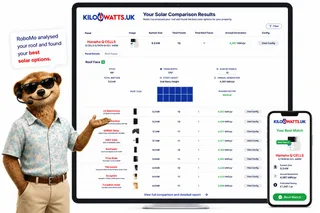
Compare top solar panels for the best performance and value.

Simple, fast & effortless
Provide a few details, sit back and watch your results unfold.
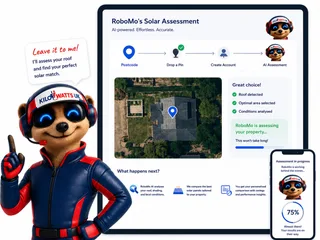
STEP 1
Choose Home, Business or Industrial
Enter your postcode to start your assessment.
STEP 2

Drop a pin on your roof
STEP 3

Create your free account
STEP 4

Sit back and watch RoboMo™ work
RoboMo™ analyses your roof and builds your personalised solar comparison.

Kilowatts UK is an authorised representative
Flower Turbines
Compact vertical-axis turbines built for real UK sites, not just open farmland.
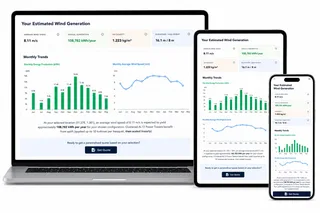
They start in light wind, sit in a small footprint, and are bird-safe by design. Cluster them as a bouquet and the group performs better together than the same turbines standing alone. Enter your postcode for a location-based generation estimate. Figures use area weather data and will differ if buildings, trees or hills sit in the way.
Starts in light UK wind
Built to generate in typical UK wind, not only open farmland.
Small rooftop or ground footprint
Compact towers for roofs, yards and tight sites.
Bird-safe slow rotation
Slow vertical-axis spin, bird-safe by design.
Bouquet clusters raise output
Grouped turbines outperform the same units standing alone.

Step 1
Enter your postcode
Start designing your wind energy system in seconds.
STEP 2

Choose a location
STEP 3

Place your cluster
Tap the map where you want the turbine cluster to go.
STEP 4

Instant generation forecasts
Compare different turbine layouts and see annual generation forecasts instantly.
STEP 5

No commitment required
Explore different configurations before deciding whether to request a quotation.
Related articles


Mo's Mission Nominations
FAQ
Need Help? RoboMo's Got Answers
What does kWp mean on a solar panel quote?
kWp means kilowatt peak. It is the rated maximum DC output of the solar panels under standard test conditions. It is a capacity label, not a guarantee that the system will produce that power all the time.
What is the difference between kWp, kW and kWh?
kWp is the peak rated capacity of the solar panel array. kW is instantaneous power, often used for inverter output or appliance demand. kWh is energy used or generated over time, which is what you see on electricity bills and solar generation forecasts.
How do I calculate the kWp of a solar system?
Add together the watt peak rating of all the panels, then divide by 1,000. For example, ten 400 Wp panels make 4,000 Wp, or 4 kWp. The quote should also show the panel model, panel count and proposed roof layout.
How much electricity does 1 kWp generate in the UK?
There is no fixed figure because output depends on location, roof direction, pitch, shading and system design. As a broad early-stage guide, UK solar output is often discussed at around 750 to 1,100 kWh per kWp per year. A proper quote should use site-specific modelling rather than relying only on a national average.
Is a bigger kWp solar system always better?
Not always. A larger array can make sense if the roof is suitable and you can use or export the extra generation. Panels added to shaded or awkward roof areas may increase the kWp figure without adding proportionate useful output.
Why might the inverter kW rating be lower than the panel kWp?
Solar panels are rated on the DC side, while the inverter converts that electricity into AC for the home. Panels rarely operate at their laboratory peak output in UK conditions, so the inverter does not always need to match the panel kWp exactly. The installer should explain any expected clipping, export limit and grid connection assumptions.
Does kWp tell me how much I will save on bills?
No, kWp alone does not show bill savings or payback. Savings depend on annual generation in kWh, how much electricity you use on site, export arrangements, tariff assumptions and whether a battery is fitted. Ask for the technical generation estimate and the financial assumptions to be shown separately.
Does a battery change the kWp of a solar system?
No, a battery does not change the kWp rating of the solar panel array. It can store surplus solar generation for later use, which may increase the amount of generated electricity used in the home. The benefit depends on your usage pattern, battery size and how generation lines up with demand.