


AC vs DC Coupled Battery Storage: Which Better for UK Homes
Published: 2026-07-19 09:56:23
Updated: 2026-08-07 14:38:08
Choose an AC-coupled battery if you already have solar panels with a working inverter, have microinverters.
The short answer for UK homes.
For most UK homes, the AC vs DC coupled battery storage decision comes down to whether you are adding a battery to an existing solar PV system or designing a new solar-and-battery system from scratch.
Choose an AC-coupled battery if you already have solar panels with a working inverter, have microinverters, want home battery storage without solar panels, or want the least disruptive retrofit route. Choose a DC-coupled battery if you are installing new solar panels and battery storage at the same time, or if your existing solar inverter is old, out of warranty, or due to be replaced.
In simple terms:
This is not a case of one technology being universally better. A DC-coupled battery may lose less energy during solar charging, but replacing a good existing inverter purely for a small efficiency gain may not make financial or practical sense. Equally, an AC-coupled system may be easier to add, but it still needs correct design, grid approval, metering, and commissioning. This guide is written for UK homeowners comparing real quotes, not just battery brochures. It explains the technical terms in plain English, highlights the practical trade-offs, and focuses on the details that affect performance in a typical UK home.
What AC-coupled and DC-coupled battery storage mean.
To understand AC-coupled and DC-coupled battery storage, it helps to start with three basic terms.
DC, or direct current, is the type of electricity produced by solar panels and stored inside a battery. AC, or alternating current, is the type of electricity used by UK homes and the electricity grid. An inverter is the device that converts electricity between DC and AC.
Solar panels produce DC electricity. Your home uses AC electricity. A battery stores DC electricity. The coupling method describes where the battery connects in relation to the solar inverter and the household AC wiring. In an AC-coupled system, the solar panels and battery each have their own inverter. The solar inverter converts solar DC into household AC. If that solar electricity is then stored in the battery, the battery inverter converts it from AC back into DC for storage. Later, when the battery supplies the home, the battery inverter converts the stored DC back into AC. That means the solar-to-battery path can involve three conversion stages:
In a DC-coupled system, the solar panels and battery usually connect through one hybrid inverter. A hybrid inverter is designed to manage both the solar panels and the battery. Solar DC can charge the battery before being converted into AC for the home. This is why DC coupling is often described as more direct. The practical difference is simple: That difference affects efficiency, cost, compatibility, installation disruption, monitoring, DNO applications, backup options, and future upgrades.
When AC-coupled battery storage is usually the better choice.
AC-coupled battery storage is often the most practical choice for UK households that already have solar panels. If the existing solar inverter is working well and still supported, an AC-coupled battery can usually be added without removing it. This can reduce disruption, avoid unnecessary equipment waste, and preserve the original solar monitoring setup.
If this is your situation, see our guide to adding a battery to your existing solar system.
AC coupling is also the normal route for home battery storage without solar panels. In a battery-only setup, the battery charges from the grid during cheaper off-peak periods and discharges during more expensive peak periods. The battery does not generate electricity, but it can shift when you buy electricity from the grid. If that is your situation, compare the case for a battery without solar before focusing on coupling type. AC-coupled battery storage tends to suit these situations.
The main advantage is flexibility. An AC-coupled battery can often be fitted near the consumer unit, meter position, garage, or utility area without changing the solar panel string wiring on the roof. This can be useful on older properties, complex roofs, or homes where scaffold access would add cost. There are drawbacks. An AC-coupled system can involve more conversion stages when storing solar electricity, which means some extra energy losses. It may also need more wall space because the solar inverter and battery inverter are separate pieces of equipment. In some homes, DNO approval can be more involved because the total connected inverter capacity may be higher. For example, a home might already have a 3.68 kW solar inverter. Adding a separate 3.68 kW AC-coupled battery inverter could mean the combined installed inverter capacity is higher than the simple connection threshold. That does not automatically make the project impossible, but it does mean the installer must check the correct G98 or G99 route before installation. Installer quality matters with AC-coupled battery storage. These systems often use current transformers, commonly called CT clamps, to measure electricity flowing to and from the grid. A CT clamp is a small measuring device fitted around a cable. It tells the battery when the home is importing electricity, exporting solar electricity, or using power on site. If CT clamps are fitted in the wrong place or facing the wrong direction, the battery may behave incorrectly. It may charge when it should discharge, export when it should not, or fail to respond properly to solar generation. A good commissioning process should test solar generation, battery charging, battery discharge, grid import, export behaviour, backup settings if included, and tariff schedules. AC-coupled battery storage is therefore not just the “easy” option. It is usually easier to retrofit, but it still needs careful design and competent commissioning.
When DC-coupled battery storage is usually the better choice.
DC-coupled battery storage is often the neatest option when solar panels and a battery are installed together. Instead of fitting a separate solar inverter and a separate battery inverter, one hybrid inverter manages both the PV array and the battery. This can reduce duplicated equipment and create a cleaner system design.
If you are planning a new solar and battery installation, it is worth using a tool to compare home solar options before committing to an inverter and battery route.
DC coupling can also make sense when an existing solar inverter is old, unsupported, out of warranty, or due for replacement. In that case, moving to a hybrid inverter may be a logical upgrade rather than an unnecessary extra cost. DC-coupled battery storage tends to suit these situations.
The main benefit is that solar electricity can often be stored with fewer conversion stages. In a typical DC-coupled system, solar DC can charge the battery as DC, then the hybrid inverter converts the stored electricity to AC only when the home needs it. Fewer conversions usually means lower losses. DC coupling can also make monitoring simpler because solar generation, battery charging, battery discharge, import, and export may all be managed through one platform. Export control can also be cleaner when the hybrid inverter controls both solar and battery output. The main limitation is compatibility. Batteries do not work with every hybrid inverter, and hybrid inverters do not suit every roof design. Some hybrid inverters have a limited number of MPPT inputs. MPPT stands for maximum power point tracking. In plain English, it is the part of the inverter that helps a string of solar panels work efficiently as sunlight changes. MPPT input limits matter if your roof has panels facing different directions or affected by shade. A simple south-facing roof may be straightforward. A roof with east-facing panels, west-facing panels, dormers, chimneys, trees, and different roof angles may need a more detailed design. A DC-coupled retrofit can become expensive if it requires: There is also a resilience consideration. If a hybrid inverter fails, both solar generation and battery operation may be affected. In an AC-coupled system, the solar and battery systems are more separate, so one fault may not necessarily stop everything. For a new installation, DC coupling is often a strong option. For an existing solar home, it should be judged against the cost and disruption of changing equipment that may still be working well.
Efficiency matters, but it is not the whole decision.
DC-coupled battery storage often has an efficiency advantage when storing solar electricity because it usually involves fewer conversions between DC and AC. Typical round-trip efficiency is commonly around 90% to 97% for DC-coupled batteries and around 85% to 94% for AC-coupled batteries, although real performance depends on the equipment, settings, temperature, cable runs, and household usage.
Round-trip efficiency means how much electricity you get back compared with how much went into the battery. If 10 kWh goes into a battery and 9 kWh is later available for the home, the round-trip efficiency is 90%. The missing 1 kWh is lost as heat, inverter consumption, and other system losses.
Headline efficiency figures should be treated with caution. Manufacturer data is usually measured under controlled test conditions. Real UK homes are messier. Loads rise and fall throughout the day. Batteries operate at different temperatures. Inverters use a small amount of power even when loads are low. Cable routes, CT clamp positions, firmware settings, and tariff schedules can all affect the final result. Low overnight loads are a good example. A battery may spend several hours supplying only background demand from a fridge, router, alarm, ventilation system, or standby appliances. At very low output, inverter standby consumption can become more noticeable, so real-world efficiency may be lower than the brochure figure. The important buyer question is not simply, “Which is more efficient?” It is, “Is the efficiency gain worth the cost and design trade-off?” For a new solar-plus-battery installation, a DC-coupled hybrid inverter may provide good efficiency without adding unnecessary complexity. For a home with an existing modern solar inverter, the gain from DC coupling may be too small to justify replacing working equipment. Efficiency should be part of the decision, but it should sit alongside:
A slightly less efficient system that is well matched to your home can outperform a theoretically better system that is poorly designed.
Battery storage without solar in the UK.
A home battery can be installed without solar panels. In most battery-only UK homes, the system will be AC-coupled because there is no solar DC circuit to connect to. The battery charges from the grid, usually during a cheaper off-peak window, and discharges later when electricity is more expensive.
This type of system should be assessed as tariff-shifting battery storage, not as a solar self-consumption product. It may reduce peak-rate imports, but it does not reduce the total energy your home needs. Because of round-trip losses, the home will buy slightly more electricity than the battery later delivers.
For battery-only storage to make sense, several conditions usually need to line up.
It is often less convincing for low-consumption homes or households with little evening use. It may be more relevant where there is high peak demand, an EV tariff, electric heating, a heat pump, or a clear difference between off-peak and peak rates. Even then, the numbers should be checked carefully. For more on the financial side, read about battery payback in the UK. There are also tariff and export rules to check. Some suppliers require compatible smart meters, approved equipment, or specific settings. Some export arrangements may restrict or treat differently electricity that was imported from the grid and then exported later. If you receive export payments, check the supplier’s terms before assuming grid-charged export is allowed or worthwhile. DNO notification or approval still matters because the battery inverter is connected to the grid. A battery-only system is not exempt from grid connection rules simply because it has no solar panels. For many battery-only homes, the key question is not AC vs DC coupled battery storage. It is whether the household’s usage pattern, tariff difference, inverter power, and installed cost create a credible case.
UK grid, DNO, and installation considerations.
UK grid connection rules can strongly affect the best battery design. Domestic solar and battery systems must comply with the relevant connection process, usually handled by the installer.
In broad terms, G98 commonly applies to small generation or storage systems up to 3.68 kW per phase. G99 commonly applies where inverter capacity is above that level or where the system design is more complex. The exact route depends on the equipment, export settings, phase supply, and DNO requirements.
A DNO, or Distribution Network Operator, is the company responsible for the local electricity network in your area. It is not the same as your electricity supplier. Your supplier sends bills and manages your tariff. The DNO manages the cables, local substations, and network connection. The DNO is interested in how much power your system could export to the local network. Exporting too much power in a weak local network can cause voltage and safety issues, so the DNO may require an application, export limitation, or specific equipment settings. This is particularly important when comparing AC-coupled and DC-coupled battery storage. An existing 3.68 kW solar inverter plus a separate 3.68 kW AC-coupled battery inverter may be assessed differently from one hybrid inverter with controlled export. A well-designed export-limited hybrid system may be simpler in some cases, but this depends on the DNO, the local network, and the approved equipment. A good installer should check the grid position before equipment is ordered, not after. This is especially important for:
Installation location is another major issue. Batteries are heavy electrical products and cannot simply be placed wherever there is spare wall space. The installer needs to consider access, ventilation, manufacturer clearances, cable routes, temperature range, fire safety, impact risk, wall strength, and whether the proposed location is allowed by the manufacturer. Loft installations can be problematic because of heat, cold, access, weight, safe working space, and emergency access concerns. Some manufacturers may not allow loft installation at all. Garages and utility spaces are common, but they still need careful design. Outdoor installation depends on the product’s weather rating and the manufacturer’s installation rules. Consumer unit condition also matters. Some homes need electrical remedial work before a battery can be installed safely. The quote should make clear whether it includes isolators, protection devices, surge protection where required, metering clamps, labelling, commissioning, and certification. Battery storage is not just a product purchase. It is an electrical installation connected to your home and the public grid. The quality of the design and commissioning is as important as the battery brand.
How tariffs change the answer.
Electricity tariffs can change the best answer to the AC vs DC coupled battery storage question. A simple solar-only calculation might suggest storing every spare unit of solar generation. A tariff-aware calculation may show that exporting some solar and charging the battery at a cheap overnight rate gives a better result.
The right strategy depends on the relationship between:
Import and export prices should be compared after allowing for round-trip losses. For example, if a battery is 90% efficient, around 1 kWh is lost for every 10 kWh cycled. That loss matters when deciding whether to store solar, export solar, or charge from the grid. Battery controls are therefore critical. Some systems can: Others are much less flexible. Before buying, confirm whether the proposed battery supports your current tariff and any tariff you may realistically move to. Do not assume that every battery can optimise every smart tariff. This is one reason not to choose on headline battery capacity alone. A smaller battery with strong tariff controls and suitable inverter power may save more than a larger battery that cannot be scheduled properly. Tariff strategy can also influence coupling choice. AC-coupled systems are common for grid charging and tariff shifting because they sit on the household AC side. DC-coupled systems can also support grid charging if the hybrid inverter and battery allow it, but this must be confirmed in the specification. The key point is that battery storage is now as much about software, metering, and tariff control as it is about hardware.
Sizing the battery before choosing the coupling method.
Battery size should be based on surplus solar generation, evening and overnight usage, tariff strategy, and inverter output. It should not be chosen simply because a larger number looks better. If you are unsure where to start, this guide to battery size explains the main sizing factors for UK homes.
Many UK home batteries are around 3 kWh to 15 kWh, with many households choosing around 5 kWh to 10 kWh. Larger homes, heat pump users, and EV owners may need more capacity, but only if they can charge and use it effectively.
Two measurements are especially important. Capacity, measured in kWh, tells you how much energy the battery can store. Power output, measured in kW, tells you how quickly the battery can deliver electricity at any moment. A 10 kWh battery does not automatically deliver 10 kW. Many domestic batteries have continuous output in the region of 2.5 kW to 5 kW, although higher-output systems exist. This difference affects what the battery can actually run. For example, a battery may comfortably support lights, a fridge, a router, a TV, computers, and small appliances. It may not cover a kettle, oven, washing machine heater, tumble dryer, heat pump, and EV charger all running at once. If demand exceeds the battery inverter output, the home will import the extra electricity from the grid. EV charging is a common misunderstanding. A typical home EV charger can draw far more power than many domestic batteries can supply continuously. A battery may help cover some household load while an EV is charging, but it is usually not sensible to size a home battery mainly to fill an EV battery. Avoid sizing from annual consumption alone. A home that uses 4,000 kWh per year does not use electricity evenly across every day and season. UK solar generation is highly seasonal, with much more production in spring and summer than in winter. A battery that fills easily in July may receive very little spare solar in December. Better sizing uses:
The coupling method should follow the design, not lead it. Once the right usable capacity, inverter output, and tariff strategy are understood, it becomes easier to decide whether AC coupling or DC coupling is the better fit.
Backup power is a separate design decision.
Many homeowners assume a solar battery will automatically power the house during a power cut. In many standard grid-tied systems, it will not.
A normal grid-connected solar or battery inverter must shut down safely during a power cut unless it has specific backup equipment installed. This is called anti-islanding protection. It prevents a home system from energising local grid cables while engineers may be working on them.
Backup power requires specific equipment, correct wiring, and clear design choices. It is not guaranteed by the presence of a battery. Some systems offer an emergency power supply, often called EPS, for selected loads. This may power a dedicated socket or a small essential-loads circuit. Whole-house backup is possible with some systems, but it is more complex and usually more expensive. It may also require additional switching equipment, consumer unit changes, and careful load management. Backup capability depends on:
DC-coupled hybrid systems can sometimes be simpler to design for solar charging during an outage, but this is not guaranteed. Some AC-coupled systems can also provide backup, but compatibility between the battery inverter, solar inverter, and backup arrangement must be checked carefully. If resilience is a priority, see our guide to whether a home battery can work during a power cut. If backup matters, specify it at the start. Retrofitting backup later may require consumer unit changes, extra switching equipment, essential-load circuits, new labels, updated DNO paperwork, and new commissioning. It is much better to design backup into the system from the beginning than to assume it can be added easily later.
How to compare quotes properly.
When comparing AC-coupled and DC-coupled battery quotes, compare the full installed system rather than the battery box alone. Two quotes with the same headline battery capacity can perform very differently once usable capacity, inverter output, tariff features, monitoring, warranty terms, and installation scope are included.
Useful quote checks include the following.
Support
Ask who provides aftercare if settings need changing or the tariff changes.DNO work
Check whether G98 or G99 paperwork and export limitation are included.Location
Confirm the battery location meets manufacturer rules and practical safety requirements.Warranty
Check battery warranty years, cycle limits, throughput limits, and minimum retained capacity.Expansion
Ask whether the system can accept more battery modules later and at what cost.Monitoring
Ask what app or portal is used and whether homeowner access is included.Peak output
Ask whether any higher output is only available for a short period.Compatibility
Confirm the battery and inverter are officially compatible and supported in the UK.Tariff features
Confirm grid charging, scheduled charging, forced discharge, and reserve settings.Usable capacity
Check the usable kWh, not just the nominal battery size.Internet failure
Ask what still works if Wi-Fi or broadband goes down.Backup capability
Treat backup as a separate specification, not an assumed feature.Continuous output
Confirm the sustained kW output and whether it covers your expected loads.Inverter approach
Ask whether the system is AC-coupled, DC-coupled, hybrid, or battery-ready for later expansion.Installation scope
Check consumer unit work, isolators, monitoring clamps, surge protection, labelling, and commissioning.
Internet dependence is often overlooked. Some batteries continue basic local operation without internet access, while smart tariff optimisation, app monitoring, or remote updates may stop. Firmware access, installer-only settings, and UK technical support can all affect long-term usability. It is also worth checking solar battery costs so you can compare quotes on a like-for-like basis. When reviewing quotes, ask the installer to explain why they have recommended AC coupling or DC coupling for your property. A strong quote should refer to your existing inverter, roof layout, battery location, grid connection route, tariff plans, export settings, and backup needs. A weak quote may focus only on battery size and brand.
Which should you choose?
Choose AC-coupled battery storage if you already have a good solar PV system, want to avoid replacing a working inverter, have microinverters, need a battery without solar panels, or want a flexible retrofit option. It is often the sensible starting point for existing solar homes in the UK.
Choose DC-coupled battery storage if you are buying solar panels and battery storage together, want a neat hybrid inverter design, have a relatively simple roof layout, or are already replacing an old solar inverter. It can be more efficient for storing solar electricity and may reduce duplicated equipment.
Do not choose DC coupling only because it sounds more efficient. Do not choose AC coupling only because it is easier to add. The right answer comes from the whole design. The main decision factors are:
For most UK retrofit projects, AC coupling is usually the practical option to assess first. For most new solar-plus-battery projects, DC coupling is often worth serious consideration. In both cases, the final decision should be made after a site survey and a quote that explains the inverter power, usable storage, grid connection route, tariff features, backup options, and installation constraints. If you want help assessing the right route for your home, you can book a free survey.
Plan, Compare & Buy Renewable Energy Solutions
AI does the thinking.
You get the perfect solar match.
Use RoboMo™ to assess your property, compare available technologies and connect with trusted UK installers, suppliers and manufacturers.
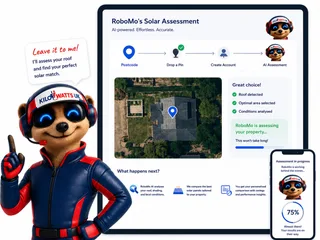
Simply enter your postcode, drop a pin on your roof, create your free account and let RoboMo™ analyse your property to find the best solar panels for your home.

You don't have to think
RoboMo™'s AI analyses your roof and does all the hard work.

Accurate & tailored
AI-powered assessment based on your roof, location, and conditions.

Best options, maximum savings
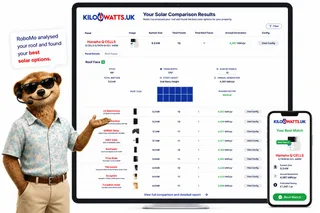
Compare top solar panels for the best performance and value.

Simple, fast & effortless
Provide a few details, sit back and watch your results unfold.
STEP 1
Choose Home, Business or Industrial
Enter your postcode to start your assessment.
STEP 2

Drop a pin on your roof
STEP 3

Create your free account
STEP 4

Sit back and watch RoboMo™ work
RoboMo™ analyses your roof and builds your personalised solar comparison.

Kilowatts UK is an authorised representative
Flower Turbines
Compact vertical-axis turbines built for real UK sites, not just open farmland.
They start in light wind, sit in a small footprint, and are bird-safe by design. Cluster them as a bouquet and the group performs better together than the same turbines standing alone. Enter your postcode for a location-based generation estimate. Figures use area weather data and will differ if buildings, trees or hills sit in the way.
Starts in light UK wind
Built to generate in typical UK wind, not only open farmland.
Small rooftop or ground footprint
Compact towers for roofs, yards and tight sites.
Bird-safe slow rotation
Slow vertical-axis spin, bird-safe by design.
Bouquet clusters raise output
Grouped turbines outperform the same units standing alone.
Step 1
Enter your postcode
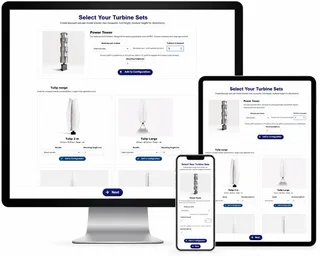
Start designing your wind energy system in seconds.
STEP 2

Choose a location
STEP 3

Place your cluster
Tap the map where you want the turbine cluster to go.
STEP 4

Instant generation forecasts
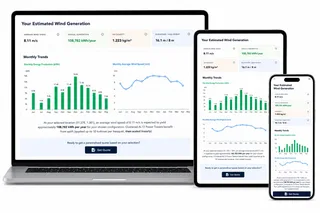
Compare different turbine layouts and see annual generation forecasts instantly.
STEP 5

No commitment required
Explore different configurations before deciding whether to request a quotation.
Related articles

Mo's Mission Nominations
FAQ
Need Help? RoboMo's Got Answers
What is the difference between AC-coupled and DC-coupled battery storage?
AC-coupled battery storage uses a separate battery inverter connected to the home’s AC electrical system, usually alongside an existing solar inverter. DC-coupled battery storage usually connects the solar panels and battery through one hybrid inverter, so solar electricity can charge the battery before being converted to AC for the home. In simple terms, AC coupling keeps the solar and battery systems more separate, while DC coupling combines them through a shared inverter.
Is AC or DC coupling better for an existing solar panel system?
AC coupling is usually the better starting point if you already have solar panels with a working inverter. It can often be added without replacing the existing solar inverter or changing the roof wiring, which reduces disruption and avoids unnecessary equipment replacement. DC coupling may still make sense if your current solar inverter is old, unsupported, out of warranty, or due to be replaced.
Is AC or DC coupling better for a new solar and battery installation?
DC coupling is often a strong choice for a new solar-and-battery installation because one hybrid inverter can manage both the solar panels and the battery. This can reduce duplicated equipment, simplify monitoring, and improve solar-to-battery efficiency. However, the best option still depends on the roof layout, shading, inverter compatibility, DNO requirements, battery size, backup needs, and total installed cost.
Is DC-coupled battery storage more efficient than AC-coupled storage?
DC-coupled battery storage is often slightly more efficient when storing solar electricity because it usually involves fewer conversions between DC and AC. AC-coupled systems may convert solar DC to AC, then AC back to DC for battery storage, then DC back to AC for household use. The efficiency difference matters, but it should not be the only deciding factor; replacing a good existing inverter just to gain a small efficiency improvement may not be worthwhile.
Can I install a home battery without solar panels?
Yes, a home battery can be installed without solar panels, and this is normally an AC-coupled system. The battery charges from the grid, usually during cheaper off-peak tariff periods, and discharges later when electricity is more expensive. This can work well for some households, but the savings depend on your tariff, electricity use, battery size, inverter output, round-trip losses, and installed cost.
Do AC-coupled batteries work with microinverters?
AC-coupled batteries are often suitable for homes with microinverters because they connect on the AC side of the home electrical system rather than needing to connect into the solar panel DC strings. This makes them a common retrofit option where the existing solar setup is not easily compatible with a hybrid inverter. The installer still needs to check metering, CT clamp placement, DNO requirements, and system settings.
Will a solar battery work during a power cut?
A solar battery will not automatically power your home during a power cut. Most standard grid-tied solar and battery systems shut down for safety unless specific backup equipment has been installed. If backup power is important, it must be designed into the system using a suitable inverter, battery, switching arrangement, and essential-loads circuit or whole-house backup setup.
Does AC or DC coupling affect DNO approval?
Yes, the coupling method can affect the DNO application because it changes how much inverter capacity is connected to the grid and how export is controlled. For example, an existing solar inverter plus a separate AC-coupled battery inverter may be assessed differently from one export-limited hybrid inverter. A competent installer should confirm whether the system falls under G98 or G99 requirements before installation.
What does a hybrid inverter do?
A hybrid inverter manages both solar panels and a battery in a DC-coupled system. It converts solar electricity for use in the home, charges and discharges the battery, manages export to the grid, and often provides monitoring through one platform. Not every hybrid inverter works with every battery or every roof layout, so compatibility and design limits must be checked before choosing equipment.
Can I charge a DC-coupled battery from the grid?
Many DC-coupled battery systems can charge from the grid, but this depends on the hybrid inverter, battery model, firmware, and system settings. If you want to use cheap overnight electricity or a smart tariff, confirm before buying that the system supports scheduled grid charging, forced discharge, reserve settings, and any tariff-specific controls you need.
Is a bigger battery always better?
No, a bigger battery is not always better. The right size depends on your surplus solar generation, evening and overnight electricity use, tariff strategy, inverter output, and whether you can charge and discharge the battery effectively. A large battery that rarely fills or cannot discharge quickly enough may offer worse value than a smaller, better-matched system.
What is the difference between battery capacity and battery power output?
Battery capacity, measured in kWh, tells you how much energy the battery can store. Battery power output, measured in kW, tells you how quickly it can deliver electricity at any moment. A 10 kWh battery does not necessarily provide 10 kW of power; many domestic systems have continuous outputs around 2.5 kW to 5 kW, so high-demand appliances may still need extra electricity from the grid.
Should I replace my existing solar inverter with a hybrid inverter?
You may want to replace your solar inverter with a hybrid inverter if the existing inverter is old, out of warranty, unsupported, faulty, or unsuitable for your future battery plans. If the inverter is modern, reliable, and still under warranty, an AC-coupled battery may be more practical and cost-effective. The decision should compare the efficiency benefit of DC coupling against the cost, disruption, warranty impact, and roof wiring changes.
Where can a home battery be installed?
A home battery must be installed in a suitable location that meets the manufacturer’s rules and electrical safety requirements. Common locations include garages, utility rooms, and some outdoor areas if the battery is rated for external installation. Loft installations can be problematic because of access, temperature, weight, ventilation, and emergency access issues, and some manufacturers do not allow them.
How should I compare AC-coupled and DC-coupled battery quotes?
Compare the full installed system, not just the battery capacity or brand. Check usable capacity, inverter output, backup capability, DNO paperwork, tariff controls, monitoring access, warranty terms, installation location, consumer unit work, expansion options, and aftercare. A good quote should explain why AC or DC coupling is recommended for your property, based on your existing inverter, roof layout, usage pattern, tariff, export limits, and backup requirements.