


energy performance validation scheme: eligibility and how to apply (UK
Published: 2026-07-25 14:11:40
Updated: 2026-08-01 07:29:34
It is mainly relevant to households considering technologies such as solar panels, battery storage.
What the Energy Performance Validation Scheme is
The Energy Performance Validation Scheme, usually called EPVS, is a UK consumer protection scheme used to check whether energy-saving, income and payback claims in domestic energy quotes are presented reasonably. It is mainly relevant to households considering technologies such as solar panel options, battery storage, heat pumps and other home energy measures where a quote includes projected savings.
This guide is for two audiences:
UK homeowners comparing renewable-energy quotes and trying to understand whether EPVS matters. UK installers or energy businesses that want to understand eligibility and the likely application process. EPVS is not a government grant, not an Energy Performance Certificate, and not a funding application. Homeowners usually do not apply directly. In most cases, installers, suppliers or sales organisations use EPVS to validate the way they calculate and present performance claims. In plain English, EPVS is about the figures in the quote. If a salesperson says a solar PV system will save a certain amount each year, pay back within a certain period, or generate export income, EPVS-style validation is intended to check the calculation method and the assumptions behind those claims. If your main concern is solar, it can also help to understand EPVS in solar quotes. It does not guarantee that your future bills will match the estimate exactly. Weather, tariffs, energy use, product performance, maintenance and household behaviour can all change the final outcome.
Short summary for UK homeowners
For most homeowners, the practical answer is simple. You do not normally apply to EPVS yourself. Instead, you ask whether the installer’s quote includes EPVS-validated performance estimates and then check that the document matches your property and proposed system.
EPVS can be useful when you are comparing quotes that make financial claims, especially where one installer is promising a much shorter payback period than another. It is most relevant where savings are being projected over time, rather than where you are simply buying equipment with no financial estimate.
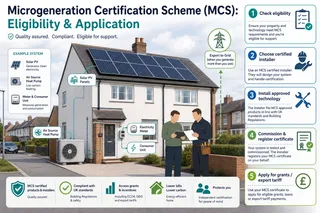
You should treat EPVS as one part of your due diligence. It does not replace a proper survey, technical design, MCS certification where relevant, electrical certification, DNO notification, planning checks or grant eligibility checks. A simple way to use EPVS as a homeowner is to ask: “Are the savings in this quote validated, and can you show me the assumptions used for my property?”
Is EPVS a grant or funding scheme
No. EPVS is not a grant, subsidy, loan or voucher scheme. This is a common source of confusion because it deals with projected financial savings, payback periods and consumer-facing claims.
EPVS sits near the grants and funding conversation because quotes often include figures about savings, export income, grants, payback and lifetime benefit. Those figures can influence whether a household decides to proceed. EPVS helps check whether the claims are calculated and presented responsibly, but it does not provide the money.
For heat pumps in England and Wales, the Boiler Upgrade Scheme may be relevant, but that is separate from EPVS. Scotland, Wales and Northern Ireland also have their own energy support arrangements. Grant eligibility should always be checked separately, and MCS certification is often more relevant than EPVS for access to grants or export tariffs. If you are researching solar support, keep EPVS separate from solar grants and funding eligibility checks.
Who is eligible to use EPVS
Eligibility depends on whether you are a homeowner checking a quote or a business applying to have its calculation process validated. The applicant is normally the installer, supplier or sales organisation, not the household.
Homeowners can benefit from EPVS where a quote includes performance, income or financial savings claims. Your role is usually to request the validated estimate, review the assumptions and keep a copy with your contract paperwork.
Installers may use EPVS where they sell domestic energy-saving technologies and need a recognised way to present savings estimates responsibly. EPVS is commonly associated with technologies such as solar PV, battery storage, air source heat pumps, ground source heat pumps, heating controls and other domestic energy measures where estimated savings are part of the sales process. The key eligibility point is that EPVS is not simply about the product being sold. It is about the claims made to the customer. If a quote includes projected savings, income, payback or return-on-investment figures, the calculation method and customer-facing wording become important.
Homeowner eligibility and what you can do
A UK homeowner is not usually the direct applicant. Your role is to request and review an EPVS-validated estimate from the installer, then make sure it relates to your home rather than a generic example.
You should check the document against the actual proposal. For solar PV, that means the system size, roof orientation, roof pitch, shading assumptions, export tariff, electricity import tariff and self-consumption estimate. Self-consumption means the electricity you use in the home at the time it is generated, instead of exporting it to the grid.
For a battery, check the usable capacity, round-trip efficiency, charging pattern and tariff assumptions. Usable capacity means the amount of stored electricity the battery can normally deliver to the home. Round-trip efficiency means how much electricity is returned after charging and discharging losses; no battery gives back 100% of the energy put into it. If storage is part of the quote, it can help to sense-check the proposed battery size against your usage pattern. For a heat pump, check the heat demand, flow temperature, emitter suitability and the fuel being compared. Flow temperature is the temperature of water sent around radiators or underfloor heating. Heat pumps usually work most efficiently at lower flow temperatures, so the heating system design matters. Useful homeowner checks include the following.
- Ask whether the quoted savings are EPVS-validated.
- Check that the validation matches your property, not a model home.
- Compare the assumptions with your actual energy use and tariff.
- Keep the validated document with your contract paperwork.
- Challenge any unusually short payback claim.
- Ask whether finance costs are included.
If the installer cannot explain the assumptions clearly, be cautious. A validated calculation should make the main inputs easier to understand, not harder. Check that grants are shown separately from savings. Ask what happens if your usage or tariff changes.
Installer eligibility and business requirements
Installers and energy businesses are the usual applicants. The business generally needs to be selling domestic energy products with consumer-facing savings, income or payback estimates.
An installer should be able to show how its calculations are produced and how those calculations appear in customer documents. The scheme is not simply about having good intentions. It is about using documented assumptions, suitable calculation methods and clear presentation.
A business may need to provide information such as company details, product categories sold, sample quotations, performance estimate templates, calculation methodology, consumer contract documents and evidence of how staff use the approved process. Where relevant, other accreditations may also be requested, but EPVS does not replace those accreditations. Installers should also think about internal control. If one approved template is used by management but sales staff alter savings figures manually, the process may become unreliable. EPVS works best when the calculation method, quote template and customer explanation are consistent.
How installers apply for EPVS
Installers normally apply through the official EPVS scheme operator. The exact onboarding process can change, so businesses should follow the current application route and scheme rules rather than relying on an old checklist.
A typical application process involves several practical steps.
Staff process
The installer may need to show how sales staff use the approved calculation method.Business details
The installer provides trading details, contact information and the domestic technologies being sold.Sample documents
The installer submits example quotations, performance estimates and customer-facing sales materials.Template changes
The installer may need to amend quote wording, calculation outputs or sales documents before approval.Assumption review
The scheme checks whether tariffs, export income, degradation, maintenance and replacement assumptions are presented responsibly.Calculation method
The installer explains the software, templates or methodology used to estimate savings, income and payback.
For an installer, the important point is consistency. It is not enough to pass an assessment once and then let sales staff create their own optimistic figures. The validated process should be embedded into quoting, document control and customer handover. Before applying, installers should prepare clean examples of customer documents and be ready to explain each input. If the calculation relies on an electricity tariff, export rate, assumed self-consumption percentage or future energy price change, that assumption should be visible and defensible. Ongoing use — Once accepted, the installer must continue using the approved approach and keep records for future checks.
What EPVS checks in energy quotes
EPVS is concerned with the reasonableness of performance and financial claims. It is not there to approve every technical detail of the installation, but the calculation still depends heavily on good technical inputs.
For solar PV, the checked figures may include annual generation, self-consumption, export, electricity bill saving, Smart Export Guarantee income, payback period, panel degradation, inverter replacement and maintenance assumptions. Panel degradation means the gradual reduction in solar panel output over time.
For battery storage, the key assumptions usually include usable capacity, round-trip efficiency, solar charging, grid charging, tariff structure, annual bill saving, battery degradation and warranty assumptions. Battery degradation means the gradual loss of storage performance as the battery ages and cycles. For heat pumps, the calculation may look at annual heat demand, seasonal efficiency, electricity use, running cost comparison, hot water assumptions, insulation, flow temperature and whether radiators or underfloor heating are suitable. Seasonal efficiency is a real-world performance estimate across changing outdoor temperatures, not just a single laboratory figure. Small changes in assumptions can make a large difference to the final saving. A quote based on actual smart meter data, recent bills and a proper property survey is usually more useful than one based only on generic household averages.
What EPVS does not prove
EPVS should not be treated as a blanket approval of the installer, the products, the workmanship or the final energy bill. It validates the way performance claims are calculated and presented within the scheme’s scope.
EPVS does not replace other checks that may matter in a real UK project.
- It does not provide grant funding.
- It does not create an EPC rating.
- It does not replace MCS certification.
- It does not remove DNO requirements.
- It does not guarantee future savings.
- It does not confirm planning permission.
This distinction matters. A quote can have a reasonable financial estimate and still need separate technical, regulatory and contractual checks before installation. It does not certify electrical workmanship. It does not prove that a proposed system is the best design for your home.
EPVS compared with EPC, MCS, SEG and the Boiler Upgrade Scheme
EPVS is often confused with other UK energy schemes. They overlap in the same projects, but they do different jobs.
EPVS checks performance and financial claims in energy product quotes. An EPC, or Energy Performance Certificate, rates the energy performance of a property using a standard assessment method. MCS certification is commonly relevant to renewable installations and may be required for certain grants and export arrangements.
The Smart Export Guarantee, usually called SEG, relates to payment for exported electricity from eligible small-scale low-carbon generation. A DNO, or Distribution Network Operator, is the company responsible for the local electricity network; some solar and battery installations need notification or approval through the DNO process. The Boiler Upgrade Scheme is a grant scheme for eligible low-carbon heating installations in England and Wales, and homeowners can read more about current heat pump grant considerations separately from EPVS. The practical takeaway is that you may need more than one of these. For example, a heat pump project may involve grant eligibility checks, MCS certification, a technical heat loss survey and an EPVS-style review of running cost claims. A solar and battery project may involve EPVS-style savings validation, MCS certification, SEG arrangements, DNO notification or approval, and electrical certification. One scheme does not automatically replace the others.
Questions homeowners should ask before relying on an EPVS-validated quote
An EPVS-validated estimate is more useful when you understand the assumptions behind it. Do not focus only on the headline payback period.
Ask the installer clear questions before signing.
- Is this estimate specific to my property?
- What import tariff has been used?
- What export tariff has been used?
- Has my actual electricity use been considered?
- Has shading been modelled?
- Are maintenance costs included?
If the answer is vague, ask for the assumptions in writing. A realistic quote should make it clear what is saving money, what is generating income, and what is simply an assumption about future conditions. For buyer intent, the key decision is not whether the quote has the most impressive payback claim. The better question is whether the proposed system is technically suitable, transparently costed and based on assumptions that match your home. Is inverter replacement included? Is battery degradation included? Is finance interest included? Are grants shown separately? Is VAT included in the total cost? What happens if my usage changes? What happens if energy prices change? Which assumptions have the biggest effect on the result?
Common mistakes when interpreting EPVS figures
The biggest mistake is treating a validated estimate as a guaranteed outcome. Validation means the calculation has been checked against a method or scheme rules. It does not mean the installer is contractually promising that exact saving unless a separate guarantee is clearly provided in the contract.
Another common mistake is comparing quotes only by payback period. A shorter payback can be caused by a better design, but it can also be caused by optimistic tariffs, unrealistic self-consumption, omitted maintenance, ignored finance costs or aggressive future energy price assumptions.
Homeowners should also be careful with export income. Exported electricity is usually valued differently from electricity you avoid buying from the grid. A solar system that exports a lot may still be technically sound, but the financial return can be lower than a system where more generation is used on site. A further mistake is assuming that a national average applies to every home. Roof shading, heating demand, occupancy pattern, appliance use, hot water use and time-of-use tariffs can all change the result. Two neighbours with similar systems may see different savings.
How property and usage affect the validated result
A validated estimate is only as good as the inputs. Two homes with the same equipment can have different savings because the property, location and usage pattern are different.
For solar PV, generation is affected by roof orientation, roof pitch, shading, available roof area and local solar resource. South-facing roofs often produce the highest annual generation, but east-west roofs can still be suitable. Shading from trees, dormers, chimneys or nearby buildings can reduce output and should not be ignored.
For batteries, savings depend heavily on when electricity is used and how the tariff works. A battery does not create energy. It shifts energy from one time to another, so the value depends on solar surplus, time-of-use pricing, round-trip efficiency and cycling behaviour. For heat pumps, performance depends on heat loss, insulation, flow temperature, emitter sizing and controls. Emitters are the parts of the heating system that release heat into rooms, such as radiators or underfloor heating. A heat pump can perform well in a suitable home, but optimistic running cost claims are risky where the design assumes low flow temperatures that the heating system cannot realistically support. For all technologies, your behaviour matters. Working from home, charging an electric vehicle, using appliances during daylight hours, changing heating schedules or moving to a different tariff can all affect the real-world saving.
When EPVS is most useful
EPVS is most useful where a quote contains a meaningful financial claim and you need to understand whether that claim is reasonable. It is particularly helpful when different installers are presenting very different savings for similar systems.
It is also useful where finance is being sold alongside the installation. If the monthly finance cost is compared with estimated bill savings, the assumptions need careful scrutiny. Payback calculations should be based on the right total cost and should not quietly exclude interest, maintenance or replacement items where those materially affect the result.
EPVS is less useful where no performance estimate is being made, where the work is labour-only, or where you need a post-installation fault diagnosis. In those cases, a technical inspection, installer warranty claim or independent survey may be more appropriate. For homeowners close to signing a contract, EPVS is best used as a sense-check alongside the survey, specification, contract terms and installer credentials. For installers, it is most valuable as a disciplined way to make sales claims that are clear, repeatable and easier for customers to trust.
Practical next steps
If you are a homeowner, ask your installer whether the quote includes EPVS-validated savings and request the underlying assumptions. Then compare those assumptions against your bills, tariff, roof, heating system and intended usage.
If the estimate looks unusually optimistic, ask the installer to show what has changed compared with other quotes. The difference may be legitimate, but it should be explainable. Pay particular attention to export rates, assumed self-consumption, finance interest, maintenance, equipment replacement and future energy price assumptions.
If you are an installer, use the official EPVS application route and prepare your calculation method, sample quote documents and customer-facing assumptions before applying. Be ready to change templates if any claims are unclear or too optimistic. For any UK energy project, treat EPVS as a useful validation tool rather than the whole decision. You may still need MCS certification, DNO approval, building regulations compliance, planning checks, electrical certification and separate grant eligibility confirmation. If you want a practical next step before comparing claims, you can book a free survey and use the results to sense-check any quote assumptions.
Plan, Compare & Buy Renewable Energy Solutions
AI does the thinking.
You get the perfect solar match.
Use RoboMo™ to assess your property, compare available technologies and connect with trusted UK installers, suppliers and manufacturers.
Simply enter your postcode, drop a pin on your roof, create your free account and let RoboMo™ analyse your property to find the best solar panels for your home.

You don't have to think
RoboMo™'s AI analyses your roof and does all the hard work.

Accurate & tailored
AI-powered assessment based on your roof, location, and conditions.

Best options, maximum savings
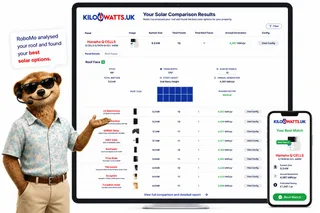
Compare top solar panels for the best performance and value.

Simple, fast & effortless
Provide a few details, sit back and watch your results unfold.
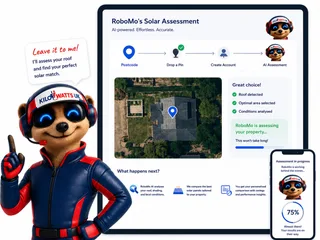
STEP 1
Choose Home, Business or Industrial
Enter your postcode to start your assessment.
STEP 2

Drop a pin on your roof
STEP 3

Create your free account
STEP 4

Sit back and watch RoboMo™ work
RoboMo™ analyses your roof and builds your personalised solar comparison.

Kilowatts UK is an authorised representative
Flower Turbines
Compact vertical-axis turbines built for real UK sites, not just open farmland.
They start in light wind, sit in a small footprint, and are bird-safe by design. Cluster them as a bouquet and the group performs better together than the same turbines standing alone. Enter your postcode for a location-based generation estimate. Figures use area weather data and will differ if buildings, trees or hills sit in the way.
Starts in light UK wind
Built to generate in typical UK wind, not only open farmland.
Small rooftop or ground footprint
Compact towers for roofs, yards and tight sites.
Bird-safe slow rotation
Slow vertical-axis spin, bird-safe by design.
Bouquet clusters raise output
Grouped turbines outperform the same units standing alone.
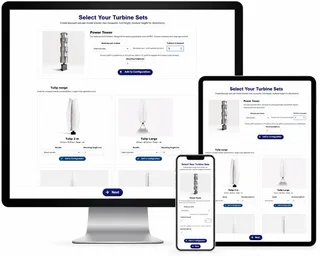
Step 1
Enter your postcode
Start designing your wind energy system in seconds.
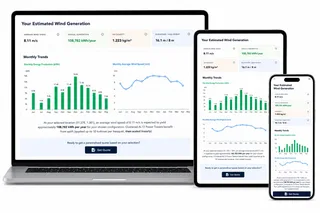
STEP 2

Choose a location
STEP 3

Place your cluster
Tap the map where you want the turbine cluster to go.
STEP 4

Instant generation forecasts
Compare different turbine layouts and see annual generation forecasts instantly.
STEP 5

No commitment required
Explore different configurations before deciding whether to request a quotation.
Related articles
Mo's Mission Nominations
FAQ
Need Help? RoboMo's Got Answers
What is the Energy Performance Validation Scheme?
The Energy Performance Validation Scheme (EPVS) is a UK consumer protection scheme that verifies whether energy-saving, income, and payback claims in domestic energy quotes are presented reasonably. It is mainly relevant to households considering technologies like solar panels, battery storage, heat pumps, and other home energy measures where a quote includes projected savings.
Is EPVS a grant or funding scheme?
No, EPVS is not a grant, subsidy, loan, or voucher scheme. It checks whether the claims are calculated and presented responsibly but does not provide the money. For heat pumps in England and Wales, the Boiler Upgrade Scheme may be relevant, but that is separate from EPVS.
Who is eligible to use EPVS?
Eligibility depends on whether you're a homeowner checking a quote or an installer applying for validation. Installers normally apply through the official EPVS scheme operator, while homeowners can benefit from EPVS where a quote includes performance, income, or financial savings claims.
How do I know if my energy quote is EPVS-validated?
Ask your installer whether the quote includes EPVS-validated savings and request the underlying assumptions. Then compare those assumptions against your bills, tariff, roof, heating system, and intended usage. If the estimate looks unusually optimistic, ask the installer to show what has changed compared with other quotes.
What does EPVS do not prove?
EPVS should not be treated as a blanket approval of the installer, products, workmanship, or final energy bill. It validates the way performance claims are calculated and presented within its scope but does not guarantee future savings, confirm planning permission, certify electrical workmanship, or replace other checks.
How does EPVS compare with EPC, MCS, SEG, and the Boiler Upgrade Scheme?
EPVS checks performance and financial claims in energy product quotes. An EPC rates the energy performance of a property using a standard assessment method. MCS is a certification scheme commonly relevant to renewable installations and may be required for certain grants and export arrangements. The Smart Export Guarantee (SEG) relates to payment for exported electricity from eligible small-scale low-carbon generation.