


BUS Grant for Heat Pumps 2026: Eligibility and £7,500 Subsidy
Published: 2026-07-18 15:22:04
Updated: 2026-07-26 18:16:48
The grant is not based on heat pump size, so an eligible 4 kW air source heat pump and an eligible 6 kW air source heat pump receive the same subsidy.
BUS grant heat pump 2026 eligibility in brief
In 2026, the Boiler Upgrade Scheme, usually shortened to BUS, is expected to remain a £7,500 grant for eligible air source and ground source heat pumps in England and Wales. The grant is not based on heat pump size, so an eligible 4 kW air source heat pump and an eligible 6 kW air source heat pump receive the same subsidy.
The main eligibility issues are:
- Whether the property is in England or Wales.
- Whether the installation replaces an eligible fossil-fuel or direct-electric heating system.
- Whether the heat pump is installed by an MCS certified installer using eligible equipment.
- Whether the system is designed as the property’s main heating system.
- Whether the installation is within the scheme’s capacity and property rules.
- Whether the voucher is applied for and redeemed correctly through Ofgem.
The scheme is currently planned to run until 2028, but 2026 applications should always be checked against the live GOV.UK Boiler Upgrade Scheme guidance and Ofgem BUS rules before committing to an installation. Grant values, evidence requirements and administrative rules can change. The installer normally applies for the voucher, claims the grant from Ofgem, and deducts the value from the customer’s quote or invoice. Homeowners should not usually expect to receive the BUS grant as a cash payment. The important distinction is between eligibility and suitability. A property may meet the scheme rules but still be expensive or awkward to convert. Equally, a heat pump could be technically sensible but fail the grant rules if it is installed as a hybrid system with a gas, oil or LPG boiler retained for routine heating.
Who can usually qualify for the Boiler Upgrade Scheme
The BUS applies to homes and some non-domestic buildings in England and Wales. It is not available in Scotland or Northern Ireland, where separate support schemes and rules apply.
The property normally needs a valid Energy Performance Certificate. Earlier versions of the scheme placed more emphasis on outstanding insulation recommendations, but the live 2026 rules should be checked because EPC and evidence requirements have changed during the life of the scheme.
The installation must use an eligible low-carbon heating product and be installed by an MCS certified installer. MCS certification matters because BUS is not simply a discount on equipment; it is a grant for a qualifying installed system. The heat pump must usually replace an existing fossil-fuel or direct-electric heating system. This can include: A mains gas boiler. An oil boiler. An LPG boiler. Coal or other fossil-fuel heating. Direct electric heating. An oil-heated house replacing the oil boiler with an air source heat pump. The new system must be designed as the property’s main heating system rather than as a small add-on intended only to reduce boiler use. Typical eligible situations include: New-build homes are generally not eligible, although self-build and custom-build homes can be treated differently if they meet the evidence requirements. Flats, park homes, listed buildings and homes in conservation areas can sometimes qualify, but they often need extra checks around outdoor unit siting, planning, lease conditions, freeholder consent, access and noise. A gas-heated home replacing the gas boiler with a correctly sized heat pump. A direct-electric property moving to a full heat pump heating system. A self-build home that meets the scheme’s self-build evidence requirements. A rented property where the landlord, tenant permissions and installation meet the scheme rules. A qualifying non-domestic building replacing eligible existing heating.
How the BUS grant is applied to a heat pump installation
The homeowner does not usually receive the BUS grant directly. In most cases, the installer applies for the BUS voucher, the property owner confirms consent to Ofgem, and the grant is deducted from the installation price.
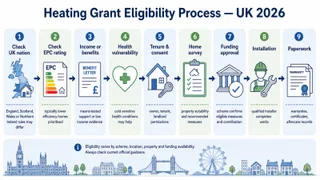
A practical BUS process usually looks like this:
Quote
The installer provides a price that should clearly show the total cost before and after the BUS grant.Grant claim
The installer claims the grant and the customer pays the remaining balance shown in the agreed quote.Installation
The system is installed, commissioned, registered and handed over under the scheme rules.Customer consent
The homeowner or property owner confirms that they understand and approve the application.[{~a.href='https
//kilowatts.uk/booking/?kwrf=8SA53&kwpid=6&kwlid=9' title="Book a free home energy survey"}]Survey[{/a~}]: The installer checks the property, heating system, outdoor unit location, cylinder space, electrical supply and heat loss.Voucher application
The installer applies to Ofgem for the BUS voucher.
A good quote should make the grant treatment clear. You should be able to see whether the £7,500 has already been deducted, whether there are excluded works, and whether electrical upgrades, radiator changes, cylinder work, oil tank removal, scaffolding or making-good costs are included. Do not rely on a verbal promise that “the grant is included”. Ask for the pre-grant price, the BUS deduction and the customer balance to be shown in writing.
How much is the BUS grant for heat pumps in 2026
The main heat pump BUS grant is £7,500 for an eligible air source heat pump and £7,500 for an eligible ground source heat pump. Shared ground loop ground source systems can also qualify where they meet the scheme rules.
Biomass boilers have a separate £5,000 grant, but biomass support is limited to eligible rural properties that are not connected to the gas grid. Biomass is not the same as a heat pump grant and should be assessed under its own BUS criteria.
The heat pump grant is fixed. It does not increase because the heat pump is larger, and it does not reduce because the unit is smaller. This is particularly important when comparing a 4 kW and 6 kW heat pump. For example, if both systems are eligible standalone air source heat pump installations, the BUS grant is the same £7,500. The final customer price may still differ because the equipment, hot water cylinder, emitters, pipework, electrical work and installation complexity may differ. Indicative UK air source heat pump installation prices vary widely by property and specification. Simple installations can be materially cheaper than complex homes needing radiator upgrades, cylinder changes, new pipework or electrical work. Ground source heat pump installations are usually more expensive than air source systems because of ground loops, trenches, boreholes, manifolds and reinstatement. For buyer comparisons, the useful figure is not the grant alone. It is the fully installed price after grant, with all required works included.
4 kW versus 6 kW heat pumps and the hybrid system question
For the query “BUS subsidy for a 4 kW versus 6 kW hybrid heat pump in 2026”, the short answer is that the kW size is not the deciding factor.
A 4 kW eligible standalone air source heat pump and a 6 kW eligible standalone air source heat pump would receive the same £7,500 BUS grant. A 4 kW or 6 kW hybrid heat pump that keeps a gas, oil or LPG boiler as part of the routine space-heating system would normally not qualify.
A hybrid heat pump usually means the heat pump works alongside a boiler. That may reduce fossil fuel use, and it can be a pragmatic option where a full low-temperature retrofit is difficult. However, BUS is intended to support a low-carbon heating system that replaces the previous fossil-fuel or direct-electric system, not one that leaves a boiler in service for normal heating loads. This means a cheaper hybrid proposal can be misleading if it is shown beside a BUS-funded standalone system. The hybrid may have a lower upfront installation cost, but it will usually lose the £7,500 grant and will continue to use fossil fuel. The better comparison is the total installed cost after grant, expected seasonal efficiency, fuel use, comfort, carbon reduction and whether the system can meet the home’s full heat demand. Be cautious with terms such as “hybrid-ready”, “boiler assisted”, “bivalent” or “backup boiler”. They can mean different things in sales material. For BUS eligibility, the practical question is whether the heat pump is the standalone main heating system or whether a fossil-fuel boiler remains part of the designed heating strategy. An immersion heater in a hot water cylinder, defrost function or emergency electrical backup is not the same as retaining a gas or oil boiler for normal heating. The installer should explain exactly what is included and how the system is intended to operate.
Why heat pump size should be based on heat loss rather than boiler size
A heat pump should be sized from a room-by-room heat loss calculation, not from the size of the existing boiler. Many UK boilers are much larger than the home’s actual space-heating demand, especially combi boilers sized for hot water rather than central heating. A 24 kW gas boiler does not mean the home needs a 24 kW heat pump.
Typical domestic air source heat pumps in the UK are often around 4 kW to 12 kW, but the right size depends on the building. Smaller flats and efficient small homes may need around 4 kW to 6 kW. Medium houses may need around 6 kW to 10 kW. Larger, leakier or rural homes may need 10 kW or more.
The correct size depends on several design factors:
- The property’s heat loss at the local design outdoor temperature.
- The insulation level and draught proofing of the building.
- The radiator or underfloor heating capacity at low flow temperatures.
- The hot water cylinder size and recovery requirement.
- The available electrical supply and outdoor unit location.
- The way the occupants use heating and hot water.
A 4 kW heat pump may be suitable for a small, well-insulated property but too small for a typical detached or poorly insulated house. A 6 kW unit may suit some small to medium homes but still be inadequate where heat loss is high. Undersizing can lead to comfort complaints, long recovery times and excessive use of backup heaters. Oversizing can increase cost, cause cycling and reduce efficiency. Neither outcome is good value simply because the BUS grant is available. Installers should also check heat output at low outdoor temperatures. Some headline heat pump ratings are quoted at milder test conditions, while UK heating design conditions can be below 0°C in many areas. Output in cold weather is what matters for comfort. The manufacturer’s heat output at cold outdoor temperatures, not just mild test conditions.
What affects the real cost after the grant
The grant is fixed, but the customer contribution is not. Two homes receiving the same £7,500 BUS grant can have very different final costs because the installation work may be very different.
Common cost drivers include:
Heat pump type: Ground source systems usually cost more than air source systems because of ground loops, trenches or boreholes. Radiator upgrades: Larger radiators may be needed to heat rooms at lower flow temperatures. Hot water cylinder work: Homes with combi boilers often need space for a heat pump-compatible hot water cylinder. Pipework limitations: Microbore pipework or restricted routes can affect flow rates and system design. Electrical supply: Older homes may need consumer unit work, wiring upgrades, DNO checks or main fuse changes. Outdoor unit siting: Long pipe runs, poor access, noise constraints and difficult condensate drainage can add complexity. The cheapest eligible quote is not always the best value. A low price can be undermined by high flow temperatures, undersized emitters, poor controls, a mismatched cylinder or weak commissioning. A more detailed quote that explains design assumptions is usually more useful than a simple equipment list. Removal work — Oil tank removal, boiler decommissioning, asbestos risk, flue removal and making good can all affect the quote. Controls and commissioning — Weather compensation, zoning, room sensors and user handover all affect real performance. Building condition — Draughts, poor loft insulation, weak glazing or uninsulated pipe runs can increase heat demand.
Technical suitability matters even when the grant rules are met
BUS eligibility does not automatically mean the home is ready for an efficient heat pump. The survey should test whether the home can be heated comfortably at sensible flow temperatures. Larger radiators, underfloor heating and good fabric performance all help because lower flow temperatures generally improve efficiency.
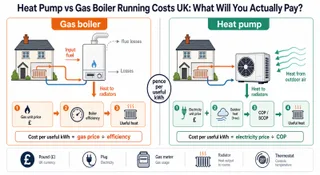
Seasonal Coefficient of Performance, often shortened to SCOP, is the average heat output divided by electricity input across the heating season. A SCOP of 3 means the heat pump delivers 3 kWh of heat for each 1 kWh of electricity used on average. Typical UK air source heat pump SCOP values are often around 2.5 to 4.0, depending heavily on design, flow temperature, climate, usage and commissioning.
Real-world points that are often missed include:
- Condensate drainage and defrost water.
- Access for servicing.
- Outdoor unit airflow.
- Noise at neighbouring windows and boundaries.
- Pipe insulation.
- Water quality and system flushing.
Enclosing an outdoor unit to hide it can reduce airflow and cause faults. Leaving old radiator sludge in the system can damage components. Setting the heat pump to run like an on-off gas boiler can reduce performance. Weather compensation is particularly important. It adjusts the flow temperature according to outdoor temperature, allowing the system to run cooler in mild weather and warmer only when needed. A homeowner should be shown how the controls work, what the normal running pattern looks like, and when an immersion heater should or should not be used. Correct antifreeze or frost protection strategy. User handover and control settings.
When a BUS-funded heat pump may not be the right choice
A BUS-funded heat pump is strongest where heat loss is manageable, the property has space for equipment, the outdoor unit can be sited sensibly, and the owner is comfortable with low-temperature heating operation. Oil, LPG and direct-electric homes can be strong candidates, provided the technical design is sound.
It may be less suitable where the building has severe insulation gaps, no realistic cylinder location, difficult outdoor unit siting, lease or planning restrictions, or electrical supply constraints that have not been resolved.
Gas-heated homes can be eligible, but running cost savings are not guaranteed because they depend on electricity prices, gas prices, system efficiency and heat demand. A well-designed heat pump can reduce carbon emissions substantially, but the financial case should be tested against the household’s actual usage and tariff options. Hybrid systems can still have a role outside BUS. They may suit homes where a full retrofit is not practical immediately, where radiator upgrades would be disruptive, or where the owner wants to reduce boiler use without replacing the whole heating system. The trade-off is that hybrids normally do not qualify for BUS and still rely on fossil fuel. The decision should separate three questions: Does the property qualify under the live BUS rules? Is the proposed heat pump system technically well designed? Does the final cost, running pattern and disruption make sense for the household or business?
What to check before accepting a BUS heat pump quote
Before accepting a quote, ask the installer to explain the eligibility route, the heat loss calculation and the design assumptions. Do not rely only on the headline heat pump size or the grant value.
A robust proposal should cover:
The room-by-room heat loss calculation and design outdoor temperature. The proposed heat pump size and the reason for choosing it. The proposed flow temperature and expected seasonal performance. Which radiators, pipework or cylinders need changing. Whether the system is standalone or hybrid. How the £7,500 BUS grant is shown in the quote. You should also confirm that the installer is MCS certified and that the product and installation meet the scheme requirements. BUS cannot normally be combined with another public grant for the same installation cost, although private finance or savings may be used for the remaining balance. If a quote is unclear, ask for it to be rewritten before paying a deposit. The BUS grant is valuable, but it should not be used to rush a poor design decision. Any electrical, planning, DNO, access or making-good assumptions. The outdoor unit location and noise considerations. The hot water cylinder size and immersion heater controls. The commissioning settings and handover documents you will receive. Warranty, servicing and aftercare arrangements.
Author and review note
This guide was prepared by the Kilowatts UK Renewable Heating Editorial Team, drawing on UK heat pump survey, electrical upgrade and low-carbon home energy planning experience. It is intended as practical buyer guidance, not a substitute for a site survey, MCS design, Ofgem approval or legal advice on planning, leases or grant eligibility.
Scheme rules can change. Always check the current GOV.UK, Ofgem and MCS requirements before signing a contract.
Sources and further reading
GOV.UK: Apply for the Boiler Upgrade Scheme Ofgem: Boiler Upgrade Scheme MCS: Boiler Upgrade Scheme information GOV.UK: Heat pumps explained
Bottom line for BUS grant heat pump 2026 decisions
For 2026, the key point is simple: BUS is a fixed grant for eligible low-carbon heating installations, not a capacity-based subsidy. A 4 kW and 6 kW eligible standalone air source heat pump receive the same £7,500 grant, while 4 kW and 6 kW hybrid heat pumps with a retained fossil-fuel boiler would normally receive no BUS grant.
The right system size should come from a proper heat loss design, not from the existing boiler size or a grant comparison. Check the live scheme rules, insist on a clear before-and-after grant quote, and make sure the design can heat the whole property efficiently before treating BUS eligibility as a reason to proceed.
Plan, Compare & Buy Renewable Energy Solutions
AI does the thinking.
You get the perfect solar match.
Use RoboMo™ to assess your property, compare available technologies and connect with trusted UK installers, suppliers and manufacturers.
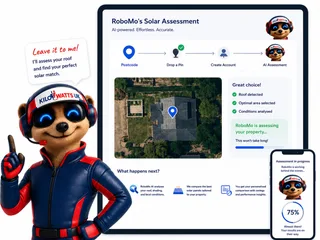
Simply enter your postcode, drop a pin on your roof, create your free account and let RoboMo™ analyse your property to find the best solar panels for your home.

You don't have to think
RoboMo™'s AI analyses your roof and does all the hard work.

Accurate & tailored
AI-powered assessment based on your roof, location, and conditions.

Best options, maximum savings
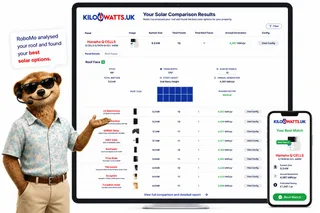
Compare top solar panels for the best performance and value.

Simple, fast & effortless
Provide a few details, sit back and watch your results unfold.
STEP 1
Choose Home, Business or Industrial
Enter your postcode to start your assessment.
STEP 2

Drop a pin on your roof
STEP 3

Create your free account
STEP 4

Sit back and watch RoboMo™ work
RoboMo™ analyses your roof and builds your personalised solar comparison.

Step 1
Enter your postcode
Start designing your wind energy system in seconds.
Are you an installer, distributor or renewable energy business?
Kilowatts UK is expanding the Flower Turbines partner network across the UK.
Become A Flower Turbines PartnerKilowatts UK is an authorised representative
Flower Turbines
Compact vertical-axis turbines built for real UK sites, not just open farmland.
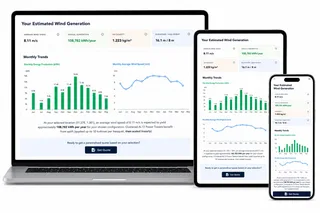
They start in light wind, sit in a small footprint, and are bird-safe by design. Cluster them as a bouquet and the group performs better together than the same turbines standing alone. Enter your postcode for a location-based generation estimate. Figures use area weather data and will differ if buildings, trees or hills sit in the way.
Starts in light UK wind
Built to generate in typical UK wind, not only open farmland.
Small rooftop or ground footprint
Compact towers for roofs, yards and tight sites.
Bird-safe slow rotation
Slow vertical-axis spin, bird-safe by design.
Bouquet clusters raise output
Grouped turbines outperform the same units standing alone.
STEP 2

Choose a location
STEP 3

Place your cluster
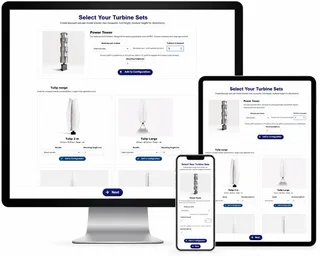
Tap the map where you want the turbine cluster to go.
STEP 4

Instant generation forecasts
Compare different turbine layouts and see annual generation forecasts instantly.
STEP 5

No commitment required
Explore different configurations before deciding whether to request a quotation.
Related articles


Mo's Mission Nominations
FAQ
Need Help? RoboMo's Got Answers
How much is the BUS grant for a heat pump in 2026?
In 2026, the Boiler Upgrade Scheme grant is £7,500 for an eligible air source heat pump and £7,500 for an eligible ground source heat pump in England and Wales. The grant is fixed, so it does not increase for a larger heat pump or a more expensive installation. The installer applies for the grant and normally deducts it from the quote or invoice, rather than the homeowner receiving the money directly.
Does a 6kW heat pump get more BUS funding than a 4kW heat pump?
No. A 6kW eligible heat pump does not receive more BUS funding than a 4kW eligible heat pump. If both systems meet the scheme rules, both can receive the same £7,500 grant. If both are ineligible, such as routine hybrid systems that keep a fossil-fuel boiler in normal use, both would normally receive £0.
Are hybrid heat pumps eligible for the BUS grant?
Hybrid heat pumps that keep a gas, oil or LPG boiler for routine heating are normally not eligible for the Boiler Upgrade Scheme. BUS is intended to support a full move to eligible low-carbon heating, not a partial upgrade where the old fossil-fuel boiler remains part of normal operation. If an installer describes a system as hybrid, ask them to confirm in writing whether it is a BUS-eligible full replacement system or a hybrid add-on that would not normally qualify.
Who can apply for the Boiler Upgrade Scheme?
Eligible applicants can include homeowners, private landlords and owners of some small non-domestic properties in England and Wales. Second homes can also be eligible if the property and installation meet the scheme requirements. The application is made by an MCS-certified installer, and the property owner must give consent during the process.
Is the BUS grant available in Scotland or Northern Ireland?
No. The Boiler Upgrade Scheme applies to eligible properties in England and Wales only. Scotland and Northern Ireland have separate support arrangements, so property owners outside England and Wales should check the relevant local schemes before planning a heat pump installation.
What type of heating system must a heat pump replace to qualify?
BUS usually supports the replacement of fossil-fuel or direct-electric heating with an eligible low-carbon heating system. This can include replacing gas, oil, LPG, coal or direct-electric heating with an eligible air source or ground source heat pump. The heat pump must be designed as the main system for space heating and domestic hot water, not simply as a top-up heater or small add-on.
Does the installer need to be MCS certified?
Yes. The heat pump must be designed and installed by an MCS-certified installer using eligible equipment and the relevant MCS standards. The installer is responsible for applying for the BUS grant, managing the voucher process and redeeming the grant after installation.
Do I need an EPC to qualify for BUS?
Most existing homes need a valid Energy Performance Certificate for the property receiving the installation. Since 2024, outstanding loft or cavity wall insulation recommendations no longer automatically block BUS eligibility, but insulation still matters because it affects heat loss, heat pump sizing, radiator requirements, comfort and running costs.
Are new-build homes eligible for the BUS grant?
Most developer-built new homes are not eligible for BUS. Self-build homes can be eligible where the owner commissioned or built the property for their own use and the scheme requirements are met. The details should be checked before relying on the grant, especially where the property is recently completed or has not previously had a conventional heating system.
Can flats qualify for the Boiler Upgrade Scheme?
Flats can qualify in some cases, but they often need extra checks before a heat pump project is realistic. Leasehold consent, freeholder permission, planning rules, outdoor unit location, noise limits, balcony restrictions, plant space and hot water cylinder space can all affect whether the installation can proceed and whether the grant can be used.
Does heat pump size affect BUS eligibility?
Heat pump size affects technical suitability, but not the grant amount. The correct size should be based on a room-by-room heat loss calculation, hot water demand, radiator or underfloor heating capacity, local design temperature and the building’s insulation level. A 4kW unit may suit a small efficient home, while a 6kW unit may suit some small to medium homes, but neither should be chosen simply because of the grant.
Can I use the size of my old boiler to choose a heat pump?
No. The size of an old gas or oil boiler is not a reliable guide to heat pump size. Many boilers, especially combi boilers, are much larger than the home’s actual space heating demand because they are also sized for hot water production. Heat pumps are usually designed to run for longer periods at lower flow temperatures, so sizing should come from proper heat loss calculations rather than the boiler rating.
What is the maximum heat pump size allowed under BUS?
The maximum eligible heat pump system capacity under BUS is 45kWth. This refers to heat output, not electrical input. Most domestic properties are well below this limit, but it can matter for larger homes and some small non-domestic buildings.
How is the BUS grant paid?
The grant is paid to the installer, not directly to the homeowner as cash. The installer applies for the voucher, the property owner gives consent, and the installer should show the BUS deduction on the quote or invoice. Homeowners should check that the quote clearly shows the full cost, the grant deduction, what is included, what is excluded and any VAT treatment.
Can I apply for BUS after the heat pump has already been installed?
You should not assume you can claim BUS after installation. The normal process is for the MCS-certified installer to apply for a voucher before the installation is completed, with the property owner confirming consent during the process. If work has already been carried out without the correct voucher process, the grant may not be available.
How long does a BUS voucher last?
BUS vouchers have a limited validity period and must be redeemed by the installer after the qualifying installation is completed. The exact timescale can depend on the technology and current scheme rules, so ask your installer to confirm the live voucher deadline before you sign. Delays with planning, permissions, grid checks, groundworks or equipment supply can put the voucher at risk if they are not managed early.
What costs remain after the BUS grant?
The remaining cost depends on the full installation scope, not just the heat pump unit. Air source heat pump projects often cost around £8,000 to £18,000 before BUS, while ground source systems are usually higher because of groundworks. After the £7,500 grant, the customer may still need to pay for the remaining installation cost, radiator upgrades, pipework changes, a hot water cylinder, electrical work, planning requirements or other property-specific items.
Can the BUS grant be combined with other funding?
BUS normally cannot be used to cover the same installation cost as another public grant. You may still be able to use personal savings, private finance or other non-conflicting support for the remaining balance, but the funding rules should be checked before signing a contract. Ask the installer to confirm whether any other discount, grant or finance offer affects BUS eligibility.
Will I need new radiators or underfloor heating?
Not always. Many heat pump retrofits work with upgraded radiators rather than underfloor heating. The key issue is whether each room can receive enough heat at the chosen flow temperature. Larger radiators or underfloor heating can help the system run at lower temperatures, which usually improves efficiency, but the right solution depends on the heat loss calculation and the existing heating layout.
Do I need space for a hot water cylinder?
If you currently have a combi boiler, you will usually need space for a hot water cylinder when moving to a full heat pump system. The cylinder must be sized for the household’s hot water use and integrated into the system design. Lack of cylinder space can be a practical barrier, especially in flats, small terraces and homes with limited cupboards or loft access.
Does a BUS-funded heat pump have to provide hot water?
In most domestic installations, the heat pump system should be designed to provide both space heating and domestic hot water. This is why many homes replacing a combi boiler need a hot water cylinder. If an installer proposes a system that heats radiators only, or relies heavily on a separate immersion heater for normal hot water, ask them to confirm how it meets the scheme rules and how it will affect running costs.
Do I need planning permission for a heat pump?
Many air source heat pump installations can fall under permitted development, but this is not automatic. Outdoor unit size, location, distance from boundaries, noise limits, conservation areas, listed buildings, flats and leasehold restrictions can all affect what permission is needed. Ground source systems can also involve groundworks, access and land constraints. Confirm planning and consent requirements before relying on a BUS quote.
What design details should I check before accepting a BUS quote?
Before accepting a quote, ask for a room-by-room heat loss calculation, proposed heat pump output at the relevant outdoor temperature, design flow temperature, radiator schedule, hot water cylinder specification, electrical requirements, outdoor unit location, noise assessment, controls strategy and commissioning plan. The quote should also state whether the old boiler is being removed or retained, whether the system is eligible for BUS, and exactly how the grant has been deducted.
Can a heat pump work in an older or poorly insulated home?
A heat pump can work in many older homes, but the design must account for heat loss honestly. Poor insulation, draughts, leaky floors, exposed walls and undersized radiators can increase the required heat pump size, raise flow temperatures and reduce efficiency. Improving insulation and airtightness before or alongside the installation can improve comfort, reduce running costs and sometimes avoid unnecessary oversizing.
Will a BUS-funded heat pump be cheaper to run than a boiler?
Not always. Running costs depend on the home’s heat demand, electricity tariff, heat pump efficiency, flow temperature, controls and user behaviour. A well-designed system running at low flow temperatures can perform well, but poor design, high heat loss, frequent immersion heater use or badly balanced radiators can make running costs higher than expected. Any estimate should be based on the property’s expected annual heat demand, not generic averages.
What does SCOP mean for heat pump performance?
SCOP stands for Seasonal Coefficient of Performance. It describes average heat pump efficiency over a heating season. A SCOP of 3 means the heat pump produces about 3kWh of heat for every 1kWh of electricity used. Typical air source heat pump performance in UK homes can vary widely, often around SCOP 2.5 to 4.0 depending on design quality, flow temperature, insulation and controls.
Will I need an electrical upgrade for a heat pump?
Possibly. Many heat pump installations can use the existing electrical supply, but the installer should still check the consumer unit, protective devices, cable routes, earthing, load capacity and whether the Distribution Network Operator needs to be notified or consulted. Extra electrical work can affect cost and timescales, so it should be included clearly in the quote.
Does BUS cover biomass boilers?
BUS includes a separate £5,000 grant for eligible biomass boilers, but this is not the same as the heat pump grant. Biomass support is more restricted and is generally limited to eligible rural properties that are not connected to the gas grid. If you are comparing biomass with a heat pump, check the separate eligibility rules, fuel storage needs, maintenance requirements and local air-quality restrictions.
What mistakes should I avoid when using the BUS grant?
Common mistakes include assuming a larger heat pump receives a larger grant, keeping a fossil-fuel boiler and expecting a hybrid system to qualify, choosing a heat pump size without a heat loss calculation, relying on the old boiler rating, ignoring insulation and draughts, forgetting cylinder space, comparing quotes with different scopes, and accepting a proposal that does not clearly show the BUS deduction or confirm eligibility in writing.
When might BUS not be the right route?
BUS may not be suitable if you want to keep a gas, oil or LPG boiler for routine backup, cannot place an outdoor unit, cannot fit a hot water cylinder, have unresolved leasehold or planning issues, or need extensive upgrades that are outside your budget. It may also be better to address major insulation, draught or building-condition problems before finalising the heat pump design.
What should I ask an installer before relying on the grant?
Ask whether the proposed system is a BUS-eligible full replacement for your existing heating, whether any fossil-fuel boiler remains in routine use, what heat loss calculation has been completed, what flow temperature has been designed for, which radiators or pipework need changing, how hot water will be provided, where the outdoor unit will go, who handles permissions and noise checks, and how the grant will appear on the quote or invoice.
How can I compare two BUS heat pump quotes fairly?
Compare the full installed scope, not just the heat pump size or the final price after grant. Check whether both quotes include radiator upgrades, cylinder work, electrical work, controls, removal of the old boiler, making good, permissions, commissioning, warranties and aftercare. A lower quote may not be better value if it assumes higher flow temperatures, leaves important work excluded or does not clearly confirm BUS eligibility.