


Heat Pump vs Gas Boiler Running Costs
Published: 2026-07-19 19:03:14
Updated: 2026-07-31 19:07:09
The answer depends on your electricity tariff, gas tariff, heat pump seasonal efficiency, boiler efficiency, annual heat demand, hot water use.
Are heat pumps cheaper to run than gas boilers in the UK?
Heat pumps can be cheaper to run than gas boilers in the UK, but they are not automatically cheaper. The answer depends on your electricity tariff, gas tariff, heat pump seasonal efficiency, boiler efficiency, annual heat demand, hot water use, and whether you can remove the gas standing charge.
The most important point is that you should compare the cost of useful heat delivered into the home, not just the unit price of gas and electricity. Gas is cheaper per kWh than electricity in the UK, but a heat pump can turn 1 kWh of electricity into several kWh of heat. A gas boiler cannot: it burns gas and loses some energy through flue gases and system losses.
As a broad guide, on a standard electricity tariff, an air source heat pump usually needs a strong seasonal performance to compete with a modern mains gas boiler. On a cheaper heat pump tariff, or against an older inefficient boiler, the comparison can look much better. A useful short summary is this:
- If a heat pump achieves a seasonal performance around 3.5, running costs can be close to a modern gas boiler on recent UK-style standard tariffs.
- If it achieves closer to 4.0, it may be cheaper to run.
- If it performs closer to 2.5, it may cost more unless your electricity tariff is favourable or your existing boiler is inefficient.
- If you can remove the gas meter and avoid the gas standing charge, the annual comparison can improve in favour of the heat pump.
This guide uses simple worked examples so you can understand the calculation before applying it to your own bills.
How this guide was produced.
This article is written from a UK residential heating and renewable-energy perspective, with a focus on how homeowners should compare real running costs before replacing a gas boiler with a heat pump. The calculations use standard engineering principles: fuel cost, appliance efficiency, seasonal performance, and annual heat demand.
For a proper decision, you should check your own tariff and household data rather than rely on a national average. Useful UK reference points include:
Current price-cap context from your supplier or regulator. Homeowner-level explanations of heat pump basics and system suitability. Certified low-carbon heating standards and consumer protection information. Your own gas and electricity bills, which are more important than any generic example. The worked figures below are examples, not a quote or a price promise. Energy prices, standing charges, tariff rules, grant rules, and installation costs change over time and vary by region, payment method, supplier, and household.
The simple running-cost formula.
The fairest way to compare a heat pump and a gas boiler is to compare the cost of useful heat.
A kWh of gas bought from your supplier is not the same as a kWh of heat delivered into your rooms, because a boiler is not 100% efficient. A modern condensing boiler may be rated above 90% in test conditions, but in real homes performance can be lower if it runs at high flow temperatures, has poor controls, or rarely condenses properly.
A kWh of electricity used by a heat pump is different. A heat pump moves heat rather than creating it directly, so 1 kWh of electricity can produce 2.5, 3, 4 or more kWh of heat depending on the system and conditions. Use these formulas: Gas boiler heat cost = gas unit rate ÷ boiler efficiency Heat pump heat cost = electricity unit rate ÷ heat pump SCOP Break-even SCOP = electricity unit rate × boiler efficiency ÷ gas unit rate COP means coefficient of performance. A COP of 3 means the heat pump produces about 3 kWh of heat for every 1 kWh of electricity used at that moment. SCOP means seasonal coefficient of performance. It is the average performance across the heating season and is the more useful figure for annual running costs. For example:
- A heat pump with SCOP 3.0 uses about 1 kWh of electricity for every 3 kWh of heat.
- A heat pump with SCOP 4.0 uses about 1 kWh of electricity for every 4 kWh of heat.
- A 90% efficient gas boiler needs about 1.11 kWh of gas to deliver 1 kWh of useful heat.
That is why the headline unit rate alone can be misleading.
Example running costs using UK-style unit rates.
To keep the calculation clear, this example uses:
Electricity unit rate: 24.5p/kWh Gas unit rate: 6.3p/kWh Gas boiler seasonal efficiency: 90% Useful annual heat demand: 10,000 kWh
These figures are illustrative and close to recent UK-style price-cap examples, but you should replace them with your own tariff rates. First, calculate the useful heat cost from gas: 6.3p ÷ 0.90 = 7.0p per useful kWh of heat Then compare different heat pump SCOPs: In this example, a heat pump at SCOP 3.5 is roughly level with a 90% efficient gas boiler before standing charges. At SCOP 4.0, the heat pump is cheaper on energy units. At SCOP 3.0 or below, it costs more on a standard electricity rate. The break-even SCOP in this example is: 24.5 × 0.90 ÷ 6.3 = 3.5 So, with these assumptions, the heat pump needs a seasonal performance of about 3.5 to match the boiler on unit costs. These are not universal figures. Your actual result depends on your current tariff, your local standing charges, the heat loss of your home, your hot water use, the heat pump design, and how the system is commissioned and controlled.
Why electricity price matters so much.
In the UK, electricity is usually much more expensive per kWh than mains gas. That price gap is the main reason heat pumps are not always cheaper to run, even though they are much more efficient at turning purchased energy into useful heat.
Recent UK price-cap periods have often had electricity at several times the gas unit rate. When electricity is around 3.5 to 4.5 times the price of gas, a heat pump may need to deliver around 3 to 4 units of heat per unit of electricity to compete with a modern gas boiler.
This is why the electricity tariff matters so much. A heat pump tariff can improve the calculation if it gives you a lower electricity rate for some or all of your heating demand. Some tariffs offer cheaper periods overnight or at specific times, and some are designed for homes with heat pumps, electric vehicles, batteries, or smart controls. However, not every property can shift much heating demand into cheap periods. A well-insulated home with good heat emitters may be able to pre-heat gently and coast through more expensive periods. A draughty or poorly insulated home may cool too quickly, forcing the heat pump to run when electricity is expensive. Before assuming a time-of-use tariff will save money, check:
- How many hours are cheap.
- What the peak rate is.
- Whether your heat pump can be scheduled sensibly.
- Whether your hot water cylinder can heat during cheaper periods.
- Whether your comfort would suffer from long off-peak gaps.
- Whether you also have solar PV, battery storage, or an electric vehicle.
A lower average electricity price can reduce the break-even SCOP substantially. If you are comparing tariffs as part of the calculation, it helps to compare energy costs before modelling the heat pump. For example, if the electricity price falls from 24.5p/kWh to 18p/kWh while gas remains 6.3p/kWh and the boiler is 90% efficient, the break-even SCOP becomes: 18 × 0.90 ÷ 6.3 = 2.6 That kind of tariff change can make a well-designed heat pump much more competitive.
Standing charges can change the annual answer.
A gas boiler home pays for gas units and usually a gas standing charge. If you remove the gas boiler and have no other gas appliances, you may be able to remove the gas meter and avoid the gas standing charge.
Recent UK gas standing charges have often been around £100 to £120 per year, although the exact figure depends on the supplier, region, payment method, and price-cap period. Because standing charges change, check your latest bill rather than relying on a generic number.
The standing charge issue is often overlooked because many comparisons focus only on pence per kWh. It can make a meaningful difference to the annual answer. For example, using the earlier 10,000 kWh useful heat example: Gas boiler energy cost at 90% efficiency: about £700 Heat pump at SCOP 3.5: about £700 If the heat pump home can remove a £110 gas standing charge, the heat pump becomes about £110 cheaper per year in this simple example. For a low-heat-use household, the standing charge can be a large part of the total difference. For a larger home with high heating demand, unit rates and system efficiency usually dominate. If you keep gas for cooking, a gas fire, or another appliance, you will normally still pay the gas standing charge. In that case, the heat pump has to win on electricity consumption and tariff alone.
What SCOP should you expect from a heat pump?
Air source heat pumps in UK homes often sit somewhere around SCOP 2.5 to 4.0, depending on the property, design, installation quality, controls, and hot water use. A well-designed air source heat pump system will often aim for around 3.0 to 3.8. Poorly designed systems, systems needing high flow temperatures, or systems with frequent immersion heater use may fall below 3.0.
Ground source heat pumps can achieve higher seasonal efficiencies, often around 3.5 to 5.0, because ground temperatures are more stable than air temperatures. They also cost more to install because they need ground loops or boreholes, and not every site is suitable.
The design target matters more than the product brochure. Manufacturer data is useful, but your real running cost is shaped by the whole heating system. A heat pump connected to undersized radiators, restrictive pipework, poor controls, or a badly matched cylinder may perform badly even if the unit itself is capable of good efficiency. The main factors that affect SCOP are:
- Outdoor temperature through the heating season.
- Required flow temperature.
- Radiator or underfloor heating capacity.
- Insulation and airtightness.
- Hot water temperature and cylinder design.
- Defrost cycles.
A homeowner should be cautious of any proposal that promises a very high SCOP without showing the design assumptions behind it. Use of backup immersion heating. Control settings and homeowner behaviour. Commissioning, balancing, and water flow rates.
Why your heating system design affects running cost.
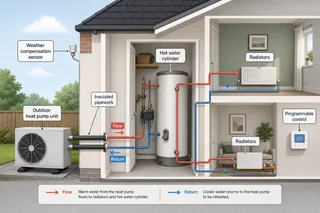
Heat pumps generally run most efficiently at lower flow temperatures, often around 35°C to 45°C. Many existing UK gas boiler systems run at 60°C to 75°C. A heat pump can run hotter than ideal, and high-temperature models exist, but higher flow temperatures usually reduce efficiency and increase running cost.
A proper heat pump survey should not size the new unit from the old boiler rating. A 30 kW combi boiler may have been sized for instant hot water, while the house might only need a 6 kW to 10 kW heat pump for space heating.
The right approach is a room-by-room heat-loss calculation. Heat loss calculation: This establishes how much heat each room needs at the local design temperature. Emitter sizing: Radiators or underfloor heating must deliver enough heat at the chosen flow temperature. Pipework assessment: Microbore or restrictive pipework can limit flow and reduce performance. Control setup: Weather compensation and sensible setback settings help the system run steadily. Commissioning: Balancing, flow rates, water quality, and user handover all affect real running cost. Oversizing the heat pump. Common mistakes include: These design details are not minor. They can be the difference between a heat pump that is cheaper than gas and one that disappoints the homeowner. Leaving too many thermostatic radiator valves closed. Fitting a buffer vessel where it is not needed. Using high flow temperatures because radiators were not checked properly. Allowing the immersion heater to cover too much hot water demand. Failing to adjust the heat curve after the homeowner has lived with the system. Treating a heat pump like an on/off gas boiler rather than a steady low-temperature system.
Hot water can reduce the advantage.
Hot water is a significant part of the running-cost comparison, especially in homes with frequent showers, baths, or high occupancy.
Space heating can often run at low flow temperatures. Domestic hot water usually needs higher cylinder temperatures, so the heat pump’s COP is normally lower when heating hot water than when heating the rooms.
Many homes moving from a combi boiler to a heat pump need a hot water cylinder. That can be a practical barrier in flats and smaller houses. The cylinder also needs to be suitable for a heat pump, with the right coil size, surface area, controls, and recovery performance. A poorly matched cylinder can increase heat-up time and push more energy use onto the immersion heater. Because immersion heaters are direct electric, they work at roughly 1 kWh of heat per 1 kWh of electricity. That is much more expensive than heat pump operation if it happens frequently. Legionella control cycles and immersion heater settings should be understood. Some systems use periodic higher-temperature cycles for hygiene. These should be designed and explained properly, not left running excessively. When comparing a heat pump with a combi boiler, remember that a combi produces hot water on demand and usually does not need a cylinder. A heat pump system normally stores hot water, so cylinder size, heat-up schedule, and household usage pattern all matter.
When a heat pump is more likely to cost less to run.
A heat pump is more likely to beat a gas boiler on running costs when the home can run at low flow temperatures, the electricity tariff is favourable, and the existing boiler is old or inefficient.
The case is also stronger where the household can remove the gas meter and stop paying the gas standing charge.
Good candidates often include homes with: Decent insulation and manageable heat loss. Radiators that are already large enough or can be upgraded. Underfloor heating or other low-temperature emitters. Space for an outdoor unit. Space for a suitable hot water cylinder. A household willing to use steady heating rather than short high-temperature bursts. Homes off the gas grid can be especially strong candidates because oil, LPG, direct electric heating, and older storage heaters may be more expensive or less efficient than mains gas. The running-cost comparison is often more favourable when the alternative is not a modern mains gas boiler. Solar PV can help by offsetting some electricity use, but it does not make a heat pump free to run. UK heat demand is highest in winter, when solar generation is usually lowest. If you are considering solar alongside low-carbon heating, it can be useful to compare home solar options before assuming a system size or payback. A battery may improve self-consumption and help with time-of-use tariffs, but it adds capital cost and should be assessed as part of the whole system rather than assumed to solve the running-cost question. If battery storage is part of your plan, make sure you compare battery costs alongside any heating savings. Access to a competitive electricity tariff. No need to keep gas for cooking or other appliances.
When a gas boiler may still be cheaper to run.
A modern, well-optimised gas boiler on mains gas can still be cheaper than a poorly performing heat pump on a standard electricity tariff. This is especially true if the heat pump has to run at high flow temperatures, the home has high heat loss, or the installation relies heavily on immersion backup.
Harder cases can include:
Small flats with no suitable outdoor unit location. Leasehold homes needing consent. Properties with no cylinder space. Poorly insulated solid-wall homes where fabric upgrades are not planned. Homes with restrictive pipework that would be costly to alter. Very low heat-use households where total savings are modest. It is also fair to optimise the boiler before comparing. Lowering boiler flow temperature, adding suitable compensation controls, improving radiator sizing, and balancing the system can reduce gas consumption in some homes. A fair decision should compare a well-designed heat pump with a sensibly optimised boiler, not an ideal heat pump against a neglected boiler. For example, if a gas boiler is currently running at high flow temperatures and rarely condensing, improving controls and lowering the flow temperature may reduce gas use. That does not remove the carbon argument for a heat pump, but it can affect the financial comparison. Households that must keep gas for another appliance and therefore keep paying the standing charge.
Installation cost is separate from running cost.
This article focuses on running cost, but the installation cost still affects the overall financial decision.
Air source heat pump installations in the UK are often around £7,000 to £14,000 before grant support, depending on the property and required upgrades. Ground source systems are often much higher because of ground works. A gas boiler replacement is typically much cheaper upfront.
Those ranges are broad because every home is different. The final cost can be affected by: Heat pump size. Cylinder requirements. Radiator upgrades. Pipework changes. Electrical work. Outdoor unit location. The Boiler Upgrade Scheme in England and Wales has offered support for eligible heat pump installations, and Scotland and Northern Ireland have different arrangements. Eligibility, VAT treatment, funding levels, and scheme rules can change, so check current official guidance before making a decision. You can also read more about BUS grant eligibility and the £7,500 subsidy. Running-cost savings alone may not repay the full installation difference quickly in every mains-gas home. Many homeowners choose heat pumps for a mix of reasons, including lower carbon heating, replacing an ageing system, improving comfort, removing gas, or combining heating upgrades with solar PV and battery storage. Condensate and drainage arrangements. Controls and monitoring. Scaffolding or access requirements. Whether the existing system is suitable for reuse.
How to estimate what you will actually pay.
Start with your annual gas use from bills. Your bill should show how many kWh of gas you use per year. If you have several years of bills, use an average and note whether any year was unusually cold or warm.
Remember that gas meter consumption is not the same as useful heat. If your boiler is around 90% efficient, 10,000 kWh of useful heat needs about 11,111 kWh of gas. If the boiler is older or poorly performing, it may need more gas for the same useful heat.
A simple homeowner method is: Find your annual gas use in kWh. Estimate boiler efficiency. Multiply gas use by boiler efficiency to estimate useful heat. Divide useful heat by possible heat pump SCOPs. Multiply by your electricity unit rate. Add or remove standing charges depending on whether you keep the gas meter. For example, if your home uses 12,000 kWh of gas per year and your boiler is assumed to be 90% efficient: 12,000 × 0.90 = 10,800 kWh useful heat Now model heat pump electricity use: If electricity costs 24.5p/kWh, the annual heat pump energy cost would be approximately: The equivalent gas cost at 6.3p/kWh for 12,000 kWh of gas would be: 12,000 × £0.063 = £756 In this example, SCOP 3.5 is roughly equal to gas before standing charges. SCOP 4.0 is cheaper. SCOP 3.0 is more expensive unless a lower electricity tariff or avoided gas standing charge changes the answer. Before choosing a heat pump, work through this checklist: A good installer should be able to explain the assumed heat loss, the chosen heat pump size, radiator changes, hot water strategy, flow temperature, and expected performance range. If the proposal only states the unit size and a headline efficiency figure, it is not enough information for a running-cost decision. If you want help sense-checking the whole-house picture, you can book a free home energy survey. Check your actual gas unit rate. Check your actual electricity unit rate. Check your gas and electricity standing charges. Add the gas standing charge if you will keep the gas meter. Remove the gas standing charge only if you will fully disconnect from gas. Estimate useful annual heat demand. Model more than one SCOP. Include domestic hot water. Include possible immersion heater use. Consider whether a specialist electricity tariff is realistic. Ask for the proposed flow temperature at design conditions. Ask what radiator or cylinder upgrades are included. Ask how the system will be commissioned and handed over.
What to ask before accepting a heat pump quote.
The running-cost question should be answered during the design stage, not after installation. Before accepting a quote, ask for the assumptions behind the proposal.
Useful questions include:
What is the room-by-room heat loss? What outdoor design temperature has been used? What flow temperature is the system designed around? Which radiators need upgrading, and why? What SCOP range is realistic for this property? How will domestic hot water be heated? Good answers should be specific to the property. Generic claims such as “heat pumps are always cheaper” or “this model has a COP of 5” are not enough. COP at one test condition is not the same as whole-season performance in a real UK home. How often is the immersion heater expected to run? Is the cylinder correctly sized for the household? Can the system work with a heat pump tariff? Will the gas meter be removed, or will the standing charge remain? What monitoring will be available after installation? Who will adjust the settings if the first winter shows the heat curve needs refinement?
Bottom line.
Heat pumps are not automatically cheaper than gas boilers in the UK, but they can be.
On standard tariffs, an air source heat pump often needs a seasonal performance around the mid-threes to compete with a modern mains gas boiler. Better electricity tariffs, removal of the gas standing charge, an inefficient existing boiler, or a very well-designed low-temperature system can shift the answer in favour of the heat pump.
The biggest risk is assuming that the equipment alone determines the bill. In real homes, running cost is decided by the tariff, insulation, heat emitters, flow temperature, hot water demand, controls, commissioning, and how the occupants use the system. For a buyer, the best approach is to model your own bills using realistic SCOP assumptions and then ask the installer to show how the design will achieve them. A careful heat-loss survey and transparent running-cost calculation are more useful than a simple claim that one technology is always cheaper.
Plan, Compare & Buy Renewable Energy Solutions
AI does the thinking.
You get the perfect solar match.
Use RoboMo™ to assess your property, compare available technologies and connect with trusted UK installers, suppliers and manufacturers.
Simply enter your postcode, drop a pin on your roof, create your free account and let RoboMo™ analyse your property to find the best solar panels for your home.

You don't have to think
RoboMo™'s AI analyses your roof and does all the hard work.

Accurate & tailored
AI-powered assessment based on your roof, location, and conditions.

Best options, maximum savings
Compare top solar panels for the best performance and value.

Simple, fast & effortless
Provide a few details, sit back and watch your results unfold.


STEP 1
Choose Home, Business or Industrial
Enter your postcode to start your assessment.
STEP 2

Drop a pin on your roof
STEP 3

Create your free account
STEP 4

Sit back and watch RoboMo™ work
RoboMo™ analyses your roof and builds your personalised solar comparison.

Kilowatts UK is an authorised representative
Flower Turbines
Compact vertical-axis turbines built for real UK sites, not just open farmland.
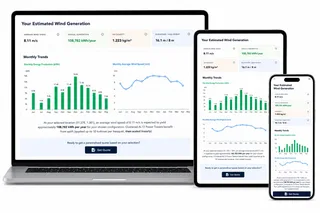
They start in light wind, sit in a small footprint, and are bird-safe by design. Cluster them as a bouquet and the group performs better together than the same turbines standing alone. Enter your postcode for a location-based generation estimate. Figures use area weather data and will differ if buildings, trees or hills sit in the way.
Starts in light UK wind
Built to generate in typical UK wind, not only open farmland.
Small rooftop or ground footprint
Compact towers for roofs, yards and tight sites.
Bird-safe slow rotation
Slow vertical-axis spin, bird-safe by design.
Bouquet clusters raise output
Grouped turbines outperform the same units standing alone.

Step 1
Enter your postcode
Start designing your wind energy system in seconds.
STEP 2

Choose a location
STEP 3

Place your cluster
Tap the map where you want the turbine cluster to go.
STEP 4

Instant generation forecasts
Compare different turbine layouts and see annual generation forecasts instantly.
STEP 5

No commitment required
Explore different configurations before deciding whether to request a quotation.
Related articles

Mo's Mission Nominations
FAQ
Need Help? RoboMo's Got Answers
Are heat pumps cheaper to run than gas boilers in the UK?
Heat pumps can be cheaper to run than gas boilers, but they are not automatically cheaper. The result depends on your home’s heat loss, electricity tariff, gas tariff, heat pump seasonal efficiency, boiler efficiency, hot water demand, system design and whether you can remove the gas standing charge. A well-designed heat pump running at low flow temperatures on a favourable electricity tariff can cost less to run than a modern gas boiler. However, if electricity is expensive, gas is cheap, or the heat pump has to run at high temperatures, a gas boiler may still have lower running costs.
What is the main factor that decides whether a heat pump is cheaper?
The key factor is the cost of useful heat delivered into the home. Gas is usually cheaper per kWh than electricity in the UK, but a boiler does not convert every kWh of gas into useful heat. A heat pump uses electricity more efficiently by moving heat rather than creating it directly, so one kWh of electricity can produce several kWh of heat. The comparison depends mainly on the heat pump’s seasonal performance, often called SCOP, and your actual gas and electricity unit rates.
What SCOP does a heat pump need to beat a gas boiler?
A useful estimate is: break-even SCOP equals electricity unit rate multiplied by boiler efficiency, divided by gas unit rate. For example, if electricity costs 24p per kWh, gas costs 6p per kWh and the boiler is 90% efficient, the heat pump would need a SCOP above about 3.6 to be cheaper on unit costs. If electricity falls to 15p per kWh with the same gas price and boiler efficiency, the break-even SCOP falls to about 2.3. This is why both tariff and system efficiency matter.
What does SCOP mean for heat pump running costs?
SCOP stands for seasonal coefficient of performance. It is the average efficiency of the heat pump over the heating season, rather than its performance at one moment. A SCOP of 3 means the heat pump produces about 3 kWh of heat for every 1 kWh of electricity used across the season. SCOP is more useful than a single COP figure because real performance changes with outdoor temperature, flow temperature, hot water production, defrost cycles and how the system is controlled.
Why do heat pump running costs vary so much between homes?
Running costs vary because homes differ in insulation, airtightness, radiator sizes, pipework, hot water demand, heating habits and tariffs. Two similar-looking properties can have very different results if one heat pump runs at low flow temperatures on a smart tariff while another runs at high temperatures on standard electricity. Installation quality, commissioning, balancing, weather compensation and homeowner controls also make a major difference.
Does a heat pump need bigger radiators?
Not always, but some radiators may need upgrading. Heat pumps are usually most efficient when they can heat the home using lower water temperatures than a typical gas boiler system. Some existing radiators may already be large enough, especially in well-insulated rooms, while others may need larger radiators, fan-assisted radiators or improved system balancing. The only reliable way to know is through a room-by-room heat loss calculation and emitter assessment.
Why does flow temperature matter so much?
Flow temperature is the temperature of the water sent from the heating system to radiators or underfloor heating. Heat pumps generally run more efficiently at lower flow temperatures, often around 35°C to 45°C. If a system needs 60°C or more to keep the home warm, the heat pump has to work harder and running costs can rise. Good radiator sizing, insulation, weather compensation and correct commissioning all help reduce the required flow temperature.
Is a heat pump cheaper if I can remove my gas meter?
Removing the gas meter can improve the annual cost comparison because you may no longer pay the gas standing charge. This only applies if you stop using gas completely. If you keep gas for cooking, a gas fire or any other appliance, the standing charge usually remains, so it should not be counted as a heat pump saving. For low-usage homes, avoiding the gas standing charge can make a noticeable difference to the annual comparison.
How does hot water affect heat pump running costs?
Hot water can reduce the heat pump’s overall efficiency advantage because cylinders usually need higher temperatures than space heating circuits. Higher water temperatures make the heat pump work harder. Large baths, long showers, high occupancy, poor cylinder sizing and frequent immersion heater use can all increase electricity consumption. A good heat pump design should include the cylinder specification, hot water schedule, immersion heater settings and realistic household demand.
Is a heat pump always better than replacing a gas boiler?
No. A heat pump can be a strong long-term choice, especially for lower-carbon heating, but it is not automatically cheaper or simpler than replacing a gas boiler. A modern gas boiler may still have lower running costs where mains gas is cheap, electricity is expensive and the home needs high flow temperatures. The right answer depends on your property, heat loss, installation cost, tariff options, grant eligibility, hot water needs and whether the system can be designed to run efficiently.
Do heat pump tariffs make a big difference?
Yes. A dedicated heat pump tariff, smart tariff or useful off-peak electricity rate can significantly reduce running costs. Tariff choice can change the break-even point enough to make a heat pump cheaper than gas in cases where it would not be cheaper on standard electricity. However, the peak rate, off-peak hours, heating schedule and comfort requirements all matter. Always compare using your actual tariff options rather than national averages.
Can solar panels make a heat pump much cheaper to run?
Solar panels can reduce the amount of electricity bought from the grid, but they should not be assumed to cover winter heating demand. Solar generation is usually lowest in winter, when heating demand is highest. Solar PV and batteries can still improve the overall household energy picture, especially with smart tariffs and daytime hot water heating, but their costs and savings should be assessed separately from the heat pump running cost calculation.
Are ground source heat pumps cheaper to run than air source heat pumps?
Ground source heat pumps can have higher seasonal efficiency than air source heat pumps because ground temperatures are more stable than air temperatures. This can reduce running costs, especially in suitable properties with enough land or borehole access. However, ground source systems usually cost more to install because of ground loops or drilling. The best choice depends on available space, installation budget, heat demand, expected SCOP and the long-term financial case.
Are heat pumps better for homes without mains gas?
Often, yes. Homes using oil, LPG, direct electric heating or older inefficient systems may see a stronger running cost case for a heat pump than homes already using an efficient mains gas boiler. Off-gas-grid properties may also benefit from avoiding fuel deliveries, improving comfort and reducing carbon emissions. The final comparison still depends on the building, system design, electricity tariff, hot water demand and installation cost.
What should I ask for in a heat pump quote?
Ask for the room-by-room heat loss, proposed flow temperature, expected SCOP range, radiator and pipework changes, cylinder specification, controls, commissioning details, electrical works and outdoor unit siting assumptions. The quote should explain how the running cost estimate has been calculated using your expected heat demand and tariff assumptions. A good proposal should not rely only on the product’s brochure efficiency or a general claim that heat pumps are cheaper.
Why is heat pump installation quality so important?
Heat pump running costs depend heavily on correct design, sizing and commissioning. A system based on rough boiler replacement rules may perform poorly because a boiler’s rated output is not a reliable guide to the home’s heat loss. Room-by-room heat loss calculations, suitable emitters, adequate water flow rates, correct cylinder selection, weather compensation, system balancing and clear handover instructions all help the heat pump run efficiently.
How can I estimate my own heat pump running cost?
Start with your annual gas use in kWh from your bills, then estimate how much useful heat your boiler delivers. For example, if you use 12,000 kWh of gas and assume 90% boiler efficiency, your useful heat demand is about 10,800 kWh. Divide that useful heat demand by possible heat pump SCOP figures, such as 3.0, 3.5 and 4.0, then multiply the electricity needed by your electricity unit rate. Finally, account for gas standing charges depending on whether you will keep or remove the gas meter.
Should I compare installation cost and running cost separately?
Yes. Running cost is only one part of the decision. Heat pumps often cost more to install than a straightforward gas boiler replacement, although grants may reduce the upfront cost for eligible installations. A fair comparison should separate installation cost, grant support, servicing, maintenance, standing charges, unit rates, system lifespan and any radiator, cylinder, pipework, electrical or insulation upgrades.
When might a gas boiler still be cheaper to run?
A gas boiler may still be cheaper where the home has mains gas, electricity is relatively expensive, the boiler is efficient and the heat pump would need high flow temperatures. This can happen in poorly insulated homes, homes with undersized radiators, properties with restrictive pipework, homes with no practical cylinder space or households that must keep gas for another appliance. It is also fair to compare against an optimised gas boiler, not just an old or poorly controlled one.
What makes a home a good candidate for low heat pump running costs?
A home is more likely to achieve low heat pump running costs if it has manageable heat loss, good insulation, suitable radiators or underfloor heating, space for an outdoor unit, space for an appropriate hot water cylinder and access to a competitive electricity tariff. The case is stronger if the household can remove gas completely and stop paying the gas standing charge. Good design, commissioning and sensible control settings are just as important as the heat pump model itself.