


power purchase agreement solar: UK homeowner guide
Published: 2026-08-09 14:38:56
Updated: 2026-08-16 16:59:07
A power purchase agreement solar deal is a long-term contract where a third party funds, owns and usually maintains solar panels on your roof.
What is a power purchase agreement solar deal for UK homes?
A power purchase agreement solar deal is a long-term contract where a third party funds, owns and usually maintains solar panels on your roof. You then buy the electricity the system generates at an agreed rate. For UK homeowners, the main benefit is reduced or avoided upfront installation cost. The main trade-offs are long contract terms, limited control over the system, possible loss of export income, and extra property paperwork when selling or remortgaging.
Residential solar PPAs are less common in the UK than commercial solar PPAs. Homeowners are more likely to see similar offers described as “free solar”, “funded solar”, roof leases, subscriptions or shared-savings agreements. The name matters less than the legal and financial effect: who owns the equipment, who receives export value, who maintains the system, and what obligations sit against the property.
A good PPA can make sense where the contract rate is clearly lower than the electricity you would otherwise buy from your supplier, the roof is suitable for long-term generation, and the transfer terms are acceptable to future buyers and lenders. A poor deal can lock in weak savings, awkward roof-access clauses or difficult exit terms.
How a solar PPA works in practice
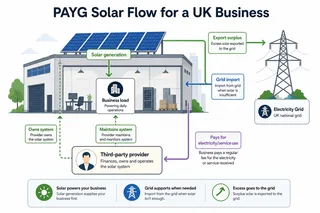
Under a typical solar PPA, the provider pays for the solar PV system and remains the owner of the panels, inverter, monitoring equipment and any battery if included. The homeowner buys some or all of the solar electricity produced on site. Export income may stay with the provider, be shared, or pass to the homeowner, depending on the contract.
The technical survey should be similar to any domestic solar installation. The installer should consider roof orientation, shading, roof covering, scaffold access, cable routes, inverter location, consumer unit condition, metering and whether the proposed connection needs Distribution Network Operator notification or prior approval. If a battery, export limitation scheme or larger inverter is included, the grid connection process can be more involved.
The commercial structure sits on top of the engineering design. That is why “no upfront cost” is not enough information. You need to know who controls the equipment, who can alter it, who pays for faults, who deals with roof repairs, and whether you can buy the system later. For a fuller breakdown of the model, see how a solar PPA works in the UK.
Export treatment
The contract decides who receives export value if electricity is sent to the grid.Homeowner payments
The homeowner pays for solar electricity under the agreed contract mechanism.Provider ownership
The PPA provider usually owns the solar equipment during the contract term.Property obligations
The agreement may include roof access rights, transfer terms or restrictions that future buyers will want to understand.Maintenance responsibility
The provider may cover maintenance, but the contract must define response times and exclusions.
Short summary for homeowners
A residential solar PPA is best viewed as a property-linked energy contract, not a free solar installation. It may reduce electricity bills if the PPA unit rate is attractive and your household uses a useful share of solar electricity on site, but it is not the same as owning the panels yourself.
The main checks are contract length, electricity rate, escalation mechanism, ownership, roof obligations, export payments, maintenance cover, grid connection paperwork and what happens when you sell the home. If any of those points are unclear, ask for the full agreement before relying on headline savings. These checks are especially important where the offer is described as “free solar”. Free upfront installation does not mean there are no long-term commitments.
Ownership
Confirm whether the provider owns the panels, inverter, battery and monitoring equipment for the whole term.Roof work
Confirm who pays to remove and reinstate panels if tiles, felt, battens or roof structure need attention.Moving home
Check whether a buyer must take over the agreement, whether a buyout is available, and who handles lender questions.Documentation
Ask for the MCS certificate if applicable, electrical certificates, warranties, DNO paperwork and monitoring details.Export income
Ask who receives Smart Export Guarantee or other export payments if power is exported.Electricity rate
Check the starting rate, how it changes, and whether the comparison uses your actual import tariff.
PPA, buying outright or finance: which route fits?
The best option depends on cash available, attitude to long contracts, roof suitability and whether you want ownership of the solar asset. Buying outright gives the most control but needs upfront capital. Finance can spread the cost while still leaving ownership with you, subject to the finance terms. A solar PPA can reduce upfront cost but usually gives the provider more control over the equipment and export value. For many homeowners, the decision is not simply free versus paid. It is whether the long-term value you give up under a PPA is worth the upfront cost you avoid. That value may include export income, flexibility to add a battery, choice of inverter, future tariff options, and the ability to remove or replace equipment without asking a third party.
| Decision area | Buying outright | Finance or loan | Solar PPA |
|---|---|---|---|
| Upfront cost | Highest initial outlay | Spread over time | Often low or no upfront cost |
| Ownership | Homeowner owns the system | Usually homeowner owns the system, subject to finance terms | Provider usually owns the system |
| Export payments | Usually available to homeowner if eligible | Usually available to homeowner if eligible | Depends on the contract |
| Maintenance control | Homeowner arranges support | Homeowner arranges support unless bundled | Provider may handle maintenance |
| Battery flexibility | Homeowner controls future upgrades | Usually homeowner controls upgrades, subject to finance terms | Contract may restrict changes |
| Contract complexity | Mainly installation warranty and equipment cover | Finance terms plus installation documents | Long energy and roof access agreement |
| Moving home | Usually simpler to explain to buyers | Finance may need settling or transferring | Buyer and lender questions can be more complex |
Overview
A PPA can suit some households but frustrate others. If you want maximum control over export tariffs, supplier switching, battery choice and future alterations, ownership may be preferable. If upfront cost is the main barrier and the PPA terms are clear, a funded model may still be worth considering. A side-by-side PPA versus buying comparison can help make those trade-offs clearer.
Costs, savings and the details that change the answer
It is not safe to assume a solar PPA will always save money. Savings depend on the rate you pay for solar electricity, how that rate changes, how much solar electricity you use on site, and what you would otherwise pay your normal electricity supplier. A household that is often empty during the day may use less solar directly unless a battery or load shifting is part of the design.
The contract should explain whether you pay only for solar electricity you consume, whether there is a standing or service charge, and how metering is handled. It should also explain what happens during inverter downtime, monitoring faults or periods when the panels produce less than expected. Solar generation varies by roof, season, shading and system design, so be cautious with any quote that presents savings as guaranteed without showing assumptions.
Export is another important point. In owner-funded solar, eligible homeowners may be able to arrange export payments through an electricity supplier under the Smart Export Guarantee, subject to supplier terms and the installation documentation they require. In a PPA, the provider may keep the export income or share it under the agreement. That single clause can materially change the benefit to the homeowner.
A practical way to compare PPA savings with ownership
A useful comparison starts with your own figures, not a generic sales estimate. Ask the PPA provider and any alternative installer to show the same roof, the same expected annual generation, the same self-consumption assumption and the same export treatment. If they use different assumptions, the comparison becomes unreliable. Use the following structure as a worked template. Replace each placeholder with numbers from your quote, your bills and your smart meter data where available. This avoids invented savings and makes the trade-offs visible.
| Calculation step | Ownership route | Solar PPA route |
|---|---|---|
| Annual solar generation | Use installer estimate for your roof | Use provider estimate for the same roof |
| Solar used in the home | Multiply generation by expected self-consumption share | Multiply generation by expected self-consumption share |
| Value of solar used | Solar used on site multiplied by avoided import rate | Solar used on site multiplied by avoided import rate, minus PPA payments |
| PPA payment | Not applicable | Solar electricity charged under the PPA rate and escalation terms |
| Export value | Usually homeowner benefit if eligible and accepted by supplier | Depends on whether the contract gives export value to the homeowner or provider |
| Maintenance allowance | Homeowner should allow for ownership responsibilities after warranties | Provider may cover maintenance, subject to contract exclusions |
| End result | Net benefit after upfront cost, export and maintenance assumptions | Net benefit after PPA payments, escalation and export treatment |
Overview
The key test is whether the PPA still looks attractive when you include export value, rate increases and the possibility that your electricity use may change. A cheap starting unit rate can be undermined by an unclear escalation clause. Equally, an ownership quote can look better on paper but may not suit a household that cannot or does not want to fund the installation upfront. Before relying on any forecast, sense-check how much solar generates on a comparable UK roof.
UK rules and protections to check
A PPA does not remove the need for a compliant UK solar installation. The installer should use suitable equipment, follow electrical safety requirements and provide proper handover documentation. Where an installation is MCS certified, the homeowner should expect MCS documentation and information needed by suppliers if export payments are later arranged. Do not assume MCS applies just because a system is solar; ask what certification and documentation will be provided, and understand what MCS certification means for solar installations.
The Smart Export Guarantee is the UK framework requiring licensed electricity suppliers above the relevant threshold to offer export tariffs to eligible small-scale low-carbon generators. Supplier requirements can vary, and export payments are not automatic just because panels are fitted. In a PPA, the contract must state who is entitled to export income and who controls the export arrangement.
Grid connection is handled through the local Distribution Network Operator. Many domestic systems are connected under G98 notification after installation, while larger or more complex systems may need G99 approval before connection. The relevant route depends on inverter capacity, export arrangements and site details. The provider or installer should be able to explain the DNO process, provide evidence of notification or approval, and show any export limitation arrangement if one is used. Planning rules are separate from electrical connection rules. Many domestic rooftop solar installations fall within permitted development rights, but this is not universal. Listed buildings, conservation areas, flats, leasehold homes, unusual rooflines and some building restrictions can change the position. The Planning Portal and your local planning authority are common places to verify the position, but the contract should also make clear who is responsible for obtaining any required permissions. It is worth checking solar planning permission before signing a long-term roof agreement.
Property, legal and lender issues
Property paperwork is often where residential PPAs become more complicated than ordinary solar ownership. A provider may need roof access rights, a lease or licence, restrictions on removal, and obligations that transfer to future owners. These provisions can matter to buyers, conveyancers, mortgage lenders and insurers.
Historic “free solar” arrangements sometimes caused concern because the panels were not simply part of the property in the way owner-funded solar panels usually are. Modern documents may be clearer, but a buyer’s solicitor will still want to know who owns the equipment, whether the roof space is subject to a lease or licence, whether any Land Registry restriction exists, and whether the agreement is acceptable to the buyer’s lender.
If you plan to move during the contract term, treat transferability as a core decision point rather than a minor clause. A future buyer may like the idea of cheaper solar electricity, but they may also be cautious about taking on a long agreement they did not choose. Independent legal advice may be sensible, especially if the agreement is long, hard to exit or registered against the property.
Lender consent
Check whether your mortgage lender needs to approve the arrangement before installation.Removal rights
Clarify when panels can be removed, who can authorise removal and who pays.Lease or licence
The contract should state whether the provider has a lease, licence or other right to occupy roof space.Conveyancing pack
Ask what documents will be supplied to a buyer’s solicitor when you sell.Land Registry issues
Ask whether any notice, restriction or property registration is required.Insurance responsibility
Confirm who insures the equipment and whether your home insurer must be notified.
Contract red flags to pause over
A homeowner should read a solar PPA like an energy contract and a property contract combined. The headline electricity rate is only one part of the decision. Clauses about access, removal, insurance, repairs, sale of the property and end-of-term ownership can matter just as much.
Ask for the full agreement before signing, not only a quotation or sales summary. If the agreement runs for many years, the practical questions are about how real life changes are handled: roof repairs, extensions, battery upgrades, supplier switching, moving home, bereavement, remortgaging and equipment failure.
Pause if the rate increase mechanism is vague, discretionary or difficult to model. Check whether the provider keeps export income, as that can reduce your benefit. Be cautious if there is no transparent method for buying the system or ending the agreement early. Roof repair clauses also need care if you must pay to remove and reinstate provider-owned panels.
Transfer terms
Sale clauses should be clear enough for buyers, conveyancers and lenders to understand.Downtime wording
The contract should say what happens if equipment fails or monitoring is inaccurate.End-of-term ownership
Confirm whether the system is removed, transferred, replaced or left in place at the end.
If any answer is vague, treat that as a reason to pause. Long-term agreements can be legitimate, but they need to be understandable to homeowners, conveyancers, lenders and future buyers.
What should be in a residential solar PPA contract?
A good residential PPA contract should be specific enough that you can understand the financial model, the roof obligations and the handover documents before installation. It should not rely on verbal assurances from the sales process. Anything important should be written into the agreement.
You should also ask who is responsible for each technical and administrative step. A PPA provider may arrange the installer, the grid connection paperwork, monitoring, maintenance and customer support, but those responsibilities need to be stated clearly. If different companies are involved, the contract should explain who remains accountable.
The agreement should cover the contract term, early termination rules, buyout method and end-of-term outcome. It should show the starting electricity rate and the mechanism for any increases. It should also say who repairs faults, how quickly issues are handled, and whether you pay when the system is not generating.
Sale of the home
It should set out whether the agreement transfers to a buyer or can be settled before completion.Export and metering
It should identify who receives export value and how solar consumption is measured.Compliance documents
It should list expected handover documents, including electrical certification, DNO evidence and any MCS paperwork where applicable.Roof and access rights
It should explain when the provider can access the roof and who pays if panels must be moved.
Keep all documents with your property records. They may be needed years later for maintenance, a supplier export application, remortgaging or conveyancing.
When a solar PPA may be a poor fit
A PPA may be unsuitable if you expect to move soon, plan major roof works, want a loft conversion, or need complete control over future energy upgrades. It can also be a poor match where daytime electricity use is low and the contract does not give you fair value for export or battery charging.
Roof condition is a common issue. Solar panels can last a long time, so installing them over a roof that may need attention soon can create avoidable cost and disruption. With a PPA, the complication is greater because another party owns the equipment and may control removal and reinstatement.
The deal may also be less attractive if the PPA rate is not meaningfully better than your import tariff, or if the escalation clause could erode savings over time. A simple comparison using your annual usage, likely daytime demand and the proposed PPA rate is often more useful than a polished savings estimate.
None of these points automatically makes a PPA impossible, but each one changes the risk profile. The more uncertain your future plans are, the more valuable flexibility becomes.
Questions to ask before signing
Before you agree to a residential solar PPA, get answers in writing and keep them with your property documents. The aim is not to make the process difficult; it is to make sure the offer still makes sense after the sales conversation is over.
A competent provider should be able to explain the technical design, the contractual model and the handover process without relying on vague claims. If the person selling the agreement cannot answer, ask for the installer, contract manager or legal team to clarify before you proceed.
Start with ownership and payments. Ask who owns the solar panels, inverter, battery and monitoring equipment, what electricity rate you will pay, and how that rate can change. Then check export: who receives export payments, who chooses the export tariff, and what happens if you switch electricity supplier.
Roof work
Who pays for removal and reinstatement if the roof needs work.Buyout option
Whether there is a buyout option and how the price is calculated.Property changes
What must happen if you sell, remortgage or transfer the property.Provider changes
What happens if the provider stops trading or transfers the contract.Grid and certification
Which DNO connection route applies, who provides the evidence, whether the installation will be MCS certified, and what documents you will receive.
These questions are especially important where the offer is described as “free solar”. The absence of an upfront installation bill does not remove the need for careful contract review.
How PPAs differ for businesses and commercial solar
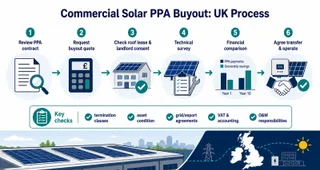
Commercial solar PPAs are more established because businesses often have larger roofs, steadier daytime demand and higher electricity consumption during working hours. That can make the model easier to structure: the provider funds the system, the business buys power, and the site uses a large share of the generation directly.
For homeowners, the economics and legal practicalities are usually more sensitive. Domestic roofs are smaller, household consumption patterns vary, and property sale issues matter more. A business may have directors, leases, energy managers and legal advisers reviewing the agreement; a homeowner may be making the decision alone.
The underlying concept is the same, but the risk profile is not. If you are reading about a commercial solar PPA, do not assume the same terms apply to a residential property. Check whether the offer is genuinely designed for homeowners and whether the provider has a clear process for domestic conveyancing and mortgage questions. Businesses can also compare PPAs with wider commercial solar finance routes.
Sensible next steps for UK homeowners
Start by comparing the PPA against ownership, not just against doing nothing. Ask what the same roof could produce under a standard solar purchase, whether a battery would improve self-consumption, and how export would be handled if you owned the system yourself. This gives you a baseline before judging the funded offer.
You should also gather practical site information before committing. Recent electricity bills, half-hourly smart meter data if available, roof age, loft access, consumer unit photos and any planned building work will all help an installer or provider assess suitability. If the roof is shaded, old or due for repair, solve that before signing a long solar agreement.
A solar PPA can be useful when it is transparent, fairly priced and compatible with your plans for the home. It is not automatically better or worse than buying panels; it is a different ownership model. The safest approach is to compare the contract, the technical design and the property implications side by side before deciding. If ownership may be simpler, you can compare home solar options before committing to a funded agreement.
Plan, Compare & Buy Renewable Energy Solutions
AI does the thinking.
You get the perfect solar match.
Use RoboMo™ to assess your property, compare available technologies and connect with trusted UK installers, suppliers and manufacturers.
Simply enter your postcode, drop a pin on your roof, create your free account and let RoboMo™ analyse your property to find the best solar panels for your home.

You don't have to think
RoboMo™'s AI analyses your roof and does all the hard work.

Accurate & tailored
AI-powered assessment based on your roof, location, and conditions.

Best options, maximum savings
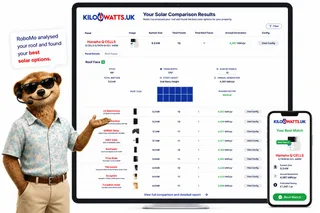
Compare top solar panels for the best performance and value.

Simple, fast & effortless
Provide a few details, sit back and watch your results unfold.
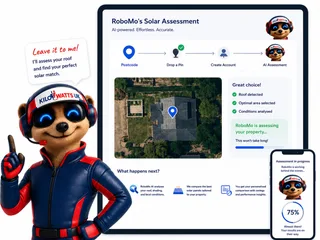
STEP 1
Choose Home, Business or Industrial
Enter your postcode to start your assessment.
STEP 2

Drop a pin on your roof
STEP 3

Create your free account
STEP 4

Sit back and watch RoboMo™ work
RoboMo™ analyses your roof and builds your personalised solar comparison.

Kilowatts UK is an authorised representative
Flower Turbines
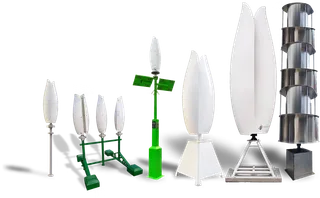
Compact vertical-axis turbines built for real UK sites, not just open farmland.
They start in light wind, sit in a small footprint, and are bird-safe by design. Cluster them as a bouquet and the group performs better together than the same turbines standing alone. Enter your postcode for a location-based generation estimate. Figures use area weather data and will differ if buildings, trees or hills sit in the way.
Starts in light UK wind
Built to generate in typical UK wind, not only open farmland.
Small rooftop or ground footprint
Compact towers for roofs, yards and tight sites.
Bird-safe slow rotation
Slow vertical-axis spin, bird-safe by design.
Bouquet clusters raise output
Grouped turbines outperform the same units standing alone.
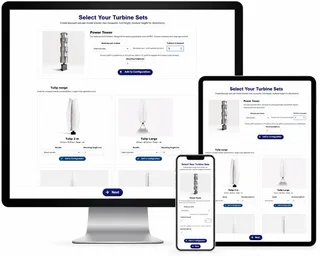
Step 1
Enter your postcode
Start designing your wind energy system in seconds.
STEP 2

Choose a location
STEP 3

Place your cluster
Tap the map where you want the turbine cluster to go.
STEP 4

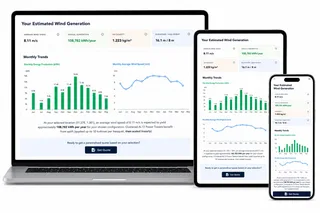
Instant generation forecasts
Compare different turbine layouts and see annual generation forecasts instantly.
STEP 5

No commitment required
Explore different configurations before deciding whether to request a quotation.
Related articles
Solar panels
Mo's Mission Nominations
FAQ
Need Help? RoboMo's Got Answers
What is a solar power purchase agreement for a UK home?
A solar power purchase agreement is a long-term deal where a provider funds and usually owns the solar panels on your roof. You buy the electricity the panels generate at a rate set out in the contract. It can reduce upfront cost, but it is not the same as owning the system yourself.
Is a solar PPA the same as free solar panels?
Not necessarily. Some offers described as free solar, funded solar or roof lease arrangements may work like a PPA, but the contract terms matter more than the label. Check who owns the equipment, who receives export income, who maintains the system and what obligations apply to the property.
Will a solar PPA always save me money?
No. Savings depend on the PPA electricity rate, any rate increases, how much solar power you use at home and what you would otherwise pay your electricity supplier. Be cautious with quotes that show guaranteed savings without explaining the assumptions.
Who gets the export payments under a solar PPA?
The contract should state who receives any export value if electricity is sent to the grid. In some agreements the provider keeps the export income, while in others it may be shared or passed to the homeowner. This can make a significant difference to the overall benefit of the deal.
What happens if I sell or remortgage my home with a solar PPA?
A buyer, conveyancer or mortgage lender may need to review the PPA, roof access rights and any transfer obligations. Some contracts require the new owner to take over the agreement, while others may allow a buyout. You should understand the sale and remortgage process before signing.
Who is responsible for maintenance and roof repairs?
The provider may maintain the panels, inverter and monitoring equipment, but you should check the response times, exclusions and fault process. Roof repairs are especially important because panels may need to be removed and refitted. The contract should say who pays for that work and how access is arranged.
What paperwork should I ask for before agreeing to a solar PPA?
Ask for the full contract, system design, ownership details, maintenance terms, export arrangements and any buyout or transfer terms. You should also ask what installation certificates, warranties, MCS documentation if applicable, DNO notification or approval, and planning information will be provided. Do not rely only on headline savings or a short sales summary.