


How commercial solar PPAs are priced: UK business guide
Published: 2026-09-29 00:10:55
Updated: 2026-09-30 19:51:30
Commercial solar PPAs are priced from capital, yield, daytime load, credit and term, not a UK-wide tariff. Export is priced separately from on-site use.
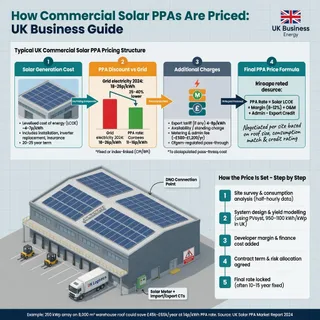
How commercial solar PPAs are priced - UK business guide
UK business guide B Solar PPA price building blocks
How commercial solar PPAs are priced UK
Commercial solar PPA pricing in the UK is a site-level contract calculation, not a national tariff. The rate has to recover capital cost, the funder's required return, operating costs and allocated risks. Those amounts are divided by the kilowatt-hours the model expects the array to generate and, for an on-site deal, the site to use. Yield, daytime load, grid constraints, credit strength and contract term move that number between buildings. Export of surplus is priced separately from power used on site.
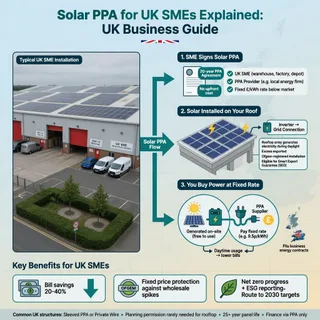
A commercial solar power purchase agreement is a contract under which a business buys electricity from a solar generator at a price set in the contract, usually for several years. In an on-site, behind-the-meter PPA the array is on the occupier's roof or land, and the price applies to solar kilowatt-hours the site uses. An off-site or sleeved PPA is a different product. Generation is elsewhere, and a licensed supplier passes volume through the supply contract, so the invoice is not only the generator's energy price.
A roof lease, a private-wire deal, a virtual PPA and an outright capital purchase allocate cost and ownership differently again. A year-one gap against today's import quote only means something if you know what it is measured against, and for how long. No UK-wide commercial solar PPA price, discount to grid, standard term or funder return is stated here, because those figures are not comparable unless the basis is fixed.
What the offtaker price has to recover
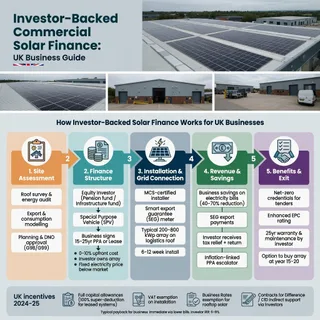
The headline pence per kilowatt-hour is the output of a financial model, not a panel price list. The funder commits capital to design, modules, mounting, inverters, electrical works and, often, roof strengthening or switchgear. That capital has to earn a return over the term the business buying the power can credibly commit to. Cleaning, inspections, monitoring, access and inverter reserves sit in the same model whether or not they appear as separate lines on a term sheet.
The unit rate tracks modelled kilowatt-hours, not roof area. Capacity, in kilowatts, drives how much capital goes in. Energy, in kilowatt-hours, is what the occupier is billed for. If the yield file is optimistic, or daytime use is thinner than assumed, the same capital produces a higher rate or a smaller array. Hardware life is not the same thing as PPA term. The plant may still generate after the contract ends. The price is set over the years this offtaker is contracted to buy.
Quotes that circulate in the market rarely share a basis. Some are unindexed opening prices. Some rise with CPI, RPI or a fixed escalator. Some are a discount to an import tariff that itself moves. Some include Renewable Energy Guarantees of Origin or sleeve fees and some do not. Wholesale prices, interest rates and build costs move the number, so an undated typical rate would mislead. Read any quote against its own basis: fixed or indexed, on-site or sleeved, and what is excluded.
Why similar UK sites are priced differently
Daytime load shape matters more than annual consumption. A warehouse drawing power through the solar day can support a different on-site price and system size from a shop whose trade is mostly evening, even with a similar roof. Commercial rooftop solar for UK offices, warehouses and retail parks is priced from the overlap between the yield profile and that site's daytime demand. Orientation, pitch, shading, soiling and structural capacity change the kilowatt-hours the funder uses to turn capital into a unit rate. A flat northern warehouse roof is not the same asset as an unshaded south-facing office roof. People often ask for a commercial solar panel cost for UK warehouses as if that figure were the PPA price. Installed cost is an input the funder has to recover. The occupier sees a unit rate for energy, which also has to carry return, operations and risk. Property rights and the network often move that rate as much as the modules. Where the occupier is a tenant, landlord consent, roof rights and the remaining lease cap the term that can be priced. Offtaker credit feeds the cost of capital. A weaker covenant usually means a higher rate or a shorter, tighter contract. The direction is consistent even without a published rate. Higher installed cost, lower expected yield, a shorter term, weaker credit, a lower share of daytime self-consumption, a cap on indexation that favours the buyer, or extra electrical and grid works all push the offtaker price up if the funder is targeting the same return. The opposite assumptions push it down. Business rates and VAT can change the economics, but treatment has moved over time and should be checked against current rules rather than treated as a fixed saving.
How on-site and sleeved prices differ
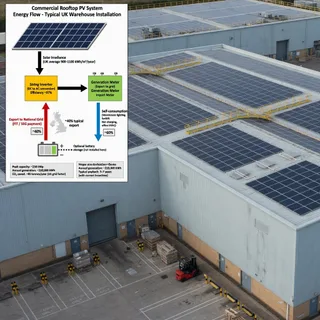
An on-site PPA price is a rate for solar kilowatt-hours generated at the premises and used there. Metering has to separate solar use, import and export, or the billed volume becomes a dispute about the price. Standing charges, residual import units and other supply-contract charges stay on the bill. A lower unit rate on solar-matched load does not remove the rest of the electricity cost. Commercial solar versus grid electricity is only a fair comparison on the units the array actually displaces.
A sleeved or off-site corporate PPA prices generation at another site. A licensed supplier passes an agreed volume through the business's supply contract. The generator's strike price is one layer. Sleeve fees, balancing and the shape of that volume against the site's demand sit on the invoice as well. That structure can suit a larger buyer who can commit volume and manage a supplier relationship. It is not a substitute for a single-site rooftop price, and it does not remove the need to see what is inside the all-in figure.
Private wire, a virtual PPA and a simple roof lease allocate risk differently again. In a funded on-site deal the business is buying energy, not the plant, and the price includes a funder's return. An outright capital purchase moves that return, and the operating risk, onto the owner. Which route costs less over the life of the roof depends on surveyed yield, the site's own load, the cost of capital each party actually faces, and how long the occupier will be there. None of that can be settled from a national pounds-per-kilowatt-peak figure.
How indexation, export and term change the bill
A year-one gap against today's import quote is not the saving over the whole term. Many supply contracts are short-dated. A PPA may run for many years and rise with an index, a fixed escalator, or a floating discount to whatever the import tariff becomes. A floating discount allocates wholesale risk differently from a fixed strike price. If the PPA is indexed and the comparison tariff is only a one-year quote, the opening discount to grid can narrow, widen or reverse without either party having mis-stated year one.
Export is often talked about as if it earned the on-site rate. It is usually a separate, and weaker, commercial arrangement. Do not copy a domestic Smart Export Guarantee explanation onto a commercial site without checking whether that scheme applies to the installation in question. If most of the modelled output would be exported, the on-site price is being asked to do a job it was not built for. The funder will usually shrink the array, pay less for export, or both.
Term is the other lever that is easy to under-read. A longer credible term spreads capital over more kilowatt-hours and can support a lower opening rate, but only if occupancy, landlord consent and roof life cover those years. A short term, or a term that ends when the occupier leaves, pushes the rate up or shifts cost into a buyout. Take-or-pay, deemed generation and a roof-strip formula can move money back to the occupier while the headline pence per kilowatt-hour still looks fixed. The lowest opening rate is not automatically the cheaper contract.
What the PPA rate leaves on the bill
A PPA rate is not the business's all-in electricity cost. It usually covers solar kilowatt-hours that are generated and, on site, consumed. Import for evening, weekend and winter load remains. Standing charges and other non-commodity items on the supply contract remain. If the comparison is solar against grid supply, it has to be solar-matched units against the import unit rate those units would otherwise have attracted, plus a clear list of what is excluded.
Third-party funding is not a capital purchase and it is not free solar. The occupier does not own the plant, or the full lifetime value of its output, unless the contract says so. Even then, the route to ownership is usually a buyout formula rather than a transfer at no cost. Performance risk often sits with the funder, which is why operation and maintenance access, as-built records and replacement reserves are priced even when they are not itemised. The occupier still carries occupancy risk, roof-access risk and the cost of power the array does not cover.
Assignment if the funder refinances, downtime exclusions, and who pays for inverter replacement all change the economic cost without changing the number on the front of the quote. Ask for those clauses in the same sitting as the unit rate. A price that cannot be reconciled to metered solar use, import and export is not a price you can audit once invoices start.
When a commercial solar PPA is a poor fit
An on-site PPA tends to fit a UK business with occupancy long enough for the term, a roof or site that can carry a worthwhile array, and daytime use that overlaps solar output. That description covers some warehouses, offices and retail units, and excludes others. It fits organisations that will not fund the asset themselves and can accept that they will not own the plant. Funders price more readily where the offtaker's credit can support the contract.
It is a weak fit if the roof needs replacement inside the term, the landlord will not consent, or most generation would be exported. It is also a weak fit if the business wants the asset and control of export income. Very small loads can be uneconomic to finance because metering, legal work and transaction costs do not shrink in proportion to the array, even where solar is technically possible. A funded PPA is then the wrong comparison. The prior question is whether any third party will price the job at all.
Off-site sleeved PPAs suit larger buyers who can commit volume. They do not fix a single shop or a small office whose problem is a rooftop and a daytime load. The decision is funded energy versus capital install versus staying on grid supply, using surveyed yield and the site's own half-hourly data.
What has to be true before a desk price holds
Commercial PPA pricing starts from a yield file and a connection assumption, then gets rewritten by the site. The file that matters covers orientation, near shading, soiling, inverter clipping and availability, not a generic UK yield per kilowatt-peak. Structural capacity, the roof-covering warranty, access for maintenance, and whether existing switchgear can take the connection without a board upgrade often sit inside the capital stack. That remains true even when the first conversation was about panel cost.
For many commercial roofs the connection is a G99 application to the local distribution network operator, not a small-scale notification. Exact thresholds and charges should be taken from current Energy Networks Association and DNO text, not from memory. Treat the commercial solar G99 DNO connection as part of the price, not as paperwork that follows a firm rate. An offer issued after the first quote can impose a smaller inverter or an export cap the original model did not use. Any rate given before the connection offer, the structural survey and the half-hourly load file is indicative.
Clauses that look administrative are part of the real cost. Deemed versus metered output, inverter replacement, downtime exclusions, assignment on refinance, and the formula if the occupier leaves or the roof must be stripped all change who pays when the site does not match the model. Ask which of those sit inside the quoted rate and which would be extra. If the answer is vague, the rate is not yet a price you can hold the funder to.
How to judge a PPA against owning the array
Read any funded offer against three questions. What volume does the rate actually cover, and is export priced separately? What is the indexation or discount formula over a term you can evidence, not just year one against a short supply quote? What capital and risk are you not taking, and what are you giving up in ownership, buyout and control of the roof?
If the business can fund the plant, wants the asset, and has occupancy and a roof that justify it, ownership is the cleaner comparison. The PPA price includes a return the owner would otherwise keep, in exchange for not tying up capital and not carrying performance. Neither route is universally cheaper. National costs for warehouses, offices or retail parks, a standard percentage discount to grid, and a standard funder hurdle are not reliable inputs and should not be used to force the decision.
Where ownership is the live alternative, the practical next step is a surveyed design and a like-for-like view of a capital install against a funded energy contract, using the same yield file and the same load. You can weigh a capital install against a funded array on that basis, then put the PPA term sheet beside it and check self-consumption, connection constraints, indexation and buyout before treating either number as firm.
Plan, Compare & Buy Renewable Energy Solutions
AI does the thinking.
You get the perfect solar match.
Use RoboMo™ to assess your property, compare available technologies and connect with trusted UK installers, suppliers and manufacturers.
Simply enter your postcode, drop a pin on your roof, create your free account and let RoboMo™ analyse your property to find the best solar panels for your home.

You don't have to think
RoboMo™'s AI analyses your roof and does all the hard work.

Accurate & tailored
AI-powered assessment based on your roof, location, and conditions.

Best options, maximum savings
Compare top solar panels for the best performance and value.

Simple, fast & effortless
Provide a few details, sit back and watch your results unfold.
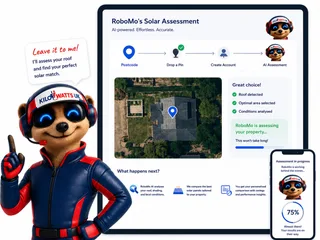
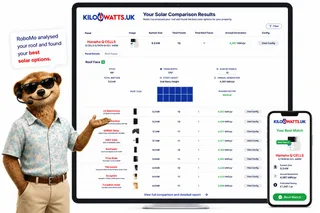
STEP 1
Choose Home, Business or Industrial
Enter your postcode to start your assessment.
STEP 2

Drop a pin on your roof
STEP 3

Create your free account
STEP 4

Sit back and watch RoboMo™ work
RoboMo™ analyses your roof and builds your personalised solar comparison.

Kilowatts UK is an authorised representative
Flower Turbines
Compact vertical-axis turbines built for real UK sites, not just open farmland.
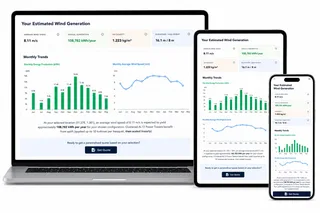
They start in light wind, sit in a small footprint, and are bird-safe by design. Cluster them as a bouquet and the group performs better together than the same turbines standing alone. Enter your postcode for a location-based generation estimate. Figures use area weather data and will differ if buildings, trees or hills sit in the way.
Starts in light UK wind
Built to generate in typical UK wind, not only open farmland.
Small rooftop or ground footprint
Compact towers for roofs, yards and tight sites.
Bird-safe slow rotation
Slow vertical-axis spin, bird-safe by design.
Bouquet clusters raise output
Grouped turbines outperform the same units standing alone.
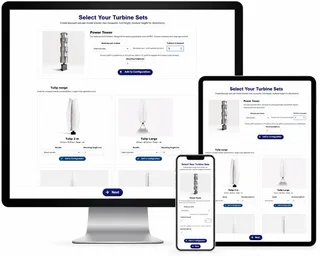
Step 1
Enter your postcode
Start designing your wind energy system in seconds.
STEP 2

Choose a location
STEP 3

Place your cluster
Tap the map where you want the turbine cluster to go.
STEP 4

Instant generation forecasts
Compare different turbine layouts and see annual generation forecasts instantly.
STEP 5

No commitment required
Explore different configurations before deciding whether to request a quotation.
Related articles
Mo's Mission Nominations
FAQ
Need Help? RoboMo's Got Answers
Is there a standard commercial solar PPA price in the UK?
No. A commercial solar PPA rate is a site-level contract calculation, not a national tariff. It has to recover capital cost, the funder's required return, operating costs and allocated risks, spread over the kilowatt-hours the model expects the array to generate and the site to use. Quotes are not comparable unless you know whether the rate is fixed or indexed, on-site or sleeved, and what is excluded. Wholesale prices, interest rates and build costs also move, so an undated typical rate would mislead.
What does a commercial solar PPA unit rate have to recover?
The headline pence per kilowatt-hour is the output of a financial model, not a panel price list. The funder commits capital to design, modules, mounting, inverters, electrical works and often roof strengthening or switchgear, and that capital has to earn a return over the term the buyer can credibly commit to. Cleaning, inspections, monitoring, access and inverter reserves sit in the same model whether or not they appear as separate lines. Capacity drives how much capital goes in, but the occupier is billed for energy, so yield and use set the unit rate.
Why can similar UK buildings be offered different PPA rates?
Daytime load shape matters more than annual consumption. A warehouse drawing power through the solar day can support a different on-site price and system size from a shop whose trade is mostly evening, even with a similar roof. Orientation, shading, soiling, structural capacity, landlord consent, remaining lease, offtaker credit and grid constraints all change the kilowatt-hours and the term the funder can use. Higher installed cost, lower yield, a shorter term, weaker credit, less daytime self-consumption or extra electrical and grid works push the rate up if the funder is targeting the same return.
How does an on-site PPA price differ from a sleeved or off-site PPA?
An on-site PPA prices solar kilowatt-hours generated at the premises and used there. A sleeved or off-site PPA prices generation elsewhere, and a licensed supplier passes an agreed volume through the business's supply contract. The generator's strike price is only one layer: sleeve fees, balancing and how that volume matches the site's demand sit on the invoice as well. That structure is not a substitute for a single-site rooftop price, and the all-in figure still needs to be read for what it includes.
Is a year-one discount against today's import quote the saving over the whole term?
No. A year-one gap only means something if you know what it is measured against and for how long. Many supply contracts are short-dated, while a PPA may run for many years and rise with an index, a fixed escalator, or a floating discount to whatever the import tariff becomes. If the PPA is indexed and the comparison is only a one-year quote, the opening gap can narrow, widen or reverse without either party having mis-stated year one. A longer term can support a lower opening rate only if occupancy, landlord consent and roof life cover those years.
Is surplus export paid at the same rate as power used on site?
Usually not. Export is priced separately from power used on site, and it is often a weaker commercial arrangement than the on-site rate. Do not assume a domestic export scheme applies to a commercial installation without checking whether that scheme covers the site in question. If most of the modelled output would be exported, the funder will usually shrink the array, pay less for export, or both. Metering has to separate solar use, import and export, or the billed volume becomes a dispute about the price.
Does the PPA rate cover the whole electricity bill?
No. It usually covers solar kilowatt-hours that are generated and, on site, consumed. Import for evening, weekend and winter load remains, as do standing charges and other non-commodity items on the supply contract. A lower unit rate on solar-matched load does not remove the rest of the electricity cost. Third-party funding is not a capital purchase and it is not free solar: the occupier does not own the plant unless the contract says so, and the route to ownership is usually a buyout formula rather than a transfer at no cost.
When is a commercial solar PPA a poor fit?
An on-site PPA is a weak fit if the roof will not last the term, the landlord will not consent, or most generation would be exported. It is also a weak fit if the business wants the plant, the warranties and the export income, in which case a capital install is the relevant comparison. Very small loads can be uneconomic to finance because metering, legal work and transaction costs do not shrink in proportion to the array. Off-site sleeved PPAs suit larger buyers who can commit volume; they do not fix a single shop or small office whose problem is a rooftop and a daytime load.