


Compare home solar panel options
Published: 2026-08-19 17:55:08
Updated: 2026-08-20 22:05:12
In the UK solar market, people usually mean MCS certification. MCS is the Microgeneration Certification Scheme.

What Is MCS Accreditation and Why Does It Matter for Solar Panel Installations?
Understand what is mcs accreditation in the UK, with clear explanations, examples, and practical next steps.
What is MCS accreditation?
Strictly speaking, installers are certified under the MCS scheme by approved certification bodies. Products can also be certified or listed under relevant MCS product schemes. The certificate issued for an eligible solar PV installation is part of the commissioning and handover record for that specific system.
MCS is not a government guarantee of savings, payback, output or future tariff access. A good solar decision still depends on roof suitability, electrical design, shading, equipment choice, installation quality, grid connection handling and aftercare. MCS gives you a recognised baseline, but you still need to compare quotes carefully.
What an MCS certificate proves and what it does not prove.
An MCS certificate is evidence that an eligible installation has been registered through the MCS process by an MCS-certified contractor. It supports the paper trail for export tariff applications, warranty discussions, future property sale records and general confidence that the installation was commissioned through a recognised quality framework.
The certificate should not be treated as proof that the system will achieve a particular financial return. Solar performance still varies with roof orientation, pitch, shading, local weather, equipment specification, household usage, export arrangements and maintenance over time.
The official MCS installer and product registers are the right places to check current certification status. For export payments, Ofgem’s Smart Export Guarantee guidance and the chosen energy supplier’s own terms are also important, because suppliers decide what evidence they will accept.
Installer certification
The contractor should be certified for the relevant technology and scope of work at the time of installation.Product suitability
Panels, inverters and other relevant components should be appropriate for the certified installation route where MCS is being used.Commissioning record
The installation should be registered and handed over with the correct documents once it has been completed.Export evidence
The certificate is commonly requested for Smart Export Guarantee applications, although supplier terms should always be checked in writing.Practical limitation
The certificate does not prove the quote was the cheapest, the layout was optimal or the financial forecast will be achieved.
Why MCS matters before you accept a solar quote.
MCS certification matters because most solar problems are not caused by the panel brand alone. In real projects, issues often come from poor roof assessment, weak design assumptions, unclear export arrangements, missing DNO paperwork, rushed handover or confusion between the salesperson, installer and electrician.
A solar quote should explain more than how many panels will fit on the roof. It should cover orientation, shading, inverter choice, mounting method, generation assumptions, electrical works, monitoring, scaffolding and whether battery storage is included or future-ready. MCS does not make every quote perfect, but it gives you a recognised framework for asking better questions.
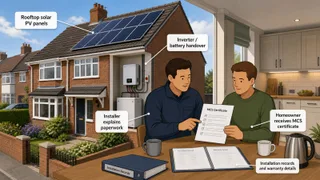
For many customers, the value of MCS becomes most obvious after installation. The handover pack helps you apply for export payments, keep records for a future property sale, support warranty queries and understand how to operate the system safely.
MCS certificate
Evidence that the eligible installation has been registered through the MCS process.Electrical certification
Documentation showing the electrical work has been tested and recorded.DNO paperwork
Confirmation of notification or approval where the grid connection process requires it.Product warranties
Details for panels, inverter, battery and mounting equipment where supplied.User information
Practical instructions for monitoring, isolation, maintenance and fault reporting.Consumer documents
Clear information on contracts, complaints routes and workmanship warranty arrangements.
Is MCS certification legally required for solar panels?
MCS certification is not the same thing as planning permission, Building Regulations compliance or electrical safety law. A non-MCS contractor may be physically able to install solar panels, but that does not mean the installation will meet the paperwork expectations of export tariff providers, lenders, insurers or future buyers.
The most common practical issue is the Smart Export Guarantee. Energy suppliers commonly ask for an MCS certificate, or evidence they consider equivalent, when a customer applies to be paid for exported solar electricity. In practice, many suppliers prefer an MCS certificate because it is familiar, standardised and easy to verify. If you are considering a non-MCS route, check the supplier’s requirements in writing before you commit.
MCS also does not remove other UK requirements. A domestic solar PV system may still need distribution network operator notification or application, commonly discussed as G98 or G99 depending on the system and export capacity. The installer must also consider roof structure, electrical safety, metering, building requirements and any planning constraints, such as listed buildings or conservation areas. ENA and DNO guidance should be checked for the correct connection route.
What an MCS-certified installer should check on site.
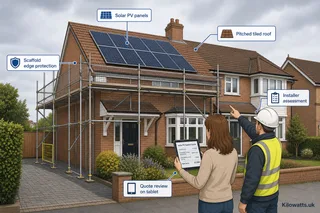
A credible MCS-certified installer should not design the system from a satellite image alone unless the job is extremely straightforward and the process still allows for verification before installation. The roof condition, loft access, consumer unit, meter position, cable route and shading can all change the specification.
The survey is where a good installer separates a realistic design from a generic sales proposal. A small chimney shadow, fragile roof covering, limited consumer unit space or awkward scaffold access can affect both performance and cost. If a battery is included, the installer also needs to consider location, ventilation, access, cable routes and manufacturer requirements.
The details that change a quote are often practical rather than eye-catching. A cheaper proposal may exclude scaffolding complexity, bird protection, consumer unit work, export limitation equipment or monitoring assumptions. A higher quote may include a more complete scope.
- Roof condition, covering, orientation, pitch and shading.
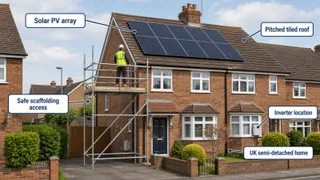
- Safe access and scaffolding requirements.
- Consumer unit capacity and cable routes.
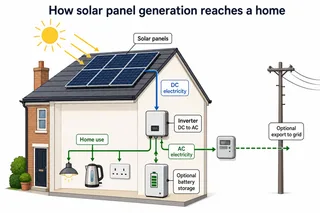
- Inverter position, metering and monitoring.
- DNO process and export arrangements.
- Battery location and future expansion options.
- Handover documents and aftercare responsibility.
How MCS compares with other installer checks.
MCS is important, but it is not the only thing to check. Solar PV work also involves electrical competence, safe roof work, suitable products, good customer service and proper grid connection paperwork. Treat MCS as a strong baseline, not a reason to stop due diligence. The best buying decision usually comes from combining several checks. An installer may be MCS-certified but still offer a weak design, vague savings assumptions or poor communication. Equally, a good review score does not replace formal certification, electrical testing or handover documents.
| Check | What it helps with | What it does not prove on its own |
|---|---|---|
| MCS certification | Recognised installation process, certified products and handover route for eligible systems. | It does not guarantee savings, payback or that every quote is the best design. |
| Electrical competence | Safe connection, testing and compliance with relevant electrical work requirements. | It does not automatically prove solar-specific design experience. |
| DNO paperwork | Correct notification or approval for connecting generation to the local network. | It does not assess roof condition, workmanship quality or customer service. |
| Product warranties | Manufacturer support for panels, inverter, battery or mounting equipment. | Warranty length does not prove the system has been well designed or installed. |
| Consumer protection | A clearer complaints route, contract expectations and workmanship protection where applicable. | It does not remove the need to read terms, exclusions and warranty conditions. |
| Reviews and references | Real customer feedback on communication, reliability and aftercare. | Reviews are not a technical certification or a substitute for documentation. |
Consumer protection and complaints routes to check.
MCS-certified contractors are expected to work within recognised consumer protection arrangements, but you should still ask exactly what applies to your installation. Do not assume that a logo automatically tells you the complaint process, workmanship warranty period, insurance-backed guarantee position or contract cancellation terms.
A good installer should be able to explain which consumer code applies, how complaints are handled, what workmanship warranty is included and what happens if there is a fault after installation. This matters because the problems customers face are often administrative as well as technical: missing certificates, unclear monitoring access, delayed DNO paperwork, warranty disputes or disagreement over what was included in the quote.
Read the contract and quotation carefully before paying a deposit. If anything important is only said verbally, ask for it in writing.
Consumer code
Ask which approved consumer code applies and how you can verify membership.Workmanship warranty
Confirm what is covered, how long it lasts and whether there are exclusions.Insurance-backed guarantee
Ask whether any workmanship protection is insurance-backed and request the policy details if applicable.Complaints process
Ask who handles complaints first and what escalation route exists if the issue is not resolved.Handover deadline
Confirm when you should receive the MCS certificate, electrical paperwork, DNO evidence and warranty documents.
When MCS is especially important, and when it is not enough.
MCS is especially relevant for domestic rooftop solar and smaller commercial systems where the customer wants recognised documentation, a smoother export tariff application and a clear quality framework. It is also useful for landlords, developers and businesses that need an auditable record for asset management, finance checks or internal approval.
For larger commercial solar projects, MCS may not be the whole answer. Bigger systems can involve more detailed structural design, grid studies, landlord permissions, procurement checks, insurance requirements and bespoke contracts. In those cases, MCS can still be useful where it applies, but it should sit alongside wider engineering and commercial due diligence.
It is also worth being realistic about what MCS cannot do. It does not guarantee a specific kWh output, a particular financial return, future electricity prices or tariff availability. It does not remove the need to compare designs, understand assumptions and check whether the proposed system suits your actual electricity use.
Can you get export payments without MCS?
Some Smart Export Guarantee suppliers may refer to an MCS certificate or equivalent evidence, but the wording and acceptance process can vary. The risk is that “equivalent evidence” is not always simple to provide after the event, especially if the installation was not designed, commissioned and documented to a standard the supplier recognises.
For most homeowners who want to apply for SEG, choosing an MCS-certified installation is usually the lower-risk route because suppliers are used to checking MCS certificates. If you are considering an alternative, ask the supplier before installation what documents they require, whether they will accept them for your proposed system and whether they will confirm that in writing.
This is not just a paperwork issue. Export arrangements also depend on metering, DNO notification or approval, commissioning records and the supplier’s tariff terms. Sorting those details after installation can be slower and more frustrating than getting the right process agreed from the start.
How to check an installer before you proceed.
Before accepting a solar quote, check the installer’s current status on the official MCS register rather than relying only on a logo in a brochure. You should also ask whether the panels, inverter and other relevant products are suitable for an MCS installation and whether the installer will register the job and provide the certificate after commissioning.
Good installers should be comfortable explaining the design in plain English. They should tell you who handles the DNO process, what export limit has been assumed, what is included in the price, what could change after survey and what documents you will receive at handover. If a quote avoids those points, the risk is not just the installation day; it is the years of ownership afterwards.
For homeowners and businesses, the practical next step is to compare like with like. Do not only compare the headline system size in kWp or the number of panels. Compare the survey quality, assumptions, equipment, installation scope, paperwork, consumer protection and aftercare. Confirm what documents you will need for your chosen export supplier before you commit, and check installer reviews alongside formal certification.
Verify certification
Check the installer on the official MCS register before signing.Check product status
Confirm that the quoted equipment is appropriate for an MCS installation where required.Clarify the DNO route
Ask whether the job falls under G98 or G99 and who submits the paperwork.Review the assumptions
Ask how generation, self-consumption and export have been estimated.Check consumer protection
Ask which consumer code, workmanship warranty and complaints process apply.Confirm the handover pack
Make sure certificates, warranties, user instructions and commissioning documents are included.
MCS certification is not a shortcut around proper comparison, but it is a strong filter for avoiding unnecessary risk. If you want a solar installation that is easier to document, easier to support and better aligned with UK market expectations, an MCS-certified installer should be high on your shortlist.
Plan, Compare & Buy Renewable Energy Solutions
AI does the thinking.
You get the perfect solar match.
Use RoboMo™ to assess your property, compare available technologies and connect with trusted UK installers, suppliers and manufacturers.
Simply enter your postcode, drop a pin on your roof, create your free account and let RoboMo™ analyse your property to find the best solar panels for your home.

You don't have to think
RoboMo™'s AI analyses your roof and does all the hard work.

Accurate & tailored
AI-powered assessment based on your roof, location, and conditions.

Best options, maximum savings
Compare top solar panels for the best performance and value.

Simple, fast & effortless
Provide a few details, sit back and watch your results unfold.
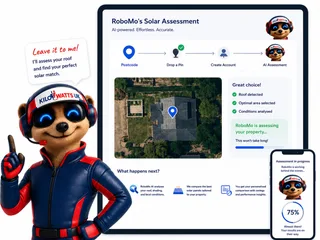
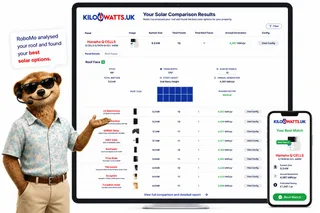
STEP 1
Choose Home, Business or Industrial
Enter your postcode to start your assessment.
STEP 2

Drop a pin on your roof
STEP 3

Create your free account
STEP 4

Sit back and watch RoboMo™ work
RoboMo™ analyses your roof and builds your personalised solar comparison.

Step 1
Enter your postcode
Start designing your wind energy system in seconds.
Are you an installer, distributor or renewable energy business?
Kilowatts UK is expanding the Flower Turbines partner network across the UK.
Become A Flower Turbines PartnerKilowatts UK is an authorised representative
Flower Turbines
Compact vertical-axis turbines built for real UK sites, not just open farmland.
They start in light wind, sit in a small footprint, and are bird-safe by design. Cluster them as a bouquet and the group performs better together than the same turbines standing alone. Enter your postcode for a location-based generation estimate. Figures use area weather data and will differ if buildings, trees or hills sit in the way.
Starts in light UK wind
Built to generate in typical UK wind, not only open farmland.
Small rooftop or ground footprint
Compact towers for roofs, yards and tight sites.
Bird-safe slow rotation
Slow vertical-axis spin, bird-safe by design.
Bouquet clusters raise output
Grouped turbines outperform the same units standing alone.
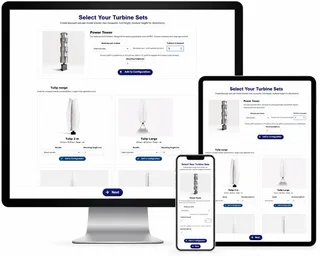
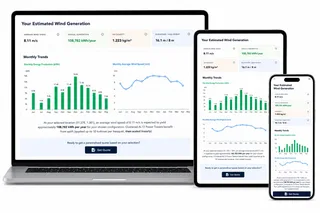
STEP 2

Choose a location
STEP 3

Place your cluster
Tap the map where you want the turbine cluster to go.
STEP 4

Instant generation forecasts
Compare different turbine layouts and see annual generation forecasts instantly.
STEP 5

No commitment required
Explore different configurations before deciding whether to request a quotation.
Related articles
Mo's Mission Nominations
FAQ
Need Help? RoboMo's Got Answers
What does MCS certification mean for a solar panel installation?
MCS is the UK Microgeneration Certification Scheme for small-scale low-carbon technologies, including solar PV. For a solar installation, it means the contractor is certified against recognised scheme standards for the relevant work. It also supports a clear paper trail for survey, design, installation, commissioning and handover.
Is MCS accreditation the same as MCS certification?
People often say MCS accreditation, but the more accurate term is MCS certification. Installers can be MCS-certified for specific technologies, such as solar PV. Products used in an MCS installation should also be suitable for the certified installation route.
Is MCS certification a legal requirement for solar panels in the UK?
MCS certification is not the same as planning permission, Building Regulations compliance or electrical safety. However, it is often important for export tariff applications, lender checks, property records and consumer confidence. You should also make sure any required grid notification or application is handled correctly.
Will I need an MCS certificate to get paid for exported electricity?
Many Smart Export Guarantee providers ask for an MCS certificate or evidence they consider equivalent before accepting a solar PV system. Requirements can vary between suppliers, so check before you commit to a quote. Ask the installer whether the proposed system will be eligible for an MCS certificate when completed.
Does using an MCS-certified installer guarantee the best solar design?
No. MCS certification gives you a recognised quality framework, but it does not automatically mean the system is the best size, layout or specification for your home. You should still compare quotes carefully and check roof suitability, shading, electricity use, inverter choice, battery plans and aftercare.
How can I check whether a solar installer is MCS-certified?
Ask the company for its MCS details and check its current status on the official MCS register. Confirm that the certification covers solar PV, not just another technology. Be cautious of vague claims such as MCS approved without clear evidence of who will design, install and sign off the system.
What paperwork should I receive after an MCS solar installation?
You should receive the MCS certificate where applicable, plus a handover pack, electrical documentation, product information, warranties and commissioning records. Keep these documents together because they may be useful for export tariffs, insurance, maintenance or selling the property. If a battery is included, ask what additional battery documents and warranties apply.
What should I ask an MCS-certified installer before accepting a quote?
Ask what roof survey has been carried out, what shading and generation assumptions have been used, and what equipment is included. Check who is responsible for DNO paperwork, electrical certification, scaffolding, monitoring and handover documents. You should also ask what workmanship warranty, complaints process and aftercare support apply.