


Solar PPA for UK SMEs explained: UK business guide
Published: 2026-09-28 23:17:06
Updated: 2026-09-30 11:52:21
A solar PPA for UK SMEs is a contract to buy on-site generation from a funder that owns the plant. Weigh daytime load, roof rights and how long you stay.
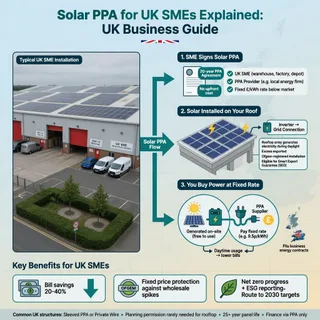
Solar PPA for UK SMEs explained - UK business guide
UK business guide B Solar SME PPA terms
What an on-site solar PPA is for a UK SME
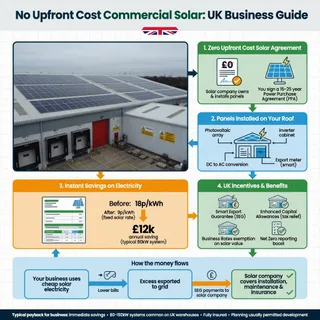
An on-site solar PPA is a contract in which a third party funds, owns and operates a solar PV system, and the business buys the electricity generated at an agreed price for an agreed term. It is not a grant, a green supply tariff, or the same thing as buying the plant with cash or a loan. Whether it beats imported grid electricity depends on daytime load, roof condition, how long the firm will occupy the site, the offtaker's credit, and any export limit on the local network.
The usual smaller-business product is behind the meter. The array sits on the firm's roof, a car-park canopy or adjacent land, and generation is used in the building before any surplus is exported. You are buying kilowatt-hours, not the asset. A lease or hire purchase is closer to paying for the equipment itself. The host does not fund the provider's capital cost, but the arrangement is not free. You pay the contract price for metered generation, you grant roof rights for the term, and you can still meet legal fees, roof repairs the funder will not accept, disruption during the works, and making-good later.
Do not treat every offer of solar on the roof as an occupier PPA. In a roof-rent deal the site owner grants roof rights and may receive rent, while the developer sells the power elsewhere. In an occupier PPA the business is the customer for the electricity. Cash flow, who can claim the renewable attributes, and what happens on exit are different. Off-site, sleeved and virtual PPAs, which buy power from a remote generator, are a further product. They are more often used by larger energy users than by a typical smaller occupier.
Who owns the plant and what the business pays
The provider owns the plant and, on a standard on-site PPA, operates and maintains it. The business is the offtaker. It pays for electricity the generation meter records, at the price and indexation written into the contract. Environmental attributes such as REGOs stay with the generator unless the contract assigns them. A roof licence gives the provider rights over the roof for access, cabling and the array. It does not, by itself, transfer ownership of the panels to the occupier.
The pence per kilowatt-hour, and any opening discount to the grid unit rate, are not national figures. Each provider prices the site. Do not assume a current market rate from a general guide. A discount on an illustration is not a permanent saving if the price is indexed, if a minimum-take or deemed-consumption clause applies, or if daytime use falls after signature. Export revenue is not automatically yours. If the provider keeps it, ask how that value has been treated in the price rather than assuming a second income.
Compare commercial solar with grid electricity on the import unit rate you actually avoid. Solar does not remove the standing charge or the capacity-related charges on a business supply. An evening-heavy site, a seasonal shop, or a later move to electric heat or vehicles can change how much generation is used on site. The result is metered use against a contract, not the headline on a first layout.
Solar PPA for UK SMEs explained against buying the system
Buying the plant and signing a PPA answer different questions. A PPA is a long purchase of metered kilowatt-hours from equipment you do not own. An owned system is a capital asset. Maintenance, residual value and the owner's tax position sit with the business. Staying on grid import avoids roof rights and a long offtake, but it leaves the full import unit rate in place. A PPA is not proof that third-party funding beats ownership on lifetime cost. Firms with capital, a long hold on the building and a stable daytime load sometimes prefer to own the asset and keep any residual value. That comparison needs a site-specific capital cost. Commercial solar panel cost for UK warehouses, offices and shops moves with structure, access, electrical works and network works, so a national typical is not a safe planning number. Where ownership is the real alternative, use a structured commercial solar panel installation comparison rather than treating a PPA illustration as the only route. The useful test is which party carries which risk, not which label sounds cheaper. Read the rows below against your lease length, your daytime load and whether you want control of the roof. None of these cells is a price, a grant, or a performance promise.
Overview
Use the table to decide which conversation to have first. If you cannot accept a long restriction on the roof, the PPA column fails before the unit rate matters. If you want the asset and can fund it, price ownership on the same roof and the same load rather than rejecting it from a slogan.
Which SME buildings are more likely to suit a PPA
An on-site PPA tends to suit a smaller occupier that expects to stay in a sound building for the contract term, uses a material share of electricity while the array is generating, and would rather buy kilowatt-hours than own plant. Here, SME means that kind of business occupier, not a checked Companies Act headcount or turnover test. Providers screen the site and the covenant together. A weak covenant can mean no offer, a shorter term, or a request for extra security. Whether any guarantee is required is a question for that funder, not a market rule.
A large warehouse roof is a common starting point and still not an automatic yes. If the unit is quiet in daylight, the covering is near the end of its life, or export will be heavily limited, the saving can fall away even when the roof looks clear. Commercial rooftop solar for UK offices can work where weekday daytime use is steady and, if the firm is a tenant, the landlord will license the roof for the full term. Solar for UK retail parks and shops can work on larger units, but multi-let buildings add a named offtaker, shared risers, wayleaves and a landlord who has to cooperate for the whole contract.
Tenants lose schemes on consent and lease length more often than on panel technology. The landlord has to allow the roof to be used for at least the PPA term, and the occupational lease must not end first. Owner-occupiers skip that consent step and still accept access rights, making-good and a long limit on how the roof can be used. Any funder minimum size, or minimum annual consumption, is set by that provider. It is not a published national floor. A clear roof on a very small site can still be uneconomic for the funder.
How roof condition, metering and G99 change the job
The survey that decides a commercial PPA is structural and commercial, not a panel count. The people pricing the job look at roof build-up, remaining life, asbestos, drainage, edge zones, and whether fixings penetrate a warranted covering or sit on ballast. A layout that voids the roof warranty, or that the building insurer will not accept, is not a saving. Asbestos, a failing deck, or a covering already due for replacement can stop the scheme after the first sales visit, even when the electricity sketch looked attractive.
Metering is what makes the contract billable. Expect to be asked for the MPAN, existing import capacity, half-hourly or equivalent load data, space for a generation meter, and a written rule for export. The provider often runs the network application, but the host has to allow access, possible shutdowns, and an outcome in which approved export is below the capacity drawn on the layout. A commercial solar G99 DNO connection in the UK is the name many larger arrays meet. The applicable route still depends on size and on the network area, and it has to be confirmed for the site. A smaller scheme may follow a different notification route. Thresholds, charges and timescales belong to the distribution network operator's current process, not to a guessed figure. Neither label approves the sales drawing.
Later roof works are the point that surprises occupiers. The contract should say who may switch the system off, who pays to lift and refit it, and how lost generation is treated. Building insurance and array insurance are separate notifications. Planning is often available for many non-domestic roofs, but it is not automatic for a listed building, some sensitive settings, or where structure or glare is a problem. Inverter replacement, cleaning access and bird proofing belong in the operating plan, which is usually the provider's, while access still falls on the occupier.
Which contract terms move the bill
The price schedule is only one page of the risk. Contract length is often multi-year, but the term, any break and any extension are points in the draft, not a standard band you can assume before you read it. Indexation needs the same attention as the opening rate. A price that tracks an inflation measure, a published energy index, or a blend of the two can close a starting gap to grid import well before the term ends. If a minimum-take clause also applies, you can be billed for generation you did not use.
End of term should be written down, not implied by the sales conversation. Buyout, extension, leaving the plant in place, or removal and reinstatement, including making good the roof, are outcomes a contract may provide. Which one applies, and at what cost, is unknown until it is in the document. Change-of-occupier, assignment and early-termination clauses matter as much as the starting unit rate if you might sell the business, refinance, or leave the building. A restriction that blocks a roof strip, or that a buyer's lender will not accept, can cost more than a modest difference in unit price.
Tax and regulatory treatment is a separate check, and it is easy to get wrong by copying a domestic job. VAT, business rates, capital allowances and any Climate Change Levy position can differ between owned solar and a third-party PPA. The current treatment has to come from up-to-date professional advice, not from a general article. Third-party on-site supply can also raise electricity licensing questions, which providers structure their contracts around. That is not confirmation that any exemption applies to the offer in front of you. Do not assume a domestic certification route carries across to a commercial PPA or to export sales. Ask what the contract and the network actually require, and have that answer checked.
When an SME solar PPA is the wrong product
A PPA is a weak fit when the occupational lease is shorter than the contract, credit is poor, the roof needs replacement, shading is heavy, or use is mostly at night and at weekends. It is also a poor fit if the business is about to relocate, or if a refinance or a planned roof strip would clash with the licence. Very small sites can be uneconomic for a funder even when the roof looks empty. The size at which a provider will engage is theirs to set, and it should be asked for rather than inferred.
Off-site and sleeved PPAs are the wrong default for this question. They suit larger buyers who can manage supplier sleeving and volume risk. Most smaller firms need the on-site product explained, including a clear account of who will not be offered it. Ownership remains the alternative where the firm wants the asset, has a long hold, and can carry maintenance and performance risk. It is not a slogan for everyone else. A PPA is not evidence that funded solar will beat an owned system over the life of the building. Specific yield, degradation and inverter life are site and product specifics. They are higher, all else equal, on an unshaded southerly roof in a sunnier part of the UK than on a shaded or east-west roof, but they are not national constants to drop into a business case.
What to ask before you treat a layout as an offer
Treat a sales illustration as a model, not as a forecast of the bill and not as a network approval. It depends on a consumption profile, weather assumptions and an export assumption. An illustration that ignores export limitation, or that is not built on real load data, should not be treated as an offer. Signing a letter of intent does not fix those assumptions, and it does not oblige the distribution network operator to accept the drawn capacity.
Before you compare a PPA with ownership or with staying on supply, pin down the contract points that change cash flow. These are the questions that most often rewrite a headline saving.
Take the draft, the structural comments and the network position to someone who can read them against your lease and your load. Confirm how long you will actually occupy the building, and ask for the same roof to be priced as a PPA and, if you might own it, as a purchased system. If either case depends on a grant, a fixed discount or a guaranteed bill, ask where that figure is written. If it is not in the contract or in a current official source, leave it out of the decision.
Plan, Compare & Buy Renewable Energy Solutions
AI does the thinking.
You get the perfect solar match.
Use RoboMo™ to assess your property, compare available technologies and connect with trusted UK installers, suppliers and manufacturers.
Simply enter your postcode, drop a pin on your roof, create your free account and let RoboMo™ analyse your property to find the best solar panels for your home.

You don't have to think
RoboMo™'s AI analyses your roof and does all the hard work.

Accurate & tailored
AI-powered assessment based on your roof, location, and conditions.

Best options, maximum savings
Compare top solar panels for the best performance and value.

Simple, fast & effortless
Provide a few details, sit back and watch your results unfold.
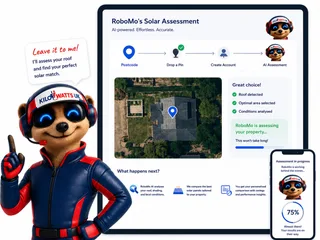
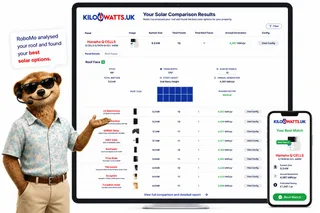
STEP 1
Choose Home, Business or Industrial
Enter your postcode to start your assessment.
STEP 2

Drop a pin on your roof
STEP 3

Create your free account
STEP 4

Sit back and watch RoboMo™ work
RoboMo™ analyses your roof and builds your personalised solar comparison.

Kilowatts UK is an authorised representative
Flower Turbines
Compact vertical-axis turbines built for real UK sites, not just open farmland.
They start in light wind, sit in a small footprint, and are bird-safe by design. Cluster them as a bouquet and the group performs better together than the same turbines standing alone. Enter your postcode for a location-based generation estimate. Figures use area weather data and will differ if buildings, trees or hills sit in the way.
Starts in light UK wind
Built to generate in typical UK wind, not only open farmland.
Small rooftop or ground footprint
Compact towers for roofs, yards and tight sites.
Bird-safe slow rotation
Slow vertical-axis spin, bird-safe by design.
Bouquet clusters raise output
Grouped turbines outperform the same units standing alone.
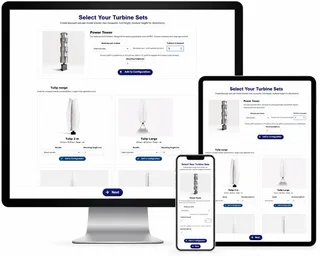
Step 1
Enter your postcode
Start designing your wind energy system in seconds.
STEP 2

Choose a location
STEP 3

Place your cluster
Tap the map where you want the turbine cluster to go.
STEP 4

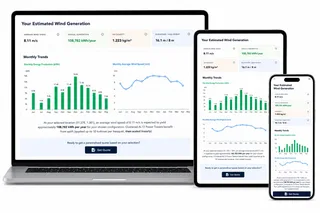
Instant generation forecasts
Compare different turbine layouts and see annual generation forecasts instantly.
STEP 5

No commitment required
Explore different configurations before deciding whether to request a quotation.
Related articles
Solar panels
Mo's Mission Nominations
FAQ
Need Help? RoboMo's Got Answers
What is an on-site solar PPA for a UK SME?
An on-site solar PPA is a contract in which a third party funds, owns and operates a solar PV system, and the business buys the electricity generated at an agreed price for an agreed term. It is not a grant, a green supply tariff, or the same thing as buying the plant with cash or a loan. In an occupier PPA the business is the customer for electricity used behind the meter. That is different from a roof-rent deal, where the site owner may receive rent and the developer sells the power elsewhere, and from off-site or sleeved PPAs, which are more often used by larger energy users.
Who owns the solar plant, and what does the business actually pay?
The provider owns the plant and, on a standard on-site PPA, operates and maintains it. The business is the offtaker and pays for electricity the generation meter records, at the price and indexation written into the contract. You also grant roof rights for the term, and you can still meet legal fees, roof repairs the funder will not accept, disruption during the works, and making-good later. The pence per kilowatt-hour is priced for that site, so a discount on an illustration is not a national rate or a permanent saving.
Does the business keep export revenue and renewable certificates?
Not automatically. Environmental attributes such as REGOs stay with the generator unless the contract assigns them. Export revenue is not automatically yours either. If the provider keeps it, ask how that value has been treated in the price rather than assuming a second income. A roof licence gives the provider access, cabling and array rights, but it does not by itself transfer ownership of the panels to the occupier.
How does a solar PPA compare with owning the system or staying on grid import?
A PPA is a long purchase of metered kilowatt-hours from equipment you do not own. An owned system is a capital asset, so maintenance, residual value and the owner's tax position sit with the business. Staying on grid import avoids roof rights and a long offtake, but it leaves the full import unit rate in place. Solar does not remove the standing charge or capacity-related charges, and a PPA is not proof that third-party funding beats ownership on lifetime cost.
Which SME buildings are more likely to suit an on-site PPA?
An on-site PPA tends to suit an occupier that expects to stay in a sound building for the contract term, uses a material share of electricity while the array is generating, and would rather buy kilowatt-hours than own plant. In this context, SME means that kind of business occupier, not a checked Companies Act headcount or turnover test. Providers screen the site and the covenant together. A weak covenant can mean no offer, a shorter term, or a request for extra security, and any funder minimum size is set by that provider rather than by a published national floor.
Can a tenant take a commercial solar PPA?
Tenants lose schemes on consent and lease length more often than on panel technology. The landlord has to allow the roof to be used for at least the PPA term, and the occupational lease must not end first. Owner-occupiers skip that consent step, but they still accept access rights, making-good and a long limit on how the roof can be used. Multi-let buildings can also need a named offtaker, shared risers, wayleaves and a landlord who will cooperate for the whole contract.
How do roof condition, metering and the network connection affect the scheme?
The survey that decides a commercial PPA is structural and commercial, not a panel count. Asbestos, a failing deck, a covering due for replacement, or a layout that voids the roof warranty or that the insurer will not accept can stop the scheme. Expect to be asked for the MPAN, import capacity, load data, space for a generation meter and a written rule for export. Many larger arrays meet a G99 connection, but the route depends on size and network area and must be confirmed for the site. Thresholds, charges and timescales belong to the distribution network operator's current process, not to a guessed figure.
Which contract terms matter most, and when is a PPA the wrong product?
Term, breaks, indexation, minimum-take or deemed-consumption clauses, and end-of-term options such as buyout, extension or removal can move the bill as much as the opening unit rate. Change-of-occupier, assignment and early-termination clauses matter if you might sell, refinance or leave the building. A PPA is a weak fit when the lease is shorter than the contract, credit is poor, the roof needs replacement, shading is heavy, or use is mostly at night and at weekends. VAT, business rates, capital allowances, Climate Change Levy and any licensing position need up-to-date professional advice, not assumptions copied from a domestic installation.