


Commercial rooftop solar for UK offices: UK business guide
Published: 2026-09-28 17:36:00
Updated: 2026-09-28 19:51:06
Check whether commercial rooftop solar fits your UK office: roof life, weekday load, landlord consent, and who keeps the saving before you size the array.
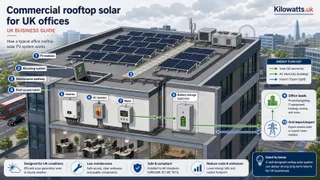
Commercial rooftop solar for UK offices - UK business guide
UK business guide B Solar office rooftops and landlord consent
What commercial rooftop solar for UK offices does
Commercial rooftop solar for UK offices is a photovoltaic array on an office roof. It connects to that building's supply so daytime generation offsets electricity the occupier would otherwise buy. It suits a sound roof with a long remaining life, enough structural capacity, and weekday demand that uses a useful share of the output on site. It is a poor fit if the lease is short, the landlord will not consent, the covering needs replacing, or shading and network limits would waste most of the generation.
The array does not take the office off the grid. Modules produce direct current. Inverters convert that to alternating current for the building. Power is used on site first. Surplus may be exported, held back by an export limit, or, less often, stored in a battery. A kilowatt rating describes power. The bill is in kilowatt-hours. An export limit caps power at the connection. It does not say how many units the office will avoid over a year.
Who may install it is a property question as well as a technical one. The freeholder, a long leaseholder, or a third-party funder may own the plant. A tenant who pays the electricity bill often does not control the roof. Consent, ownership and who keeps the saving have to be written into the lease or a licence. They are not implied by a quotation.
Which offices should proceed and which should wait
Proceed where the roof is sound, the structure can carry the proposed load, shading is limited, and weekday daytime demand is large enough that a useful share of generation is used on site. Owner-occupiers, and landlords and tenants who can agree investment and benefit, are the realistic parties. A large empty roof with very low daylight occupancy does not by itself justify a large array.
Wait, or redesign, where the lease is short and the landlord will not consent or share value, where the covering needs replacing first, or where asbestos, failed waterproofing or a weak deck rules out a normal mounting method. Heavy shading, or a listed building where consent looks unlikely, can stop the job before orientation is discussed. In a multi-let office, a system on the landlord's supply does not automatically reduce tenant bills. Landlord supplies, tenant supplies and half-hourly settlement may not share one meter.
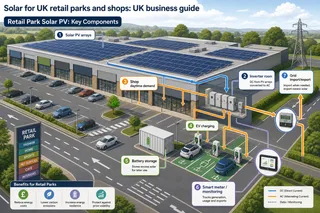
Warehouses, retail parks and shops are related commercial cases, not the same specification. A warehouse often has a larger, simpler roof and a different load shape. A shop or retail park does not share an office's weekday core-hours pattern. Use this guide for offices. Treat those other buildings as separate design jobs, including any question of commercial solar panel cost for a warehouse, which this article does not price.
Landlord consent and who keeps the saving
Landlord consent is the item that most often stops or reshapes an office project. A tenant who occupies the building cannot assume a right to commission work on the roof. They will usually need a licence for alterations. The landlord will look at the roof warranty, structure, insurance, reinstatement, and whether the array blocks a future roof replacement or redevelopment.
Ownership and benefit have to be agreed in writing before equipment is ordered. One party may fund the system while another takes the bill saving. That split, any effect on rent, access for maintenance, and what happens at lease end belong in the licence or a side agreement. If a funder owns the plant and sells power to the occupier, the price, term and end position are negotiated contract terms, not a standard outcome of fitting modules.
Price removal or making good before consent is signed. Leaving that to a later dilapidations claim is how a tidy energy project becomes a property dispute. The same document should say who may walk on the roof after handover, and who pays if the covering has to be opened for a leak that is not caused by the array.
Size from weekday demand rather than roof area
Design should start from half-hourly import and the incoming supply, not from covering every square metre. Office demand often peaks on weekday mornings and afternoons. That lines up with solar better than a home's evening peak. Hybrid working, weekends, bank holidays and shutdowns cut on-site use. An array sized to the whole roof can therefore export, or be curtailed, for much of the year.
Southern England generally yields more than northern Scotland for the same array. Shading, tilt and layout can still outweigh postcode. This guide does not state a national kilowatt-hour figure per kilowatt-peak. Neighbouring buildings and rooftop plant often matter more than a perfect south orientation. East-west layouts on flat roofs are used to spread output through the working day. That can suit a weekday office better than a south-only peak around midday.
What changes the quotation is often the electrical work, not the module count. Existing switchgear, power factor and supply constraints can force upgrades that cost more than the panels. A full-roof layout is the wrong brief if export will be limited, or if much of the output falls when the office is empty. Ask for the proposed kilowatt size against the half-hourly profile, and for a clear statement of what happens to surplus.
Roof condition, structure and fixings
The roof needs a condition survey, and any membrane warranty should be read, before a fixing method is chosen. Many offices have flat roofs already carrying plant, risers and parapets. Penetrations can void a waterproofing warranty. Ballasted frames avoid piercing the membrane but add weight and wind uplift. They must be designed for the structural codes that apply, including existing plant and snow. They must not block drainage or overload the slab.
Older low-rise stock may have pitched roofs or fragile coverings. Asbestos cement, still present on some older commercial roofs, is a specialist constraint, not a standard rail-and-hook job. If the covering is near the end of its life, replace or recover it first. A design life is often discussed over about 25 years. That is not a guarantee. It should be checked against roof life and the warranties on the actual equipment. Multi-decade module performance warranties and shorter inverter cover are common market practice. The years in a quotation must come from the products offered.
Occupied offices are a construction site. Crane or hoist position, edge protection and working around tenants need planning under the construction design and management duties that apply in that nation. Cable routes, isolators, inverter location, fire-service information and clear roof paths belong in the design, not as an afterthought once the layout is drawn. An inverter in a hot plant room, or in a locked riser with no route for replacement, becomes an operation problem on day one.
Network connection and export limits
Connection is made with the local distribution network operator. Office arrays are commonly large enough that the G99 process, rather than the small-system notification route, is the relevant path for a commercial solar G99 application. The exact threshold, forms and timescales differ by operator. Take them from current Energy Networks Association guidance and that operator's documents. This guide does not state a national kilowatt cut-off or a typical waiting time.
The network can limit export even where the roof could hold more modules. Export limitation, or a smaller array, is sometimes the workable design. Larger connections can require the operator to witness tests at commissioning. Offices are usually on a three-phase supply. Incoming capacity, protection settings and any existing generation often decide whether reinforcement is needed. Reinforcement is a site outcome. It should not be assumed away in an early sketch of the saving against grid electricity.
Build the connection question into the first design meeting. Ask who submits the application, what export the proposal assumes, and what the layout becomes if the operator accepts less. A layout drawn only to fill the roof is expensive to redraw once that answer arrives.
How office solar compares with grid electricity
For a UK business, commercial solar versus grid electricity is a comparison of avoided import during occupied daylight hours, not a plan to leave the network. Output is seasonal and lower than in sunnier countries. Cloudy weather reduces yield. It does not, by itself, make an office array pointless. For many offices the larger effect is not buying units at the import price while people are in the building. Export is often worth less per unit than avoided import, and the network may not accept export at all. Current installed cost per kilowatt-peak, payback, export prices and power-purchase prices for UK offices are not stated here. They depend on roof type, access, electrical upgrades and connection works, and they move over time. A pound figure for a warehouse, or a shop on a retail park, should not be reused as an office budget. Those buildings differ in roof, access and load shape.
Overview
A third-party funded or power-purchase arrangement can move capital away from the occupier. It does not remove roof, consent or connection risk. The price and the position at the end of the term still have to be read against the lease.
Operation, guarantees and leaving the building
Arrays are not maintenance-free. Inspection, inverter checks and electrical checks still apply, and someone has to be allowed onto the roof to do them. Monitoring should show generation and, ideally, consumption and export. Generation alone cannot show how much the office used. A performance guarantee cannot then be checked against the building's actual behaviour. Guarantee levels, exclusions and response times are contract terms. They are not a fixed UK rule, and this guide does not state a percentage or a service cost.
Inverters are commonly expected to need major service or replacement before the modules. The interval is product-specific and is unknown as a national figure. Operation and maintenance cost, as a share of capital cost, is also unknown here. Price it from access rules, roof constraints and the monitoring scope, not from a domestic service plan. Insurance should match who owns the plant and who may work on the roof.
At lease end, the licence should already say whether the array stays, transfers, or is removed and the covering made good. That cost is part of the original decision. It is a poor surprise in a dilapidations schedule. If the landlord is replacing the roof during the term, the design should say how modules come off and go back, and who pays.
What to settle before you compare quotations
Before you ask for prices, gather half-hourly import, the lease or title, the roof warranty, and a note of the incoming supply and any existing generation. Planning, building regulations, and listed-building or conservation-area controls are not identical in England, Wales, Scotland and Northern Ireland. This guide does not set permitted development limits. Ask the planning authority, and where relevant the conservation officer, against the current rules for that nation before a layout is treated as approved.
Do not assume a fixed move in Energy Performance Certificate band. The rating method and the rest of the building decide the result. VAT on commercial supply and installation, capital allowances, and business rates treatment of rooftop solar are tax and valuation questions. Rates and reliefs are not stated here. Confirm them with a qualified adviser against current rules in the relevant nation. Whether a certification scheme is required depends on the contract, any tariff, and the client's own standard. It is not assumed for every office project.
A useful quotation states the kilowatt size against demand, the fixing method the warranty holder will accept, the connection approach and any export assumption, the monitoring that can prove performance, who owns the plant, and the cost of removal. A roof-coverage figure without those items is not a business case. A structured look at commercial solar installation options is only worth using once roof control, demand data and connection constraints are known.
Plan, Compare & Buy Renewable Energy Solutions
AI does the thinking.
You get the perfect solar match.
Use RoboMo™ to assess your property, compare available technologies and connect with trusted UK installers, suppliers and manufacturers.
Simply enter your postcode, drop a pin on your roof, create your free account and let RoboMo™ analyse your property to find the best solar panels for your home.

You don't have to think
RoboMo™'s AI analyses your roof and does all the hard work.

Accurate & tailored
AI-powered assessment based on your roof, location, and conditions.

Best options, maximum savings
Compare top solar panels for the best performance and value.

Simple, fast & effortless
Provide a few details, sit back and watch your results unfold.
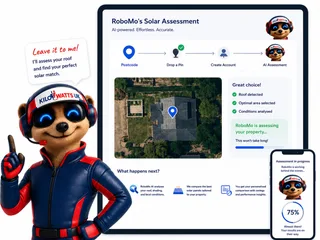

STEP 1
Choose Home, Business or Industrial
Enter your postcode to start your assessment.
STEP 2

Drop a pin on your roof
STEP 3

Create your free account
STEP 4

Sit back and watch RoboMo™ work
RoboMo™ analyses your roof and builds your personalised solar comparison.

Kilowatts UK is an authorised representative
Flower Turbines
Compact vertical-axis turbines built for real UK sites, not just open farmland.
They start in light wind, sit in a small footprint, and are bird-safe by design. Cluster them as a bouquet and the group performs better together than the same turbines standing alone. Enter your postcode for a location-based generation estimate. Figures use area weather data and will differ if buildings, trees or hills sit in the way.
Starts in light UK wind
Built to generate in typical UK wind, not only open farmland.
Small rooftop or ground footprint
Compact towers for roofs, yards and tight sites.
Bird-safe slow rotation
Slow vertical-axis spin, bird-safe by design.
Bouquet clusters raise output
Grouped turbines outperform the same units standing alone.
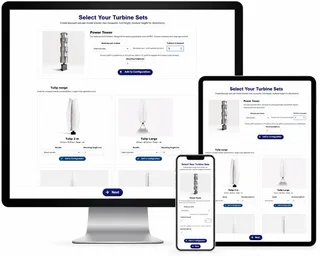
Step 1
Enter your postcode
Start designing your wind energy system in seconds.

STEP 2

Choose a location
STEP 3

Place your cluster
Tap the map where you want the turbine cluster to go.
STEP 4

Instant generation forecasts
Compare different turbine layouts and see annual generation forecasts instantly.
STEP 5

No commitment required
Explore different configurations before deciding whether to request a quotation.
Related articles


Solar panels
Mo's Mission Nominations
FAQ
Need Help? RoboMo's Got Answers
Does commercial rooftop solar take a UK office off the grid?
No. The array connects to the building supply so daytime generation offsets electricity the occupier would otherwise buy, but the office remains on the network. Modules produce direct current, and inverters convert that to alternating current for the building. Power is used on site first. Surplus may be exported, held back by an export limit, or, less often, stored in a battery.
Which UK offices are a realistic fit for rooftop solar?
A sound roof with a long remaining life, enough structural capacity, limited shading and weekday demand that uses a useful share of the output on site is the better starting point. Owner-occupiers, and landlords and tenants who can agree investment and benefit, are the realistic parties. Wait or redesign if the lease is short, the landlord will not consent, the covering needs replacing, or asbestos, failed waterproofing or a weak deck rules out a normal mounting method. A large empty roof with very low daylight occupancy does not by itself justify a large array.
Can an office tenant install solar without the landlord's consent?
A tenant who pays the electricity bill often does not control the roof and cannot assume a right to commission work there. They will usually need a licence for alterations covering warranty, structure, insurance, reinstatement and whether the array blocks a later roof replacement or redevelopment. Ownership and who keeps the saving have to be written into the lease or a licence before equipment is ordered. They are not implied by a quotation. In a multi-let office, a system on the landlord's supply does not automatically reduce tenant bills.
Should an office array be sized to fill the roof?
No. Design should start from half-hourly import and the incoming supply, not from covering every square metre. Office demand often peaks on weekday mornings and afternoons, but hybrid working, weekends, bank holidays and shutdowns cut on-site use. An array sized to the whole roof can therefore export, or be curtailed, for much of the year. Ask for the proposed kilowatt size against the half-hourly profile, and for a clear statement of what happens to surplus.
What roof and structural checks should come before fixings are chosen?
The roof needs a condition survey, and any membrane warranty should be read, before a fixing method is chosen. Penetrations can void a waterproofing warranty. Ballasted frames avoid piercing the membrane but add weight and wind uplift, and they must not block drainage or overload the slab. If the covering is near the end of its life, replace or recover it first. Asbestos cement, where it is still present, is a specialist constraint rather than a standard rail-and-hook job.
How do network connection and export limits affect the design?
Connection is made with the local distribution network operator. Office arrays are commonly large enough that the G99 process, rather than the small-system notification route, is the relevant path, but the exact threshold, forms and timescales differ by operator and should be taken from current guidance. The network can limit export even where the roof could hold more modules. Ask who submits the application, what export the proposal assumes, and what the layout becomes if the operator accepts less.
Is office solar simply a cheaper substitute for grid electricity?
The comparison is avoided import during occupied daylight hours, not a plan to leave the network. Output is seasonal and lower than in sunnier countries, and cloudy weather reduces yield, but that does not by itself make an office array pointless. Export is often worth less per unit than avoided import, and the network may not accept export at all. Installed cost, payback and export or power-purchase prices are not fixed national figures. They depend on the roof, access, electrical upgrades and connection works, and they move over time.
What should be settled before quotations are compared?
Gather half-hourly import, the lease or title, the roof warranty, and a note of the incoming supply and any existing generation. Agree in writing who owns the plant, who keeps the saving, who may access the roof for maintenance, and whether the array stays, transfers or is removed and the covering made good at lease end. Planning, building regulations and listed-building controls differ across the UK nations, so confirm the current rules with the planning authority before treating a layout as approved. Do not assume a fixed Energy Performance Certificate band change, and confirm VAT, capital allowances and business rates with a qualified adviser. This guide does not state rates or reliefs.