


Does an Electric Car Change the Solar Panel Maths?
Published: 2026-08-20 09:41:47
Updated: 2026-10-06 13:00:30
An EV is a large, flexible electrical load. Here's how UK home charging changes solar self-consumption, sizing decisions and long-term system value.

Does an Electric Car Change the Solar Panel Maths?
An EV is a large, flexible electrical load. Here's how UK home charging changes solar self-consumption, sizing decisions and long-term system value.
Your Electric Car Changes the Solar Calculation
If you already drive an electric car, or you're about to, the question "is solar worth it for my house?" quietly becomes a different question. A home without an EV has a fairly modest, fairly predictable electrical appetite. A home with an EV has something most houses have never had before: a very large, very flexible load that can be moved around the day. That matters, because the value of a solar array in the UK depends less on how much electricity it makes and more on how much of that electricity your household actually uses on site. An EV is unusually good at absorbing rooftop generation that would otherwise be exported. It doesn't turn sunlight into free motoring, and it doesn't remove the need to plug into the grid — British weather sees to that. But it does change the shape of the calculation, and this article explains how, in plain terms, so you can judge your own situation before anyone tries to size a system for you.
The fuel tank moved, and the paperwork changed with it
For a century, refuelling was an event that happened somewhere else. You drove to a forecourt, paid a price set by a market you had no influence over, and drove away. Electric driving breaks that pattern in an unglamorous but important way: the refuelling now happens at your house, on your meter, at a rate you have some control over. That's the whole idea behind the episode. The car used to need petrol. Now part of its energy can come from your roof.
Note the word 'part'. This is not a claim that a rooftop array will run a car outright, and any installer who tells you it will is selling rather than explaining. What actually happens is more modest and more useful: on days when the panels are producing and the car happens to be at home and plugged in, some proportion of your driving energy comes off the roof instead of off the grid. The rest still comes from the grid, and quite often that's the majority. Knowledge beats marketing here, and the honest version is still a good one.
Why self-consumption is the number that actually matters
Solar panels generate when the sun is up, which in most UK households is precisely when nobody is in. The fridge hums, the router blinks, a few standby loads tick over — and everything else the array produces is exported. Export has value, but it is generally worth less to you than electricity you use yourself, because you avoid paying the full import rate on every unit you consume at home.
This is the reason two identical arrays, on two identical roofs, in the same street, can perform very differently in financial terms. The roof isn't the variable. The household is. Anything that shifts consumption into daylight hours — a dishwasher on a timer, a hot water cylinder, a heat pump running gently through the afternoon — lifts self-consumption. An EV charger does this on a scale nothing else in a normal home can match, because a car battery is simply far larger than any other store in the house. When it's plugged in during generation, it can soak up a substantial share of what the roof makes rather than letting it drift out to the network.
An incidental fact worth carrying: standby mode on idle appliances wastes a meaningful amount of household energy. Before you spend money generating more electricity, it's always worth spending an evening finding out what your house is quietly consuming while you sleep.
The awkward truth: the car has to be at home
where the calculation gets personal. Solar generates during the working day. If your car spends the working day in a car park eleven miles away, the overlap between generation and charging is small on weekdays and larger at weekends. If you work from home some or all of the week, are retired, drive shifts, run a second household car that stays parked, or simply have a driveway where the vehicle sits for long stretches, the overlap is far better.
This is not a reason to talk yourself out of solar. It's a reason to be realistic about which benefit you're buying. A household whose car is rarely home is still getting a perfectly sound array; it's just getting it for the same reasons as everyone else — offsetting daytime household load and exporting the surplus — with the EV as an occasional bonus at weekends. A household whose car is often home is getting something genuinely different: a large flexible load that can be aimed at the roof's output on demand.
It also helps to be calm about range. A typical EV's range vastly exceeds the average daily journey, so range anxiety is usually unfounded. That's relevant here because it means most drivers don't need a full charge every night. If you only need to top up a modest amount each week, you have real freedom to choose when that top-up happens — which is exactly the flexibility that makes solar charging feasible in the first place.
What the roof can and can't do in a British winter
Two things surprise people about UK solar, and both are relevant to EV owners. The first is that panels are more efficient in cold weather than in hot weather; the limiting factor in winter is short days and low sun angles, not the temperature itself. The second is that UK homes still generate useful power on overcast days — output falls compared with clear skies, but a grey British afternoon is not a zero.
What this means practically is that solar EV charging is seasonal rather than binary. In the long days of late spring and summer, a car parked at home can absorb a genuinely large share of what the roof produces. In December, generation is short and thin, most charging will come from the grid, and the array will be quietly doing its job on household load instead. Any assessment that presents summer behaviour as a year-round average is doing you a disservice. Engineering beats hype: look at annual figures and seasonal shape together.
Where batteries, smart chargers and tariffs fit in
Three pieces of equipment change how much of your driving energy realistically comes from the roof.
A smart EV charger with solar-matching capability can throttle charging to follow available surplus, so the car takes what the roof is producing rather than pulling a fixed high current from the grid. Without this, plugging in during the day often just means importing at full rate while your generation goes out the door.
A home battery adds a buffer. It stores midday surplus for use in the evening, which suits households whose car returns after dark. The interaction matters: battery and car are competing for the same surplus, so how the system prioritises them is a design decision, not an afterthought. Tariff structure shapes everything. Time-of-use electricity tariffs designed for EV owners offer cheaper overnight windows, and on many winter nights importing cheaply is simply the sensible option. A well-designed system uses sunshine when there is sunshine and cheap grid electricity when there isn't. Facts beat opinions, and the fact is that the two approaches are complements, not rivals.
A practical checklist before you size anything
Work through these honestly before you look at any quotation. They cost nothing and they'll tell you more than a brochure will.
If you'd like to see how different system sizes respond to these answers, the comparison tool at /services/residential/renewable-energy/residential-solar-panel-installation/compare/ is a reasonable place to sanity-check assumptions before speaking to anybody.
Follow-up questions people ask next
Can I charge my car entirely from solar? On some days in summer, potentially. As a year-round strategy in the UK, no — and be wary of anyone who implies otherwise. The realistic outcome is a meaningful share of your driving energy, concentrated in the lighter half of the year.
Do I need a bigger array because I have an EV? Not automatically. Roof space, shading, orientation and your consumption pattern all cap what's sensible. A larger array only pays its way if the extra generation is used or exported at a worthwhile value.
Should I get the battery or the EV charger first? If you don't yet have a charge point and you drive an EV, the charger is usually the more immediately useful piece of infrastructure. A battery is a refinement layered on top, and its value depends heavily on your tariff and evening usage. Will charging from solar damage the car battery? Charging from a properly specified home charge point is charging, whatever the electricity source. The vehicle's own management system governs how the pack is treated. Does solar make sense if I don't have an EV yet? Yes, on its own merits — and it's worth mentioning a future EV during the survey so cable routes, consumer unit capacity and inverter choice don't have to be revisited later.
Video transcript
Mo: Your car used to need petrol. RoboMo: Now part of its energy can come from your roof.
An electric car doesn't make solar worthwhile on its own, and solar doesn't make electric driving free. What the two do together is more interesting than either headline: the car gives your roof somewhere useful to send its output, and the roof gives your car a source of energy that isn't set by a forecourt price board. How much of that benefit you actually capture depends on unglamorous details — when the car is home, how your roof faces, what tariff you're on, and whether the charger can follow the sun. Those are answerable questions, and answering them properly before you commit is the difference between a system that quietly performs for decades and one that never quite matches the sales pitch.
If you're weighing up solar with an EV in the picture, it's worth starting with your own numbers rather than a generic estimate. You can read more about how residential installations are assessed, compare system options, or arrange a survey when you're ready — no pressure, and no obligation to proceed.
Plan, Compare & Buy Renewable Energy Solutions
AI does the thinking.
You get the perfect solar match.
Use RoboMo™ to assess your property, compare available technologies and connect with trusted UK installers, suppliers and manufacturers.
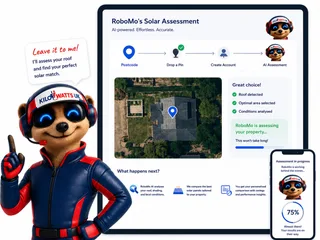
Simply enter your postcode, drop a pin on your roof, create your free account and let RoboMo™ analyse your property to find the best solar panels for your home.

You don't have to think
RoboMo™'s AI analyses your roof and does all the hard work.

Accurate & tailored
AI-powered assessment based on your roof, location, and conditions.

Best options, maximum savings
Compare top solar panels for the best performance and value.

Simple, fast & effortless
Provide a few details, sit back and watch your results unfold.

STEP 1
Choose Home, Business or Industrial
Enter your postcode to start your assessment.
STEP 2

Drop a pin on your roof
STEP 3

Create your free account
STEP 4

Sit back and watch RoboMo™ work
RoboMo™ analyses your roof and builds your personalised solar comparison.

Step 1
Enter your postcode
Start designing your wind energy system in seconds.
Are you an installer, distributor or renewable energy business?
Kilowatts UK is expanding the Flower Turbines partner network across the UK.
Become A Flower Turbines PartnerKilowatts UK is an authorised representative
Flower Turbines
Compact vertical-axis turbines built for real UK sites, not just open farmland.
They start in light wind, sit in a small footprint, and are bird-safe by design. Cluster them as a bouquet and the group performs better together than the same turbines standing alone. Enter your postcode for a location-based generation estimate. Figures use area weather data and will differ if buildings, trees or hills sit in the way.
Starts in light UK wind
Built to generate in typical UK wind, not only open farmland.
Small rooftop or ground footprint
Compact towers for roofs, yards and tight sites.
Bird-safe slow rotation
Slow vertical-axis spin, bird-safe by design.
Bouquet clusters raise output
Grouped turbines outperform the same units standing alone.


STEP 2

Choose a location
STEP 3

Place your cluster
Tap the map where you want the turbine cluster to go.
STEP 4

Instant generation forecasts
Compare different turbine layouts and see annual generation forecasts instantly.
STEP 5

No commitment required
Explore different configurations before deciding whether to request a quotation.
FAQ
Need Help? RoboMo's Got Answers
Can I charge my electric car entirely from solar panels?
Sometimes you may cover a large amount of charging from solar on bright summer days, especially if the car is at home and plugged in. Across a full UK year, it is not realistic to expect rooftop solar to run an EV entirely. Most households will still use the grid for a significant share of charging, particularly in winter and overnight.
Does having an electric car make solar panels more worthwhile?
It can, because an EV gives your home a large flexible load that can use solar generation on site. Using your own electricity is often more valuable than exporting it, so higher self-consumption can improve the case for solar. The benefit depends on when the car is at home, your driving pattern, roof performance and tariff.
What if my car is not at home during the day?
If the car is away during the main solar generation hours, weekday solar charging will be limited. You may still benefit at weekends, on work-from-home days, or through normal household electricity savings and export. In that situation, the EV is more of an occasional bonus than the main reason for installing solar.
Do I need a larger solar array because I have an EV?
Not automatically. A larger array only makes sense if the extra generation can be used by the home, used by the car, stored, or exported at a worthwhile value. Roof size, shading, orientation and your actual charging habits should guide the system size.
Do I need a special charger to charge from solar?
A standard home charge point can charge an EV while your panels are generating, but it may still draw from the grid if solar output is not enough. A smart charger with solar-matching features can adjust charging to follow available surplus. This can improve self-consumption, but it should be specified as part of the overall system design.
Should I add a home battery if I have solar and an EV?
A home battery can store daytime solar for evening household use, which is useful if the car comes home after dark. It does not replace the much larger EV battery, and the car and home battery may compete for the same solar surplus. Whether it is worthwhile depends on your usage pattern, tariff and how the system is set to prioritise energy.
How much does winter affect solar EV charging in the UK?
Winter has shorter days and lower sun angles, so solar generation is much lower than in spring and summer. Panels can still produce useful electricity on cold or cloudy days, but most EV charging in winter will usually come from the grid. It is best to look at annual estimates alongside a seasonal breakdown, not just a summer example.
Will charging an EV from solar damage the car battery?
No, not if the car is charged through a properly specified charge point. The car's battery management system controls how the battery is charged. From the vehicle's point of view, electricity from solar and electricity from the grid are simply different sources feeding the same charging equipment.