


UK Hydrogen-Hybrid Engine Begins Testing as a Drop-In Diesel Replacement
Published: 2026-10-07 00:49:27
Updated: 2026-10-07 07:17:26
Perkins is fitting a hydrogen-hybrid unit to a UK shredder as a diesel stand-in. It is a trial: tanks, refuelling and results are unpublished.
UK Hydrogen-Hybrid Engine Begins Testing as a Drop-In Diesel Replacement
How hydrogen hybrid industrial engine work, typical output, costs and limits, and whether they have a future for UK homes, balconies and businesses.
A UK hydrogen-hybrid engine is on test, not a buyable drop-in diesel replacement
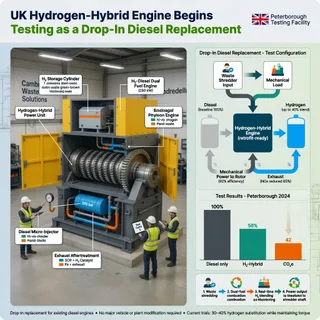
A UK hydrogen-hybrid industrial engine is in machine testing. It is not a drop-in diesel replacement an operator can buy. Perkins is reported to be fitting a fuel-configurable hybrid power unit to a Terex Ecotec TDS 820 waste shredder at its Peterborough research facility. The package pairs a 1200 Series spark-ignition engine with an electric motor-generator and is aimed at 379 kW and 1,938 Nm. Those numbers describe the power unit, not a published shredder result. Tanks, permits, refuelling and transient control still have to be designed.
This is a research installation in a TDS 820 shredder, not a machine an operator can order. The fuel running on the Peterborough unit has not been published. The figures of 379 kW and 1,938 Nm are power-unit targets only, not measured shredder throughput, runtime or fuel use.
No engineer's note, operator comment, packaging drawing or installation record has been published with the claims used here, so balance, access and service clearance cannot be judged from outside the project. No price, production date, battery capacity or fuel-use figure has been released. Treat this as integration work, not a buying specification.
Why the shredder trial is still an integration step
Bench work can show that an engine starts, holds a load and talks to a motor controller. It cannot show whether a shredder stays stable once tanks are added, or whether hybrid control keeps torque when a dense bale hits the rotor. Moving a unit into a TDS 820 is the point at which packaging, vibration, dust and violent load changes become the test.
A date of 5 October 2026, a programme name of Project Coeus, and a sum of £11.14 million of UK government support have been attached to this story, with Perkins, Norfolk-based Equipmake and Loughborough University described as participants. The funding body is not named in the material available for this article, and no primary Perkins or Terex announcement is attached here. Until that source is cited, treat the date, the programme name, the consortium description and the sum as unverified. If the sum is later confirmed, it is development support for a research programme, not a grant an operator can claim and not a guide to machine price.
Completed duty-cycle results from the Peterborough machine have not been released. Progress in bolting hardware into a shredder is not proof of fuel economy, emissions or uptime.
How the 379 kW engine and motor are arranged
The architecture described for the unit is an industrial open power unit built around the 1200 Series spark-ignition engine, with an electric machine assisting rather than replacing sustained output. The combustion engine is still expected to carry the long shift. The motor-generator is there for peaks, and for moments when torque demand jumps faster than a combustion engine likes to follow.
379 kW is nameplate engineering intent for the hybrid unit, and 1,938 Nm is the matching torque figure. Neither number is measured throughput for the TDS 820, and neither says how long the machine can run. Battery energy, tank pressure, mass and package size are unpublished. Until those exist, a fitter cannot tell whether hybrid assist lets the combustion element be smaller, or whether the electric machine is only smoothing a full-size engine.
On a real install, the checks that decide fit are mundane and easy to skip in a headline. Cable looms have to survive rotor shock. The inverter needs a dust path that does not cook it. Exhaust and air intake have to clear guards. The combined mass has to leave the machine inside its transport width and without a nose-heavy or tail-heavy stance once tanks are full. None of that is settled by matching a kilowatt target. Shock, dust and guard clearance still need competent industrial wiring work around the power unit, separate from any fuel claim.
How hybrid assist deals with sudden peaks
A waste shredder is a harsh first application because load is not steady. Material arrives in lumps, the rotor slows, and torque demand spikes. A diesel engine sized for every spike spends much of its life heavier than the average load requires. A hybrid layout can let the electric machine cover those short transients so the engine stays nearer a load it can hold.
That only works if the control software knows when to assist and when to let the engine lead, and if the motor, inverter and any buffer survive shock, dust and heat. Cooling and shutdown logic matter as much as kilowatts. None of that has been demonstrated in published shredder data. Hybrid assist is also not a battery-electric machine. If the engine stops, the electric system as described is not a substitute for a full shift of stored energy.
The failure mode to plan for is a control handover, not a brochure curve. If assist arrives late, the rotor bogs and the operator feeds less. If assist stays on too long, the buffer is empty for the next spike and the combustion engine is back to covering the worst case alone. Without a published waste mix, duration and fault log, those behaviours are still design intent.
Hydrogen, biomethane, methanol and ethanol
The platform is spark-ignition and is described as configurable for hydrogen, biomethane, methanol or ethanol. That is a development aim for one engine family, not evidence that four commercial fuel versions are ready. It is also not clear which fuel the Peterborough shredder is actually running, as against which fuels the platform is meant to accept later. Anyone quoting the trial should say the on-machine fuel is unpublished.
Each fuel changes the job outside the crankcase. Hydrogen needs high-pressure or other specialised storage and careful leak management. Biomethane is still a gas-handling problem, with a different supply chain and a different energy density in the store. Methanol and ethanol are liquids, so tanks and fire precautions look more familiar, but materials, seals, flame control and site permits still change. Multi-fuel flexibility is useful for an equipment maker only if each configuration has its own safety case, after-treatment and refuelling plan. It is not a switch an operator flips on a Monday morning.
What drop-in diesel replacement actually means
Drop-in, in this context, means a power unit intended to occupy a similar engine-bay role to a diesel industrial unit. It does not mean an unchanged shredder, yard, permit set or fuel routine. The engine-sized package may be intended to bolt into a similar space and deliver similar power and torque. Hydrogen tanks, pipework, sensors and refuelling still have to be designed around stability, service access, transport width and how the rotor is fed. In practice, the integration problem is the machine. Joints and shutdown logic have to live with vibration. The motor-generator has to be cooled under shock loads. Exhaust after-treatment and air intake are not settled by matching a footprint. A yard that currently fills a diesel tank cannot treat this trial as permission to swap the tank and carry on. Existing plant still needs routine industrial electrical inspections while any new power unit remains a trial. The comparison below is a decision frame, not a test result.
Hydrogen storage, DSEAR and job-site refuelling
Off-highway plant often works long shifts on temporary sites. A shredder, crusher or forestry machine cannot pause for a long charge in the way a delivery van might. That is why a hybrid combustion unit is being trialled, and why storage volume matters more than the badge on the engine. Hydrogen is not a routine UK forecourt fuel, so a site needs a method that matches the working day: a fixed store, a delivered supply, or a different fuel on the same platform if hydrogen logistics do not fit.
A site storing hydrogen or another dangerous substance would normally have to work through the Dangerous Substances and Explosive Atmospheres Regulations, known as DSEAR. The duty holder, overseen in this area by the Health and Safety Executive, has to find where a flammable atmosphere could form, zone those areas, and control ignition sources. Ventilation, leak detection and emergency shutdown sit in that assessment. They are not supplied automatically by an engine maker.
Planning hazardous-substances consent can be required once stored quantities pass the threshold for that substance. Those thresholds are set in the relevant regulations and differ by substance, so a yard cannot assume a development engine is consented or exempt. The Control of Major Accident Hazards regulations, COMAH, apply only where inventory reaches the qualifying quantity for an establishment. Many single-machine trials will sit below that level, but the operator still has to check the inventory rather than guess. If the fuel is a compressed gas, British Compressed Gases Association codes of practice are the usual industry reference for cylinder and tube-trailer layout, separation and handling. They guide a design. They do not replace a site risk assessment, and they are not a statutory approval of this shredder. Insurers often add their own conditions on store location, impact protection, training and emergency plans before they will cover a hydrogen or methanol installation. Those conditions can be stricter than the minimum legal duty, and they are site-specific. A recycling yard with space and a managed store is a different problem from a quarry face or a farm with no suitable set-back. In a dusty hall, shredder dust, hot surfaces and a flammable gas store can overlap, so zones may change when the machine moves between sites or when doors are left open for loading.
NOx, NRMM Stage V and what lower carbon depends on
Hydrogen has no carbon in the fuel, so burning it does not produce carbon dioxide from fuel carbon in the way diesel does. That is not a zero-emission exhaust. Hydrogen combustion can still form NOx, because flame temperature drives much of that pollutant. NOx control has to hold when a shredder loads and unloads, not only on a steady test point. The after-treatment or calibration method for this unit has not been published, so it should be treated as part of the machine trial, not as a settled feature.
Production non-road mobile machinery placed on the UK market is assessed against the NRMM emissions regime, commonly called Stage V for the current limits on pollutants including NOx. A research installation is not evidence that this power unit is type-approved, and no approval status has been published with the figures used here. An operator writing a tender should ask for the emissions stage, the test cycle and the transient result, and should not infer Stage V compliance from a hydrogen label.
Lifecycle emissions depend on how the hydrogen, biomethane, methanol or ethanol is made and moved. A low-carbon pathway can support a lower-carbon machine. A high-carbon pathway does not become clean because the engine is new. No comparative efficiency or emissions figures against the diesel unit this hardware is meant to replace have been published. Until that comparison exists, any climate claim for a particular yard would be guesswork.
Where a unit like this could matter in the UK
This is UK engineering for continuous, high-transient off-highway work, not a household technology. The places named around the reported project are Peterborough for the Perkins facility, Norfolk for Equipmake, and Loughborough University as a research partner. Those partner roles sit inside the programme description that remains unverified until a primary source is attached. If the platform works, the duty it is aimed at is recycling and waste processing first, then potentially construction, quarrying, forestry and some farm machinery that cannot stop to charge and cannot rely on a large electrical supply.
Battery-electric plant can still be the better fit where shifts are short, charging is available and peak energy is modest. Diesel, or whatever fuel a site already stores under a completed safety case, remains the practical choice where uptime, permits and cost are not yet demonstrated. Farms and factories should not read this trial as a near-term replacement for red diesel in everyday tractors or generators. A factory roof is a different question, covered in guides to solar for manufacturing sites, and farm buildings are covered separately in solar on working farms. Rebated-fuel rules, tank practices and machine duty are a separate decision, and this shredder trial does not change them. There is no announced date when an operator could specify the same configuration.
The sites where it is least suitable are the ones the headline tends to ignore. A quarry face with no set-back, a farm with no managed store, and a contractor who moves plant weekly will struggle with zoning and refuelling long before engine efficiency matters. A fixed recycling yard with space, a competent person for DSEAR, and a fuel supplier who can match the shift is the only pattern that even looks workable, and only after the missing trial numbers exist. Wider industrial energy services for a fixed site are not a substitute for those missing engine results.
What the machine trial still has to show
The reported installation would answer one question only: hardware is being put into a real high-load machine. It would not answer whether the hybrid unit uses less fuel, holds emissions limits, or fits a working shift. Anyone assessing this for a UK site should treat missing numbers as missing, not as details to be assumed from the 379 kW and 1,938 Nm targets. The absence of packaging evidence matters as much as the absence of a fuel figure. Without a drawing or a measured install, tank position, guard access and centre of gravity are unknown.
The useful next step is to wait for a primary announcement and then for duty-cycle evidence, and to compare that evidence with the diesel unit the shredder would otherwise use. Operators and equipment makers should ask for duration, consumption, the fuel actually used, tank and storage assumptions, NOx results under transient load, and whether hybrid assist changed engine size or only smoothed it. They should also ask how emergency stop, leak detection and inverter cooling were proved in dust and shock. Price, service interval and a production date are absent. Without those, this remains a British development to watch, not a drop-in specification for a fleet.
Until that set is public, the honest reading is limited. Replacing an engine-sized power unit is a real engineering step. Solving fuel storage, refuelling, DSEAR zoning, insurer conditions and whole-machine economics is a separate project, and it has not been completed by the act of installing a unit.
When an operator could specify the unit
An operator cannot responsibly specify this configuration now. Drop-in does not mean the diesel tank, the permit file and the shift plan stay the same. Refuelling is unsolved until the fuel on the machine is named and a store, delivery method, training plan and DSEAR zoning study exist for that site. A production date has not been announced, so a tender that names this unit as a required diesel substitute is writing in a research installation.
Specification becomes reasonable only after published duty-cycle evidence, a stated fuel, storage assumptions an insurer will accept, an NRMM position that can be checked, and a service and cost basis the buyer can compare with the diesel unit already on site. Until then, the sound procurement step is to keep the existing plant strategy, ask the manufacturer for the evidence list above, and treat 379 kW and 1,938 Nm as power-unit targets rather than a promise of shredder output. For a nearer-term on-site generation question, buyers can compare industrial solar on its own evidence, not as a stand-in for this engine.
Plan, Compare & Buy Renewable Energy Solutions
AI does the thinking.
You get the perfect solar match.
Use RoboMo™ to assess your property, compare available technologies and connect with trusted UK installers, suppliers and manufacturers.
Simply enter your postcode, drop a pin on your roof, create your free account and let RoboMo™ analyse your property to find the best solar panels for your home.

You don't have to think
RoboMo™'s AI analyses your roof and does all the hard work.

Accurate & tailored
AI-powered assessment based on your roof, location, and conditions.

Best options, maximum savings
Compare top solar panels for the best performance and value.

Simple, fast & effortless
Provide a few details, sit back and watch your results unfold.

STEP 1
Choose Home, Business or Industrial
Enter your postcode to start your assessment.
STEP 2

Drop a pin on your roof
STEP 3

Create your free account
STEP 4

Sit back and watch RoboMo™ work
RoboMo™ analyses your roof and builds your personalised solar comparison.

Step 1
Enter your postcode
Start designing your wind energy system in seconds.
Are you an installer, distributor or renewable energy business?
Kilowatts UK is expanding the Flower Turbines partner network across the UK.
Become A Flower Turbines PartnerKilowatts UK is an authorised representative
Flower Turbines
Compact vertical-axis turbines built for real UK sites, not just open farmland.
They start in light wind, sit in a small footprint, and are bird-safe by design. Cluster them as a bouquet and the group performs better together than the same turbines standing alone. Enter your postcode for a location-based generation estimate. Figures use area weather data and will differ if buildings, trees or hills sit in the way.
Starts in light UK wind
Built to generate in typical UK wind, not only open farmland.
Small rooftop or ground footprint
Compact towers for roofs, yards and tight sites.
Bird-safe slow rotation
Slow vertical-axis spin, bird-safe by design.
Bouquet clusters raise output
Grouped turbines outperform the same units standing alone.


STEP 2

Choose a location
STEP 3

Place your cluster
Tap the map where you want the turbine cluster to go.
STEP 4

Instant generation forecasts
Compare different turbine layouts and see annual generation forecasts instantly.
STEP 5

No commitment required
Explore different configurations before deciding whether to request a quotation.
Related articles
FAQ
Need Help? RoboMo's Got Answers
Can UK operators buy this hydrogen-hybrid engine as a drop-in diesel replacement?
No. The unit described is a research installation in a Terex Ecotec TDS 820 waste shredder at Perkins’ Peterborough facility, not a machine an operator can order. Drop-in here means a power unit aimed at a similar engine-bay role and output, not an unchanged shredder, yard, permit set or fuel routine. No price or production date has been released, so it should be treated as integration work rather than a buying specification.
Is this relevant to homeowners, farm tractors or everyday red diesel use?
Not as a near-term household or farm product. The trial is aimed at continuous, high-transient off-highway plant, starting with waste shredding, not homes, generators or everyday tractors. Battery-electric plant can still suit short shifts with charging available. Sites that already store diesel under a completed safety case should not treat this trial as permission to swap tanks.
Which fuel is the Peterborough shredder actually running?
That has not been published. The platform is spark-ignition and is described as configurable for hydrogen, biomethane, methanol or ethanol, but that is a development aim for one engine family, not evidence that four commercial versions are ready. Anyone quoting the trial should say the on-machine fuel is unpublished. Each fuel still needs its own tanks, safety case, after-treatment and refuelling plan.
What do the figures of 379 kW and 1,938 Nm actually mean?
They are nameplate targets for the hybrid power unit, which pairs a 1200 Series spark-ignition engine with an electric motor-generator. They are not measured shredder throughput, runtime or fuel use. The combustion engine is still expected to carry the long shift, with the motor-generator intended for peaks and sudden torque demand. Battery energy, tank pressure, mass and package size have not been published.
Has a UK grant, programme name or test date been confirmed for this project?
Not in the material available for this article. A date of 5 October 2026, the name Project Coeus, a sum of £11.14 million and a consortium including Perkins, Equipmake and Loughborough University have been attached to the story, but the funding body is not named and no primary Perkins or Terex announcement is attached. Until a primary source is cited, treat those details as unverified. Even if funding is later confirmed, it would be development support for a research programme, not a grant an operator can claim and not a guide to machine price.
Would a site need new storage, permits and electrical checks before using hydrogen?
Yes, if hydrogen or another dangerous substance is stored. A duty holder would normally work through DSEAR, find where a flammable atmosphere could form, zone those areas and control ignition sources, with oversight in this area from the Health and Safety Executive. Hazardous-substances consent and COMAH depend on stored quantities and must be checked rather than assumed. Insurers may add stricter, site-specific conditions, and existing plant still needs routine industrial electrical inspections while any new power unit remains a trial.
Does a hydrogen label mean the exhaust is zero-emission or Stage V approved?
No. Burning hydrogen does not produce carbon dioxide from fuel carbon in the way diesel does, but hydrogen combustion can still form NOx, and the after-treatment or calibration for this unit has not been published. A research installation is not evidence of NRMM type-approval, and no approval status has been published with these figures. Lifecycle emissions also depend on how the fuel is made and moved, and no comparative figures against the diesel unit this hardware is meant to replace have been released.
What would still have to be proved before specifying a machine like this?
Packaging, vibration, dust, cooling, guard clearance, transport stance and control of sudden rotor loads all still have to be demonstrated on the shredder, not only on a bench. Tanks, pipework, ventilation, leak detection, refuelling logistics and site permits are separate from matching a kilowatt target. Completed duty-cycle results, fuel use, runtime, emissions stage and a fault log have not been published. Until that evidence exists, diesel or another fuel already stored under a completed safety case remains the practical fleet choice.