


New Seawater Hydrogen System Uses Waste Heat to Make Its Own Pure Water
Published: 2026-10-07 00:36:41
Updated: 2026-10-07 07:23:04
A seawater hydrogen system announced on 5 October 2026 does not push raw seawater through the cell. Waste heat pulls purified water out first.
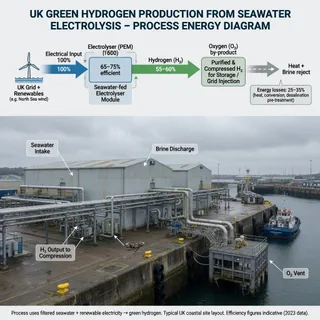
UK Hydrogen-Hybrid Engine Begins Testing as a Drop-In Diesel Replacement
How seawater hydrogen electrolysis system work, typical output, costs and limits, and whether they have a future for UK homes, balconies and businesses.
Waste-heat distillation feeding a conventional alkaline electrolyser
This is a laboratory water train, not a commercial engine, a domestic unit or an off-grid plant. It is not a UK hydrogen-hybrid engine and it is not a drop-in diesel replacement. Researchers at HKUST, Arizona State University and Hong Kong Polytechnic University paired waste-heat osmotic membrane distillation with a conventional alkaline electrolyser, so purified water rather than raw seawater reaches the cell. The sea is only a proposed water source. Splitting that water still needs electricity.
The account is dated 5 October 2026 and says the work was published in Nature Communications. Nothing in that account describes a vehicle, a hybrid drivetrain, a diesel substitute, a balcony unit or a farm installation. A coastal developer should treat it as early evidence about a water-and-heat layout, not as a product that has been consented, priced or proven in British water.
What the coupled system actually does
The system does not push raw seawater through the cell. Waste heat from electrolysis drives a membrane step that pulls purified water out of seawater, and that water then feeds a conventional alkaline electrolyser. Salt, chloride and other seawater constituents are meant to stay on the dirty side of the membrane, away from electrodes and separators specified for clean electrolyte.
In the HKUST announcement, laboratory tests on real seawater were reported with more than 99% rejection of major seawater constituents, more than 99% Faradaic efficiency, hydrogen and oxygen purity above 99%, and stable running for 500 continuous hours. Those figures are announcement claims. They are not a stack datasheet and they are not a UK type approval.
"Self-sustaining" in this context means the water-and-heat loop inside the rig. It does not mean the machine makes its own electricity. Recovered heat is not a power source.
What is reported, and what is still not disclosed
A reader cannot yet check the announcement claims against a citable paper record from the material this page is based on. No paper title, author list, DOI or announcement URL was supplied with those figures. They are not invented here. Until the Nature Communications record is opened and the numbers are read there, the rejection, Faradaic, purity and 500-hour statements should be treated as summary claims, not as verified quotations. The same gap covers the engineering specification. Power, current density, hydrogen rate, available heat temperature and electrical energy use were correctly left unpublished rather than guessed. They still need to sit in one place, tied to that primary source, before anyone compares the rig with a bought-water plant.
Why untreated seawater damages electrolysers
Commercial electrolysers are specified around clean water and a controlled electrolyte. Seawater is a mixture of chloride, sodium, magnesium, calcium, sulphate, organics and suspended solids. Put that straight into a cell and the electrochemistry stops being a simple split of water into hydrogen and oxygen.
Chloride is the problem operators notice first. At the anode it can form chlorine or related oxidants instead of, or as well as, oxygen. Those side reactions waste current, contaminate the gas stream and attack materials. Magnesium and calcium tend to scale. Biofouling and fine solids clog separators and flow fields. Catalysts and membranes then age for reasons that have little to do with how well the cell splits pure water.
That is why many direct-seawater concepts spend their effort on corrosion-proof catalysts and coatings. Those materials have to survive chloride while still making hydrogen at a useful rate. The HKUST route takes the opposite bet: leave the cell chemistry alone, and solve the water quality beside the stack.
How osmotic membrane distillation makes the feed water
Osmotic membrane distillation moves water as vapour across a membrane because of a difference in water activity, not because a high-pressure pump forces liquid through a reverse-osmosis membrane. Heat helps that vapour transfer. In this layout the heat is not bought from a separate boiler. It is heat the electrolyser is already rejecting while it runs.
Seawater stays on the dirty side of the membrane. Purified water is condensed or collected and sent to the alkaline electrolyser. The cell therefore sees treated water, then its own alkaline electrolyte management, rather than harbour water. The announcement's rejection figure, more than 99% of major seawater constituents, is the laboratory evidence offered for that separation. It still has to be read in the paper, not only in a news note.
In practice the membrane skid is balance of plant, not a clever electrode. It needs pumps, a heat exchanger or thermal contact with the cell circuit, a clean-water buffer, and a route for the water that did not cross the membrane. That residual stream is more concentrated than the intake. Treating it as free water from the sea misses the discharge problem.
Where the waste heat actually comes from
Electrolysis is not perfectly efficient. A large share of the electrical input leaves the stack as heat rather than as the chemical energy stored in hydrogen. On a normal plant that heat is removed so the stack stays inside its temperature window. Here the same heat is asked to do a second job: drive purification.
The announcement does not state the temperature available, the share of heat recovered, or whether the cell had to run hotter or cooler than a standard alkaline design to suit the membrane. That gap matters. If the membrane needs heat the stack cannot spare without leaving its design point, the integration fails even if both units work alone on a bench.
Parasitic loads sit in the same gap. Circulation pumps, seawater intake pumps and any extra temperature drop across a heat exchanger all consume electricity that does not appear in a Faradaic-efficiency number. Faradaic efficiency only says how much of the current went into the intended gas reaction rather than side reactions. It is not kilowatt-hours per kilogram of hydrogen.
What 500 hours of laboratory running does and does not show
The HKUST School of Engineering reported continuous laboratory operation on real seawater for 500 hours, with the purity and rejection figures above. That is useful early evidence that the coupled system can hold a steady laboratory condition, not a one-hour demonstration. It is still a short window beside the service life expected of a commercial stack, and this announcement does not give a lifetime figure to compare against. The note also does not disclose electrolyser power, current density or hydrogen production rate. Without those, a reader cannot tell whether the result was a small cell at gentle load or something closer to an industrial current. Gas purity above 99% is not, by itself, a statement that the hydrogen meets a pipeline, fuel-cell or industrial specification.
Why this is not direct seawater electrolysis
Direct seawater electrolysis would put seawater, ions included, into the electrochemical cell. This system does the opposite. Purification happens first. The cell is a conventional alkaline electrolyser fed with water the membrane step has already cleaned. Calling it direct seawater electrolysis would mis-specify the plant and hide the equipment that actually does the hard work. That separation is also why the approach may be more credible than a new corrosion-proof catalyst. Alkaline electrolysis is a mature industrial route, with known electrolyte handling, separators and stack designs. The novel part is the heat link to osmotic membrane distillation. If that link fails, the fallback is still a known cell plus some other source of pure water, not an unproven electrode that only works in brine. The result does not transfer automatically to a PEM stack. PEM and alkaline plants differ in electrolyte, water-quality tolerance and how they reject heat. A heat-linked membrane skid sized for one alkaline temperature window is not a universal water train. Solid oxide is a different temperature and water duty again. The honest comparison is among water routes into a cell you already know how to specify.
Overview
You have not eliminated desalination-like equipment. You have tried to run a particular membrane process on heat the electrolyser would otherwise throw away. That can be a better research path than inventing chloride-proof chemistry. It is not the same claim as electrolysing the sea, and it is not evidence about green hydrogen until the electricity is specified. Green hydrogen means hydrogen made with low-carbon power. Recovered heat does not supply that power.
Water, brine and the UK permissions a coastal scheme would still need
At commercial scale the intake and the brine outlet dominate the environmental question, not the laboratory rejection rate. A coastal plant needs a lawful way to take seawater and a lawful way to return or treat a more concentrated stream. Temperature, solids and ecology differ between an open coast, an estuary and a working port. Five hundred hours in a laboratory does not describe fouling rates in those waters, nor how often membranes would be cleaned or replaced.
This paper grants no UK approval and states no installed price. A port or harbour scheme would still have to assemble the permissions that apply to that nation and that outfall. In England, many deposits and construction activities in the marine area need a marine licence from the Marine Management Organisation. Taking seawater can be an abstraction, regulated in England by the Environment Agency, and is not automatically outside control because the source is the sea. Returning concentrated brine is a discharge: depending on where the outfall sits and what the stream contains, it may need an environmental permit for a water discharge activity, a marine licence, or both.
Scotland, Wales and Northern Ireland use different regulators for the same three functions (marine licensing, abstraction and concentrated-brine discharge), so a consent pack written for an English harbour cannot be copied across. Harbour authorities, landowners and the local planning authority can also control pipes, compounds and buildings on the landward side. Exact thresholds and exemptions depend on site and scale. They cannot be read off this paper, and no grant should be inferred from it. Freshwater competition is why the idea is interesting. Electrolysers need reliable pure water, and coastal industry, cooling and public supply already compete for it. Shifting the raw source to seawater eases that competition only if purification works at the project duty and brine handling is acceptable. It does not remove water regulation.
Where British ports might look, and where they should not
The relevant UK setting is a coastal hydrogen project or a port energy hub that would otherwise buy purified water or draw on local freshwater. Any commercial solar for manufacturing nearby is a power-supply question, not a feature of this membrane result. Waste-heat integration is most plausible where an electrolyser already sits near a marine interface, so heat exchangers, intake screening and a brine route are part of the site rather than an afterthought. An estuary with high solids is a different duty from clearer offshore water. Screening, biofouling and cleaning intervals have to be designed for that water, not for a laboratory beaker.
It is a poor fit inland, where there is no lawful seawater intake and no brine outlet. It is also the wrong frame for a house, a balcony or a farm. There is no domestic product, no installer route and no building-scale unit in the announcement. A port developer still needs a grid or private-wire connection, hydrogen handling and a buyer for the gas. Those are separate decisions from the membrane skid. Recovered heat only helps the water step. Power for the stack is a different design choice, including whether to combine solar and wind on a suitable site.
Offshore adds distance, marine corrosion of pipes and skids, and the cost of moving either electricity or hydrogen. Those constraints sit outside the cell. A laboratory rejection rate does not shrink them. Nor does this result choose between alkaline and PEM for the hub: it only shows one laboratory coupling of alkaline waste heat to a membrane water train.
Efficiency, cost and durability the announcement leaves out
No cost per kilogram, capital cost or electrical energy use was published with the 5 October note. No UK installed price, grant or payback should be inferred. If overall efficiency is in the Nature Communications paper, it has to be cited from that paper, with title, authors and DOI in hand, rather than guessed from a news summary.
Durability is the other open item. Membrane fouling, replacement interval and how the alkaline loop behaves when the purification step drifts are not established. A supplier who cannot state cleaning intervals and a design temperature for the heat link does not yet have a specification. UK coastal water is not one fluid, and parasitic intake and circulation pumps can erase a paper efficiency gain that was never an energy-per-kilogram figure in the first place.
Until power, current density, production rate, energy use and lifetime are published against the primary source, this remains early laboratory evidence. It is not a substitute for a commercial alkaline, PEM or solid-oxide plant with a specified water supply and a bankable availability figure.
What to ask before anyone treats this as a project option
If a coastal scheme is weighing water supply, the useful question is not whether seawater can be turned into hydrogen in principle. It is whether purification should sit inside the cell, in a separate desalination train, or in a heat-linked membrane skid beside a mature electrolyser. This result argues for the third option as a research path. It does not yet price it, and it does not licence it.
Ask for the Nature Communications paper (title, authors, DOI and the announcement URL) and read the figures on energy use, heat temperature and production rate before comparing the rig with a normal electrolyser fed by bought pure water. Quote only numbers that appear there. Ask how brine concentration and intake screening would be consented at the specific harbour, including marine licensing, abstraction and concentrated-brine discharge under the rules of that nation. Ask what happens to gas purity and electrode life if membrane rejection slips.
Keep the electrical supply as a separate decision. Where a site is weighing on-site generation, compare industrial solar options on their own merits. Recovered heat does not replace low-carbon power, a laboratory loop is not an off-grid plant, and a water-train experiment is not an engine.
Plan, Compare & Buy Renewable Energy Solutions
AI does the thinking.
You get the perfect solar match.
Use RoboMo™ to assess your property, compare available technologies and connect with trusted UK installers, suppliers and manufacturers.
Simply enter your postcode, drop a pin on your roof, create your free account and let RoboMo™ analyse your property to find the best solar panels for your home.

You don't have to think
RoboMo™'s AI analyses your roof and does all the hard work.

Accurate & tailored
AI-powered assessment based on your roof, location, and conditions.

Best options, maximum savings
Compare top solar panels for the best performance and value.

Simple, fast & effortless
Provide a few details, sit back and watch your results unfold.
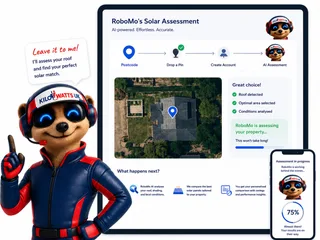

STEP 1
Choose Home, Business or Industrial
Enter your postcode to start your assessment.
STEP 2

Drop a pin on your roof
STEP 3

Create your free account
STEP 4

Sit back and watch RoboMo™ work
RoboMo™ analyses your roof and builds your personalised solar comparison.

Step 1
Enter your postcode
Start designing your wind energy system in seconds.
Are you an installer, distributor or renewable energy business?
Kilowatts UK is expanding the Flower Turbines partner network across the UK.
Become A Flower Turbines PartnerKilowatts UK is an authorised representative
Flower Turbines
Compact vertical-axis turbines built for real UK sites, not just open farmland.
They start in light wind, sit in a small footprint, and are bird-safe by design. Cluster them as a bouquet and the group performs better together than the same turbines standing alone. Enter your postcode for a location-based generation estimate. Figures use area weather data and will differ if buildings, trees or hills sit in the way.
Starts in light UK wind
Built to generate in typical UK wind, not only open farmland.
Small rooftop or ground footprint
Compact towers for roofs, yards and tight sites.
Bird-safe slow rotation
Slow vertical-axis spin, bird-safe by design.
Bouquet clusters raise output
Grouped turbines outperform the same units standing alone.


STEP 2

Choose a location
STEP 3

Place your cluster
Tap the map where you want the turbine cluster to go.
STEP 4

Instant generation forecasts
Compare different turbine layouts and see annual generation forecasts instantly.
STEP 5

No commitment required
Explore different configurations before deciding whether to request a quotation.
Related articles


FAQ
Need Help? RoboMo's Got Answers
Is this a UK hydrogen-hybrid engine or a drop-in diesel replacement?
No. The work described is a laboratory water train, not a vehicle, a hybrid drivetrain or a diesel substitute. Researchers paired waste-heat osmotic membrane distillation with a conventional alkaline electrolyser so purified water, rather than raw seawater, reaches the cell. Nothing in the account describes a domestic unit, a balcony product, a farm installation or an off-grid plant.
Can a UK homeowner or small business buy or install this system?
No product, installer route or building-scale unit is described. It is early laboratory evidence about a water-and-heat layout, not a consented, priced or proven British installation. It is a poor fit inland, where there is no lawful seawater intake and no route for concentrated brine. A house, balcony or farm is the wrong frame for this result.
What does the coupled system actually do?
Waste heat from electrolysis drives a membrane step that pulls purified water out of seawater. That water then feeds a conventional alkaline electrolyser, so salt, chloride and other seawater constituents are meant to stay away from the electrodes. The sea is only a proposed water source. Splitting the water still needs electricity, and recovered heat is not a power source.
Does “self-sustaining” mean it makes its own electricity or green hydrogen?
No. In this context “self-sustaining” means the water-and-heat loop inside the rig, not that the machine generates its own power. Faradaic efficiency only describes how much of the current went into the intended gas reaction. It is not a figure for kilowatt-hours per kilogram of hydrogen. Green hydrogen depends on low-carbon electricity, which this announcement does not specify.
How reliable are the laboratory figures, including 500 hours of running?
The announcement reported more than 99% rejection of major seawater constituents, more than 99% Faradaic efficiency, gas purity above 99%, and 500 continuous hours on real seawater. Those are summary claims. The paper title, authors, DOI and URL were not supplied with the figures used here, and power, current density, hydrogen rate, heat temperature and electrical energy use were not disclosed. Five hundred laboratory hours do not show commercial life, fouling in UK coastal water, or cost per kilogram.
Why is this not the same as electrolysing seawater directly?
Direct seawater electrolysis would put seawater, ions included, into the cell. This layout purifies water first and then uses a conventional alkaline electrolyser. That still needs balance-of-plant equipment: pumps, thermal contact with the cell, a clean-water buffer and a route for a more concentrated residual stream. It has not removed desalination-like kit; it has tried to run a membrane process on heat the electrolyser would otherwise reject.
Would a UK coastal hydrogen project still need permissions and a power supply?
Yes. This research grants no UK approval and states no installed price. A coastal scheme would still need a lawful seawater intake and a lawful way to return or treat concentrated brine, plus landward consents for pipes, compounds and buildings. Regulators differ between England, Scotland, Wales and Northern Ireland, and exact thresholds depend on site and scale. The project would also need a grid or private-wire connection, hydrogen handling and a buyer for the gas. Those are separate from the membrane result.