


Why are UK electricity prices so high
Published: 2026-06-07 07:21:48
Updated: 2026-06-07 12:20:26
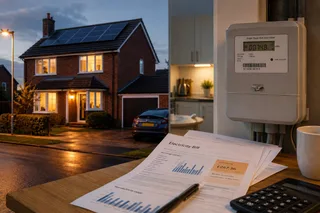
Why are UK electricity prices so high?
UK electricity prices are high mainly because electricity remains heavily influenced by gas prices, while consumers also pay for network infrastructure, standing charges, supplier operating costs, policy costs and VAT. Even though renewable energy now generates a significant proportion of UK electricity, gas-fired power stations still frequently set the market price when demand is high or renewable output is lower.
In simple terms, the biggest drivers of UK electricity bills are wholesale energy costs and electricity network costs. Supplier profit is only a small part of the final bill.
For households searching for "uk electricity prices explained", understanding how electricity is priced is the first step towards reducing energy costs and making informed decisions about tariffs, solar panels, battery storage and other energy-saving technologies.
A quick summary of why electricity is expensive
The main reasons UK electricity prices remain high are:
- Wholesale electricity prices are still heavily linked to gas prices.
- The UK imports a significant amount of energy.
- Electricity networks require constant maintenance and upgrades.
- Standing charges recover fixed system costs.
- Policy and environmental costs remain part of the system.
- VAT is applied to domestic energy bills.
- Growing electricity demand requires continued infrastructure investment.
The combination of these factors means electricity costs considerably more than simply generating power at a power station.
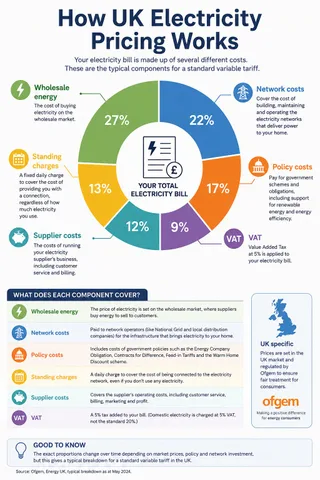
What actually makes up a UK electricity bill?
Many consumers assume their supplier keeps most of their bill. In reality, suppliers collect money that is distributed across several parts of the energy system.
VAT
Domestic energy VAT.Policy Costs
Government-backed energy and support schemes.Network Charges
Maintaining and upgrading transmission and distribution networks.Operating Costs
Billing, customer support, metering and administration.Supplier Margin
The supplier's operating profit allowance.Wholesale Energy
The cost suppliers pay to purchase electricity.Typical electricity bill components include
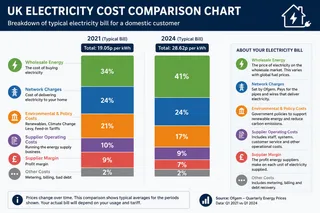
The largest elements are generally wholesale energy and network costs rather than supplier profit. This is one reason why changing supplier alone often does not dramatically reduce bills compared with reducing consumption or changing tariff structure.
Why gas prices still affect electricity prices
Many homeowners are surprised to learn that electricity prices remain heavily linked to gas despite the growth of renewable energy.
The UK electricity market uses a system known as marginal pricing. The final power station needed to meet demand often determines the market price paid across the market.
In practice, that final generator is frequently a gas-fired power station.
- This means:
- Higher gas prices increase electricity prices.
- International gas markets affect UK bills.
- Global energy events can impact UK households.
- Renewable generation does not automatically determine market prices.
This relationship was particularly visible during the energy crisis, when wholesale gas prices increased dramatically and electricity prices followed.
Why are UK electricity prices higher than gas prices?
A common question is why electricity costs significantly more per kilowatt-hour than gas.
There are several reasons.
Electricity requires a more complex infrastructure to generate, balance, transmit and distribute power in real time. The electricity network must constantly match supply and demand every second of every day. Gas can be stored relatively easily. Electricity generally cannot. Electricity bills also recover substantial network costs, while policy costs have historically been weighted more heavily towards electricity than gas. This is one reason the government continues to explore reforms designed to encourage electrification technologies such as heat pumps and electric vehicles.
Why standing charges are so controversial
Standing charges are fixed daily costs paid regardless of how much electricity a household uses.
Even if a property uses no electricity on a particular day, the standing charge still applies.
- Standing charges help fund:
- Network maintenance.
- Metering systems.
- Industry administration.
- Certain policy costs.
- Supplier fixed operating costs.
Many low-usage households dislike standing charges because they represent a significant percentage of their total annual bill. However, simply removing standing charges would not eliminate these costs. In most cases they would instead be recovered through higher unit rates.
Why electricity prices vary across the UK
Not every household pays identical electricity rates.
Regional differences exist because distribution network costs vary between different parts of Great Britain.
- Factors influencing regional pricing include:
- Network infrastructure requirements.
- Population density.
- Geography.
- Historic investment needs.
- Distribution network operator costs.
This is why households in London may see different standing charges compared with households in North Wales, Merseyside or parts of Scotland. Many consumers are unaware that postcode alone can influence energy costs.
Have renewable energy schemes made electricity more expensive?
This is one of the most misunderstood parts of the energy debate.
The evidence suggests recent increases in electricity prices have been driven primarily by wholesale gas prices rather than renewable energy generation.
Renewables still require investment in infrastructure and support mechanisms. However, they are not considered the primary driver of the sharp increases seen since 2021. Renewable technologies can also reduce long-term exposure to volatile international fuel markets. The challenge is that the electricity market structure still allows gas generation to influence electricity pricing even when renewable generation is high.
Why haven't renewables made bills dramatically cheaper?
Many homeowners see news reports about wind and solar generating large amounts of electricity and understandably ask why bills remain high.
The answer is that generating electricity cheaply is only one part of the system.
- The UK must also:
- Maintain the electricity grid.
- Invest in new infrastructure.
- Balance supply and demand.
- Provide backup generation.
- Manage seasonal demand changes.
As renewable penetration increases, investment in storage, flexibility and network upgrades becomes increasingly important.
What homeowners can actually do about high electricity prices
Most households cannot influence wholesale electricity prices.
They can, however, reduce their exposure to them.
- Practical options include:
- Switching to a better tariff.
- Using a smart meter.
- Moving energy use to cheaper periods.
- Improving insulation.
- Reducing unnecessary consumption.
- Using smart EV charging schedules.
- Reviewing heating controls.
These measures often deliver savings faster than many homeowners expect.
Can batteries save money without solar?
One of the biggest misconceptions we encounter is the idea that batteries only make sense alongside solar panels.
That is no longer true.
Modern battery systems can charge overnight using cheaper off-peak electricity tariffs and discharge during expensive daytime periods. For some households, this can reduce electricity costs even if no solar panels are installed.
- Real-world performance depends on:
- Electricity consumption patterns.
- Available tariffs.
- Battery size.
- Property demand profile.
- Peak and off-peak price differences.
Battery systems can also provide backup power functionality in some configurations, which is increasingly attractive for households concerned about resilience.
Are solar panels still worth considering?
Solar panels remain one of the most effective ways to reduce exposure to rising electricity prices for suitable properties.
However, suitability depends on several factors.
- Roof orientation.
- Roof condition.
- Shading levels.
- Available roof space.
- Household electricity use.
- Export tariff arrangements.
A common mistake is focusing entirely on panel efficiency. In practice, tariff choice, battery sizing, export rates and household usage patterns often have a greater impact on financial outcomes than the difference between two premium solar panel models.
Common myths about UK electricity prices
This section explains the key points below.
Myth
Supplier profits are the main reason electricity is expensive.Myth 2
The price cap limits your annual bill.Myth 3
Renewable energy caused the energy crisis.Myth 4
Standing charges are mostly profit.Myth 5
Batteries only work with solar panels.Reality
Wholesale energy and network costs are significantly larger bill components.Reality 2
The cap limits unit rates and standing charges, not total spending.Reality 3
Wholesale gas prices were the primary driver of recent price increases.Reality 4
Standing charges recover a wide range of fixed system costs.Reality 5
Many battery systems now operate effectively using smart electricity tariffs alone.
Frequently asked questions about UK electricity prices
The following points summarise the most important takeaways:
Why are standing charges so high?
Standing charges recover fixed costs that exist regardless of how much electricity a household uses.Can a battery save money without solar?
In many cases yes. Time-of-use tariffs can allow batteries to store cheaper overnight electricity for use during expensive periods.Will electricity prices fall in the future?
Prices may reduce if wholesale energy costs fall, but network investment and infrastructure spending are likely to remain significant factors.Can solar panels protect against rising electricity prices?
Solar panels can reduce grid electricity consumption, although performance depends on roof suitability and household usage patterns.Why is UK electricity so expensive compared with some countries?
The UK remains exposed to international gas markets while also funding substantial electricity network infrastructure and system costs.
The future of UK electricity prices
Electricity prices will continue to be influenced by wholesale markets, infrastructure investment and government energy policy.
Future developments are likely to include greater renewable generation, more battery storage, smarter tariffs, increased electrification and ongoing grid upgrades.
For homeowners, the most important takeaway is that electricity bills are not determined by a single factor. Wholesale markets, network costs, standing charges, tariffs and household behaviour all play a role. Understanding how these elements work together makes it easier to identify practical opportunities to reduce energy costs and improve energy resilience over the long term.
Ready to compare your options?
Get tailored comparisons and connect with trusted installers in under a minute.
Plan, Compare & Buy Renewable Energy Solutions
AI does the thinking.
You get the perfect solar match.
Use RoboMo™ to assess your property, compare available technologies and connect with trusted UK installers, suppliers and manufacturers.
Simply enter your postcode, drop a pin on your roof, create your free account and let RoboMo™ analyse your property to find the best solar panels for your home.

You don't have to think
RoboMo™'s AI analyses your roof and does all the hard work.

Accurate & tailored
AI-powered assessment based on your roof, location, and conditions.

Best options, maximum savings
Compare top solar panels for the best performance and value.

Simple, fast & effortless
Provide a few details, sit back and watch your results unfold.


STEP 1
Choose Home, Business or Industrial
Enter your postcode to start your assessment.
STEP 2

Drop a pin on your roof
STEP 3

Create your free account
STEP 4

Sit back and watch RoboMo™ work
RoboMo™ analyses your roof and builds your personalised solar comparison.

Step 1
Enter your postcode
Start designing your wind energy system in seconds.
Are you an installer, distributor or renewable energy business?
Kilowatts UK is expanding the Flower Turbines partner network across the UK.
Become A Flower Turbines PartnerKilowatts UK is an authorised representative
Flower Turbines
Compact vertical-axis turbines built for real UK sites, not just open farmland.
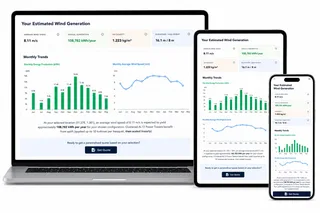
They start in light wind, sit in a small footprint, and are bird-safe by design. Cluster them as a bouquet and the group performs better together than the same turbines standing alone. Enter your postcode for a location-based generation estimate. Figures use area weather data and will differ if buildings, trees or hills sit in the way.
Starts in light UK wind
Built to generate in typical UK wind, not only open farmland.
Small rooftop or ground footprint
Compact towers for roofs, yards and tight sites.
Bird-safe slow rotation
Slow vertical-axis spin, bird-safe by design.
Bouquet clusters raise output
Grouped turbines outperform the same units standing alone.

STEP 2

Choose a location
STEP 3

Place your cluster
Tap the map where you want the turbine cluster to go.
STEP 4

Instant generation forecasts
Compare different turbine layouts and see annual generation forecasts instantly.
STEP 5

No commitment required
Explore different configurations before deciding whether to request a quotation.
Related articles


Mo's Mission Nominations
FAQ
Need Help? RoboMo's Got Answers
Why are UK electricity prices so high?
UK electricity prices are high because wholesale electricity prices remain heavily influenced by gas prices, while household bills also include network infrastructure costs, standing charges, supplier operating costs, policy costs and VAT. Even though renewable energy generates a growing share of UK electricity, gas-fired power stations still frequently influence market prices.
What makes up a UK electricity bill?
A UK electricity bill is made up of several components, including wholesale energy costs, network charges, supplier operating costs, policy costs, VAT and supplier margin. Wholesale energy and network costs generally account for a much larger share of the bill than supplier profit.
Why do gas prices affect electricity prices?
The UK electricity market uses a marginal pricing system, where the final power station needed to meet demand often determines the market price. Because that generator is frequently a gas-fired power station, changes in gas prices can have a direct impact on electricity prices.
Why is electricity more expensive than gas?
Electricity requires a more complex infrastructure to generate, balance, transmit and distribute power in real time. Unlike gas, electricity cannot easily be stored at scale, and the network must constantly match supply and demand. Electricity bills also include substantial network and system costs that do not apply in the same way to gas.
What are standing charges on electricity bills?
Standing charges are fixed daily costs that apply regardless of how much electricity a household uses. They help fund network maintenance, metering systems, industry administration and other fixed costs within the energy system.
Why do electricity prices vary across different parts of the UK?
Electricity prices can vary by region because distribution network costs differ across Great Britain. Factors such as geography, population density and infrastructure requirements influence local network costs, which can affect standing charges and electricity rates.
Have renewable energy schemes caused high electricity prices?
Recent increases in UK electricity prices have been driven primarily by higher wholesale gas prices rather than renewable energy generation. While renewable energy schemes require investment and support mechanisms, they are not considered the main cause of the sharp price rises seen in recent years.
Why haven't renewable energy sources made electricity much cheaper?
Generating electricity is only one part of the overall system. The UK must also invest in grid infrastructure, energy storage, network upgrades and balancing services. As renewable energy generation grows, additional investment is needed to ensure the electricity system remains reliable.
Can batteries save money without solar panels?
Yes. Modern battery storage systems can charge using cheaper off-peak electricity tariffs and discharge stored energy during more expensive periods. Depending on household usage patterns and tariff structure, this can reduce electricity costs even without solar panels.
Are solar panels still worth installing?
Solar panels can still be an effective way to reduce exposure to rising electricity prices for suitable properties. However, factors such as roof orientation, shading, battery storage, export rates and household energy usage often have a greater impact on financial performance than panel efficiency alone.
What can homeowners do to reduce electricity costs?
Homeowners can reduce electricity costs by choosing suitable tariffs, shifting energy use to cheaper periods, improving insulation, using smart controls, reviewing EV charging schedules and considering technologies such as battery storage or solar panels where appropriate.
Will UK electricity prices fall in the future?
Future electricity prices will continue to be influenced by wholesale energy markets, infrastructure investment and government energy policy. Increased renewable generation, battery storage, smarter tariffs and grid improvements may help reduce price volatility, but multiple factors will continue to influence household bills.