


What is JA Solar Jumbo? Understanding Large-Format Solar Panels in the UK
Published: 2026-06-29 12:35:32
Updated: 2026-07-26 18:36:30
Our solar content is reviewed for technical accuracy, UK relevance, and buyer usefulness, with a focus on system design, roof suitability.
What is JA Solar Jumbo?
JA Solar Jumbo usually means a large-format, high-wattage JA Solar panel. It is not a separate solar technology. In the UK, retailers and installers often use the phrase for JA Solar modules in the region of 500W to 560W.
The main difference is size. A Jumbo panel can generate more power per panel, but it is also larger and heavier. That can make it harder to fit on a typical UK roof.
JA Solar Jumbo can be a good option for:
- Large, simple roof areas
- Commercial roofs
- Agricultural buildings
- Workshops and warehouses
- Ground-mounted systems
- Larger homes with clear roof space
It can be less suitable for smaller terraced or semi-detached homes, especially where the roof has chimneys, dormers, roof windows, hips, valleys, flues, or tight edge margins. The exact model number matters more than the word “Jumbo”. JA Solar has produced many module ranges, including large 72-cell equivalent and 144 half-cell panels. Some newer large panels use n-type TOPCon cells, while older or lower-cost versions may use mono PERC cells. Always check the datasheet before comparing output, price, warranty, roof fit, mounting requirements, and inverter compatibility.
How JA Solar Jumbo compares with a standard domestic panel.
A typical modern UK domestic solar panel is often around 400W to 450W. A JA Solar Jumbo panel is commonly around 500W to 560W.
That does not automatically mean the Jumbo panel is much more efficient. Much of the extra wattage comes from the panel being physically larger.
For example, a 545W panel may sound much better than a 430W panel. But if it is over two metres long and weighs close to 30kg, it may be awkward on a smaller roof. A standard panel can sometimes give a better layout because it is easier to position around roof features. If you are comparing panel sizes, use a home solar panel comparison tool rather than judging by panel wattage alone. Key points to remember: Jumbo panels usually have higher wattage per module. Standard panels are often easier to arrange around UK roof features. Larger panels can be harder to lift, handle, and replace. Smaller panels can sometimes use awkward roof space more effectively. Fewer panels do not always mean a cheaper or better system. On a simple rectangular roof, a Jumbo panel can reduce the number of modules needed. On a roof with a chimney, roof light, dormer, or hip end, the same large panel may leave unusable gaps.
Typical specifications to check.
JA Solar Jumbo is not one fixed product. The datasheet is essential.
Installers should look beyond headline wattage. The wrong panel can cause problems with roof fit, mounting, wind loading, inverter design, warranty compliance, or future replacement.
Common large-format JA Solar panels seen in the UK are often around 500W to 560W. Efficiencies are commonly around the 20.5% to 22% range, depending on the model. Many are much longer than standard domestic panels and can weigh close to 30kg. Product warranties and performance warranties vary by model, supplier, and distribution route. A common mistake is to compare only wattage and price. Two panels with similar wattage can have different dimensions, current ratings, degradation terms, mounting rules, and warranty support. Those differences can matter more than a small difference in peak output.
When JA Solar Jumbo makes sense in the UK.
JA Solar Jumbo panels tend to work best where the roof or mounting area is large, open, and easy to access.
They can be practical when the design goal is to build a higher-capacity array with fewer modules. The mounting system, inverter, and grid connection still need to be designed correctly.
They are often well suited to:
- Larger detached homes
- Commercial units
- Farm buildings
- Workshops
- Warehouses
- Ground-mounted arrays
For businesses with large roof areas, comparing commercial solar options can help show whether a large-format JA Solar module is genuinely the best fit. They can also make sense for homes with high electricity demand, such as properties with EV charging, electric heating, a heat pump, or high daytime usage. JA Solar Jumbo may not be the best choice where roof space is small or awkward. Many UK roofs have hidden constraints, including required margins near ridges and verges, chimney shading, roof windows, valleys, flues, and changes in roof plane. Access also matters. A panel over two metres long can catch the wind during lifting. It is also harder to manoeuvre on scaffold. On exposed coastal, upland, or high-wind sites, mounting design and structural checks become more important.
How it compares with premium panels.
JA Solar is generally positioned as a mainstream Tier 1 solar manufacturer. In this context, Tier 1 is mainly a bankability term used in the solar industry. It should not be treated as a direct ranking of panel quality or proof that one model is the best choice.
Premium panels often offer higher efficiency, longer product warranties, lower degradation, or more compact high-output designs. That can be useful where roof space is limited and every square metre matters.
JA Solar Jumbo panels often appeal where the project needs high wattage at a competitive panel cost per watt, provided there is enough space to use the larger format properly. In simple terms: JA Solar Jumbo: often a sensible mainstream option for large, clear roof areas. Standard domestic panels: often more flexible on typical UK house roofs. Premium high-efficiency panels: often useful where roof space is limited. Large commercial modules: often best where handling, access, and mounting are straightforward. Warranty handling should be considered carefully. A long warranty is only useful if the installer, supplier, and UK distribution route can support a claim. In practice, serial numbers, commissioning photographs, test records, and proof of installation quality may all matter if a panel warranty claim is ever needed.
UK output, inverter compatibility, and grid connection.
A 545W panel is rated at 0.545kWp under standard test conditions. In the UK, annual generation is usually estimated in kWh per kWp per year.
A well-oriented south-facing roof may generate around 850 to 1,100kWh per kWp per year. Location, pitch, shading, and system design can change the result significantly.
On that basis, one 545W panel might produce roughly 460 to 600kWh per year on a good UK roof. Ten 545W panels would form a 5.45kWp array and might generate roughly 4,600 to 6,000kWh per year in favourable conditions. These are broad estimates, not guarantees. Shading from one chimney or nearby tree can reduce output more than the difference between two similar panel brands. For a deeper UK output guide, see how much electricity solar panels generate in the UK. Inverter design is another area where high-wattage panels need care. The panel rating is DC power. The inverter rating is AC power. It is normal in the UK for the DC array size to be larger than the inverter rating. Some clipping on bright days can be acceptable. The important point is compatibility. The inverter, optimisers, or microinverters must accept the panel’s voltage and current. Large modern panels can have higher current than older panels. Some older microinverters or optimisers may not accept 500W-plus modules, even if the headline wattage looks close. String design must also allow for cold-weather open-circuit voltage. Panel voltage rises in cold conditions, so the system must remain within safe inverter limits during UK winter conditions. For grid connection, DNO requirements usually relate to AC export capacity, not panel wattage alone. Smaller domestic systems may fall under G98 limits. Larger systems or higher export capacities may need G99 approval. Export limitation using G100 equipment may be part of the design where a larger array is installed but export is restricted.
Planning, roof condition, and installation details.
Most domestic roof-mounted solar in England is permitted development when conditions are met. That does not remove the need for good design.
Panels should not usually protrude more than 200mm beyond the roof plane. They should not usually be installed above the highest part of the roof, excluding the chimney.
Listed buildings, conservation areas, flats, and commercial properties can have additional requirements. If you are unsure about the rules, read more on whether you need planning permission for solar panels in the UK. Building Regulations still apply. Structural safety matters because larger panels add load and wind uplift forces. Electrical safety also matters. MCS certification is commonly needed if the customer wants access to Smart Export Guarantee payments. Installer-level checks are especially important with large-format modules.
Access
Narrow side passages, awkward scaffolding, and windy sites increase difficulty.Ballast
Flat-roof systems may need extra ballast that the roof must be able to carry.Clamp zones
Incorrect clamp positions can void warranty or reduce load resistance.Wind loading
Edge zones, exposed sites, and flat roofs need careful design.Roof covering
Old, fragile, or failing roof coverings should be addressed before installation.Roof structure
Rafters, battens, and fixings must be suitable for the proposed system.
The cheapest panel is not always the cheapest installed system. Scaffolding, labour, inverter selection, mounting, electrical work, certification, and roof complexity usually have a larger effect on the final installed price than the panel alone. Replacement — Future panel replacement may be harder if exact sizes become unavailable. Fire and electrical safety — DC cabling, isolators, labelling, and routing should follow relevant standards. Monitoring — Good monitoring helps identify underperformance or faults early.
Common misconceptions about JA Solar Jumbo.
The biggest misconception is that “Jumbo” automatically means better. It does not.
A large panel can be excellent on the right roof and inconvenient on the wrong one.
Another misconception is that fewer panels always reduce installation cost. Fewer modules can reduce some labour and mounting components. But larger panels are harder to carry, lift, position, and replace. They may also need more careful mounting calculations, especially on exposed roofs or flat-roof systems. Some buyers also assume a 545W panel must be more efficient than a 430W panel. That is not always true. The higher wattage may come mainly from a larger surface area. Efficiency is about output relative to panel area, not just the wattage printed on the datasheet. If roof area is the main constraint, it may help to compare different module types using Kilowatts’ residential solar panels database. Shading is another practical issue. A high-wattage panel will not solve shading from chimneys, trees, neighbouring buildings, or roof features. Good layout, string design, and the right use of optimisers or microinverters can matter more than choosing the largest available panel. Common assumptions to avoid: “Higher wattage always means higher efficiency.” “Fewer panels always means a cheaper installation.” “Tier 1 means the best panel.” “A large panel is always better for a small roof.” “Panel wattage alone tells me annual output.” “Any inverter will work with any high-wattage panel.”
Is JA Solar Jumbo a good choice?
JA Solar Jumbo can be a good choice if you have a large, clear roof area and want a high-capacity system using fewer modules.
It is often more suitable for commercial roofs, agricultural buildings, large detached homes, and ground-mounted arrays than for small or complex domestic roofs.
For factories, warehouses, and larger sites, an industrial solar comparison may be the more relevant starting point. It may not be the best choice if the roof is tight, broken up by obstacles, difficult to access, structurally uncertain, or likely to need a very precise layout. In those cases, a standard domestic panel or a premium high-efficiency panel may give a better real-world result. The sensible next step is to compare the exact JA Solar model against the roof layout, not just against another panel’s wattage. Ask for:
- The full JA Solar datasheet
- A roof layout drawing
- The proposed array size in kWp
- Inverter, optimiser, or microinverter compatibility checks
- Mounting details and clamp positions
- Wind-loading assumptions
You can also book a free home energy survey if you want a roof-specific view before choosing panel size. For most UK homes, the best panel is the one that produces the strongest whole-system result. That means good roof fit, safe installation, suitable inverter design, reliable warranty support, and sensible value over the life of the system. Warranty terms and UK support route Expected annual generation estimate Any G98, G99, or G100 requirements A clear reason why that panel size has been chosen
Plan, Compare & Buy Renewable Energy Solutions
AI does the thinking.
You get the perfect solar match.
Use RoboMo™ to assess your property, compare available technologies and connect with trusted UK installers, suppliers and manufacturers.
Simply enter your postcode, drop a pin on your roof, create your free account and let RoboMo™ analyse your property to find the best solar panels for your home.

You don't have to think
RoboMo™'s AI analyses your roof and does all the hard work.

Accurate & tailored
AI-powered assessment based on your roof, location, and conditions.

Best options, maximum savings
Compare top solar panels for the best performance and value.

Simple, fast & effortless
Provide a few details, sit back and watch your results unfold.
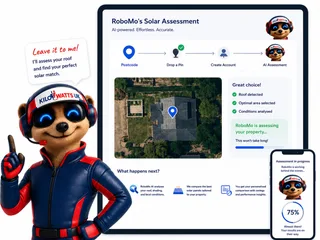
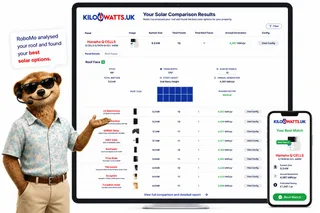
STEP 1
Choose Home, Business or Industrial
Enter your postcode to start your assessment.
STEP 2

Drop a pin on your roof
STEP 3

Create your free account
STEP 4

Sit back and watch RoboMo™ work
RoboMo™ analyses your roof and builds your personalised solar comparison.

Kilowatts UK is an authorised representative
Flower Turbines
Compact vertical-axis turbines built for real UK sites, not just open farmland.
They start in light wind, sit in a small footprint, and are bird-safe by design. Cluster them as a bouquet and the group performs better together than the same turbines standing alone. Enter your postcode for a location-based generation estimate. Figures use area weather data and will differ if buildings, trees or hills sit in the way.
Starts in light UK wind
Built to generate in typical UK wind, not only open farmland.
Small rooftop or ground footprint
Compact towers for roofs, yards and tight sites.
Bird-safe slow rotation
Slow vertical-axis spin, bird-safe by design.
Bouquet clusters raise output
Grouped turbines outperform the same units standing alone.
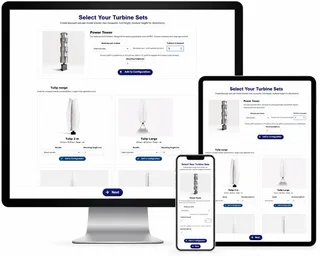
Step 1
Enter your postcode
Start designing your wind energy system in seconds.
STEP 2

Choose a location
STEP 3

Place your cluster
Tap the map where you want the turbine cluster to go.
STEP 4

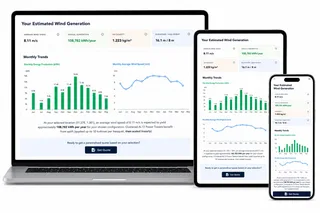
Instant generation forecasts
Compare different turbine layouts and see annual generation forecasts instantly.
STEP 5

No commitment required
Explore different configurations before deciding whether to request a quotation.
Related articles
Mo's Mission Nominations
FAQ
Need Help? RoboMo's Got Answers
What does JA Solar Jumbo mean?
JA Solar Jumbo is an informal UK trade name for large-format JA Solar solar panels, usually around 500 W to 560 W. It is not a separate solar technology or a special JA Solar product range. The word “Jumbo” mainly refers to the panel’s larger physical size, so the exact model number, datasheet, dimensions, weight, electrical ratings, cell technology, and warranty terms matter more than the nickname.
Are JA Solar Jumbo panels different from standard domestic solar panels?
Yes, mainly in size and wattage. A typical UK domestic solar panel is often around 400 W to 450 W, while a JA Solar Jumbo panel may be around 500 W to 560 W and physically larger. The higher wattage usually comes from having more panel area, not necessarily from producing much more electricity per square metre.
Are JA Solar Jumbo panels good for UK homes?
They can be good for UK homes with large, simple, unshaded roof areas. They are less suitable for small or awkward roofs with dormers, chimneys, roof windows, vents, hips, valleys, or limited edge margins. For most homes, the key question is whether the exact panel fits the roof and electrical design better than a smaller domestic module.
Are JA Solar Jumbo panels better than smaller solar panels?
Not always. Jumbo panels can reduce the number of modules needed for a system, which may simplify some installations on large clear roofs. However, smaller panels can sometimes fit a complex roof more neatly and allow a higher total system size by reducing wasted space around obstacles. The better option depends on the roof layout, inverter design, mounting system, shading, access, and total installed cost.
How much electricity can a JA Solar Jumbo panel generate in the UK?
As a broad estimate, a 545 W JA Solar Jumbo panel might generate around 460 kWh to 600 kWh per year on a favourable UK roof. Output can be lower on shaded, east-west, north-facing, steep, shallow, or poorly designed systems. Actual generation depends on location, roof orientation, pitch, shading, temperature, inverter performance, and system design, and the panel will not produce its rated wattage all day because the rating is measured under standard test conditions.
Are JA Solar Jumbo panels suitable for commercial and agricultural roofs?
Yes, they are often well suited to commercial, agricultural, ground-mounted, warehouse, workshop, and other large-scale installations where there is plenty of clear space. Their larger size can reduce panel count, clamps, electrical connections, and installation complexity on suitable roofs. The roof structure, fixing strength, wind loading, access, maintenance route, and electrical design still need to be checked carefully.
When might JA Solar Jumbo panels be the wrong choice?
They may be the wrong choice where the roof is small, fragile, shaded, difficult to access, or broken up by features such as dormers, rooflights, chimneys, vents, hips, and valleys. They can also be unsuitable if the inverter, optimiser, or microinverter is not compatible with the panel’s current and voltage characteristics. Large panels need careful handling, correct clamp zones, suitable lifting arrangements, and a mounting design that matches the roof.
Do JA Solar Jumbo panels produce more power per square metre?
Not necessarily. A Jumbo panel has a higher wattage mainly because it is larger. Its efficiency per square metre depends on the exact model. A smaller premium panel may produce more power from a limited roof area if it has higher efficiency or fits the usable roof space more effectively.
What should I check before accepting a quote for JA Solar Jumbo panels?
Ask for the exact model code, datasheet, dimensions, weight, wattage, voltage, current, cell type, efficiency, product warranty, performance warranty, and installation method. The quote should also confirm inverter compatibility, mounting system suitability, clamp zones, wind-loading assumptions, DNO requirements, MCS certification where relevant, and whether the roof layout has been designed from real roof measurements rather than a generic panel count.
Why is the exact JA Solar model number important?
“JA Solar Jumbo” is not specific enough to identify the panel. Different JA Solar large-format panels can have different dimensions, weights, electrical ratings, cell technologies, efficiencies, warranties, and installation requirements. The full model number is needed to check whether the panel suits the roof, inverter, mounting system, warranty conditions, and any future replacement requirements.
Are JA Solar Jumbo panels compatible with all inverters?
No. The installer must check open-circuit voltage, short-circuit current, MPPT voltage range, MPPT current limits, string design, optimiser or microinverter ratings, and connector compatibility. Some large modern panels have higher current characteristics than older inverters were designed for, so compatibility should never be assumed from wattage alone.
Do JA Solar Jumbo panels need DNO approval in the UK?
Grid-connected solar systems in the UK must meet DNO requirements. G98 usually applies to smaller systems up to 3.68 kW per phase inverter output, while G99 usually applies above that level or where a more detailed application is required. The inverter’s AC output and export capacity are especially important for DNO assessment, not just the total wattage of the panels.
Do JA Solar Jumbo panels qualify for Smart Export Guarantee payments?
They can, provided the overall installation meets the supplier’s requirements. In practice, Smart Export Guarantee payments usually require an MCS-certified installation, a suitable export meter setup, and an eligible export tariff. The panel brand alone does not determine SEG eligibility.
How long do JA Solar Jumbo panels last?
JA Solar panels are generally designed for long service lives, commonly 25 years or more. Many older p-type models have a 12-year product warranty and a 25-year linear power output warranty, while some newer n-type models may offer longer warranty terms. Always check the exact warranty document for the specific model and supply route being quoted.
What is the difference between a product warranty and a performance warranty?
A product warranty covers defects in the solar panel itself, subject to the manufacturer’s terms. A performance warranty promises that the panel should retain a minimum level of output over time, again subject to the warranty conditions. These warranties are separate from the installer’s workmanship warranty, which covers the quality of the installation.
Are JA Solar Jumbo panels cheaper to install?
Not always. They may reduce the number of panels, clamps, and connections required, which can help on some large, simple projects. However, their larger size can make handling harder, increase labour on awkward roofs, require more careful mounting design, or create access issues. The value should be judged on the full installed system cost and expected output, not the panel wattage alone.
How do JA Solar Jumbo panels compare with premium residential panels?
Premium residential panels often focus on higher efficiency, compact size, appearance, longer product warranties, or stronger degradation terms. JA Solar Jumbo panels often appeal where cost per watt, availability, and total project value are important. On a large simple roof, Jumbo panels can be a practical mainstream choice; on a small constrained roof, compact premium panels may achieve a better layout and higher total output.
How do JA Solar Jumbo panels compare with other large-format brands?
JA Solar large-format panels are broadly comparable with large modules from brands such as Trina Solar, Jinko Solar, LONGi, and Canadian Solar. The best choice depends on the exact datasheet, dimensions, electrical characteristics, warranty route, availability, efficiency, degradation terms, and installation design. A slightly higher wattage panel is not automatically the better option.
Are JA Solar Jumbo panels too heavy for a house roof?
Not necessarily, but the roof structure and mounting method must be suitable. Large-format panels commonly weigh more than smaller domestic modules, often around 27 kg to 29 kg depending on the model. The installer should consider panel weight, wind loading, roof covering, rafter condition, hook or fixing layout, access, scaffold design, and safe handling.
Can JA Solar Jumbo panels be installed in landscape or portrait orientation?
Often yes, but the permitted mounting method depends on the specific datasheet and mounting system. Clamp zones, rail positions, wind load calculations, cable reach, and drainage considerations must be checked. Landscape installation may require a different rail arrangement from portrait installation and should not be assumed without checking the manufacturer’s installation guidance.
Are JA Solar Jumbo panels affected more by shading?
Any solar panel is affected by shading, and larger panels can be more difficult to position away from shadows on complex roofs. Chimneys, dormers, roof vents, aerials, trees, and neighbouring buildings can all reduce output. A good system design should assess shading and may use smaller panels, optimisers, microinverters, or a different layout where appropriate.
Should I choose JA Solar Jumbo panels just because they have higher wattage?
No. Higher wattage per panel does not automatically mean a better solar system. The best panel is the one that fits the roof safely, works with the inverter, avoids avoidable shading, meets warranty conditions, and gives the strongest overall system performance for the property.
What are the most common mistakes when choosing JA Solar Jumbo panels?
Common mistakes include treating “Jumbo” as a technology upgrade, choosing the highest wattage without checking roof fit, ignoring inverter current limits, overlooking wind loading and clamp zones, comparing quotes without the exact model number, and accepting a quote that does not include a datasheet. A good installer should design the system around the property rather than the panel nickname.
Do JA Solar Jumbo panels use n-type TOPCon or mono PERC cells?
It depends on the exact model. Some newer JA Solar large-format panels use n-type TOPCon cells, while older or lower-cost versions may use mono PERC technology. Cell type can affect efficiency, degradation, warranty terms, and temperature performance, so it should be checked on the datasheet rather than assumed from the word “Jumbo”.
Does Tier 1 mean JA Solar Jumbo panels are the best panels?
No. Tier 1 is mainly a bankability term used in the solar industry and is not a direct ranking of panel quality, efficiency, warranty strength, or suitability for a specific roof. JA Solar is a major global manufacturer, but the right choice still depends on the exact panel model, installer quality, mounting design, inverter compatibility, and warranty support.
Do JA Solar Jumbo panels need planning permission in the UK?
Most domestic roof-mounted solar installations in England are permitted development if they meet the relevant conditions, but there are exceptions. Listed buildings, conservation areas, flats, commercial properties, ground-mounted systems, and unusual designs may need extra checks or consent. Planning rules are separate from Building Regulations, DNO requirements, and MCS requirements.
What Building Regulations issues matter with JA Solar Jumbo panels?
Structural and electrical safety are the main Building Regulations considerations. Larger panels add weight and can create significant wind uplift forces, especially near roof edges or on exposed sites. The roof structure, fixings, fire safety, DC cable routing, isolators, labelling, and electrical testing should all be handled by a competent installer.
Are JA Solar Jumbo panels harder to replace in future?
They can be. Large-format panel sizes change over time, and an exact physical match may not be available years later. This can matter where the roof layout is very tight or where a replacement panel must match existing rails, clamps, string design, appearance, and electrical ratings. Good installation records, model details, and commissioning documents make future maintenance easier.