


How Solar Panels Work UK - Guide to Home Battery Storage
Published: 2026-07-25 16:36:45
Updated: 2026-08-01 11:15:31
Discover how home batteries can reduce your reliance on the grid and lower your energy bills.
What a home battery is and how it works in the UK
A home battery is a rechargeable electricity storage system for your property. In the UK, it is usually paired with solar panels so excess daytime generation can be stored and used later. Some batteries can also charge from the grid during cheaper off-peak tariff periods.
The battery stores electricity as chemical energy, then releases it through an inverter when your home needs power. It does not make a house off-grid by default, and it will not remove electricity bills altogether. It can reduce grid reliance when it is correctly sized, installed and controlled.
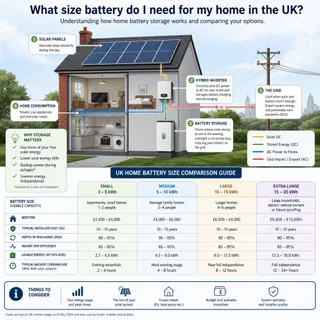
For most UK homes, the key questions are practical ones. Do you have enough surplus solar generation? Is your electricity use higher in the evening? Does your tariff reward load shifting? Is the system compatible with your existing solar inverter and DNO connection requirements? Create a clean, realistic UK home energy diagram showing rooftop solar panels feeding a hybrid inverter, a wall-mounted home battery in a garage or utility room, household appliances using stored power in the evening, and the electricity grid connection for import and export. Use clear arrows to show solar generation, battery charging, home consumption and grid import or export, with a neutral technical style and no logos, branding, watermarks or UI screenshots.
The short version for UK homeowners
A home battery works best when it captures electricity that would otherwise be exported, or not used directly by the home. During the day, solar panels may produce more power than the property is using. Instead of sending all of that surplus to the grid, the system charges the battery.
Later, when the sun is down or generation is low, the battery discharges to run household loads such as lighting, cooking appliances, refrigeration, computers, televisions and heat pump controls. If the battery runs empty, the home imports from the grid as normal.
Some homes also use the battery without solar, or alongside solar, to charge from the grid when electricity is cheaper and discharge when electricity is more expensive. This can work well with certain time-of-use tariffs, but it depends on the tariff, battery efficiency, usage pattern and smart controls. If you are considering this route, it is worth checking whether a battery without solar suits your usage pattern.
The main parts of a home battery system
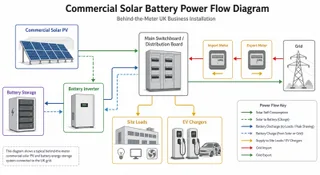
A domestic battery system is more than a box on the wall. It is a controlled electrical system that needs to communicate with the inverter, the consumer unit, the solar array if present, and often an online monitoring platform.
Most UK home batteries use lithium-ion technology, with lithium iron phosphate often used because it suits stationary storage. Battery chemistry matters, but so do the installation design, inverter compatibility, control settings and operating temperature.
Inverter
Converts electricity between direct current and alternating current so it can be used by the home.Energy meter
Measures import, export, solar generation and household demand so the system knows when to charge or discharge.Battery module
Stores electrical energy chemically and releases it when required.Control software
Decides when the battery should charge, hold energy, discharge or preserve capacity.Isolation and protection equipment
Allows safe installation, maintenance and disconnection in line with electrical requirements.
In real installations, the layout can vary. Some batteries sit indoors in garages or utility rooms, while others are rated for external installation. Location is not just about convenience. Temperature, access, ventilation, cable routes and manufacturer instructions all affect suitability.
How solar panels and batteries work together
Solar panels generate direct current electricity. In a standard solar PV system, an inverter converts that energy into alternating current for the home. When a battery is added, the system must decide whether solar generation should supply the home, charge the battery, or export to the grid.
The usual operating sequence is simple. The home uses available solar power first. The battery then charges with surplus generation. Only after that is remaining surplus exported. In the evening, the battery discharges to cover household demand until it reaches its minimum permitted charge level.
This is why a home battery is not the same as fitting more solar panels. It changes how the property uses the solar energy it already produces. It can be especially useful where occupants are out during the day and electricity demand rises after work, school or commuting hours.
Hybrid and AC-coupled battery systems
There are two common approaches in UK domestic projects: a hybrid inverter system and an AC-coupled battery system. The right option depends partly on whether the battery is being installed with new solar panels or retrofitted to an existing PV system. For a deeper comparison, see how AC and DC coupling affect system design.
| System type | How it works | When it is commonly used | Practical consideration |
|---|---|---|---|
| Hybrid inverter | One inverter manages both the solar panels and the battery | New solar and battery installations | Can be neat and efficient, but design depends on compatible panels, battery and inverter |
| AC-coupled battery | A separate battery inverter connects to the home’s AC electrical system | Retrofitting a battery to an existing solar system | Often easier for existing PV systems, but adds another inverter and control layer |
| Battery without solar | The battery charges from the grid rather than solar panels | Time-of-use tariff optimisation | Savings depend strongly on tariff structure, efficiency and usage habits |
What happens during charging and discharging
When a battery charges, electricity is converted and stored chemically inside the cells. When it discharges, that stored energy is converted back into usable electricity for the property. Every conversion has losses, so the amount of energy you get back is slightly less than the amount put in.
Round-trip efficiency is typically in the region of 85% to 95%, depending on the equipment and operating conditions. That means not all stored energy is recovered as usable electricity. This matters when comparing solar self-consumption savings or grid-charging strategies.
The battery also has a usable capacity, which may be lower than its headline capacity. Many systems reserve a portion of charge to protect the battery and maintain long-term performance. Manufacturer settings, depth-of-discharge limits and warranty conditions can all affect how much energy is available day to day.
How big should a home battery be?
Home battery capacity in the UK commonly ranges from smaller systems around 3 kWh to larger domestic systems around 15 kWh. The right size is not simply the largest battery you can afford. It should be matched to your solar generation, evening demand, tariff and future plans.
An undersized battery may run out early in the evening, leaving you importing from the grid at peak times. An oversized battery may not fill regularly, especially in winter or on dull days, which can reduce the financial benefit of the extra capacity.
Evening demand
Batteries are often most valuable where consumption rises after sunset.Solar array size
A larger PV system may create more surplus energy to store.Tariff structure
Time-of-use tariffs can change the value of charging and discharging.Daily electricity use
Higher-use homes usually have more opportunity to benefit from stored energy.Future electrification
EV charging, heat pumps or growing household demand may alter the best size.Roof orientation and shading
Generation patterns affect how often the battery can charge.
A good design starts with consumption data, not guesswork. Smart meter data, solar generation estimates and household routines are more useful than a generic battery size. If you want to sense-check capacity, use a guide to battery sizing before comparing products.
Using a battery with off-peak electricity tariffs
Some home batteries can charge from the grid during off-peak periods and discharge during peak periods. This is often described as time-of-use shifting. It can be helpful where the tariff difference is meaningful and the battery controls can reliably follow the schedule.
Stored grid electricity is not free. You still pay for the electricity used to charge the battery, and conversion losses reduce the amount you get back. The economics depend on the tariff, standing charges and unit rates, how much stored energy is actually used, and whether the battery has enough capacity to cover the high-cost period.
Smart tariff integration can make a major difference. A system that charges at the wrong time, discharges too early, or fails to reserve energy for the evening may perform poorly even if the battery hardware is good.
Will a home battery make you independent from the grid?
In most UK installations, no. A standard solar and battery system remains grid-connected. The grid still supplies the property when the battery is empty, when demand is higher than the inverter can provide, or when winter solar generation is low.
Backup power during a power cut is also not automatic. Many battery systems shut down during an outage unless they have specific backup hardware and protected circuits installed. This is a safety and design issue, not just a software setting. If resilience is a priority, read more about power cut backup before assuming it is included.
If backup is important, it needs to be discussed before installation. The installer must determine which circuits should be supported, how they will be separated from the grid during an outage, and whether the battery and inverter can handle the loads you expect to run.
UK installation, DNO and certification considerations
A home battery is part of the property’s electrical system, so installation needs proper design and notification or approval where required. The local Distribution Network Operator may need to be notified or consulted depending on the inverter capacity and overall system arrangement.
Grid connection requirements such as G98 and G99 can apply depending on the size and configuration of the generating equipment. Export limits may also affect how the system is set up. These are not areas to guess. They should be handled by a competent installer who understands current DNO processes.
If the system is intended to work with solar export payments under the Smart Export Guarantee, MCS certification is usually an important consideration for the solar installation route. Homeowners should check the requirements of their chosen energy supplier and installation provider before assuming export payments will be available.
Where home batteries are usually installed
Most domestic batteries are wall-mounted or floor-mounted in practical areas such as garages, utility rooms or external locations where the product is approved for outdoor use. The chosen position affects installation cost, cable length, access and long-term performance.
Temperature is often overlooked. Cold conditions can reduce battery efficiency and usable capacity, while unsuitable locations may affect lifespan or breach manufacturer guidance. Ventilation, clearances and protection from damage should be considered before the installation day. Long-term performance also depends on the expected battery lifespan and how the system is operated.
The neatest-looking location is not always the best engineering location. A long cable run, awkward isolation position or poor access for maintenance can make the installation more expensive and less practical over time.
Common myths about home batteries
Home batteries are often oversold or misunderstood. They can be highly useful in the right property, but they are not a universal solution and should not be treated as a guaranteed bill-cutting device.
The biggest misconception is that a battery makes solar panels work like a private power station all year round. In reality, UK solar output varies significantly by season, roof orientation, shading and location. A battery stores available energy; it does not create extra generation.
- Batteries do not eliminate electricity bills.
- Batteries do not always provide backup power in a cut.
- Bigger batteries are not automatically better.
- Stored solar energy still has efficiency losses.
- Grid charging only works financially on the right tariff.
- A poor control setup can reduce real-world savings.
A well-designed battery system should be explained in terms of expected behaviour, limitations and trade-offs, not just capacity and headline features.
When a home battery is a good fit
A home battery is often most suitable for households with solar panels and significant electricity use outside daylight hours. It can also suit homes on appropriate time-of-use tariffs where shifting consumption away from peak periods is realistic.
The case becomes stronger where the household has a clear pattern of evening use, enough solar surplus to charge the battery for much of the year, and an inverter setup that can be upgraded without excessive complexity. Monitoring data is particularly useful because it shows whether the home is exporting enough electricity to justify storage.
Solar with daytime surplus: The battery has regular excess generation to capture. Evening-heavy usage: Stored energy is used when solar generation has fallen. Smart tariff access: The system may benefit from scheduled off-peak charging. Suitable installation space: The battery can be located safely and practically. Compatible inverter design: The system can be integrated without unnecessary replacement work. A battery may be less suitable for homes with very low electricity use, limited solar generation, heavy daytime consumption that already uses most solar power, or no appetite for tariff management.
What affects cost and payback?
Battery costs vary with capacity, brand, inverter type, installation complexity, electrical upgrades and whether the work is done alongside a new solar installation or as a retrofit. Retrofit work can cost more because the installer has to integrate with equipment and wiring that are already in place. A fuller breakdown of battery costs can help you compare like for like.
Payback is not fixed. It depends on what the battery is actually doing: storing surplus solar, avoiding peak-rate imports, supporting a smart tariff strategy, or providing resilience. A battery installed mainly for backup may be judged differently from one installed purely for financial return.
Export payments also matter. If you store more solar energy, you may export less. That can be positive if the stored energy replaces more expensive grid imports, but it is still part of the calculation. A proper comparison should consider import savings, export income, tariff rates, efficiency losses and likely degradation over time.
Questions to ask before choosing a system
Before buying a home battery, gather real information about your property and energy use. The right installer should ask about your consumption pattern, solar system, tariff, future plans and backup expectations before recommending a size or product.
Avoid choosing a battery purely from a brochure capacity figure. The inverter rating, usable capacity, charge and discharge power, warranty terms, retained capacity guarantee and smart control features all affect how the system performs in practice.
- What is my typical evening electricity demand?
- How much solar electricity do I currently export?
- Is my existing inverter compatible with a battery?
- Will the DNO need to be notified or approve the system?
- Does the battery support my preferred tariff controls?
- Do I need backup power, or just bill optimisation?
The best outcome usually comes from matching the battery to the way the home actually behaves, rather than trying to force the home around the battery.
The practical takeaway
A home battery stores electricity for later use, either from solar panels or from the grid. In the UK, its main role is usually to increase solar self-consumption, reduce peak-time grid imports, and give homeowners more control over when they use electricity.
It is not automatically the right choice for every property. Solar generation, household demand, inverter compatibility, installation location, DNO requirements, tariffs and expectations all shape the result. A modest, well-used battery can be better than a larger system that rarely fills or is poorly controlled.
If you are planning solar, adding storage, or comparing system designs, start with your usage data and ask for a design that explains expected charging, discharging, export and backup behaviour in plain English. You can also book a free survey to discuss suitable options for your home.
Plan, Compare & Buy Renewable Energy Solutions
AI does the thinking.
You get the perfect solar match.
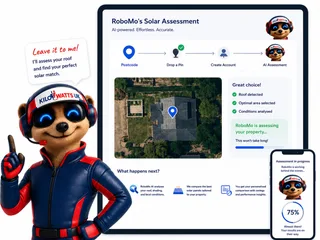
Use RoboMo™ to assess your property, compare available technologies and connect with trusted UK installers, suppliers and manufacturers.
Simply enter your postcode, drop a pin on your roof, create your free account and let RoboMo™ analyse your property to find the best solar panels for your home.

You don't have to think
RoboMo™'s AI analyses your roof and does all the hard work.

Accurate & tailored
AI-powered assessment based on your roof, location, and conditions.

Best options, maximum savings
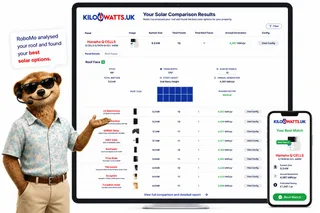
Compare top solar panels for the best performance and value.

Simple, fast & effortless
Provide a few details, sit back and watch your results unfold.
STEP 1
Choose Home, Business or Industrial
Enter your postcode to start your assessment.
STEP 2

Drop a pin on your roof
STEP 3

Create your free account
STEP 4

Sit back and watch RoboMo™ work
RoboMo™ analyses your roof and builds your personalised solar comparison.

Kilowatts UK is an authorised representative
Flower Turbines
Compact vertical-axis turbines built for real UK sites, not just open farmland.
They start in light wind, sit in a small footprint, and are bird-safe by design. Cluster them as a bouquet and the group performs better together than the same turbines standing alone. Enter your postcode for a location-based generation estimate. Figures use area weather data and will differ if buildings, trees or hills sit in the way.
Starts in light UK wind
Built to generate in typical UK wind, not only open farmland.
Small rooftop or ground footprint
Compact towers for roofs, yards and tight sites.
Bird-safe slow rotation
Slow vertical-axis spin, bird-safe by design.
Bouquet clusters raise output
Grouped turbines outperform the same units standing alone.
Step 1
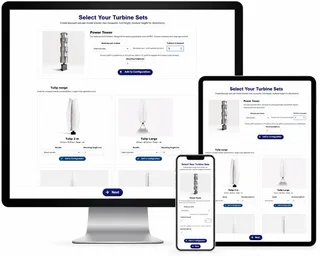
Enter your postcode
Start designing your wind energy system in seconds.
STEP 2

Choose a location
STEP 3

Place your cluster
Tap the map where you want the turbine cluster to go.
STEP 4

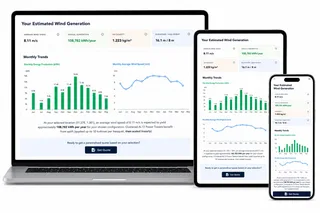
Instant generation forecasts
Compare different turbine layouts and see annual generation forecasts instantly.
STEP 5

No commitment required
Explore different configurations before deciding whether to request a quotation.
Related articles

Mo's Mission Nominations
FAQ
Need Help? RoboMo's Got Answers
What is a Home Battery?
A home battery is an innovative technology that enables homeowners to store excess energy generated by their solar panels or wind turbines. This stored energy can then be used to power appliances during periods of low energy generation or when the grid is down.
How Does a Home Battery Work?
A typical home battery system consists of a rechargeable battery pack, inverter, and charge controller. The solar panels generate electricity during the day, which is stored in the battery pack. When the sun isn't shining or at night, the inverter converts the DC power from the battery into AC power, allowing you to use it in your home.
Benefits of Home Batteries
Home batteries offer several benefits, including: * Energy independence: Store excess energy for later use, reducing your reliance on the grid. * Reduced energy bills: Use stored energy to power appliances, lowering your energy consumption. * Increased solar usage: With a home battery, you can use more of the energy generated by your solar panels.
The Expertise Behind Kilowatts.uk
As a leading provider of renewable energy solutions in the UK, we're committed to helping homeowners like you take control of their energy usage. Our team of experts has years of experience in designing and installing home battery systems that meet your unique needs.