


Kwp in solar power
Published: 2026-10-07 02:24:54
Updated: 2026-10-06 19:25:43
Kilowatt-peak (kWp) is a solar array's DC nameplate under lab test conditions. It is not inverter AC output or the yearly kWh a UK roof delivers.

What is kwp in solar power?
Understand what is kwp in solar power in the UK, with clear explanations, examples, and practical next steps.
What is kWp in solar power?
Kilowatt-peak (kWp) is the rated direct-current power of a solar module, or of an array of modules added together, under Standard Test Conditions. Those conditions are the laboratory reference used in the IEC 61215 module standards and the IEC 60904 measurement series: irradiance of 1,000 watts per square metre, a cell temperature of 25°C, and the air-mass 1.5 spectrum set out in IEC 60904-3. A system described as 4 kWp is rated to produce 4 kW of DC power only in that test. It does not produce 4 kW whenever the sun is up, and it does not produce 4 kWh every hour.
On a quote, kWp is normally the sum of the module nameplate ratings, before inverter, cable, temperature and shading losses. Installers do not derate that headline for British weather. It is the standard way to state array size for a home, a small commercial roof, a factory or a farm. It is not a product, a grant, or a measure of bill savings. Annual energy still has to be estimated in kilowatt-hours, and that estimate depends on the roof, the weather and how the building uses electricity. A plain account of how solar panels work helps separate that laboratory rating from what a roof actually delivers.
Many UK domestic contracts are written so the installer and the products sit on the Microgeneration Certification Scheme (MCS). Where an MCS certificate is issued, the kWp on that paperwork is still this installed DC rating. It is not a promise of annual kilowatt-hours, and it is not, by itself, proof that any tariff, funding or consumer protection applies. Scheme rules change, so current MCS guidance matters more than the nameplate. In practice, two proposals can show the same kWp and still be different jobs. One array may sit on a clear south face. Another may be split across east and west pitches, or sit partly in shade from a chimney or a neighbouring roof. The headline rating will not show that split. Ask how the figure was added up, which roof faces are included, and what annual kilowatt-hour figure the installer expects from that rating.
How a quote turns module watts into kWp
The kilowatt-peak line is a multiplication, not a measurement taken on your roof. Take a worked quote, not a national average: ten modules rated 400 watts each. Ten times 400 watts is 4,000 watts, which is 4.0 kWp of DC nameplate. If the inverter beside that array is rated 3.6 kW AC, the DC rating is larger than the AC rating. That pairing can be a deliberate design. It does not mean the building receives 4 kW of usable power, and it does not mean 4.0 kWp is a recommended size for every house.
There is no single domestic array size worth quoting as typical. A small terraced roof may only take a few modules. A large unshaded detached roof can take many more. Factories and farms often carry a much larger kWp because they have more area and, often, more daytime load. The useful figure is the one that survives module count, usable roof faces, inverter rating and how the building uses electricity. Roof area is what usually decides how many panels fit, not a round kilowatt-peak picked from a brochure.
The annual kilowatt-hour line still has to show the losses the nameplate ignores. Those usually include irradiance below the test level for much of the year, cells warmer than 25°C, orientation and tilt, shading, soiling, mismatch between modules, DC cable loss, inverter conversion, and any midday clipping or export cap. If a proposal prints 4.0 kWp and an annual energy figure with none of those assumptions written down, that energy figure is not yet comparable with another quote. Bifacial gain, where it is claimed, is a yield-model item. It is not normally added into the STC kilowatt-peak.
How kWp differs from kW and kWh
kWp, kW and kWh answer different questions. Mixing them up is the usual reason a quote feels larger than the electricity the building actually sees. kWp is a nameplate rating under test conditions. kW is power at a moment in time, whether that is the inverter’s AC output or a kettle switching on. kWh is energy: power sustained over time, which is what meters and bills record. A 4 kWp array is not a 4 kW supply you can rely on at teatime, and it is not 4 kWh of energy delivered each hour. Household and site demand peaks often do not line up with solar peaks. A kettle, oven or heat pump can draw several kilowatts for a short spell while the array is producing far less, especially in winter or under cloud. Self-consumption depends on when the building uses electricity, not on the peak rating by itself. Estimates of how much panels generate belong in kilowatt-hours, not in the kilowatt-peak line.
Overview
When you read a proposal, keep the three units in separate columns in your own notes. Compare array size in kWp, inverter capacity in kW, and expected generation in kWh. If a salesperson slides between them in one sentence, ask them to separate the rating, the AC equipment size and the yearly energy estimate.
Why roof output is not the laboratory peak
The laboratory rating assumes strong, even light and a cool cell. UK irradiance is often below 1,000 watts per square metre, and module cells on a roof often run warmer than 25°C once the sun is on them. Power falls as cell temperature rises. Datasheets give a temperature coefficient for that effect. For crystalline modules that coefficient is negative, so warmer cells mean fewer watts. Installers use it, with orientation and shading, when they model yield. Temperature is one of several factors in what affects panel efficiency.
Datasheets also quote a Nominal Operating Cell Temperature (NOCT) or, on newer modules, a Nominal Module Operating Temperature (NMOT). NOCT was defined at 800 watts per square metre, 20°C ambient air and a wind speed of 1 metre per second, with the module open-circuited. NMOT, used in later IEC 61215 editions, is measured on the module under a stated reference rather than assumed to be one temperature for every product. Both exist so a yield model can estimate temperature on a real roof. Neither is a second peak-power rating, and neither replaces the annual kilowatt-hour estimate.
Cold, bright days are the exception people misread. If irradiance is near the test level and cell temperature falls below 25°C, a crystalline module can produce more than its nameplate watts for a short time. That can push the array above its kWp figure at the DC terminals. The inverter’s AC rating may then limit what leaves the array, which is one form of clipping. Those hours are not the year. For much of the year, delivered AC power sits below the DC kilowatt-peak, including much of the solar output in winter. Orientation, tilt, shading, soiling and local weather matter more than the headline rating alone. A south-facing, unshaded array in a sunnier part of Britain will usually yield more kilowatt-hours per kilowatt-peak than a shaded array, or a steeply east- or west-facing array, of the same rating. Modules on different roof faces will not all peak at the same time, even if their nameplates have been added into one total. There is no single UK average yield that is valid for every roof, and this article does not state a national kilowatt-hour per kilowatt-peak figure. Ask for the installer’s own estimate, the irradiance data behind it, and the loss assumptions they applied. Pitch and aspect are covered in guides on which way panels should face.
Why the same kWp can generate different amounts
Ranking quotes only by kilowatt-peak hides the things that change annual energy. Module efficiency changes how much roof you need for a given rating, but it does not by itself tell you how many kilowatt-hours the building will use on site. Inverter size, string design, shading and any export limit on the connection can all leave delivered AC power below the DC rating. A larger array is not automatically more useful if much of the extra generation would be exported, clipped by the inverter, or limited by the network connection, or if the layout forces heavy shading.
In practice, the useful comparison is expected kilowatt-hours against daytime load, not kilowatt-peak against kilowatt-peak. A factory or farm with steady daytime demand can often use a larger share of whatever the array produces. A home that is empty on weekdays may export a large share of the same rating, unless a battery or a shift in usage changes that pattern. Export can still have value, but that value depends on the tariff and on how much the connection is allowed to send out. Neither of those is fixed by the module nameplates.
Roof structure and layout also change what a quoted kilowatt-peak is worth. Weak timbers, limited fixings, or a roof that will need work before a long-lived array goes on can make a large rating a poor project even if the modules would fit on paper. Split arrays, dormers and nearby trees change the yield model more than a one-line kWp comparison will show. Ask for a layout drawing and a note of which modules are shaded at which times of year.
How array kWp sits beside the inverter and the grid
The DC array in kWp is often larger than the inverter’s AC rating in kW. That can be sensible, because modules rarely sit at their test rating for long, so a slightly smaller inverter may still capture most of the year’s energy. It can also mean the inverter limits output near the middle of bright days. Clipping is not automatically a fault, but it should be visible in the design notes, not buried in a single kilowatt-peak number. In the ten-by-400-watt example, a 3.6 kW inverter cannot pass 4 kW of AC even if the modules briefly exceed nameplate in cold sun.
Export limits, where they apply to the connection, cap what leaves the site regardless of array size. Clipping and an export cap are different constraints. One is inside the inverter. The other is a limit on what the connection may send to the network. The route is agreed with the local distribution network operator, often under the G98 or G99 engineering recommendations, and it depends on the equipment and the network. This article does not state a size threshold, because that needs a current primary reference and can differ by area and by job. What changes the quote is whether the installer has checked the connection route, whether an export cap is expected, and whether that cap was used in the annual energy and savings model.
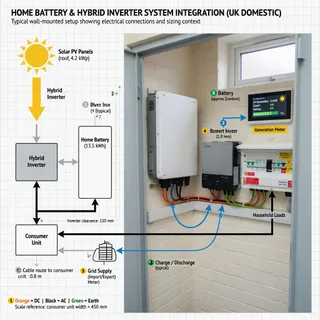
If you later add a battery, an EV charger or a heat pump, the original kilowatt-peak figure does not describe the new electrical design. A hybrid inverter or an AC-coupled battery can change how generation is stored and used without changing the module nameplates. A larger daytime load from a heat pump can raise self-consumption in some hours and still leave a winter shortfall, because solar output and heat demand often move in opposite directions. Consumer-unit space, cable routes and the existing supply capacity are separate checks. Treat kWp as the array size, then ask what else on the board has to be sized around it. Storage is a separate design: start with how a home battery works before treating it as part of the array rating.
What to check on a solar quote
A larger kilowatt-peak is not automatically the better proposal. Use the rating to check whether the annual kilowatt-hour figure looks plausible for that roof, then look at the equipment and the assumptions underneath. Installers commonly estimate yield with irradiance tools and then apply system-loss assumptions. You are entitled to see those assumptions in plain language, even if the software printout is dense. Side-by-side kit and layout differences are easier to see if you compare home solar options against the same roof constraints.
If two solar installation companies quote similar kilowatt-peak totals, the useful differences are usually layout, inverter choice, shading treatment and how carefully the annual energy was modelled. Price per kilowatt-peak is not stated here, because installed cost depends on roof, access, electrical work and equipment, and a single rate would mislead. Compare itemised scopes, not a lone size figure.
When kilowatt-peak is a poor guide
kWp matters when you are comparing proposals, because it is how array size is stated. It is a weak guide where the roof is heavily shaded, structurally limited or awkward to access, and where daytime electricity use is very low. The rating does not describe those constraints. A monthly cost comparison still needs kilowatt-hours and tariff assumptions, not kilowatt-peak alone. Savings are not guaranteed by a larger nameplate.
It is also a poor way to judge a battery or a heat pump on its own. A battery is sized around usable capacity, round-trip losses and when you want stored energy. A heat pump is sized around heat loss and flow temperatures. Solar kilowatt-peak can support those decisions only after you know daytime surplus and winter shortfall. Do not treat the array rating as proof that either appliance will run from solar whenever you need it. Adding storage does not increase the STC rating of the modules.
If you are early in a project, gather what you already know: a year of electricity use if you have it, which parts of the day that use falls in, roof orientation and obvious shade. Then ask an installer to show kWp as a sum of module ratings, the inverter AC rating beside it, and an annual kilowatt-hour estimate with the losses written down. That set of figures is enough to compare options without treating the laboratory peak as what the roof will do every hour. A free home energy survey is a practical next step if you want those figures checked against the actual roof.
Plan, Compare & Buy Renewable Energy Solutions
AI does the thinking.
You get the perfect solar match.
Use RoboMo™ to assess your property, compare available technologies and connect with trusted UK installers, suppliers and manufacturers.
Simply enter your postcode, drop a pin on your roof, create your free account and let RoboMo™ analyse your property to find the best solar panels for your home.

You don't have to think
RoboMo™'s AI analyses your roof and does all the hard work.

Accurate & tailored
AI-powered assessment based on your roof, location, and conditions.

Best options, maximum savings
Compare top solar panels for the best performance and value.

Simple, fast & effortless
Provide a few details, sit back and watch your results unfold.


STEP 1
Choose Home, Business or Industrial
Enter your postcode to start your assessment.
STEP 2

Drop a pin on your roof
STEP 3

Create your free account
STEP 4

Sit back and watch RoboMo™ work
RoboMo™ analyses your roof and builds your personalised solar comparison.

Step 1
Enter your postcode
Start designing your wind energy system in seconds.
Are you an installer, distributor or renewable energy business?
Kilowatts UK is expanding the Flower Turbines partner network across the UK.
Become A Flower Turbines PartnerKilowatts UK is an authorised representative
Flower Turbines
Compact vertical-axis turbines built for real UK sites, not just open farmland.
They start in light wind, sit in a small footprint, and are bird-safe by design. Cluster them as a bouquet and the group performs better together than the same turbines standing alone. Enter your postcode for a location-based generation estimate. Figures use area weather data and will differ if buildings, trees or hills sit in the way.
Starts in light UK wind
Built to generate in typical UK wind, not only open farmland.
Small rooftop or ground footprint
Compact towers for roofs, yards and tight sites.
Bird-safe slow rotation
Slow vertical-axis spin, bird-safe by design.
Bouquet clusters raise output
Grouped turbines outperform the same units standing alone.


STEP 2

Choose a location
STEP 3

Place your cluster
Tap the map where you want the turbine cluster to go.
STEP 4

Instant generation forecasts
Compare different turbine layouts and see annual generation forecasts instantly.
STEP 5

No commitment required
Explore different configurations before deciding whether to request a quotation.
Related articles


FAQ
Need Help? RoboMo's Got Answers
What does kWp mean on a solar quote?
Kilowatt-peak (kWp) is the rated direct-current power of a solar module, or of an array of modules added together, under Standard Test Conditions. Those laboratory conditions, used in the IEC 61215 module standards and the IEC 60904 measurement series, are irradiance of 1,000 watts per square metre, a cell temperature of 25°C, and the air-mass 1.5 spectrum in IEC 60904-3. On a quote, kWp is normally the sum of the module nameplate ratings before inverter, cable, temperature and shading losses. Installers do not derate that headline for British weather, and it is not a promise of bill savings.
Does a 4 kWp system produce 4 kW all the time?
No. A system described as 4 kWp is rated to produce 4 kW of DC power only under those test conditions. It does not produce 4 kW whenever the sun is up, and it does not produce 4 kWh every hour. UK irradiance is often below the test level, and cells on a roof often run warmer than 25°C, which reduces power. Annual energy has to be estimated separately in kilowatt-hours.
How is kWp calculated from module ratings?
The kilowatt-peak line is a multiplication, not a measurement taken on your roof. Ten modules rated 400 watts each give 4,000 watts, which is 4.0 kWp of DC nameplate. If the inverter beside that array is rated 3.6 kW AC, the DC rating is larger than the AC rating. That pairing can be a deliberate design; it does not mean the building receives 4 kW of usable power.
What is the difference between kWp, kW and kWh?
kWp is a nameplate rating of the modules under test conditions. kW is power at one moment, such as the inverter’s AC output or a kettle switching on. kWh is energy over time, which is what meters and bills record and how annual generation should be stated. A 4 kWp array is not a 4 kW supply you can rely on at teatime, and it is not 4 kWh delivered each hour.
Why can two arrays with the same kWp generate different amounts?
The headline rating does not show roof faces, shade or how the building uses electricity. A clear south-facing array will usually yield more kilowatt-hours per kilowatt-peak than a shaded array, or one split across east and west pitches, of the same rating. Inverter size, string design, soiling and any export limit can also leave delivered AC power below the DC rating. Ask for the installer’s own kilowatt-hour estimate, the irradiance data behind it, and the loss assumptions they applied. There is no single UK average yield that is valid for every roof.
Is the kWp on an MCS certificate a guarantee of annual generation?
Where an MCS certificate is issued, the kWp on that paperwork is still the installed DC rating under the nameplate method. It is not a promise of annual kilowatt-hours, and it is not, by itself, proof that any tariff, funding or consumer protection applies. Many UK domestic contracts are written so the installer and the products sit on the Microgeneration Certification Scheme, but scheme rules change. Current MCS guidance matters more than the nameplate figure.
Why is the array kWp often larger than the inverter rating?
Modules rarely sit at their test rating for long, so a slightly smaller inverter may still capture most of the year’s energy. On bright, cold days a crystalline module can briefly exceed its nameplate, and the inverter’s AC rating may then limit output, which is one form of clipping. Clipping is not automatically a fault, but it should be visible in the design notes. An export limit, where it applies to the connection, is a separate constraint agreed with the distribution network operator and is not fixed by the module nameplates.
What should I check beside the kWp figure on a quote?
Ask which module rating was multiplied by how many modules, and which roof faces are included. Ask for the inverter’s AC kilowatt rating, whether output is expected to be limited on bright days, and which orientation, tilt, shading and temperature assumptions sit behind the annual kilowatt-hours. Also ask whether an export limit is expected and whether it was included in the generation figures, and what was checked on the roof structure. A larger kilowatt-peak is not automatically the better proposal.