


Why Your Solar Panels Never Hit Their Rated Wattage
Published: 2026-09-25 04:14:32
Updated: 2026-10-06 12:29:17
A panel's wattage is a lab rating at 1000 W/m² and 25°C. Here's why UK roofs rarely match it, and why annual kilowatt-hours are the honest measure.
The Number Printed On The Panel: Why Your Roof Rarely Hits It
If you have solar panels and a monitoring app, you have probably had this moment. The label says 440 watts. The app says 310. Nothing is broken, nothing is faulty, and nobody has mis-sold you anything. The number printed on the back of a solar panel is a laboratory rating, measured under Standard Test Conditions: 1000 watts per square metre of irradiance and a cell temperature of 25°C. Those two conditions are a controlled benchmark, not a British weather forecast. A wet slate roof in Yorkshire almost never meets both at the same moment, because the light bright enough to hit 1000 W/m² is usually the light that warms the cells well past 25°C. So nameplate watts is a comparison benchmark — a fair way to line up one module against another — and not a promise of what your roof will do on a Tuesday in March. The number that actually matters to your bills is the total kilowatt-hours gathered across a whole British year. This article explains where the printed figure comes from, when your roof genuinely brushes it, why cold weather helps, and how to judge a solar quote on annual yield rather than a big impressive watt figure.
"Mo: Why doesn't my roof ever hit that number? RoboMo: Those watts assume bright light and a cool twenty-five-degree cell."
What the number on the back of the panel actually means
Every solar module carries a nameplate on the rear: a small printed plate listing peak power in watts, along with voltage and current figures. That peak power is measured in a flash test chamber under Standard Test Conditions — an irradiance of 1000 watts per square metre, a cell temperature held at 25°C, and a defined light spectrum. The point of fixing those conditions is fairness. If every manufacturer tested in their own local weather, no two ratings would be comparable. By agreeing one artificial reference point, the industry makes it possible to say that one panel is genuinely more powerful than another of the same physical size. That is a useful thing, and it is the job the number was designed to do. What it was never designed to do is describe a roof. Your roof has weather. It has cloud, haze, dust, morning dew, a chimney, a pitch that is probably not perfect, and a cell temperature that wanders freely with sunshine and wind. The printed figure is the ceiling of a controlled test, and treating it as a daily target sets you up to feel disappointed by a system that is working exactly as designed.
Why a British roof rarely meets both conditions at once
The awkward part is that the two test conditions pull against each other. Reaching 1000 W/m² of irradiance in the UK generally requires a clear sky and the sun reasonably high — the sort of day that also pours heat into a dark panel on a dark roof. Cell temperature is not air temperature. A module sitting in full sun will run considerably warmer than the shaded thermometer in your garden, because it is a dark surface absorbing energy and only partly converting it. So on the very days bright enough to satisfy the irradiance condition, the cells have usually drifted well above 25°C, and silicon loses a little voltage as it warms. Every datasheet states this as a temperature coefficient — a percentage of power lost per degree above the test temperature. Meanwhile, on a cool overcast day the cells are perfectly happy at 25°C or below, but the irradiance arriving is a fraction of the test value. The two markers drift past each other all year without ever quite lining up. That is not a defect. It is geometry and thermodynamics doing exactly what they always do.
The narrow window when your roof does get close
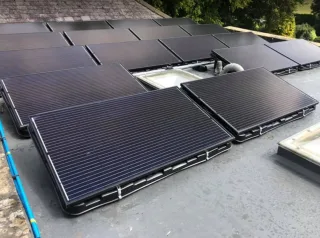
There is a window, and it is worth knowing because it explains an odd thing many owners notice. The best instantaneous readings of the year rarely come in August. They come on cold, bright days — clear crisp spring mornings, a sharp February noon, a windy cool April afternoon — when the light is strong, the air is cold, and a breeze keeps the modules from heating up. This connects to one of the most counter-intuitive true facts in domestic solar: solar panels generate more efficiently in cold weather than in hot weather. Heat is a performance tax on photovoltaics, not a fuel. Sunlight provides the energy; temperature quietly erodes the conversion. With the right combination of clear sky, low ambient temperature and moving air, a well-sited array can brush its nameplate figure — and on rare occasions, with bright cloud-edge reflections adding to direct sun, momentarily exceed it. Then haze builds, the afternoon warms, and the live readout slides back down. A narrow window, not a normal operating state. Equally, the reverse is true and worth remembering: UK homes still generate useful solar power on overcast days. Diffuse light is genuine light. It will never look impressive on an instantaneous power readout, but gathered patiently over hundreds of grey British hours it is a serious contributor to the annual total.
Kilowatt-hours across a year: the measure that pays your bills
Watts are a rate. Kilowatt-hours are an amount. Your supplier does not bill you in watts, your export payment is not calculated in watts, and no household budget has ever been improved by a peak reading. What matters is the accumulating total: how many units the array gathers from January's low grey light through June's long evenings and back again. That total is produced by things the nameplate never mentions — roof orientation and pitch, shading from trees, chimneys and neighbouring buildings, inverter sizing and efficiency, cable losses, soiling, and how sensibly the system is configured. Two homes fitted with identical panels can land in very different places on annual yield simply because one roof faces south-west with a clear horizon and the other faces east with an oak tree. This is why a reputable design is quoted with an estimated annual generation figure produced by a recognised methodology, not just a panel count and a watt number. When you compare proposals, the honest comparison is annual kilowatt-hours for your specific roof, alongside how much of that generation you are realistically likely to use in the home rather than export. A bigger nameplate on a shaded roof is not an upgrade. It is a bigger number on a worse outcome.
A practical checklist for reading a solar quote properly
Use this when you are holding two or three proposals and trying to work out which one is genuinely better rather than which one has the largest font. First, find the estimated annual generation in kilowatt-hours for your roof, and check it is stated for your actual orientation, pitch and shading — not a generic figure. Second, check whether a shading assessment was carried out, and what it concluded. Third, look at the layout: are panels being placed on an elevation that genuinely earns its keep, or filled in to raise the headline system size? Fourth, ask for the panel datasheet and look at the temperature coefficient and the performance warranty — the guaranteed output retention over time tells you more about long-term value than peak watts. Fifth, check inverter sizing against array size and ask the installer to explain their reasoning. Sixth, ask how much of the generation they expect you to self-consume, and on what assumptions about your household. Seventh, if a battery is proposed, ask what it is expected to add in annual terms, not just its capacity. Eighth, confirm the monitoring you will receive, so you can see daily and annual totals rather than only a live power dial. And finally, be gently sceptical of any conversation that leans hard on the panel wattage and skips lightly over annual yield. Knowledge beats marketing, and the units are where the knowledge lives.
Questions people ask next
Is my system faulty if it never reaches the rated output? Almost certainly not. Consistently reading below the nameplate is normal and expected. What is worth investigating is a sudden unexplained drop against your own historical pattern, a single string underperforming against its twin, or a panel or optimiser showing zero on a bright day. Compare against yourself, not against the label. Does a higher-wattage panel always mean more electricity? Not necessarily. It means more power from the same physical area under test conditions, which matters enormously if your roof is small and you are fitting as much capacity as the space allows. On a large unobstructed roof, total installed capacity and layout quality can matter more than squeezing out the highest-rated module. Why does my system sometimes cap out even on a perfect day? Inverters have a maximum output, and designs are sometimes deliberately configured with a little more panel capacity than inverter capacity, because those rare peak moments are brief while the gains across the rest of the year are real. Your installer should explain this if it applies. Do panels wear out? They degrade slowly and predictably, which is why manufacturers publish long performance warranties. Degradation is a gentle annual slope, not a cliff. And does cleaning help? Usually less than people expect in the UK, where rain does most of the work — though persistent shading, moss, lichen or bird fouling on lower rows is worth addressing.
Video transcript
Mo: Why doesn't my roof ever hit that number? RoboMo: Those watts assume bright light and a cool twenty-five-degree cell.
Mo: So does it ever reach it? RoboMo: Briefly — on a cold, bright day, when the cells stay cool.
Mo: Then what should I actually judge it on? RoboMo: The units it gathers across a whole British year, not the label. Mo: Why doesn't my roof ever hit that number? RoboMo: Those watts assume bright light and a cool twenty-five-degree cell. / Mo: So does it ever reach it? RoboMo: Briefly — on a cold, bright day, when the cells stay cool. / Mo: Then what should I actually judge it on? RoboMo: The units it gathers across a whole British year, not the label.
Wrapping up
The number printed on the back of a solar panel is honest, useful and precisely defined — it simply answers a different question from the one most homeowners are asking. It tells you how this module compares to that module under identical laboratory conditions. It does not tell you what a wet Yorkshire roof will do in February, or what your electricity bill will look like next year. For that, the measure is kilowatt-hours accumulated across a full British year: through cold bright mornings when the cells are at their most efficient, through long grey afternoons that quietly contribute more than people assume, and through the handful of perfect cool midday moments when the live readout brushes the label and then slides away again. Judge a system on what it gathers, not on what it is rated. The nameplate is a reference marker. The annual total is the truth.
Next step
If you would like to understand what your own roof could realistically gather across a year — orientation, shading, sensible array size and an honest annual kilowatt-hour estimate rather than a headline watt figure — our residential solar guidance and comparison pages are a good place to start, and a no-pressure survey will tell you far more than any label ever could.
Plan, Compare & Buy Renewable Energy Solutions
AI does the thinking.
You get the perfect solar match.
Use RoboMo™ to assess your property, compare available technologies and connect with trusted UK installers, suppliers and manufacturers.
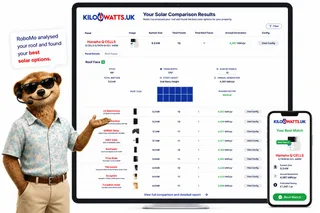
Simply enter your postcode, drop a pin on your roof, create your free account and let RoboMo™ analyse your property to find the best solar panels for your home.

You don't have to think
RoboMo™'s AI analyses your roof and does all the hard work.

Accurate & tailored
AI-powered assessment based on your roof, location, and conditions.

Best options, maximum savings
Compare top solar panels for the best performance and value.

Simple, fast & effortless
Provide a few details, sit back and watch your results unfold.
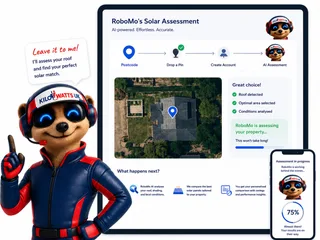
STEP 1
Choose Home, Business or Industrial
Enter your postcode to start your assessment.
STEP 2

Drop a pin on your roof
STEP 3

Create your free account
STEP 4

Sit back and watch RoboMo™ work
RoboMo™ analyses your roof and builds your personalised solar comparison.

Kilowatts UK is an authorised representative
Flower Turbines
Compact vertical-axis turbines built for real UK sites, not just open farmland.
They start in light wind, sit in a small footprint, and are bird-safe by design. Cluster them as a bouquet and the group performs better together than the same turbines standing alone. Enter your postcode for a location-based generation estimate. Figures use area weather data and will differ if buildings, trees or hills sit in the way.
Starts in light UK wind
Built to generate in typical UK wind, not only open farmland.
Small rooftop or ground footprint
Compact towers for roofs, yards and tight sites.
Bird-safe slow rotation
Slow vertical-axis spin, bird-safe by design.
Bouquet clusters raise output
Grouped turbines outperform the same units standing alone.
Step 1
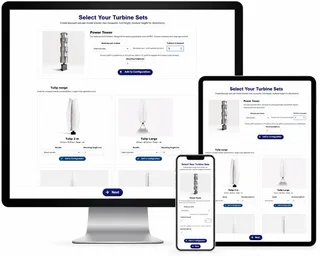
Enter your postcode
Start designing your wind energy system in seconds.
STEP 2

Choose a location
STEP 3

Place your cluster
Tap the map where you want the turbine cluster to go.
STEP 4

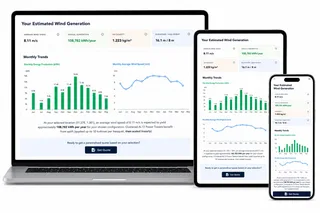
Instant generation forecasts
Compare different turbine layouts and see annual generation forecasts instantly.
STEP 5

No commitment required
Explore different configurations before deciding whether to request a quotation.
FAQ
Need Help? RoboMo's Got Answers
What is Why Your Solar Panels Never Hit Their Rated Wattage about?
If you have solar panels and a monitoring app, you have probably had this moment. The label says 440 watts. The app says 310. Nothing is broken, nothing is faulty, and nobody has mis-sold you anything. The number printed on the back of a solar panel is a laboratory rating, measured under Standard Test Conditions: 1000
Who is this video for?
UK homeowners comparing the options discussed in Why Your Solar Panels Never Hit Their Rated Wattage.