


Why Your Solar Array Can Be Bigger Than The Inverter
Published: 2026-09-02 09:09:16
Updated: 2026-10-06 12:41:23
Oversizing a solar array above the inverter rating is deliberate UK design. Here's what clipping really costs, and why the dim hours gain far more.
Why The Solar Array Can Be Bigger Than The Inverter
If you have been sent a solar quote where the panel total in kilowatts is larger than the inverter's rating, nothing has gone wrong and nobody has made a typing error. It is a deliberate design choice, and in the British climate it is usually the right one. The inverter sets a ceiling on how much power can be converted and delivered at any one instant. On a handful of brilliant, cold, cloudless hours each year, the panels can push past that ceiling and the surplus is 'clipped' — shaved off and never produced. That sounds like waste, and it is the first thing most people object to. But an array is not judged on its best hour. It is judged on the thousands of ordinary hours in between: grey mornings, hazy afternoons, October, February, and the long shoulders either side of noon when the sun is low and weak. Extra panels lift every one of those hours, none of which comes anywhere near the ceiling. This article explains what the ceiling actually costs you, where the extra panels earn their keep, how batteries and EV charging change the maths, and how to sanity-check an oversized design before you sign anything.
"More panels than the inverter can take? Sounds wasteful."
What 'array bigger than inverter' actually means
Two different numbers get quoted on every solar proposal. The first is the array size — the sum of the panels' rated output in kilowatts peak (kWp). The second is the inverter's rating, in kilowatts, which is the most AC power it can deliver at once. When the first is larger than the second, the system is described as oversized, or as having a DC-to-AC ratio above one.
The important thing to understand is that kWp is a laboratory figure. Panels are rated under standard test conditions — a specific, strong level of irradiance at a controlled cell temperature. A UK roof rarely sees those conditions, and when it does, it sees them briefly. Orientation, pitch, dust, temperature, cabling losses and simple British weather all pull real-world output below the nameplate. So a 6 kWp array paired with a smaller inverter is not a 6 kW machine constantly straining against a smaller pipe. For most of its working life it is producing a fraction of its badge rating, and the inverter has capacity to spare.
That is the whole argument in one line: the badge number describes a rare moment, while the inverter has to serve every moment.
Clipping: what the ceiling really costs
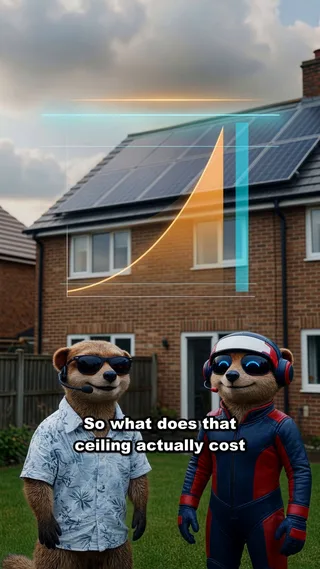
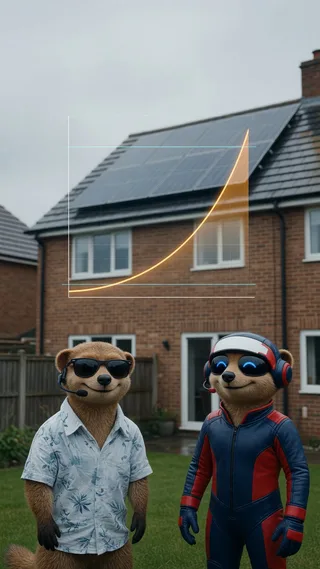
Clipping happens when the array could deliver more than the inverter can pass through. The inverter simply holds output at its limit and the potential surplus is not harvested. On a generation graph it looks exactly as the episode shows it: a curve sweeping upward, hitting a horizontal line, and running flat along it for a while before falling away again.
The key detail is the shape of that lost region. It is not a block, it is a thin sliver — narrow at the base and tapering to nothing, because the array only exceeds the ceiling for a limited window around solar noon, on the minority of days bright enough to get there at all. Widen the array and that sliver grows only slowly, because the flat-topped section extends sideways a little rather than ballooning upward. The ceiling cannot be exceeded, so the loss is bounded by definition.
Meanwhile, everything below the ceiling scales up with the extra panels. That is the trade being made: a strictly limited loss on your best hours in exchange for an unlimited gain on all the rest.

The shoulders are where the extra panels earn their keep
The 'shoulders' are the parts of the daily curve either side of the midday peak: from first light through mid-morning, and from mid-afternoon into evening. Add panels and those shoulders rise across their whole length, because at low irradiance the array is nowhere near the inverter's limit and every additional watt of DC input converts straight through.
This matters more than it sounds, because shoulder hours line up unusually well with how households actually use electricity. Breakfast, showers, the morning kettle, then the late-afternoon return home, cooking, laundry and, increasingly, an EV plugging in. A larger array raises the floor of self-consumption at exactly those times, which is the electricity you never have to buy. The same logic applies seasonally. Spring and autumn days have long, weak shoulders and short, unimpressive peaks. Winter days are essentially all shoulder. In those months a bigger array is not fighting the inverter at all — it is simply doing more work, earlier and later in the day, in conditions where a smaller array would be producing very little.
Why this suits the British climate in particular
UK homes still generate useful solar power on overcast days. Diffuse light — sunlight scattered through cloud — is genuine fuel, and a well-installed array converts it happily. It produces a lower, flatter curve than direct sun, but it produces one, and across a British year those days are the majority rather than the exception.
That single fact is why oversizing behaves differently here than in a hot, reliably sunny climate. On a dull day the curve simply never approaches the inverter ceiling, so there is no clipping to worry about and the additional panels contribute in full. Accelerate through a whole year, as the episode does, and the pattern is consistent: most days never touch the limit, while the cumulative annual energy total keeps climbing.
There is a second British advantage. Solar panels generate more efficiently in cold weather than in hot weather, so a crisp, bright day in March or October can produce surprisingly strong output. That is also when clipping is most likely — which is why designers check the inverter's maximum DC input and voltage window against cold-weather conditions, not just average ones.
How batteries, EV charging and export limits change the sums
A home battery changes what clipping means. Surplus that would otherwise be exported at midday can be stored and used through the evening instead, so a larger array fills the battery earlier in the day and on more days of the year — including dull ones where a smaller array might not fill it at all. Clipping still caps the instantaneous rate, but the total energy captured rises.
EV charging pushes the same way. Daytime charging draws steady, substantial power for hours, and a bigger array covers more of that draw during the shoulder periods when a small array would fall short. A typical EV range vastly exceeds the average daily journey, so most owners are topping up modestly and opportunistically rather than racing to fill a battery — which is precisely the pattern solar suits.
Grid connection rules also work in favour of oversizing. In Great Britain, what the network operator cares about is what you can push onto the grid, which is governed by the inverter and any export limit set on it — not by how many panels sit on the roof. Where a system exceeds the threshold for simple connect-and-notify, your installer makes an application to the Distribution Network Operator on your behalf. Export limiting is a normal, well-established tool, and it lets a household size the array for its own consumption while keeping the connection straightforward. Your installer should explain which route applies to your property before installation.
A practical checklist for reviewing an oversized design
Oversizing is a legitimate engineering choice, but it should be a considered one. Use these questions when you review a proposal:
- Ask for the DC-to-AC ratio, stated plainly. A designer who has thought about it will tell you the number and why they chose it. - Check the inverter's maximum DC input and voltage limits. The array must sit inside the manufacturer's stated window in cold conditions, not just typical ones. This is a safety and warranty matter, not a preference. - Ask for an estimate of clipping losses. It should be modelled, small, and expressed as energy over a year — not hand-waved away. - Look at the modelled monthly output, not just the annual total. Oversizing should visibly lift the winter and shoulder-season months. - Match it to your usage pattern. Morning and evening loads, a battery, or an EV all strengthen the case for more panels. - Confirm the export arrangement. Know your inverter rating, whether an export limit is applied, and who is handling the DNO notification or application. - Check roof suitability honestly. Extra panels are only worth adding where shading, orientation and pitch mean they will actually produce. If the answer to most of these is clear and documented, the design is being engineered. If the extra panels appear without explanation, ask why.
Common follow-up questions
Does clipping damage the inverter? No. Limiting output is normal operating behaviour — the inverter holds at its rating and the array simply operates away from its maximum power point. What must be respected are the manufacturer's maximum DC input voltage and current limits, which is why the design has to be checked properly.
Is there a point where oversizing stops making sense? Yes. Push far enough and the clipped sliver grows into a genuine loss, and you eventually breach the inverter's input limits. The gains flatten off long before the losses do, which is why sensible designs sit modestly above a one-to-one ratio rather than dramatically above it.
Wouldn't a bigger inverter just solve it? Sometimes, and it may be the better answer. But a larger inverter costs more, can run less efficiently at the low loads it will spend most of its life at, and may push you into a different grid connection route. It is a comparison worth making rather than an automatic upgrade. Will my monitoring app show clipping? Often, yes — as a flat top on the daily curve on the brightest days. Seeing it occasionally is expected. Seeing it on most days would be worth a conversation with your installer. Does this affect my export payments? Export is capped by the inverter rating or export limit, so a bigger array increases the total energy you export across dull days and shoulder hours rather than the peak rate. Where a battery or EV is present, more of that surplus is likely to be used at home instead.
Video transcript
Mo: More panels than the inverter can take? Sounds wasteful. RoboMo: Only the brief midday peak is clipped. Cloudy hours gain all day.
Mo: So what does that ceiling actually cost us? RoboMo: A thin sliver on a few bright hours. The shoulders gain far more.
Mo: And across a whole British year? RoboMo: Most days never reach the ceiling. The extra panels earn every dim hour. Mo: More panels than the inverter can take? Sounds wasteful. RoboMo: Only the brief midday peak is clipped. Cloudy hours gain all day. / Mo: So what does that ceiling actually cost us? RoboMo: A thin sliver on a few bright hours. The shoulders gain far more. / Mo: And across a whole British year? RoboMo: Most days never reach the ceiling. The extra panels earn every dim hour.
Wrapping up
An array larger than its inverter looks like an error and behaves like good engineering. The ceiling costs you a thin, bounded sliver on a small number of bright hours. The extra panels repay you across every grey morning, every hazy afternoon, every low-sun February day and every shoulder hour when the household is actually using electricity. In a country where useful generation happens under cloud far more often than under blazing sun, that is a sensible trade — provided it is designed within the inverter's stated limits and explained to you in plain terms. The number to be interested in is not the peak your system can hit once or twice a year. It is the total it quietly accumulates over twelve months of ordinary British weather.
Next step
If you would like to understand how an oversized array would behave on your particular roof, a proper site assessment will model the shoulders, the seasons and any clipping losses honestly — no pressure, just the numbers for your house.
Plan, Compare & Buy Renewable Energy Solutions
AI does the thinking.
You get the perfect solar match.
Use RoboMo™ to assess your property, compare available technologies and connect with trusted UK installers, suppliers and manufacturers.
Simply enter your postcode, drop a pin on your roof, create your free account and let RoboMo™ analyse your property to find the best solar panels for your home.

You don't have to think
RoboMo™'s AI analyses your roof and does all the hard work.

Accurate & tailored
AI-powered assessment based on your roof, location, and conditions.

Best options, maximum savings
Compare top solar panels for the best performance and value.

Simple, fast & effortless
Provide a few details, sit back and watch your results unfold.


STEP 1
Choose Home, Business or Industrial
Enter your postcode to start your assessment.
STEP 2

Drop a pin on your roof
STEP 3

Create your free account
STEP 4

Sit back and watch RoboMo™ work
RoboMo™ analyses your roof and builds your personalised solar comparison.

Kilowatts UK is an authorised representative
Flower Turbines
Compact vertical-axis turbines built for real UK sites, not just open farmland.
They start in light wind, sit in a small footprint, and are bird-safe by design. Cluster them as a bouquet and the group performs better together than the same turbines standing alone. Enter your postcode for a location-based generation estimate. Figures use area weather data and will differ if buildings, trees or hills sit in the way.
Starts in light UK wind
Built to generate in typical UK wind, not only open farmland.
Small rooftop or ground footprint
Compact towers for roofs, yards and tight sites.
Bird-safe slow rotation
Slow vertical-axis spin, bird-safe by design.
Bouquet clusters raise output
Grouped turbines outperform the same units standing alone.
Step 1
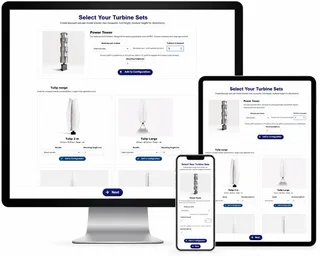
Enter your postcode
Start designing your wind energy system in seconds.
STEP 2

Choose a location
STEP 3

Place your cluster
Tap the map where you want the turbine cluster to go.
STEP 4

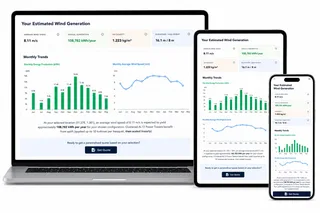
Instant generation forecasts
Compare different turbine layouts and see annual generation forecasts instantly.
STEP 5

No commitment required
Explore different configurations before deciding whether to request a quotation.
FAQ
Need Help? RoboMo's Got Answers
Is it normal for my solar panel array to be bigger than the inverter?
Yes, it is common for a solar array’s kWp rating to be higher than the inverter’s kW rating. Panel ratings are measured under laboratory conditions, while a UK roof usually produces less than the nameplate figure. A modestly oversized array can generate more useful energy during cloudy, low-light and shoulder hours.
What is solar clipping and should I worry about it?
Clipping happens when the panels could produce more power than the inverter can convert at that moment. The inverter simply limits output to its rated capacity, usually for short periods around solar noon on very bright days. Occasional clipping is expected in many well-designed systems and does not automatically mean the design is poor.
Does clipping damage the inverter or panels?
No, clipping itself is normal inverter behaviour and should not damage the equipment. The important point is that the system must stay within the inverter manufacturer’s maximum DC voltage, current and input limits. Your installer should check this carefully, including cold-weather conditions.
Why not just fit a bigger inverter?
Sometimes a bigger inverter is the right choice, but it is not always the best value or best design. A larger inverter may cost more, may spend more time operating at lower loads, and could affect the grid connection or export arrangement. A good quote should compare the likely annual generation, clipping loss and practical constraints rather than assume bigger is always better.
How do batteries or EV charging affect an oversized solar design?
A battery or daytime EV charging can make a larger array more useful because there is somewhere for extra generation to go. More panels can fill a battery earlier and more often, especially on dull days when a smaller array may struggle. Clipping can still happen, but the total usable energy over the year may increase.
Will a bigger array mean I can export more power to the grid?
Not necessarily at any one moment, because export is governed by the inverter rating and any export limit agreed for the property. A larger array may increase the amount of energy exported over the year, especially in lower-light conditions, but it does not automatically increase the peak export rate. Your installer should explain the DNO notification or application route that applies to your system.
How can I tell if an oversized array has been designed sensibly?
Ask for the DC-to-AC ratio, the modelled annual clipping loss and the expected monthly generation. Check that the inverter’s input limits, export arrangement, roof shading, orientation and pitch have all been considered. If the installer can explain why the extra panels help your actual usage pattern, the design is more likely to be well thought through.