


How much does solar battery cost per kwh cost in the UK?
Published: 2026-10-14 02:46:05
Updated: 2026-10-13 19:48:38
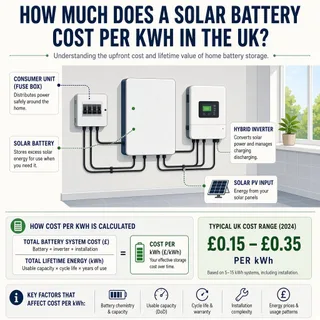
UK solar battery cost per kWh is not a national rate. Divide the surveyed installed total by usable kilowatt-hours, not nameplate or supply-only prices.
How much does solar battery cost per kwh cost in the UK?
Find out solar battery cost per kwh in the UK, including costs, what affects price, and how to choose an installer.
Solar battery cost per kWh in the UK
There is no single current solar battery cost per kWh in the UK, and a web average is not the price you will be offered. The figure that matters is the surveyed installed total on your quote, divided by usable kilowatt-hours, with the same scope of hardware in every comparison. It is a screening tool for quotes. It is not a national tariff, and it is not the pence per kilowatt-hour on your electricity bill. Nameplate capacity, usable capacity, a hybrid inverter or backup gateway, labour, and the VAT line all move the result.
A low number on the nameplate can lose to a higher number calculated on usable capacity. Supply-only module prices sit lower still, and they are a poor guide to a surveyed household job. Published round-ups often mix those supply prices with installed work, and battery-only retrofits with solar-plus-storage packages, so they cannot be treated as your rate. A clearer starting point is how much a home battery costs as a surveyed total, not a web average.
How many kilowatt-hours you actually need is a separate question from the rate. Size the pack from surplus and evening use before you chase the lowest pounds per kilowatt-hour, using a method such as the UK home battery sizing discussion rather than a rule of thumb.
Why a published pounds-per-kWh band is not your price
This page does not print an installed pounds-per-kilowatt-hour band. No reliable, like-for-like UK range was supplied that separates installed work from supply-only hardware, and usable kilowatt-hours from nameplate kilowatt-hours. A mixed band would look like a price and would already be stale. Any figure you see elsewhere should show its survey date, whether it is supply-only or installed, and which capacity it divides by. If those three points are missing, do not budget to it.
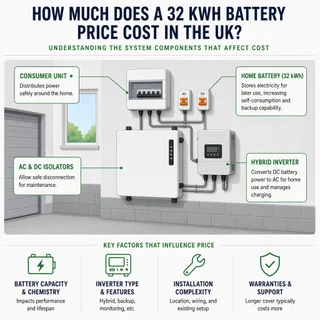
What you can price is the survey line-item total for your property. That total should show the battery, the inverter or hybrid inverter if the job needs one, and any gateway or changeover if backup is specified. It should also show labour, the cable route, containment, and commissioning. Electrical upgrades belong on the same page when they are required, including meter tails, earthing, and consumer-unit work. Access, scaffolding, and any distribution network operator application should be either inside the price or listed as exclusions. VAT should be its own line. The solar array should be split out unless you asked for a combined package and are happy to judge the package as a whole.
Grants and VAT treatment are not a national discount you can assume. Read the VAT line against the current HMRC notice covering energy-saving materials, and do not assume a zero rate still applies, or that it applies to a supply-only purchase or a commercial site. If a grant is mentioned, it should name a live scheme the installer has checked for your property. An old article is not that check. Treat any mention of support as a prompt to read what UK solar grants cover against the quote, not as a discount already included.
How to divide one quote by nominal and usable kWh
Solar battery cost per kWh is only comparable when both quotes use one definition of a kilowatt-hour and one scope of work. Nominal capacity is the nameplate. Usable capacity is what the manufacturer allows the household to charge and discharge. The reserved slice at the top and bottom of the pack protects the cells. It is hardware you have paid for, but it is not energy you can shift into the evening.
The arithmetic does not need a national rate. Take the installed total from one quote. Divide it by the nameplate kilowatt-hours, then divide that same total by the usable kilowatt-hours on the datasheet. The second result is higher because the divisor is smaller. If usable capacity is four-fifths of the nameplate, the usable screen is a quarter higher than the nameplate screen. The hardware has not changed. The cheaper-looking figure was using a larger divisor.
A round illustration makes the same point without being a market price. An installed total of £8,000 divided by 10 kWh nameplate is £800 per nameplate kilowatt-hour. The same £8,000 divided by 8 kWh usable is £1,000 per usable kilowatt-hour. Those sums were chosen so the division is obvious. They are not a current UK installed price, not a budget, and not a band you should expect on a survey. If that total left out a hybrid inverter or a backup gateway, add those amounts before you divide, or you are screening an incomplete job.
Usable capacity, power and round-trip losses
Divide by usable kilowatt-hours if you want a fair screen, and take that figure from the datasheet for the model on the quote, not from a generic average. Ask which state of charge the usable figure assumes. A salesperson’s rounded kilowatt-hour is not the same as the warranted usable capacity.
Power rating is a different unit, and it decides whether that capacity is useful. Kilowatt-hours are how much energy is stored. Kilowatts are how fast the battery can charge or discharge. A large pack with a modest continuous output may not cover a heat pump, an oven, and a kettle together, even when the pounds per kilowatt-hour look attractive. Peak power and continuous power are not interchangeable, and a short surge does not mean the battery can hold a high load for the evening.
Round-trip efficiency sits between stored energy and energy you can use later. Energy put in is not fully available on the way out. A datasheet efficiency is not the same as a year of UK use, where the pack may sit part-charged through dull weeks. When you compare products, read usable capacity, continuous power, and efficiency for those models. Do not borrow a single percentage from an unrelated brochure and apply it to every quote.
What a surveyed install is actually pricing
Installers price a connection job, not a cell. The visit, design, cable route, consumer-unit condition, earthing, and commissioning are largely fixed costs. Spread across a very small pack they push the cost per kilowatt-hour up. Spread across a larger pack they often fall, until the extra capacity forces a bigger inverter, a stronger wall, a different mounting method, or a different network application.
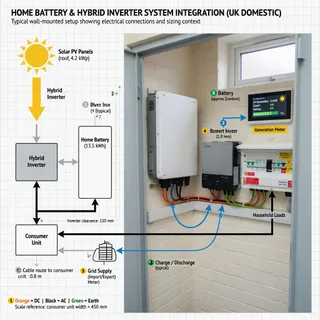
A battery added to older solar is often a different job from a battery designed with the array. An existing inverter may not accept a battery. The quote then includes a hybrid replacement or a separate AC-coupled inverter, and that hardware belongs in the installed price. Leaving it out makes the pounds per kilowatt-hour look artificially low. DC-coupled and AC-coupled designs are not the same electrical job, even when the battery cabinet looks similar.
Location changes labour, access, and sometimes how long the network application takes. It does not, by itself, change the cell price. Indoor or outdoor siting, ventilation, fire separation, and the weight of the pack can change the mounting and the cable run. A calculator that only asks for kilowatt-hours will miss those survey items. Single-phase and three-phase supplies also change the inverter choice on some homes and on small commercial sites. Storage that can export is a grid connection, not only a consumer-unit job. Ask the installer whether the proposal is a G98 notification or a G99 application, and what export limit will be commissioned. Those are Engineering Recommendations used by distribution network operators. Which route applies depends on the equipment and the local network, so the installer should say which one this design uses rather than leave it as a later surprise. The local distribution network operator’s process can change inverter settings even when the battery hardware stays the same. If you need Microgeneration Certification Scheme cover for a lender, an insurer, or a scheme, ask whether both the installer and the products are MCS certified for the work being sold. MCS status does not replace the usable-capacity figure on the datasheet, and it is not something to assume from a logo on a van. Read the current official MCS listing and the quote, not a second-hand summary of the rules.
How quote scope changes the pounds per kilowatt-hour
Two offers that both say 10 kWh can be different products and different electrical jobs. One figure may be nominal and the other usable. One quote may keep the present inverter. The other may replace it. One may be grid-tied storage only. The other may add a gateway so selected circuits can run in an outage. That last design is usually a dearer specification, and it should not be judged on storage capacity alone. The comparison below is about scope, not a price list. No current installed range is printed here, because a single column of pounds would mix jobs that are not the same product.
Overview
Do not treat a lower headline as proof that the job is simpler. Match the included list first. Only then compare the pounds per usable kilowatt-hour.
When a low cost per kilowatt-hour is the wrong decision
Cost per kilowatt-hour is a fair screen when you already export a surplus, or when you can charge from a cheaper import window and use that energy later. It is a weak screen if you have almost no surplus and no off-peak import worth storing. In that case the battery has little cheap energy to absorb, however attractive the capital figure looks.
It is also the wrong primary metric if the goal is keeping the house on during a power cut. Ordinary grid-tied storage shuts down with the grid unless the system is designed to island. That shutdown is deliberate protection, not a fault. Backup is a different specification, usually with a gateway or changeover and a defined list of circuits, and it should be priced as backup rather than as cheap storage. If the quote does not name the circuits that stay on, do not assume the kettle and the lights are covered.
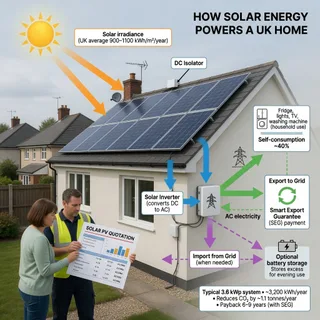
A very small battery can look expensive per kilowatt-hour and still match the roof and the evening load. A very large one can look cheap per kilowatt-hour and sit half empty for most of the year. Domestic headlines are also a poor guide for factories and farms, where storage is specified around site load, connection capacity, and operating hours rather than a home pack size. Payback is not today’s import price divided by the capital cost per kilowatt-hour. You do not save the full import rate on every stored kilowatt-hour. Round-trip losses reduce what comes back out. Storing surplus instead of exporting it gives up Smart Export Guarantee income, or whatever export payment your tariff actually pays, on the energy you keep. Days when the pack never fills reduce the value again. Tariff savings are household-specific. Warranty years are not the same as expected cycles, and a throughput limit in the small print can end cover before the calendar term if the battery is cycled hard. Read how long home batteries last against the warranty on your quote, not against a brochure for a different model.
Checks before you accept a pounds-per-kWh figure
Ask for the line items, then do the division yourself on usable capacity. The installer should be willing to show usable kilowatt-hours, continuous and peak power, and a clear included and excluded list. Scaffolding, meter tails, a consumer-unit upgrade, and a distribution network operator application are common reasons a web estimate and a survey diverge. Commissioning is part of getting the kilowatt-hours you paid for. Usable capacity set in the inverter, the export limit, and the charge windows are installer settings. If those are wrong, the advertised price per kilowatt-hour does not describe how the house will run.
Warranty cover should name the warrantor, whether the inverter shares the battery term, and whether a minimum state of charge or a throughput cap applies. A long calendar warranty with a tight throughput cap is not the same promise as a long warranty you can actually cycle. Get that in writing on the quote, not only in a brochure for a different model.
Get two or three surveys against the same usable capacity and the same backup expectation, then compare scope before you compare the resulting pounds per kilowatt-hour. If the kilowatt-hours themselves are still a guess, fix the size from your solar surplus and your evening load first. Open the current MCS listing if certification matters to you, read the VAT line against the current HMRC notice, and keep the installer’s G98 or G99 statement with the quote. Those checks age better than any national rate this page could have invented.
Plan, Compare & Buy Renewable Energy Solutions
AI does the thinking.
You get the perfect solar match.
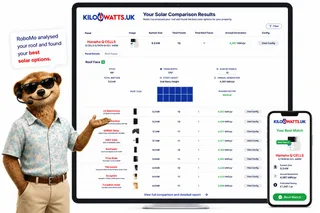
Use RoboMo™ to assess your property, compare available technologies and connect with trusted UK installers, suppliers and manufacturers.
Simply enter your postcode, drop a pin on your roof, create your free account and let RoboMo™ analyse your property to find the best solar panels for your home.

You don't have to think
RoboMo™'s AI analyses your roof and does all the hard work.

Accurate & tailored
AI-powered assessment based on your roof, location, and conditions.

Best options, maximum savings
Compare top solar panels for the best performance and value.

Simple, fast & effortless
Provide a few details, sit back and watch your results unfold.

STEP 1
Choose Home, Business or Industrial
Enter your postcode to start your assessment.
STEP 2

Drop a pin on your roof
STEP 3

Create your free account
STEP 4

Sit back and watch RoboMo™ work
RoboMo™ analyses your roof and builds your personalised solar comparison.

Kilowatts UK is an authorised representative
Flower Turbines
Compact vertical-axis turbines built for real UK sites, not just open farmland.
They start in light wind, sit in a small footprint, and are bird-safe by design. Cluster them as a bouquet and the group performs better together than the same turbines standing alone. Enter your postcode for a location-based generation estimate. Figures use area weather data and will differ if buildings, trees or hills sit in the way.
Starts in light UK wind
Built to generate in typical UK wind, not only open farmland.
Small rooftop or ground footprint
Compact towers for roofs, yards and tight sites.
Bird-safe slow rotation
Slow vertical-axis spin, bird-safe by design.
Bouquet clusters raise output
Grouped turbines outperform the same units standing alone.
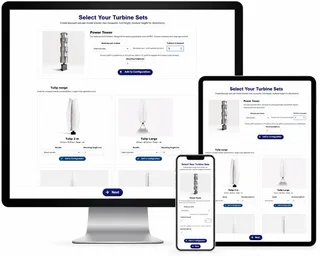
Step 1
Enter your postcode
Start designing your wind energy system in seconds.
STEP 2

Choose a location
STEP 3

Place your cluster
Tap the map where you want the turbine cluster to go.
STEP 4

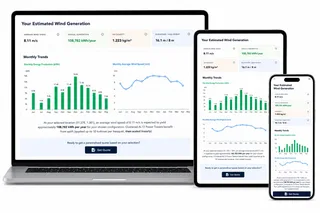
Instant generation forecasts
Compare different turbine layouts and see annual generation forecasts instantly.
STEP 5

No commitment required
Explore different configurations before deciding whether to request a quotation.
Related articles
FAQ
Need Help? RoboMo's Got Answers
Is there a single solar battery cost per kWh in the UK?
No. There is no national rate, and a web average is not the price you will be offered. The figure that matters is the surveyed installed total on your quote, divided by usable kilowatt-hours, with the same scope of hardware in every comparison. It is a screening tool for quotes, not the pence per kilowatt-hour on your electricity bill.
Should I divide the quote by nameplate or usable kWh?
Use usable capacity from the datasheet for the model on the quote if you want a fair screen. Nameplate, or nominal, capacity includes a reserved slice that protects the cells and is not energy you can shift into the evening. Dividing the same total by a smaller usable figure gives a higher pounds-per-kWh result even though the hardware has not changed. Do not treat a salesperson’s rounded kilowatt-hour as the warranted usable capacity.
Why can two 10 kWh quotes have very different costs per kWh?
The same headline capacity can hide different products and different electrical jobs. One figure may be nominal and the other usable. One quote may keep the present inverter, while another replaces it or adds a backup gateway and extra electrical work. Match the included list first, then compare pounds per usable kilowatt-hour.
What should a surveyed battery quote include before I divide by kWh?
The total should show the battery, any hybrid or replacement inverter the job needs, and a gateway or changeover if backup is specified. It should also show labour, the cable route, containment, commissioning, and VAT as its own line. Electrical upgrades, access, scaffolding, and any distribution network operator application should be inside the price or listed as exclusions. Leaving hardware out makes the pounds per kilowatt-hour look artificially low.
Does a low cost per kWh mean the battery is a good buy?
Not always. Cost per kilowatt-hour is a fair screen when you already export a surplus, or when you can charge from a cheaper import window and use that energy later. It is a weak screen if you have almost no surplus and no off-peak import worth storing. A very small pack can look expensive per kilowatt-hour and still match the roof and evening load, while a very large one can look cheap and sit half empty for much of the year.
Does cost per kWh tell me whether the battery will run the house in a power cut?
No. Ordinary grid-tied storage shuts down with the grid unless the system is designed to island, and that shutdown is deliberate protection rather than a fault. Backup is usually a dearer specification, with a gateway or changeover and a defined list of circuits. If the quote does not name the circuits that stay on, do not assume the kettle and the lights are covered.
Can I assume a grant or zero-rated VAT will cut the cost per kWh?
No. Grants and VAT treatment are not a national discount you can assume. Read the VAT line against the current HMRC notice covering energy-saving materials, and do not assume a zero rate still applies, or that it applies to a supply-only purchase or a commercial site. If a grant is mentioned, it should name a live scheme the installer has checked for your property. An old article is not that check.
What else should I check before accepting a pounds-per-kWh figure?
Ask for usable kilowatt-hours, continuous and peak power, and a clear included and excluded list, then do the division yourself. Power rating decides whether the stored energy is useful: kilowatt-hours are how much is stored, and kilowatts are how fast the battery can charge or discharge. Also ask whether the design is a G98 notification or a G99 application, what export limit will be commissioned, and whether MCS cover is required for a lender, insurer, or scheme. Read warranty terms on the quote, including throughput caps, rather than treating calendar years as guaranteed cycles.