


How much does 32 kwh battery price cost in the UK?
Published: 2026-10-14 02:59:15
Updated: 2026-10-14 04:46:25
A 32 kWh battery price in the UK depends on quote scope, not a national rate. Check usable energy, continuous power and what the installer excludes.
How much does 32 kwh battery price cost in the UK?
Find out 3.5 kwh battery price in the UK, including costs, what affects price, and how to choose an installer.
What a 32 kWh home battery costs in the UK
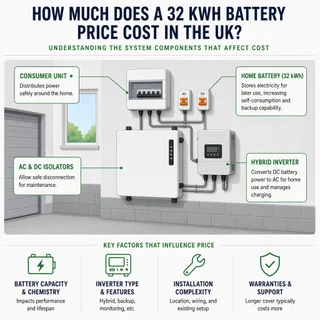
A 32 kWh home battery cost in the UK is not one product and not one pound figure. It can mean a stack of modules, a single cabinet, a battery plus inverter, or a fully installed and commissioned system. Those offers are not interchangeable. No national installed price is stated here, because an unsourced range would mix unlike quotes. The only figure worth using is a dated quote that names the scope, whether 32 kWh is nameplate or usable, the continuous power in kW, and what is excluded.
The 32 kWh figure is stored energy, not power. It is not 32 kW. Energy is how much electricity the unit can hold. Power is how fast it can charge or discharge, and that is set by the inverter and the battery’s discharge rating. Reserve settings, temperature and the battery management system can still cut what the house can draw even when the brochure already says “usable”. At this size you are usually looking at a multi-module stack or a larger cabinet, not a compact unit for light evening use.
Treat a shelf price and an installer quote as different offers. Online listings and commissioned installs diverge with brand, stock, labour, supply type and the electrical work the property needs. A low module price that omits the inverter, cable run, gateway or consumer-unit work is not comparable with a turnkey price.
Why hardware listings and installed prices diverge
Installed cost is not the module price. Inverter or hybrid-inverter hardware, isolators, containment, electrical labour, commissioning and any remedial work sit on top. Whether the quote is ex-VAT hardware, inc-VAT hardware, or installed and commissioned changes the number before the cells do. Ask for the quote date as well as the scope. Hardware listings move with stock, and an old screenshot is not a price you can hold an installer to.
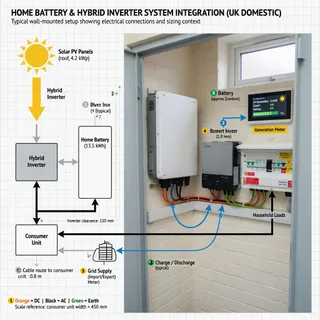
Coupling is the first split on site. A DC-coupled battery on an existing hybrid inverter is a different job from an AC-coupled battery with its own inverter. At this capacity the inverter is often large enough that cable size, route length and voltage drop matter, not just a run to the garage. Spare ways in the consumer unit, earthing, meter position and whether the unit is indoors or outdoors all change labour. A house with a plant room and a short route is a different job from a flat, a listed building, a long cable route, or a board that has to be replaced.
VAT should be read from HMRC, not from an advert. GOV.UK and HMRC guidance on energy-saving materials sets out when battery storage installed in residential accommodation in Great Britain is relieved, including battery storage added to that list for qualifying installs. Battery-only work and battery-with-solar work both need checking against that current notice, because eligibility, the rate and any end date are not sales claims. Northern Ireland does not automatically follow the Great Britain treatment, and non-residential buildings usually sit outside the residential relief. Any grant or scheme value, if one applies at all, belongs on the official scheme page for that date, not on the hardware sticker. Import and export tariffs change what shifting a large block of energy is worth. They do not fix the hardware price. Warranty length, warranted throughput, round-trip efficiency and whether cells are serviceable affect lifetime cost more than the headline kWh. Those figures belong to a named model, not to “32 kWh” as a class.
Stack versus cabinet, power and the connection class
A 32 kWh offer is usually either several modules on one battery management system or one heavier cabinet. Those are not the same install. A stack can be built from smaller modules, sometimes added in stages, but only if the brand, the BMS and the inverter still have headroom. A cabinet may be simpler to commission and harder to expand. Both can weigh enough that floor loading, wall fixing and delivery access are design items, not afterthoughts. A cheap stack that will not fit the only place you can legally and safely put it is not cheaper once the location has to change.
Continuous power is the limit people miss. A large store on a modest inverter can take many hours to empty and may still refuse a heat pump, an oven and an EV charger at once. Reading 32 kWh as “32 kilowatts for the house” mixes capacity and power. Whole-board backup is a further line item: a gateway or backup circuit, a decision about which loads are on that circuit, and often a lower power cap in island mode. It is not included because the capacity looks large.
The connection class follows inverter rated power, export limit and generation already on site, not the kWh label. In Great Britain the usual routes are the ENA Engineering Recommendations: G98 for smaller equipment within the per-phase limit, often treated as a notification, and G99 where the equipment or the site total needs an application before connection. Inverters paired with a store of this size are often well above a small G98 unit, especially once existing solar is counted, so many of these jobs are G99 applications with an agreed export limit. The distribution network operator for the postcode confirms the path. A single-phase house may also be constrained by the cut-out and the spare capacity. Three-phase supplies, common on larger homes, workshops and farms, are a different board, a different inverter and a different application. Do not assume a battery this large can be added with no checks, and do not assume every house can host the inverter power that would make 32 kWh useful. Placement is model-specific and stricter at this size. Manufacturer instructions and current UK guidance on residential storage cover indoor or outdoor rating, clearance, escape routes and separation from sleeping accommodation. Flats and listed buildings often fail on weight, landlord consent or fire strategy before they fail on price. A grey-import unit can look cheaper and still be unusable if it lacks the type-test evidence the DNO process expects, or if the manufacturer will not warrant a UK install. An MCS battery installation is a separate quality and paperwork route some owners want. It is not the same thing as DNO approval, and it does not set the price.
Who a 32 kWh battery suits, and who it does not
This class can suit a high-use home, a house with solar that regularly has surplus, or a household whose goal is shifting a large block of import around a heat pump or an EV. It can also suit a small commercial site that wants a defined store, not site-wide backup. It is a poor fit if measured evening and overnight use is only a small slice of 32 kWh, if the only aim is the lowest price per kilowatt-hour, or if the hope is several days of heating cover. A heat pump in cold weather and an EV on a fast charger can each draw hard. 32 kWh may cover a useful part of that, not an open-ended outage.
A smaller expandable stack can be the better buy when the platform truly allows later modules and your logged use does not need 32 kWh now. Adding modules later is not free capacity. It can mean a second visit, a revised connection check and an inverter that is already at its limit. Businesses with three-phase supplies are not automatically in class either. A 32 kWh unit can be a minor add-on on a high-demand site, or the whole project on a small one. The supply, the inverter kW and the load profile decide that, not the label.
Before you lock a size, compare a few weeks of import and any solar surplus with the store, rather than treating 32 kWh as a default. The home battery size guide is a better starting point than a capacity chosen because it sounds like whole-home cover.
How to read a 32 kWh quote without a national price
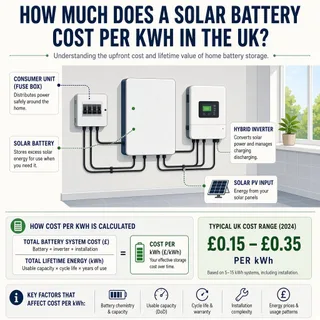
There is no reliable single UK installed price to publish for this capacity. Use the quote’s scope, date, usable energy and continuous power, not a headline rate per kWh, to judge whether a figure is realistic.
Overview
Ask whether 32 kWh is nameplate or usable, and ask for continuous kW as well as peak. Ask what is excluded: inverter, backup gateway, cable run, consumer-unit or three-phase board work, access and any supply upgrade. If two quotes differ, check brand, warranty throughput, indoor or outdoor rating, and whether the price assumes solar is already on site. A product listing is not the same offer as an installer-commissioned system. Generic claims of a 10–15 year life are unverified unless they are tied to that model’s warranty.
What to confirm before you accept a price
Get at least two quotes on the same scope: installed and commissioned, with usable energy, continuous power and the quote date written down. If the platform cannot be expanded and your logged use is far below this capacity, ask for a smaller stack priced the same way before you decide. A competent installer should also say where the unit can physically go, what temperature range it needs, whether the supply is single-phase or three-phase, and what happens to warranty and connection approval if the model changes.
If the quote cannot separate those items, it is not yet a price you can compare.
Plan, Compare & Buy Renewable Energy Solutions
AI does the thinking.
You get the perfect solar match.
Use RoboMo™ to assess your property, compare available technologies and connect with trusted UK installers, suppliers and manufacturers.
Simply enter your postcode, drop a pin on your roof, create your free account and let RoboMo™ analyse your property to find the best solar panels for your home.

You don't have to think
RoboMo™'s AI analyses your roof and does all the hard work.

Accurate & tailored
AI-powered assessment based on your roof, location, and conditions.

Best options, maximum savings
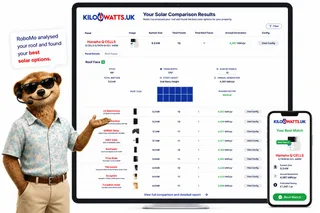
Compare top solar panels for the best performance and value.

Simple, fast & effortless
Provide a few details, sit back and watch your results unfold.
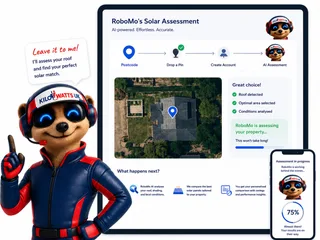
STEP 1
Choose Home, Business or Industrial
Enter your postcode to start your assessment.
STEP 2

Drop a pin on your roof
STEP 3

Create your free account
STEP 4

Sit back and watch RoboMo™ work
RoboMo™ analyses your roof and builds your personalised solar comparison.

Kilowatts UK is an authorised representative
Flower Turbines
Compact vertical-axis turbines built for real UK sites, not just open farmland.
They start in light wind, sit in a small footprint, and are bird-safe by design. Cluster them as a bouquet and the group performs better together than the same turbines standing alone. Enter your postcode for a location-based generation estimate. Figures use area weather data and will differ if buildings, trees or hills sit in the way.
Starts in light UK wind
Built to generate in typical UK wind, not only open farmland.
Small rooftop or ground footprint
Compact towers for roofs, yards and tight sites.
Bird-safe slow rotation
Slow vertical-axis spin, bird-safe by design.
Bouquet clusters raise output
Grouped turbines outperform the same units standing alone.

Step 1
Enter your postcode
Start designing your wind energy system in seconds.

STEP 2

Choose a location
STEP 3

Place your cluster
Tap the map where you want the turbine cluster to go.
STEP 4

Instant generation forecasts
Compare different turbine layouts and see annual generation forecasts instantly.
STEP 5

No commitment required
Explore different configurations before deciding whether to request a quotation.
Related articles
FAQ
Need Help? RoboMo's Got Answers
How much does a 32 kWh home battery cost in the UK?
There is no single national installed price for a 32 kWh home battery. The figure can mean modules only, a cabinet, a battery plus inverter, or a fully installed and commissioned system, and those offers are not interchangeable. A usable figure is a dated quote that names the scope, whether 32 kWh is nameplate or usable, the continuous power in kW, and what is excluded.
Is 32 kWh the same as 32 kW of power for the house?
No. 32 kWh is stored energy, not the rate at which the battery can charge or discharge. Power is set by the inverter and the battery’s discharge rating, so a large store on a modest inverter can take many hours to empty and may still refuse several heavy loads at once. Reserve settings, temperature and the battery management system can also cut what the house can draw.
Why do online hardware prices differ from installer quotes?
A shelf or listing price often omits the inverter, cable run, isolators, consumer-unit work, labour and commissioning. Installed cost also depends on brand, stock, supply type, route length and whether the job is DC-coupled to an existing hybrid inverter or AC-coupled with its own inverter. Ask whether the quote is ex-VAT hardware, inc-VAT hardware, or installed and commissioned, and keep the quote date.
Does VAT relief apply to a 32 kWh battery install?
VAT treatment should be read from current HMRC and GOV.UK guidance on energy-saving materials, not from an advert. That guidance sets out when battery storage installed in residential accommodation in Great Britain can be relieved, including battery-only and battery-with-solar work. Northern Ireland does not automatically follow the Great Britain treatment, and non-residential buildings usually sit outside the residential relief. Any grant or scheme, if one applies, belongs on the official scheme page for that date.
Will a 32 kWh battery need DNO approval?
Connection follows inverter rated power, export limit and generation already on site, not the kWh label. In Great Britain the usual routes are the ENA Engineering Recommendations: G98 for smaller equipment within the per-phase limit, often treated as a notification, and G99 where the equipment or the site total needs an application before connection. Inverters paired with a store of this size are often above a small G98 unit, especially once existing solar is counted, so many jobs are G99 applications with an agreed export limit. The distribution network operator for the postcode confirms the path, and a single-phase cut-out may also constrain the job.
Who is a 32 kWh battery a good fit for?
It can suit a high-use home, a house with solar that regularly has surplus, or a household shifting a large block of import around a heat pump or an EV. It is a poor fit if measured evening and overnight use is only a small slice of 32 kWh, if the only aim is the lowest price per kilowatt-hour, or if the hope is several days of heating cover. Compare a few weeks of import and any solar surplus with the store before treating 32 kWh as a default.
Does a large battery include power-cut backup, and is MCS the same as DNO approval?
Whole-board backup is a further line item: a gateway or backup circuit, a decision about which loads are on that circuit, and often a lower power cap in island mode. It is not included just because the capacity looks large. An MCS battery installation is a separate quality and paperwork route some owners want. It is not the same thing as DNO approval, and it does not set the price.
What should I check before accepting a 32 kWh quote?
Get at least two quotes on the same scope: installed and commissioned, with usable energy, continuous power and the quote date written down. Confirm whether 32 kWh is nameplate or usable, whether the supply is single-phase or three-phase, and what is excluded, including inverter, gateway, cable run, board work, access and any supply upgrade. Also check weight, fixing, indoor or outdoor rating, clearances and fire-separation rules for that model, and whether the same brand, BMS and inverter have headroom if you plan to add modules later.