


How much does solar battery price per kwh cost in the UK?
Published: 2026-10-14 03:14:48
Updated: 2026-10-14 04:46:37
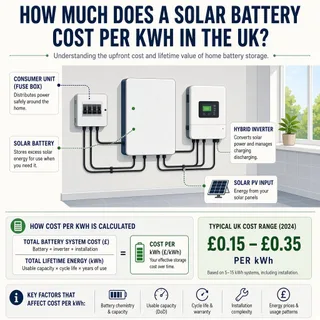
No single UK solar battery price per kWh exists. Divide matched supply-and-fit by usable kWh, not nameplate, and keep inverters and extras out.
How much does solar battery price per kwh cost in the UK?
Find out solar battery price per kwh in the UK, including costs, what affects price, and how to choose an installer.
Solar battery cost per kWh in the UK: how to compare quotes
A solar battery price per kWh is a quote total divided by storage capacity. In the UK there is no single installed figure that fits every home, so this page is a quote-comparison guide, not a price index. Compare supply and fit of the matched storage scope, divided by usable kWh, with the VAT treatment stated. A nameplate label, a product-only shelf price, or an inverter folded into the cells will flatter the number. Coupling, cable routes, and warranty limits change the job. The method is for screening quotes. It is not a tariff, a grant, or a promise of bill savings.
No dated national band is published here. Wholesale modules, labour, and tax treatment move, and an undated "from" price is advertising. Date the quotes you are comparing, and do not treat a stale article figure as the price an installer should match.
Why dividing by the label flatters the quote
Nominal, or nameplate, capacity is the size printed on the battery. Usable capacity is what the system is allowed to charge and discharge after the depth-of-discharge limit and any reserve left for battery health or backup. Dividing the same pounds by nameplate kWh makes the system look cheaper than dividing by the energy the household can actually cycle.
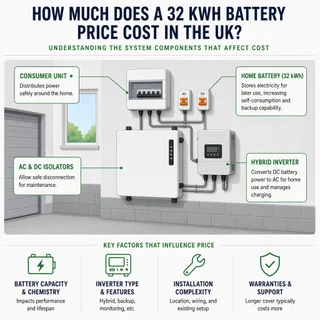
Scope creates the same distortion. One installer may price a battery module only. Another may include supply and fit, a hybrid inverter, cabling, consumer-unit work, and commissioning. Those totals are not the same product, so they must not be ranked as if the kilowatt-hour were identical.
Fixed labour does not shrink in proportion to a small battery. Design, the visit, testing, and network notification still happen, so a modest usable capacity often looks expensive per kWh even when the cell price is ordinary. A larger pack can look cheaper per kWh until a second inverter, a gateway, or a longer cable run appears. Two batteries with the same label can also differ in continuous kilowatts, which is a power limit, not a capacity limit.
What solar battery price per kWh should include
Ask for the line that will be divided, and the kWh that will divide it, before you compare installers. A fair screening price is supply and fit of the storage equipment the household will actually use, on usable kWh, with extras called out rather than smeared into the cells. Put both quotes on the same VAT basis, either both including VAT or both excluding it. Scaffolding is rarely a battery-only cost, but it can appear if solar is being altered at the same time. Do not let a solar access cost masquerade as storage. If one installer will not separate the lines, do not force that quote into the same ranking as a clean storage scope.
A labelled example using matched supply and fit
The pounds in this section are placeholders so the arithmetic can be checked. They are not a UK installed rate, not a budget, and not a figure to show an installer. They only show why the divisor and the scope change the answer.
Take illustration quote A. Matched storage supply and fit is £4,500. Nameplate capacity is 10 kWh and usable capacity is 9 kWh. Divided by the label, £4,500 / 10 is £450 per nameplate kWh. Divided by usable energy, £4,500 / 9 is £500 per usable kWh. The £50 gap is not a discount. It is the flattery from using energy the battery is not set up to cycle. If a £1,800 hybrid inverter is folded into the same £4,500, the bundle is £6,300. That is £630 per nameplate kWh, or £700 per usable kWh, and neither number is a storage price.
Illustration quote B has the same 9 kWh usable, so the divisor matches, and a matched storage line of £5,400. That is £5,400 / 9, or £600 per usable kWh. On this screen B looks dearer than A by £100 per usable kWh. That ranking is only fair if coupling, backup, consumer-unit work, and earthing sit outside both storage lines. If B's £5,400 quietly includes a gateway and A's £4,500 does not, the gap is scope, not a cheaper cell.
When a lower price per kWh is the worse buy
A lower unit rate is not automatically the better system. A cheap nameplate kilowatt-hour with a low usable fraction, a short warranty, or no installation can cost more once it is commissioned and limited to real discharge. Package maths that divides a bundled inverter by nameplate kWh has the same flattering effect as the illustration above.
Price per kWh is also not savings per kWh. What you avoid paying depends on the import rate, any export rate, whether the battery fills from solar or from a cheap overnight window, and whether it is empty before the next charge. A large battery with an attractive unit rate can still be poor value if it rarely cycles.
Many UK systems are not solar-only. They charge from the grid on a time-of-use tariff as well as from the roof. Judging size only against summer solar export misstates both utilisation and a fair capacity. Sizing should follow evening and overnight load, not the cheapest pound per kilowatt-hour on a shortlist. The practical check is in the UK home battery size guidance, which is about matching usable energy to use, not about chasing a unit rate.
How AC-coupled and hybrid installs change the figure
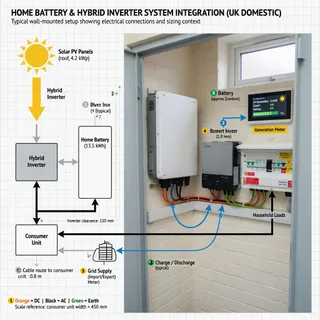
Coupling is a price issue, not a footnote. An AC-coupled battery sits beside an existing solar inverter and often needs its own power electronics, metering, and sometimes a gateway. A new hybrid, or DC-coupled, arrangement shares the solar inverter, so the battery line and the solar line of the quote move together. Comparing an AC add-on unit rate with a hybrid replacement unit rate mixes two projects. Replacing a working inverter can also interact with the existing solar warranty and with generation metering. That belongs on the quote as its own assumption.
Which connection process applies is not decided by the battery's kilowatt-hour label. The Energy Networks Association publishes Engineering Recommendation G98 for fully type-tested generation up to 16 amps per phase, Engineering Recommendation G99 where the equipment falls outside G98, and Engineering Recommendation G100 where a customer export-limitation scheme is used. Sixteen amps per phase is often discussed as about 3.68 kW on a 230 V single-phase supply. That is a connection threshold for the generating equipment, not a battery size limit. The distribution network operator applies the current documents to the inverter ratings and the export arrangement on that supply.
A battery added beside an existing inverter can change the combined generation the operator sees. A quote that assumes a straightforward notification can grow if the existing inverter cannot work with the new equipment, if export limitation is required, or if a G99 offer includes commissioning that needs a witness test. Single-phase and three-phase supplies change the equipment list as well. Take the process from the current operator and those ENA recommendations, not from a price table. Location matters on the day. Installers commonly work to BS 7671 and the IET Code of Practice for Electrical Energy Storage Systems, plus the manufacturer's clearances. A garage with a short, accessible cable route is a different labour job from a loft, an outside enclosure, or a flat and terrace with a long run and awkward fire separation from living space and escape routes. Temperature in a loft can also derate output. Those costs belong in the visit price. They should not be used to declare one battery chemistry cheaper than another.
Warranty years, cycles and a rough cost per warranted kWh
Installers specify usable energy and continuous power in kilowatts, not kWh alone. A strong unit rate with a low continuous output may not cover a kettle, an oven, and a heat pump at the same time. Peak power and continuous power should sit beside usable kWh. If they are missing, the unit rate is not ready to judge. Round-trip efficiency is also outside the price metric. It affects how many imported or generated kilowatt-hours you get back, and it belongs on the datasheet for the model being quoted.
Warranties are usually a mix of calendar years and a throughput or cycle cap, with a stated capacity retention at the end of the term. Read those figures from that product's warranty. A rough screen for warranted throughput is storage scope divided by usable kWh, times equivalent full cycles, times an average capacity fraction. If retention falls in a straight line from full usable capacity to the end-of-term figure, the average fraction is those two percentages added and halved. It is a screening approximation, not a degradation model. Temperature, charge rate, and partial cycles sit outside it.
Using the same placeholders as before, quote A is £4,500 for 9 usable kWh, with a stand-in warranty of 10 years, 3,000 equivalent full cycles, and 70% retention at the end. The average fraction is (100% + 70%) / 2, which is 0.85. Warranted throughput is about 9 × 3,000 × 0.85, or 22,950 kWh. Then £4,500 / 22,950 is about 20 pence per warranted kWh of throughput, in this illustration only. Quote B at £5,400 for the same 9 usable kWh is dearer per usable kWh, at £600 rather than £500. If its stand-in warranty is 10 years, 6,000 cycles, and the same 70% retention, throughput is about 45,900 kWh, and £5,400 / 45,900 is about 12 pence per warranted kWh. The cheaper unit rate is not the cheaper warranty screen. The calendar cap can bind first. At one full cycle a day, 3,000 cycles is a little over eight years, so a 10-year calendar term may never be reached. At 200 full cycles a year, the same 3,000-cycle cap lasts 15 years, so the 10-year term binds first and the extra cycle allowance on quote B may never be used. A lower £ per usable kWh with an earlier throughput limit can therefore be dearer per warranted kilowatt-hour cycled, or it can be irrelevant if the household will not cycle enough to meet the cap.
VAT treatment and MCS paperwork
VAT on a domestic battery is a quote fact, not a rate to copy from an older article. HMRC's VAT Notice 708/6 is the guidance on energy-saving materials and heating equipment. In Great Britain, a temporary zero rate has applied to qualifying installations in residential accommodation, and electrical battery storage has been brought within that energy-saving materials list. The published end date, what counts as an installation rather than a supply-only sale, and the Northern Ireland position belong on the current notice. The installer should state the rate, the basis for it, and whether Great Britain or Northern Ireland rules are being applied. If the quote is silent, ask before you divide.
The Microgeneration Certification Scheme is an installer and product certification scheme. Some finance products, and eligibility under Ofgem's Smart Export Guarantee rules, can turn on certified installation. Check the current Ofgem position and the supplier's terms if export income is part of the decision. An MCS certificate is not itself a grant, a loan, or a tariff, and it does not fix a pound per kWh. If a salesperson treats the paperwork as a saving, ask which live scheme rule they are relying on.
Who should not screen quotes on a domestic unit rate
The metric suits homeowners and small non-domestic sites comparing the same usable kWh, the same coupling, and the same electrical scope. It is a screening step before warranty, throughput, and inverter compatibility. It is a weak guide if night-time load is small, solar is limited, or there is no cheap import window, because utilisation dominates whether storage earns its keep.
It is also a poor guide when the quote is really an electrical upgrade, a three-phase hybrid replacement, or a backup install. Backup gateways and critical-load boards add cost that should stay visible. Folding that cost into the storage unit rate makes the backup option look unfairly expensive as storage, and the simple battery look unfairly cheap as resilience.
Farms, factories, and other larger sites should not borrow a domestic headline. Commercial and containerised storage is priced on a different scope, often with different connection costs. This article does not set those ranges. If the project is really about connection capacity or process load, start with the load profile and the network application, not a home unit-rate screenshot.
How to line up installer quotes
Collect two or three quotes that state usable kWh, continuous kilowatts, coupling type, and whether backup is included. Ask each installer to split storage supply and fit from inverter or gateway costs and from consumer-unit or earthing extras. Then divide only the matched storage scope by usable kWh, on the same VAT basis, and note the quote date. Repeat the warranty screen with the cycle cap and end-of-term retention from that product, not from a generic claim about lithium batteries. If the lines are still unclear, book a free home energy survey.
Price per kWh will not tell you the right size or the payback. Measure evening and overnight use, note whether you can charge overnight on your tariff, and only then decide whether a larger pack's lower unit rate is capacity you will use. If the quotes still disagree after the scope is aligned, the gap is usually power electronics, warranty, or site work, not a secret discount on cells.
Plan, Compare & Buy Renewable Energy Solutions
AI does the thinking.
You get the perfect solar match.
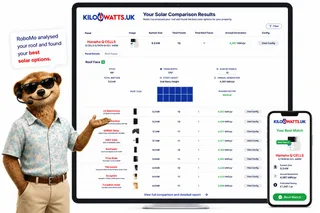
Use RoboMo™ to assess your property, compare available technologies and connect with trusted UK installers, suppliers and manufacturers.
Simply enter your postcode, drop a pin on your roof, create your free account and let RoboMo™ analyse your property to find the best solar panels for your home.

You don't have to think
RoboMo™'s AI analyses your roof and does all the hard work.

Accurate & tailored
AI-powered assessment based on your roof, location, and conditions.

Best options, maximum savings
Compare top solar panels for the best performance and value.

Simple, fast & effortless
Provide a few details, sit back and watch your results unfold.

STEP 1
Choose Home, Business or Industrial
Enter your postcode to start your assessment.
STEP 2

Drop a pin on your roof
STEP 3

Create your free account
STEP 4

Sit back and watch RoboMo™ work
RoboMo™ analyses your roof and builds your personalised solar comparison.

Kilowatts UK is an authorised representative
Flower Turbines
Compact vertical-axis turbines built for real UK sites, not just open farmland.
They start in light wind, sit in a small footprint, and are bird-safe by design. Cluster them as a bouquet and the group performs better together than the same turbines standing alone. Enter your postcode for a location-based generation estimate. Figures use area weather data and will differ if buildings, trees or hills sit in the way.
Starts in light UK wind
Built to generate in typical UK wind, not only open farmland.
Small rooftop or ground footprint
Compact towers for roofs, yards and tight sites.
Bird-safe slow rotation
Slow vertical-axis spin, bird-safe by design.
Bouquet clusters raise output
Grouped turbines outperform the same units standing alone.

Step 1
Enter your postcode
Start designing your wind energy system in seconds.

STEP 2

Choose a location
STEP 3

Place your cluster
Tap the map where you want the turbine cluster to go.
STEP 4

Instant generation forecasts
Compare different turbine layouts and see annual generation forecasts instantly.
STEP 5

No commitment required
Explore different configurations before deciding whether to request a quotation.
Related articles
FAQ
Need Help? RoboMo's Got Answers
What does solar battery price per kWh mean in the UK?
It is a screening figure: a stated quote total divided by a stated storage capacity. There is no single installed pound-per-kWh that fits every UK home, and this article does not publish a national price band. Date the quotes you compare, and do not treat an undated article figure as a price an installer should match.
Should I divide by nameplate kWh or usable kWh?
Use usable kWh, which is the energy the system is allowed to charge and discharge after depth-of-discharge limits and any reserve for battery health or backup. Nameplate, or label, capacity is larger, so dividing the same pounds by the label makes the battery look cheaper. Two batteries with the same label can also differ in continuous power, which is a kilowatt limit, not extra storage.
What should a fair solar battery price per kWh include?
Ask which line will be divided and which kWh will divide it. A fair screen uses supply and fit of the storage the household will actually use, on usable kWh, with both quotes on the same VAT basis. Keep hybrid inverters, backup gateways, consumer-unit work, earthing and long cable runs visible as their own lines, and do not treat scaffolding for solar access as a battery cost.
Is a lower price per kWh always the better buy?
No. A cheap nameplate rate with a low usable fraction, a short warranty, or no installation can cost more once the system is commissioned and limited to real discharge. Price per kWh is also not savings per kWh. What you avoid paying depends on import and export rates, whether the battery fills from solar or a cheap overnight window, and whether it is actually cycled.
How do AC-coupled and hybrid installs change the figure?
An AC-coupled battery sits beside an existing solar inverter and often needs its own power electronics, metering and sometimes a gateway. A hybrid, or DC-coupled, arrangement shares the solar inverter, so the battery line and the solar line move together. Comparing those unit rates mixes two projects. Connection steps depend on inverter ratings and the export arrangement, not on the battery’s kilowatt-hour label, so take the process from the current operator and the relevant Energy Networks Association recommendations.
How should warranty years and cycles affect the comparison?
Read usable energy, continuous power, cycle or throughput caps, calendar years and end-of-term capacity retention from the product warranty being quoted. A rough screen is storage scope divided by usable kWh, then set against equivalent full cycles and an average capacity fraction. It is only an approximation. The calendar cap can bind before the cycle cap if the household does not cycle often enough, so a lower pound per usable kWh is not automatically cheaper per warranted kilowatt-hour.
How should VAT and MCS paperwork be treated?
VAT is a quote fact. Ask the installer to state the rate, whether the job is an installation or a supply-only sale, and whether Great Britain or Northern Ireland rules apply, rather than copying a rate from an older article. MCS is an installer and product certification scheme. It is not itself a grant, a loan or a tariff, and it does not fix a pound per kWh. If export income matters, check the current Ofgem position and the supplier’s terms.
Who should not rely on a domestic price per kWh?
The metric suits homeowners and small sites comparing the same usable kWh, coupling and electrical scope. It is a weak guide if night-time load is small, solar is limited, or there is no cheap import window, because utilisation decides whether storage earns its keep. It is also a poor guide for backup installs, three-phase hybrid replacements and larger commercial or farm projects, which should start from the load profile and the network application rather than a home unit rate.