


What a UKPN grid connection for Kent solar means
Published: 2026-10-06 03:31:04
Updated: 2026-10-05 20:32:07
A UKPN grid connection for Kent solar is G98 or G99 permission to run in parallel, not a tariff or planning decision. Check the DNO, MPAN and export cap.
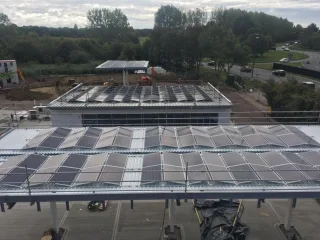
UKPN grid connection for Kent solar
UKPN grid connection for Kent solar from Kilowatts.uk in Broadstairs. Costs, roofs, planning and what to do next then compare a local system.
What a UKPN grid connection for Kent solar means
A UKPN grid connection for Kent solar is permission to run a generator in parallel with the local distribution network. For most of Kent that operator is UK Power Networks, not the transmission system operator. The approval is not a Smart Export Guarantee contract, a planning decision, or Building Regulations sign-off.
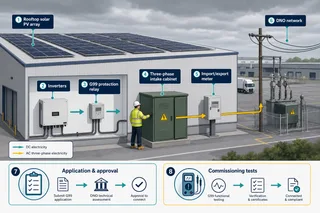
The route depends on the postcode and MPAN, the inverter rating per phase, any generation already on the same supply, and whether the local cable and transformer can take the proposed export. A typical single-phase home often sits near the G98 band of 16 A per phase, about 3.68 kW at 230 V. On a three-phase supply the same 16 A per phase band is about 11.04 kW at 230 V. A battery inverter or an existing array can still push the job into G99. For a Kent home solar job, that check comes before anyone treats a quote as a connection offer.
The technical rules sit in the current issues of ENA Engineering Recommendation G98 and G99, and in G100 where an export limitation scheme is used, as applied through UK Power Networks’ generation connection guidance. Ofgem’s Smart Export Guarantee guidance covers the export contract only. Use the latest issue from the publisher, not a PDF saved from a previous job. In practice the installer submits the technical record. Your job is to confirm who the DNO is, keep the MPAN and address consistent, and not treat a quote that assumes unrestricted export as a connection offer.
Check that UK Power Networks is actually your DNO
County boundaries do not decide the network operator. Most of Kent is in the UK Power Networks area, covering much of London, the East of England and the South East, but a border supply or an independent distribution network on a newer estate is not UKPN merely because the postal county is Kent. A postcode lookup matched to the MPAN is the check that matters before anyone quotes a G98 or G99 route.
If the supply is not UKPN, forms sent to UK Power Networks will not create a valid connection. The same applies the other way. A national overview of the grid does not tell an installer in Maidstone, Broadstairs, Dover, Canterbury or Medway which process applies to that cut-out. The town is a clue, not a determination.
Ask the installer to record the MPAN, supply phase and DNO name on the quote. If those three items are missing, the connection assumption in the price is still a guess.
When a Kent home solar job is G98 or G99
Engineering Recommendation G98 covers small, fully type-tested generation, most often judged at 16 A per phase. At 230 V that is about 3.68 kW on a single-phase supply and about 11.04 kW across three phases, still at 16 A on each phase. The usual path in that band is connect and notify, not a full application before the panels are fitted. G98 is still a standard. The equipment has to be type-tested, commissioned to the right settings, and notified. It is not an absence of permission.
The three-phase figure is not permission to put the whole rating on one phase. A single-phase inverter on a three-phase service is still assessed on the phase it uses. Existing generation on the same MPAN counts as well. The DNO looks at inverter nameplate and what is already connected, not panel kilowatt-peak alone. A larger DC array behind a 3.68 kW inverter is a different proposal from a larger inverter. An AC-coupled battery adds another inverter. A hybrid inverter can change the aggregated capacity even if the new panels look modest.
G99 applies when the plant does not fit that band. Higher inverter capacity, several devices whose combined rating exceeds 16 A per phase, or equipment that is not fully type-tested normally need an application before the system is connected. Connecting a G99-scale system first and filing afterwards is not a shortcut. A fast-track G99 path can exist where the current UK Power Networks form and the current issue of EREC G99 allow a shorter route for some fully type-tested plant above the G98 band. A full application is the route when the live form says so, when the equipment is not fully type-tested, or when capacity sits outside the fast-track limits published in those documents. Those limits change between issues. Take them from the form you are about to submit, not from memory of a previous Kent job. Treat fast-track as a shorter application, not as the G98 sequence under another name.
Who submits the UKPN connection for a Kent home
The installer normally submits the technical record, because the ENA type-test reference, protection settings and single-line diagram sit with the designer, not on a household bill. You may be asked to authorise that submission. The connection is still about your supply, so the MPAN, site address and inverter model on the form should match what will actually be commissioned.
Do not file a notification yourself for a different inverter from the one on the roof, and do not let a sales quote stand in for the form. If you already have solar or a battery, give the installer the earlier MCS certificate and any DNO letter before they choose G98 or G99. Adding a second inverter to an old notification is a new aggregation, not a minor extra. That choice is the same G98 or G99 judgement set out above, not a separate courtesy email.
You should be copied on what is sent. After commissioning, the serial numbers on the DNO record, the MCS certificate and any later export-tariff application need to be the same, or the records will not match when a supplier checks them.
Can the system be connected before a G99 offer
Only a plant that still fits G98 after aggregation follows the usual connect-and-notify sequence, and even then the notification and commissioning settings are part of the standard. If the aggregated inverter rating is outside that 16 A per phase band, do not connect and hope the paperwork catches up.
Where a fast-track G99 option appears on the live UK Power Networks form, read that form for whether a response is required before connection. Do not infer the sequence from a neighbour’s install or from an older issue of G99. A full G99 application is clearer still. The connection offer comes before parallel operation. Energising first is not a way to shorten the wait.
If two installers disagree, ask which ratings they added together and whether they assumed they could energise before an offer. That is often the real difference between quotes, not the panel brand. It is worth taking time to compare home solar options on the connection assumption, not only on the kit list.
How an export limit differs from the system you buy
Export limitation, often set out under ENA Engineering Recommendation G100, caps what may be sent out to the network. It is not the array size and it is not the inverter nameplate. An export cap does not, by itself, stop the home using solar behind the meter. The inverter can still supply the house. What it cannot do is push more than the agreed limit out through the meter. Surplus that the house and any battery cannot take is curtailed rather than exported, including where the offer is a zero-export condition.
UK Power Networks assesses voltage rise on the local cable and transformer. A roof that is fine for the house can still be offered only with an export cap, a smaller inverter, or network works. If a limit is part of the offer, the scheme has to be set, tested and left in the agreed mode. Overriding it at the inverter defeats the connection terms.
A cap can change how much surplus reaches a Smart Export Guarantee tariff. It does not rewrite the tariff, and the tariff does not raise the cap. Do not assume a particular Kent substation is full, or clear, from headlines. Constraint is site-specific. Waiting times, application fees and reinforcement charges are not fixed county figures. They should come from the current UKPN process or a written offer, not from an estimate in an article.
What is checked on site before the form goes in
The paperwork follows the site, not the other way round. Before the form goes in, installers record details the homeowner rarely holds: the ENA type-test reference, proposed protection settings, a single-line schematic, and the inverter rating that will be aggregated with anything already on the MPAN. Those details decide whether UK Power Networks can treat the job as G98 or must take a G99 path.
At the cut-out they also look at voltage, cut-out rating, earthing and whether the service is looped or shared. A looped service or an undersized cut-out can force a supply alteration that sits outside the solar equipment price and outside the panel quote. Three-phase supplies change the per-phase headroom. They do not remove G98 or G99, and they do not repair a shared service.
Notification after commissioning should follow the current G98 or G99 text and the UKPN form in force, not a template from an earlier install in the same town. Keep the MPAN and site address identical across the DNO record and the MCS certificate. A mismatch here is a common reason a later export-tariff application stalls even though the roof is already generating.
Connection consent is not planning, Building Regulations or a tariff
These are separate gates. A DNO offer does not decide planning permission where it applies, and planning permission does not authorise parallel operation. In England, electrical work in the home also sits under Building Regulations, including Part P. MCS certification is evidence of installer and product status where a quality scheme or a supplier asks for it. A Smart Export Guarantee contract, as described in Ofgem’s SEG guidance, is a commercial arrangement with an electricity supplier. One does not stand in for another. A legacy feed-in account, an installer’s verbal assurance, or a battery added years after the original solar notification is not a fresh connection agreement. Additional inverters can change the aggregated capacity and the form required. Read the current EREC and the UK Power Networks generation connection guidance for the plant in front of you, rather than assuming older paperwork still describes it.
Overview
If two quotes disagree, ask which inverter ratings they aggregated and whether they assumed unrestricted export. That disagreement is often the real difference in price, not the panel brand.
When this process is the wrong frame
This guide fits grid-tied homes and small non-domestic sites in the UKPN part of Kent, including jobs with a hybrid or AC-coupled battery, where the question is which connection route applies. It is a poor fit for off-grid systems that never parallel with the network, for premises whose DNO is not UK Power Networks, and for large commercial or community schemes that need a bespoke G99 or higher-voltage study.
It also will not answer panel prices, payback or which export tariff pays more. Those depend on usage, roof and supplier terms, and they should not be inferred from a connection form. Nor does this page set application fees, reinforcement charges or how long a particular primary substation will take. Those are offer-specific.
What to ask before you book a survey
Before a survey, have the MPAN, a recent bill and any paperwork for existing solar or batteries ready. The useful conversation is about route, aggregation and the service, not about a county-wide yes for Kent.
Ask which route the installer expects, what would move the job from G98 to G99, and whether a looped service or export limit would change the kit list. After an offer, read the export limit and any service works before you treat the original quote as fixed. If the quoted inverter is not the one they intend to notify, the connection assumption is already out of date.
If you want a Kent installer to walk the supply and the roof together, you can book a survey and bring the MPAN with you.
Plan, Compare & Buy Renewable Energy Solutions
AI does the thinking.
You get the perfect solar match.
Use RoboMo™ to assess your property, compare available technologies and connect with trusted UK installers, suppliers and manufacturers.
Simply enter your postcode, drop a pin on your roof, create your free account and let RoboMo™ analyse your property to find the best solar panels for your home.

You don't have to think
RoboMo™'s AI analyses your roof and does all the hard work.

Accurate & tailored
AI-powered assessment based on your roof, location, and conditions.

Best options, maximum savings
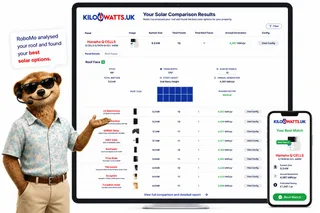
Compare top solar panels for the best performance and value.

Simple, fast & effortless
Provide a few details, sit back and watch your results unfold.
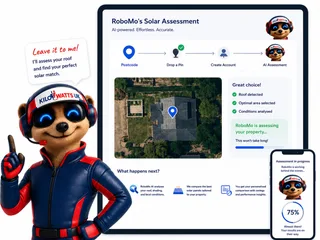
STEP 1
Choose Home, Business or Industrial
Enter your postcode to start your assessment.
STEP 2

Drop a pin on your roof
STEP 3

Create your free account
STEP 4

Sit back and watch RoboMo™ work
RoboMo™ analyses your roof and builds your personalised solar comparison.

Step 1
Enter your postcode
Start designing your wind energy system in seconds.
Are you an installer, distributor or renewable energy business?
Kilowatts UK is expanding the Flower Turbines partner network across the UK.
Become A Flower Turbines PartnerKilowatts UK is an authorised representative
Flower Turbines
Compact vertical-axis turbines built for real UK sites, not just open farmland.
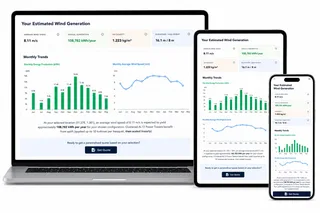
They start in light wind, sit in a small footprint, and are bird-safe by design. Cluster them as a bouquet and the group performs better together than the same turbines standing alone. Enter your postcode for a location-based generation estimate. Figures use area weather data and will differ if buildings, trees or hills sit in the way.
Starts in light UK wind
Built to generate in typical UK wind, not only open farmland.
Small rooftop or ground footprint
Compact towers for roofs, yards and tight sites.
Bird-safe slow rotation
Slow vertical-axis spin, bird-safe by design.
Bouquet clusters raise output
Grouped turbines outperform the same units standing alone.
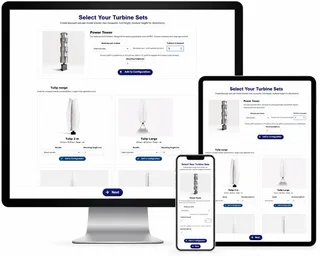
STEP 2

Choose a location
STEP 3

Place your cluster
Tap the map where you want the turbine cluster to go.
STEP 4

Instant generation forecasts
Compare different turbine layouts and see annual generation forecasts instantly.
STEP 5

No commitment required
Explore different configurations before deciding whether to request a quotation.
Related articles
FAQ
Need Help? RoboMo's Got Answers
What does a UKPN grid connection for Kent solar actually allow?
It is permission to run a generator in parallel with the local distribution network. For most of Kent that operator is UK Power Networks, not the transmission system operator. It is not a Smart Export Guarantee contract, a planning decision or Building Regulations sign-off. A quote that assumes unrestricted export is not a connection offer.
How do I check that UK Power Networks is my DNO?
County boundaries do not decide the network operator. Most of Kent is in the UK Power Networks area, but a border supply or an independent network on a newer estate may not be UKPN. Match a postcode lookup to the MPAN before anyone quotes a G98 or G99 route. Forms sent to the wrong operator do not create a valid connection.
When is a home solar job G98 rather than G99?
G98 covers small, fully type-tested generation, most often judged at 16 A per phase. At 230 V that is about 3.68 kW on a single-phase supply and about 11.04 kW across three phases, still at 16 A on each phase. The usual path in that band is connect and notify, with type-tested equipment, correct commissioning settings and a notification. Existing generation, an AC-coupled battery or a hybrid inverter can push the aggregated rating into G99 even if the new panels look modest.
Can the system be switched on before a G99 offer?
Only plant that still fits G98 after aggregation follows the usual connect-and-notify sequence. If the aggregated inverter rating is outside the 16 A per phase band, do not connect and hope the paperwork catches up. A full G99 application needs a connection offer before parallel operation. Where a fast-track G99 option appears on the live UK Power Networks form, follow that form rather than a neighbour’s install or an older issue of G99.
Who submits the UKPN connection paperwork?
The installer normally submits the technical record, because the type-test reference, protection settings and single-line diagram sit with the designer. You may be asked to authorise that submission, and the MPAN, site address and inverter model should match what will be commissioned. Give the installer any earlier MCS certificate and DNO letter if you already have solar or a battery. Adding a second inverter is a new aggregation, not a minor extra on an old notification.
How is an export limit different from the system I buy?
An export limit, often set under ENA Engineering Recommendation G100, caps what may be sent out to the network. It is not the array size and it is not the inverter nameplate. The inverter can still supply the house, but surplus the house and any battery cannot take is curtailed rather than exported, including where the offer is zero export. A cap can change how much surplus reaches a Smart Export Guarantee tariff, but the tariff does not raise the cap, and overriding the limit defeats the connection terms.
Does a DNO offer replace planning permission, Building Regulations or MCS?
No. These are separate gates. A DNO offer does not decide planning permission where it applies, and planning permission does not authorise parallel operation. Electrical work in the home also sits under Building Regulations, including Part P. An MCS certificate is evidence of installer and product status where a quality scheme or a supplier asks for it. A Smart Export Guarantee contract is a commercial arrangement with a supplier and does not permit connection or allow you to exceed an export cap.
What should I ask before booking a Kent solar survey?
Have the MPAN, a recent bill and any paperwork for existing solar or batteries ready. Ask which route the installer expects, what would move the job from G98 to G99, and whether a looped service or an export limit would change the kit list. Ask them to record the MPAN, supply phase and DNO name on the quote. After an offer, read the export limit and any service works before you treat the original quote as fixed.