


Solar panel installation in Dartford
Published: 2026-10-06 02:05:40
Updated: 2026-10-05 19:06:22
Solar panel installation in Dartford is a roof, planning and UK Power Networks question. Terraces, shade and looped supplies decide more than the town.
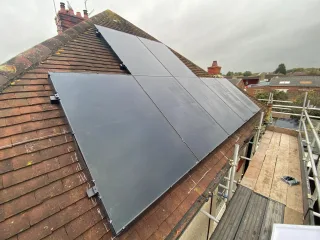
Solar panel installation in Dartford
Solar panel installation in Dartford from Kilowatts.uk in Broadstairs. Costs, roofs, planning and what to do next then compare a local system.
Solar panel installation in Dartford
Dartford Borough Council is the local planning authority. Many householder arrays in England are considered under the General Permitted Development Order, but that is conditional, and listed buildings and conservation areas are separate checks. The electrical work is Building Regulations work. Payments under the Smart Export Guarantee generally need an MCS-certified installation, and the rate itself is set by the supplier, not by the borough.
Dartford sits in north-west Kent, close to the Thames and to London. Housing runs from older terraces and post-war semis to newer estates and flats. A sound, accessible, lightly shaded roof on an owner-occupied house is the usual starting point. A failing covering, heavy shade, or no right to alter the roof is a reason to pause before anyone talks about kit.
Kilowatts covers this area through residential solar panel installation in Kent, rather than a Dartford-only service page. A useful next step is a measured survey of your own roof and supply, not a price taken from a satellite image.
What a Dartford roof survey actually decides
Installers treat the first visit as a design survey, not a sales walk-round. Pitch, orientation, usable area, and the condition of tiles, slates, or felt matter more than the postcode. South-east England is a relatively bright part of the UK, but a shaded Dartford roof can still perform poorly. Chimneys, dormers, neighbouring buildings, and trees, including growth you can already see, often cut output more than a roof that faces a little off south.
East- and west-facing arrays are widely used. They produce less at the midday peak and more in the morning and afternoon, which can suit a household that is home at those times. A due-south roof is not a requirement. What does cause trouble is shade across a string of modules, unless the electrical design limits how far that shade pulls the rest of the array down. That is a stringing and inverter decision, made on site, not a slogan about optimisers on every roof.
Covering type changes the mounting. Concrete tile, slate, flat roof, and in-roof systems are not interchangeable, and poor flashing is a common source of later leaks. Thames-side and tighter urban plots often have one usable face, mutual shading, and awkward scaffold drops. Those access details change the programme even when the modules themselves are straightforward. The survey should also note whether the roof needs repair before anyone fixes a long-lived array to it.
Planning, Building Regulations and UK Power Networks
Planning consent, building control, and the network connection are three different regimes. Treating them as one yes-or-no is how jobs stall after the deposit. A design can be acceptable on the roof and still be the wrong proposal for the street, the building, or the local substation.
Many roof-mounted arrays on houses in England are treated as permitted development under the General Permitted Development Order, subject to conditions in the current legislation. Dartford Borough Council is the authority that interprets those rules for a house in the borough, including whether the property is listed or sits in a conservation area. Flat roofs, equipment on a principal elevation, and work that is not on a dwellinghouse can fall outside the usual householder route. Exact limits should be checked against the current order and the council record for the property in front of you. A general article cannot clear a specific house, and permitted development rights that apply to many houses do not automatically apply to flats.
The electrical installation is Building Regulations work. In practice that means a competent design of the photovoltaic circuits, isolators, labelling, earthing, and the connection into the consumer unit, with certification that matches the route the installer actually uses. It is separate from planning permission. A neat roof layout does not, by itself, show that the board, the cable routes, or the fire-stopping through the loft have been thought through. Grid connection sits with the distribution network operator. For Dartford that operator is UK Power Networks, not the energy supplier and not the council. Smaller, straightforward connections are often notified. Larger arrays, batteries, or export-limited designs commonly need prior approval before the system is installed. Those routes are widely known as G98 notification and G99 application. The live UK Power Networks process sets the boundary for a given site. Export limits, looped supplies, and a constrained local substation can cap system size even when the roof is large. A design that limits export can be a deliberate response to the network, not a fault in the equipment. Do not assume a town-wide export cap or a universal approval time.
Local constraints that show up in Dartford
The borough is not interchangeable with every Kent town, even though the technology is the same. Older terraces and tight semis are common, so scaffold, hoist parking, and access across a narrow frontage often shape the programme as much as the module count. Party-wall or neighbour access sometimes has to be agreed before the scaffold goes up. Rear gardens, alley widths, and overhead cables are the sort of details a desktop quote misses.
Conservation areas and listed buildings exist in the borough and have to be checked for the address, not assumed from the street name. Dartford Borough Council holds the conservation area information and the listing record. Being near a historic centre, or in an older terrace, is a prompt to look, not a finding that consent is required. Neighbours with panels are not evidence that your elevation, your listing, or your lease is in the same position.
UK Power Networks remains the network counterparty across these streets. Looped or otherwise shared supplies still turn up on older housing and can limit export or delay a connection even where the roof is clear. Newer estates can bring a different constraint: a shallow pitch, a roof already close to its design load, or a developer connection that was never sized for a later array. Thames-side plots can add wind exposure and one-sided roofs. None of that is a reason to avoid solar. It is a reason to survey the building you actually have.
How the system is specified on a real job
A typical domestic installation is modules on the roof, mounting and cabling, an inverter or microinverters, generation metering, and a connection into the consumer unit. A battery, an immersion diverter, or an EV charger can be added later or at the same time. Each is a separate design choice. A battery does not create extra sunshine. It shifts when generated electricity is used, and it needs space, ventilation, and a compliant circuit, not only a spare corner of a garage.
The survey should record roof structure, covering, orientation, shading, consumer-unit condition, earthing, spare ways, meter type, and whether the supply is looped or otherwise constrained. Those details decide cable routes, where the inverter can sit, and whether the board needs work before photovoltaic circuits can be connected. Inverter location affects heat, noise, and whether monitoring can reach the household Wi-Fi. Fire and electrical practice also govern isolators, labelling, and how DC cables run through a loft.
For most homes the larger saving is electricity not bought from the supplier. Export income depends on the tariff you actually hold, and on whether storage changes when power leaves the house. Treat "no bills" and "free electricity" claims as overstatements, especially in winter, when generation falls and household demand often rises. The survey record usually needs to settle a few practical points before anyone fixes a layout.
Handover should include schematics, product warranties, portal access, and evidence of the UK Power Networks notification or application, plus the Building Regulations certification for the electrical work. MCS certification is the usual route to Smart Export Guarantee eligibility. Ask what any quality scheme membership does and does not cover under its current rules, rather than treating a logo as a yield guarantee. Inverter warranties are often shorter than module warranties, and inverters are a common replacement item within the life of the panels. That is an industry pattern, not a promise for a named product.
When installation is a weak fit
The strongest cases are owner-occupiers with a sound, accessible roof, enough unshaded area for a useful array, and daytime electricity use, or a clear reason to store or export. Households that expect to stay long enough to use the system, and who can accept scaffolding and electrical works, are the core audience. Very low electricity use can make a large array hard to justify on self-consumption alone. That is a sizing question, not an automatic refusal. It is a weak fit where the roof is failing, heavily shaded, or too small, or where the household is leasehold or in a flat without rights over the roof. Listing or a restrictive covenant can block external equipment even when the neighbours have panels. Renters generally cannot commission a rooftop system. New-build buyers should check what the developer has already fitted, and whether warranties or the existing network offer limit later changes. Park homes and some non-standard roofs need a different structural approach. They should not be treated as standard tiled pitched roofs. Installed price, annual generation, and export rates for Dartford are not fixed town figures. They depend on array size, orientation, tilt, shading, inverter design, your tariff, and the connection UK Power Networks offers. A single kilowatt-hour figure for the town would be misleading. The same applies to payback: it cannot be stated without usage, import price, and export assumptions for that house.
Access, cost drivers, export caps and winter output
Dense Dartford streets often add programme time that brochure photos omit. Scaffold, parking for a hoist, and access across a narrow frontage can matter as much as the module count. Birds, pigeons, and debris under arrays are a maintenance issue on some urban roofs, so the design should leave a sensible way to inspect flashings later. Those are real cost drivers. They are not a reason to publish a borough price, because a straightforward pitched-tile roof with a modern consumer unit is a different job from slate, a flat roof, a board upgrade, or a connection that must wait for UK Power Networks.
Leasehold flats are a frequent local question, and they are often a poor fit until the paperwork is clear. You need the right to alter the roof, freeholder or management-company consent, and a clear answer on who owns the structure and who pays if a flashing fails. Covenants and service-charge rules can block external equipment even when the roof is technically sound. An installer cannot waive those documents. Houses in multiple occupation and rented homes raise the same rights problem from the other side: the person paying the bill is often not the person who can authorise the work.
Export caps are a connection outcome, not a Dartford by-law. UK Power Networks may accept the full proposed export, ask for a smaller system, or accept the array only with an agreed export limit. A limit changes how much surplus can leave the house. It does not stop the home using what it generates at the time. If a quote assumes unlimited export, ask what happens if the offer is tighter than the roof's physical capacity. The technical threshold for notification versus prior approval should be read from the live UK Power Networks application for that supply, not from a town average. Winter performance is the other place generic claims fail. Days are short, the sun is low, and shade from chimneys and neighbouring roofs bites harder than it does in June. A south-east England roof is still a relatively good UK location across the year, but winter generation is lower while heating and lighting demand often rise. The system will not typically clear a winter bill on its own. Self-consumption of what you do generate, and any stored energy, matter more in those months than a summer export snapshot. No honest survey can turn that seasonal pattern into a single Dartford kilowatt-hour figure. Do not assume a grant, a particular VAT treatment, or a Smart Export Guarantee rate from this page. VAT rules for residential energy-saving materials are set by HMRC and change. The Smart Export Guarantee framework sits with Ofgem, while the pence per kilowatt-hour is a supplier tariff. A town guide cannot lock either of them. Check the current HMRC VAT guidance and the Ofgem Smart Export Guarantee pages, then the tariff your own supplier is actually offering, before you treat a quote's income line as fixed.
What to do before you compare quotes
Start with the building, not the panel brand. Note roof covering, obvious shade, whether you own the roof, and roughly when you use electricity. A year's worth of bills, in kilowatt-hours rather than pounds alone, is more useful than a guess. If the property is listed, in a conservation area, or leasehold, gather that paperwork before the survey so the design is not drawn for a roof you cannot alter. The conservation and listing check is a Dartford Borough Council record for the address. The connection check is a UK Power Networks matter for the supply.
On the day, ask where the inverter and any battery would sit, whether the consumer unit can take the new circuits, and how the installer will notify or apply to UK Power Networks under G98 or G99 as the design requires. Ask how Building Regulations certification will be provided for the electrical work. Ask for the shading assumption in writing, and for what happens if approval caps export below the roof's physical capacity. Compare proposals on design and inclusions, including mounting, electrical work, scaffold, monitoring, and paperwork, not only on a headline array size.
If you want export payments, confirm that the install will be MCS-certified. That certification is what Smart Export Guarantee eligibility generally depends on. It is not a promise of a particular rate, and it does not replace the supplier's own terms. Read the live Ofgem explanation of the scheme and the current HMRC position on VAT rather than a figure copied into a local quote. Those official pages move. This article cannot freeze them. If the roof, the rights, and the supply look workable, the Kent residential installation page is the right place to set out coverage and what a surveyed design includes. If the roof needs repair first, or consent is uncertain, fix that question before you treat solar as the next purchase. A paused job is cheaper than a system that cannot be connected or cannot stay on the building.
Plan, Compare & Buy Renewable Energy Solutions
AI does the thinking.
You get the perfect solar match.
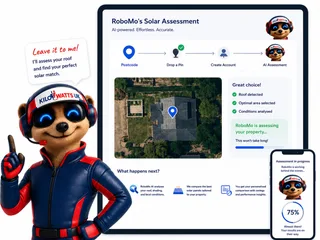
Use RoboMo™ to assess your property, compare available technologies and connect with trusted UK installers, suppliers and manufacturers.
Simply enter your postcode, drop a pin on your roof, create your free account and let RoboMo™ analyse your property to find the best solar panels for your home.

You don't have to think
RoboMo™'s AI analyses your roof and does all the hard work.

Accurate & tailored
AI-powered assessment based on your roof, location, and conditions.

Best options, maximum savings
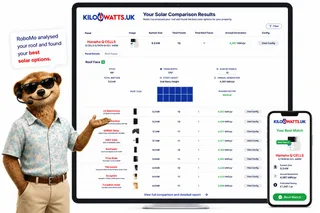
Compare top solar panels for the best performance and value.

Simple, fast & effortless
Provide a few details, sit back and watch your results unfold.
STEP 1
Choose Home, Business or Industrial
Enter your postcode to start your assessment.
STEP 2
Drop a pin on your roof
STEP 3

Create your free account
STEP 4

Sit back and watch RoboMo™ work
RoboMo™ analyses your roof and builds your personalised solar comparison.

Step 1
Enter your postcode
Start designing your wind energy system in seconds.
Are you an installer, distributor or renewable energy business?
Kilowatts UK is expanding the Flower Turbines partner network across the UK.
Become A Flower Turbines PartnerKilowatts UK is an authorised representative
Flower Turbines
Compact vertical-axis turbines built for real UK sites, not just open farmland.
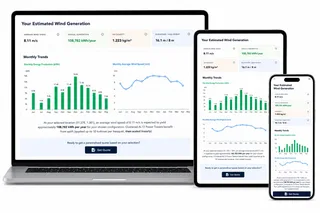
They start in light wind, sit in a small footprint, and are bird-safe by design. Cluster them as a bouquet and the group performs better together than the same turbines standing alone. Enter your postcode for a location-based generation estimate. Figures use area weather data and will differ if buildings, trees or hills sit in the way.
Starts in light UK wind
Built to generate in typical UK wind, not only open farmland.
Small rooftop or ground footprint
Compact towers for roofs, yards and tight sites.
Bird-safe slow rotation
Slow vertical-axis spin, bird-safe by design.
Bouquet clusters raise output
Grouped turbines outperform the same units standing alone.

STEP 2

Choose a location
STEP 3

Place your cluster
Tap the map where you want the turbine cluster to go.
STEP 4

Instant generation forecasts
Compare different turbine layouts and see annual generation forecasts instantly.
STEP 5

No commitment required
Explore different configurations before deciding whether to request a quotation.
Related articles
FAQ
Need Help? RoboMo's Got Answers
Is solar panel installation in Dartford different from the rest of Kent?
The technology is the same, but the building and the connection are not interchangeable with every Kent street. Dartford has older terraces, tight semis, newer estates and some Thames-side plots, so shade, scaffold access, roof condition and the supply can matter as much as orientation. Dartford Borough Council is the planning authority, and UK Power Networks is the distribution network operator. The town name itself does not decide whether a system is sensible.
Do I need planning permission for solar panels on a house in Dartford?
Many roof-mounted arrays on houses in England are treated as permitted development, but that is conditional and is not an automatic yes. Listed buildings, conservation areas, flat roofs, equipment on a principal elevation, and work that is not on a dwellinghouse can fall outside the usual householder route. Dartford Borough Council interprets the rules for the property in front of you. A general article cannot clear a specific house, and rights that apply to many houses do not automatically apply to flats.
Who deals with the grid connection in Dartford?
The connection sits with UK Power Networks, not the energy supplier and not the council. Smaller, straightforward connections are often notified, while larger arrays, batteries or export-limited designs commonly need prior approval. Those routes are widely known as G98 notification and G99 application, but the live process sets the boundary for a given site. Export limits, looped supplies or a constrained local substation can cap system size even when the roof is large.
What should a roof survey in Dartford actually check?
A useful survey records pitch, orientation, usable area, shading, covering type and whether the roof needs repair before a long-lived array is fixed to it. It should also look at the consumer unit, earthing, spare ways, meter type and whether the supply is looped or otherwise constrained. Chimneys, dormers, trees and neighbouring buildings often cut output more than a roof that faces a little off south. East- and west-facing arrays are widely used and do not require a due-south roof.
Can I get solar panels if I live in a flat or a leasehold home?
Often this is a weak fit until the paperwork is clear. You need the right to alter the roof, freeholder or management-company consent, and a clear answer on who owns the structure and who pays if a flashing fails. Covenants and service-charge rules can block external equipment even when neighbours already have panels. Renters generally cannot commission a rooftop system, and an installer cannot waive those documents.
Will solar panels remove my electricity bill?
No. For most homes the larger saving is electricity not bought from the supplier, and export income depends on the tariff you actually hold. A battery does not create extra sunshine; it shifts when generated electricity is used, and it needs space, ventilation and a compliant circuit. Treat claims of no bills or free electricity as overstatements, especially in winter, when generation falls and household demand often rises.
Is there a fixed price or payback figure for solar in Dartford?
No. Installed cost, annual generation and export rates are not fixed town figures. They depend on array size, orientation, tilt, shading, inverter design, your tariff and the connection UK Power Networks offers. Scaffold, parking, narrow frontages, slate or flat roofs, and a consumer-unit upgrade can change the job even when the module count looks similar. Payback cannot be stated without usage, import price and export assumptions for that house.
What paperwork should I expect at handover?
Handover should include schematics, product warranties, monitoring access, and evidence of the UK Power Networks notification or application. The electrical installation is Building Regulations work, so you should also receive certification that matches the route the installer actually uses. Payments under the Smart Export Guarantee generally need an MCS-certified installation, but the export rate is set by the supplier, not by the borough. A quality-scheme logo is not a yield guarantee, and inverter warranties are often shorter than module warranties.