


Why One Shaded Solar Panel Drags Down the Whole String
Published: 2026-09-25 15:50:12
Updated: 2026-10-06 12:52:44
One chimney shadow can cut output across a whole solar string. Here's why series wiring limits current, and how optimisers isolate the loss in UK homes.
Why One Shaded Panel Can Drag Down Many
If eleven of your twelve panels are sitting in bright sun and your app still shows a disappointing number, you are almost certainly looking at a shading problem rather than a broken panel. Solar panels are usually wired together in a series string, which means they share a single current path. In that arrangement, the current flowing through the whole string is limited by the weakest module in it — so the moment a chimney shadow, a dormer, a satellite dish or an overgrown sycamore clips one panel, every panel on that chain is pulled down with it. That is the entire idea behind this episode of Solar, Clearly. The fix is not to move the chimney. It is module-level power electronics — optimisers or microinverters — which let each panel work independently, so only the shaded module drops and the rest carry on at full tilt. Below, we unpack what a series string actually is, what shades British roofs in practice, what optimisers do and do not solve, and how to decide whether your roof genuinely needs them.
"Mo: Every panel's in full sun. Why so low? / RoboMo: They share one current path."
Why solar panels are wired in strings in the first place
A single solar panel produces a fairly modest voltage. Inverters, on the other hand, want a decent voltage to work with efficiently. The neatest engineering answer is to wire panels in series — positive to negative, panel to panel — so their voltages add up while the same current flows through all of them. Twelve panels daisy-chained into one string behave, electrically, like one long generator with one shared current path. This is not a shortcut or a cheap installation trick. Series stringing is the default for good reasons: fewer cables, lower current for the same power, less resistive loss in the DC run, and a simpler, more reliable inverter input. On an unshaded roof it is genuinely excellent engineering, and it is why the majority of solar arrays worldwide are built this way. The catch is the phrase "one shared current path". Everything in this article follows from it.
Mo: Every panel's in full sun. Why so low? / RoboMo: They share one current path.
The weakest module sets the pace for everyone
In a series circuit, current cannot be different in different places along the chain. Whatever passes through the shaded panel must also pass through every other panel on that string. So if a shadow reduces one module's ability to push current, it does not simply lose its own share — it throttles the flow available to the entire chain. The usual analogy is a hosepipe with a pinch in it. It does not matter how wide the rest of the hose is; the pinch decides the flow. In the episode, that is exactly what the wiring overlay shows: the current path visibly narrows at the shaded module and the other panels dim in sympathy, even though they are in full autumn sun. Modern panels do soften this. Almost all include bypass diodes, which allow current to route around a heavily shaded group of cells rather than the panel becoming a bottleneck for the entire string. Bypass diodes are a safety and salvage feature, though, not a performance fix — when they activate, that section of the panel simply stops contributing. They limit the damage; they do not restore the output.
What actually shades a British roof
UK housing stock is unusually good at casting shadows on its own roof. Chimney stacks are the classic culprit — most brick semis and terraces have at least one, often positioned right where the array wants to go. Then there are dormers, hip ends, roof vents, soil pipes, TV aerials and satellite dishes, plus neighbouring properties, street trees and garden trees that were modest when planted and are now considerable. Season and time of day matter enormously. In midsummer, with the sun high, a chimney throws a short shadow that may barely touch the panels. In late autumn and winter the sun sits low, and the same chimney throws a long, hard shadow that sweeps across the array through the middle of the day — precisely when generation should be at its best. This is why a roof can look perfectly fine in a July commissioning check and disappoint in November. It is also worth being clear that shade is not the same as cloud. A crisp, hard-edged chimney shadow on one module is a very different problem from a uniformly grey sky. In fact, one of the more reassuring truths about solar in Britain is that homes still generate useful power on overcast days, because panels respond to diffuse light as well as direct sunlight. Uniform cloud reduces everyone's output evenly; a chimney shadow creates a mismatch, and mismatch is what strings dislike.
What module-level optimisers actually change
A power optimiser is a small device fitted behind each panel. Instead of the panel feeding raw DC straight into the shared string, the optimiser manages that individual module's operating point and hands a conditioned output to the string. The practical effect is the one shown in the final beat of the episode: the single current path splits into twelve independent flows. The eleven sunlit panels return to full output and the shaded one drops on its own, without dragging its neighbours down. Microinverters achieve a similar independence by a different route — each panel gets its own small inverter and converts to AC at the roof, so there is no shared DC string at all. Both approaches are module-level electronics; both decouple one panel's bad afternoon from everyone else's good one. The honest framing matters here. Optimisers do not create energy. The shaded panel still loses output — physics is not negotiable. What they recover is the collateral damage: the output the other panels were losing purely because of how they were wired. On a roof with genuine, recurring shade that recovery can be substantial. On a completely clear roof it is close to nothing, which is exactly why we would rather explain the mechanism than sell you hardware.
The quiet second benefit: per-panel monitoring
Because each optimiser reports separately, you gain visibility you simply cannot get from a plain string. Instead of one number for the whole array, you get twelve — and that changes how faults are found. With string-only monitoring, a single underperforming panel shows up as a slightly lower total, which is easy to blame on weather and easy to ignore for years. With module-level data, an installer can see that panel seven is consistently down at 2pm every day from October onwards and immediately understand it is the chimney, not a defect. Equally, a genuine fault — a failed connector, a cracked cell, a soiled module under a gutter overflow — stands out against its neighbours rather than hiding in an average. For a system expected to run for decades, that diagnostic clarity is arguably as valuable as the recovered kilowatt-hours. Knowledge beats guesswork, and data beats promises.
Decision checklist: does your roof need module-level electronics?
Work through these before anyone quotes you hardware. - Stand in the garden at around midday in autumn or winter and photograph the roof. Note where chimney, dormer, aerial and tree shadows actually fall — not where you assume they fall. - Ask whether the shading is recurring and predictable (a chimney, a neighbour's gable) or occasional and short (a passing branch on a windy day). Recurring, structural shade is the strong case for optimisers. - Ask your surveyor to model the array both ways — one plain series string, and with module-level electronics — and to show you the difference in estimated annual output rather than describing it in adjectives. - Ask how the array could be split into two strings. Sometimes putting the shade-prone panels on their own string, or on a separate inverter input, solves most of the problem without per-panel devices. - Ask whether panels could simply be relocated. Fewer panels on a clean part of the roof can outperform more panels partly in shade. - Consider maintenance and lifespan. Optimisers are additional electronic components mounted on the roof; ask about warranty terms, failure rates and what replacing one involves. - Weigh the monitoring value. If you want per-panel visibility for long-term system health, that is a legitimate reason on its own — just make it a conscious choice rather than an assumption. - Do not accept "everyone has them now" as an answer. On a genuinely unshaded south-facing roof, the case is much weaker, and a good installer will tell you so.
Questions people ask next
Does a shaded panel damage the rest of the array? No. The other panels are not harmed; they simply operate below their potential. Bypass diodes exist partly to prevent shaded cells from being forced into a damaging condition, and they are standard on modern modules. If I clean the panels, will that help? Cleaning helps with soiling — moss, lichen, bird mess, gutter run-off — which behaves a little like shade in that it creates mismatch between modules. It does nothing about a chimney. Will trimming a tree fix it? Often yes, and it is usually the cheapest intervention available. Vegetation shade is the one form of shading you can genuinely remove. Structural shade from your own or a neighbour's building is not. Does shading matter less in winter because output is low anyway? It matters more in relative terms, because low winter sun casts the longest shadows across the most productive hours of a short day. Do I need optimisers on every panel? Not necessarily. Some system designs allow module-level devices on the shade-affected modules only. Ask whether that is compatible with the inverter you are being offered. What about batteries — do they help with shading? A battery stores what you generate; it does not increase generation. It changes when you use your solar energy, not how much a shadow costs you.
Video transcript
Mo: Every panel's in full sun. Why so low? RoboMo: They share one current path. Optimisers let each work independently. Mo: So one shaded panel throttles the whole row? RoboMo: In a series string, current is limited by the weakest module. Mo: And with optimisers under each panel? RoboMo: Each module reports separately, so only the shaded one drops. Mo: Every panel's in full sun. Why so low? RoboMo: They share one current path. Optimisers let each work independently. / Mo: So one shaded panel throttles the whole row? RoboMo: In a series string, current is limited by the weakest module. / Mo: And with optimisers under each panel? RoboMo: Each module reports separately, so only the shaded one drops.
Wrapping up
The reason a fully sunlit array can post a disappointing number is rarely mysterious once you understand the wiring. Panels in a series string share one current path, that current is limited by the weakest module, and a single chimney shadow is enough to become the weak link for eleven perfectly healthy neighbours. Module-level optimisers or microinverters break that dependency: each module works and reports independently, so the shadow costs you one panel rather than a row. None of this makes shade free — the shaded panel still loses its output — but it stops one small problem becoming a whole-array problem, and it gives you the per-panel data to spot real faults years down the line. If your roof has a chimney, a dormer or a determined tree, this is the single design question worth getting right before anything is fixed to the tiles.
Next step
If you would like to know how the shadows on your own roof would actually behave through a British winter, a proper site survey will model it panel by panel — and tell you honestly if optimisers would make little difference. You can explore how we approach residential solar design, compare system options, or book a no-pressure survey whenever it suits you.
Plan, Compare & Buy Renewable Energy Solutions
AI does the thinking.
You get the perfect solar match.
Use RoboMo™ to assess your property, compare available technologies and connect with trusted UK installers, suppliers and manufacturers.
Simply enter your postcode, drop a pin on your roof, create your free account and let RoboMo™ analyse your property to find the best solar panels for your home.
You don't have to think
RoboMo™'s AI analyses your roof and does all the hard work.

Accurate & tailored
AI-powered assessment based on your roof, location, and conditions.

Best options, maximum savings
Compare top solar panels for the best performance and value.

Simple, fast & effortless
Provide a few details, sit back and watch your results unfold.
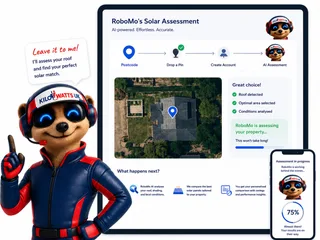
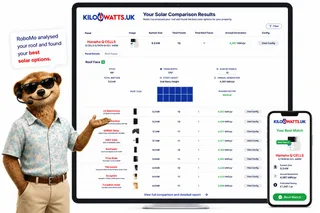
STEP 1
Choose Home, Business or Industrial
Enter your postcode to start your assessment.
STEP 2
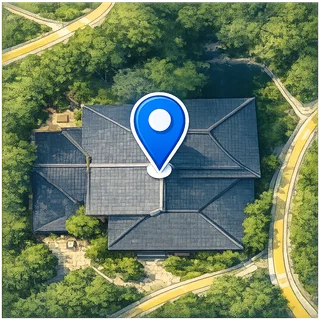
Drop a pin on your roof
STEP 3

Create your free account
STEP 4

Sit back and watch RoboMo™ work
RoboMo™ analyses your roof and builds your personalised solar comparison.
Kilowatts UK is an authorised representative
Flower Turbines
Compact vertical-axis turbines built for real UK sites, not just open farmland.
They start in light wind, sit in a small footprint, and are bird-safe by design. Cluster them as a bouquet and the group performs better together than the same turbines standing alone. Enter your postcode for a location-based generation estimate. Figures use area weather data and will differ if buildings, trees or hills sit in the way.
Starts in light UK wind
Built to generate in typical UK wind, not only open farmland.
Small rooftop or ground footprint
Compact towers for roofs, yards and tight sites.
Bird-safe slow rotation
Slow vertical-axis spin, bird-safe by design.
Bouquet clusters raise output
Grouped turbines outperform the same units standing alone.
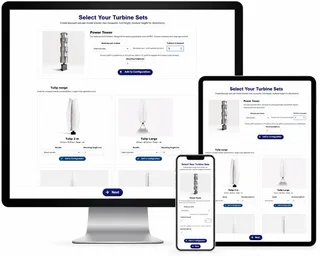
Step 1
Enter your postcode
Start designing your wind energy system in seconds.

STEP 2

Choose a location
STEP 3
Place your cluster
Tap the map where you want the turbine cluster to go.
STEP 4

Instant generation forecasts
Compare different turbine layouts and see annual generation forecasts instantly.
STEP 5

No commitment required
Explore different configurations before deciding whether to request a quotation.
FAQ
Need Help? RoboMo's Got Answers
What is Why One Shaded Solar Panel Drags Down the Whole String about?
If eleven of your twelve panels are sitting in bright sun and your app still shows a disappointing number, you are almost certainly looking at a shading problem rather than a broken panel. Solar panels are usually wired together in a series string, which means they share a single current path. In that arrangement, the
Who is this video for?
UK homeowners comparing the options discussed in Why One Shaded Solar Panel Drags Down the Whole String.