


Solar panel installation in London starts with the roof
Published: 2026-10-06 04:19:01
Updated: 2026-10-05 21:19:33
Solar panel installation in London turns on roof area, shade, the lease and UK Power Networks, not the borough. A survey sets the layout and consents.
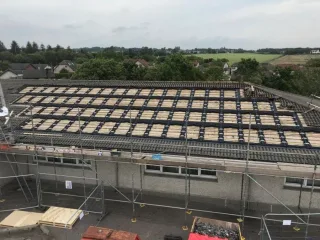
Solar panel installation in London
Solar panel installation in London from Kilowatts.uk in Broadstairs. Costs, roofs, planning and what to do next then compare a local system.
Solar panel installation in London starts with the roof and the supply
Solar panel installation in London means fitting a grid-connected photovoltaic system on a Greater London home: modules, mounting, DC cabling, an inverter or microinverters, and an AC connection into the existing supply, plus the notices needed to connect and, where relevant, to export. It is not solar thermal, which heats water rather than generating electricity. Whether it is worth doing depends less on the borough name than on usable roof area, shade, when the household uses electricity, and whether planning, the lease, and the network all allow the same design.
A south-facing, lightly shaded roof will usually outperform an east-west or heavily shaded plane on the same street. Cloud reduces output. It does not stop generation. A small terrace roof and evening-heavy use will cap savings long before the weather does. Without a measured load and a proper survey, claims that panels will wipe a bill are guesswork.
What the installer is actually specifying
A domestic array is designed around the usable roof, daytime use, and the electrical supply, not around a standard kit size. The module layout, inverter location, cable route through the loft, and how export is treated are one design. Houses with a private roof and flats or mansion blocks with a shared roof are different jobs. Treating them as one product wastes the first conversation.
Kilowatts covers residential work across Greater London from an office in Broadstairs. That changes survey travel, parking, and how a site day is booked. It does not change the engineering, the borough, or the network rules. The practical scope of solar panel installation in London is set out on the London service page. Battery storage and the AC connection are separate specifications from the modules, and the constraints below apply whichever competent installer you instruct.
On a survey the useful output is a layout after setbacks, a note of what the supply can accept, and a plain statement of which consents are still open. A module count copied from a neighbouring street is not that document. New-build homes that already have developer PV need a check of what is connected before anyone specifies more. Adding modules to an existing system is not the same job as a first install.
How shade, pitch and terrace form limit the array
Output depends more on roof area, tilt, orientation, and shading from chimneys, dormers, trees, and neighbouring buildings than on postcode. Terraces, shallow pitches, and small rear roofs often limit the array before the inverter or the supply does. A desktop satellite view is not a survey. On London terraces, chimney and parapet shade, a neighbour’s loft extension, and ridge or fire-break setbacks can remove panels that look free online.
The pattern on many inner-London streets is familiar without being a standard kit. A two-storey house with a butterfly or shallow rear roof, a party chimney, and a loft extension next door often loses the modules a satellite image appeared to allow. Cable runs through a back-addition loft are short but awkward. None of that is a reason to abandon a survey, and none of it is a measured yield. It is a reason not to price or promise output from a street photograph.
East-west arrays are common where they match daytime use, or where the south plane is too small or shaded. A north-facing or heavily shaded roof is not an automatic refusal, but it may only support a token array after walkways and shading setbacks. If the covering is also near the end of its life, the honest survey result is sometimes to repair the roof first. Fixing mounts to a covering that will need stripping within a few years means paying later to remove and refit the array.
Planning, the lease and the network are three separate gates
Many houses can use permitted development for roof-mounted solar if the conditions in force at the time are met. The national signpost is the current GOV.UK guidance on solar panels and permitted development, read with the Town and Country Planning (General Permitted Development) (England) Order as amended. That guidance does not decide a listed building, an extra conservation-area control, or an Article 4 direction. Greater London is not one planning authority. Exact limits, and how a borough applies them, should be checked against the legislation in force and that borough’s guidance rather than assumed from a national summary.
Most of London’s distribution network is operated by UK Power Networks. Smaller compliant connections are often handled as a G98 notification, while larger systems, and some more complex or limited-export designs, need a G99 application before the connection is made. The live threshold, the forms, and whether export limitation changes the path are set out in the current Energy Networks Association engineering recommendations and on UK Power Networks’ own G98 and G99 guidance. Those documents move, so the design should be checked against them when it is drawn, not copied from an older job on the same street. Permitted development does not remove those connection rules.
A design can be acceptable to the network and still be blocked by a lease or a listed-building constraint. Building insurance, roof warranties, and access arrangements with neighbours can also gate the job. A renter who does not control the roof is not the decision-maker. The landlord or freeholder is.
Which London homes are a realistic fit
The useful comparison is not borough against borough. It is whether someone can control a sound roof, get plant and cables to it, and clear the consents that apply to that building. A freehold terrace with a clear rear or main roof is a different proposition from a mansion-block roof owned in common, even when both face south. In practice the early questions are control, condition, and connection. Who can authorise work on that roof, is the covering fit to carry mounts for the life of the array, and can the existing supply accept the proposed connection without a redesign? If any one of those is unanswered, a module layout is premature.
Shared roofs, listed buildings and conservation areas
A flat or mansion block is workable only when someone with authority over the roof agrees in a form the installer can rely on. The lease, the freeholder, and often the building manager have to allow roof use, a defined cable route, and a metering arrangement that does not mix supplies. If the roof is owned in common and consent is refused or simply unclear, the job stalls. Sharing a south-facing roof with other flats does not, by itself, create a right to put modules on it.
A listed building does not follow the simple householder permitted-development path. Listed building consent is commonly required, and the borough confirms what mounting, if any, it will accept. A conservation area, or a street covered by an Article 4 direction, can also tighten or remove rights that apply on an ordinary house nearby. Formal consent may still be granted. If it is uncertain, or the only layout that fits the electrics conflicts with the building, pausing is better than fitting first and arguing later.
These are planning and property gates, not a judgement on whether photovoltaic modules work in London. A consented listed roof with a sound covering and a supply that can take the connection can be a straightforward electrical job. An unconsented shared roof is not, however good the irradiance looks on a map.
What the London programme actually involves
A sensible sequence is a survey with an on-site shade study, then the three consents in parallel where they can run together, then scaffold, pavement and parking arrangements, then the install, then the network notice or confirmation that an earlier application has been met, then handover. The three consents are a planning or permitted-development check, lease or freeholder consent where the building is not a freehold house, and the UK Power Networks step. There is no typical duration worth quoting. A city-wide week count would hide the step that actually holds the job.
A freehold house with a clear rear roof and a straightforward notification can move far faster than a leasehold block waiting on a freeholder, or a street that needs a pavement licence and a parking suspension before scaffold can stand. Scaffold and access often dominate the timetable once consents are in hand. A rear roof over a lightwell, a basement area, or a street with nowhere to stand may need a pavement licence, a parking suspension, or a different access method. Party-wall and oversailing questions arise when scaffold or trays cross a boundary. Those are common London constraints. They do not apply to every street, and there is no reliable share of jobs that need them.
Handover should include the array layout, inverter settings, the shutdown procedure, and a clear record of who notified the network and under which process. Electrical alterations in a dwelling are building work. In England they sit under the building regulations regime for electrical safety in homes, and a competent electrician should certify what was changed. A sales brochure is not that certificate. Quality marks on the generation equipment are a separate question from that electrical certificate.
What an export limit does and whether solar backs up a power cut
An export limit caps how much power may leave the property onto the network. It does not stop the household using solar on site at the same time. It is specified so the connection can be accepted on a constrained urban supply, not because the array is faulty. Small supplies, looped services shared with a neighbour, and older consumer units can force a smaller system, export limitation, or electrical work before the panels are the constraint. The limit should appear in the design, with the settings explained, rather than as a surprise at commissioning.
Ordinary grid-tied solar does not provide backup in a power cut unless that function is specified and the wiring is designed for it. The system is required to shut down so it does not energise a dead street. Backup, if it is wanted, is a separate design: equipment arranged to island, and a clear list of circuits that should stay on. Fitting modules, or even adding a battery later, does not create that function by default.
A battery is optional. It can shift daytime generation toward evening use, which matters in homes that are empty all day, but it is a separate cost and a separate connection question. It does not, by itself, remove an export limit the network has required. Earthing arrangements, spare ways in the consumer unit, and a ventilated place for the inverter with maintenance access can all change the quote before storage is even discussed. Thick walls and awkward meter cupboards can also make a simple Wi-Fi dongle a poor monitoring path, so the data route needs a plan of its own.
Why costs, yield and tariffs stay site-specific
There is no single installed price for a London home that is worth quoting, and this article does not invent one. Cost moves with access, scaffold, electrical work, any roof repairs, and how many modules the roof can actually take. An access premium on tight streets is plausible, but it is not a figure you can take from a postcode. Anyone offering a London-wide price before seeing the roof, the consumer unit, and the access is guessing.
Annual yield in kilowatt-hours per kilowatt-peak should come from a current irradiance dataset or a model of that roof, not from a city-wide average. Payback and bill savings depend on the tariff, how much generation is used in the house, and the export terms in force at the time. Those rates, and any grant or scheme rules, change. A sales illustration is not proof of eligibility. This guide assumes no grant. If a scheme exists when you instruct the work, eligibility has to be read then, not inferred from a neighbouring install.
The Smart Export Guarantee is the current Great Britain framework for paid export from eligible small-scale generation. Ofgem and GOV.UK publish the scheme framework. Suppliers publish the actual tariff and can change it. Eligibility commonly expects an MCS-certified installation, or another route that supplier accepts, plus metering that can record export. MCS is often required before an export tariff will pay, but that must be checked against the rules in force when the work is instructed. It is not a reason to assume a grant, and it is not a performance guarantee. Module warranties are often long and inverter warranties shorter. Those are manufacturer terms, not a guaranteed service life on a London roof. Ventilation, roof condition, and whether the inverter is replaced later all matter. Homes that use little electricity in the daytime should expect more of the generation to be exported, and should treat the value of that export as uncertain until the current supplier terms are checked. Using more of the generation in the house is usually the more dependable part of the saving, because it offsets electricity you would otherwise buy. That still depends on the tariff and on when the household actually runs loads.
What to settle before mounts go on
A useful commission starts with measurements and consents, not a module count copied from a neighbouring street. Ask for the shade study, the proposed layout after setbacks, and a plain explanation of what happens if the consumer unit or the supply cannot take the design as drawn. If the survey shows only a token array, a roof that should be renewed first, or a shared roof with no consent path, pausing is a sound outcome.
Quality schemes may matter for some tariffs, warranties, or notifications. Do not assume a named scheme is mandatory for every purpose, or that it unlocks a grant, without checking the rules that apply when you instruct the work. The practical close is a written design that names the layout, the connection route, and the consents still outstanding, so mounts are not fixed against an assumption.
Plan, Compare & Buy Renewable Energy Solutions
AI does the thinking.
You get the perfect solar match.
Use RoboMo™ to assess your property, compare available technologies and connect with trusted UK installers, suppliers and manufacturers.
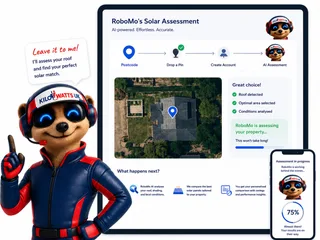
Simply enter your postcode, drop a pin on your roof, create your free account and let RoboMo™ analyse your property to find the best solar panels for your home.

You don't have to think
RoboMo™'s AI analyses your roof and does all the hard work.

Accurate & tailored
AI-powered assessment based on your roof, location, and conditions.

Best options, maximum savings
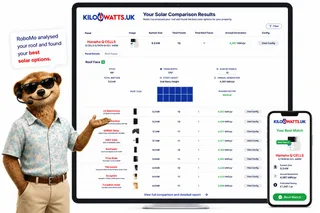
Compare top solar panels for the best performance and value.

Simple, fast & effortless
Provide a few details, sit back and watch your results unfold.
STEP 1
Choose Home, Business or Industrial
Enter your postcode to start your assessment.
STEP 2
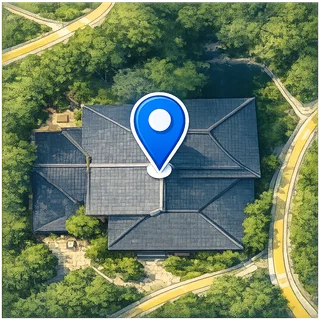
Drop a pin on your roof
STEP 3

Create your free account
STEP 4

Sit back and watch RoboMo™ work
RoboMo™ analyses your roof and builds your personalised solar comparison.

Step 1
Enter your postcode
Start designing your wind energy system in seconds.
Are you an installer, distributor or renewable energy business?
Kilowatts UK is expanding the Flower Turbines partner network across the UK.
Become A Flower Turbines PartnerKilowatts UK is an authorised representative
Flower Turbines
Compact vertical-axis turbines built for real UK sites, not just open farmland.
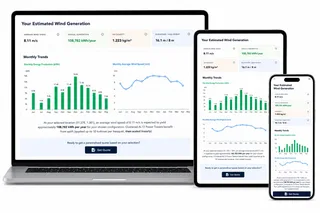
They start in light wind, sit in a small footprint, and are bird-safe by design. Cluster them as a bouquet and the group performs better together than the same turbines standing alone. Enter your postcode for a location-based generation estimate. Figures use area weather data and will differ if buildings, trees or hills sit in the way.
Starts in light UK wind
Built to generate in typical UK wind, not only open farmland.
Small rooftop or ground footprint
Compact towers for roofs, yards and tight sites.
Bird-safe slow rotation
Slow vertical-axis spin, bird-safe by design.
Bouquet clusters raise output
Grouped turbines outperform the same units standing alone.

STEP 2

Choose a location
STEP 3

Place your cluster
Tap the map where you want the turbine cluster to go.
STEP 4

Instant generation forecasts
Compare different turbine layouts and see annual generation forecasts instantly.
STEP 5

No commitment required
Explore different configurations before deciding whether to request a quotation.
Related articles
FAQ
Need Help? RoboMo's Got Answers
What does solar panel installation in London actually involve?
On a typical Greater London house it means fitting a grid-connected photovoltaic system: modules, mounting, DC cabling, an inverter or microinverters, and an AC connection into the existing supply, plus the notices needed to connect and, where relevant, to export. It is not solar thermal, which heats water rather than generating electricity. Houses with a private roof and flats or mansion blocks with a shared roof are different jobs, so a module count copied from a neighbouring street is not a design.
Do I need planning permission for solar panels in London?
Many houses can use permitted development for roof-mounted solar if the conditions in force at the time are met. National GOV.UK guidance and the Town and Country Planning (General Permitted Development) (England) Order do not decide a listed building, an extra conservation-area control, or an Article 4 direction. Greater London is not one planning authority, so the limits should be checked against the legislation in force and that borough’s guidance.
How does the electricity network affect a London solar install?
Most of London’s distribution network is operated by UK Power Networks. Smaller compliant connections are often handled as a G98 notification, while larger systems, and some more complex or limited-export designs, need a G99 application before the connection is made. The live threshold, the forms, and whether export limitation changes the path are set out in the current Energy Networks Association recommendations and UK Power Networks’ own guidance, so the design should be checked when it is drawn rather than copied from an older job.
Can I put solar panels on a flat, mansion block, or listed building?
A flat or mansion block is workable only when someone with authority over the roof agrees in a form the installer can rely on. The lease, the freeholder, and often the building manager have to allow roof use, a defined cable route, and a metering arrangement that does not mix supplies. A listed building does not follow the simple householder permitted-development path, and listed building consent is commonly required. A renter who does not control the roof is not the decision-maker.
Will shade, a small terrace roof, or an east-west pitch stop solar in London?
Output depends more on roof area, tilt, orientation, and shading from chimneys, dormers, trees, and neighbouring buildings than on the borough. Terraces, shallow pitches, and small rear roofs often limit the array before the inverter or the supply does, and a desktop satellite view is not a survey. East-west arrays are common where they match daytime use or where the south plane is too small or shaded. Cloud reduces output but does not stop generation.
Will solar panels work in a power cut, and what does an export limit mean?
Ordinary grid-tied solar does not provide backup in a power cut unless that function is specified and the wiring is designed for it. The system is required to shut down so it does not energise a dead street. An export limit caps how much power may leave the property onto the network; it does not stop the household using solar on site at the same time. A battery is optional and does not, by itself, remove an export limit the network has required or create backup.
How much does solar panel installation in London cost, and how much will it generate?
There is no single installed price for a London home that is worth quoting. Cost moves with access, scaffold, electrical work, any roof repairs, and how many modules the roof can actually take. Annual yield should come from a current irradiance dataset or a model of that roof, not from a city-wide average. Payback depends on the tariff, how much generation is used in the house, and the export terms in force at the time, and those rates and any scheme rules change.
What should happen before and after the panels are fitted?
A sensible sequence is a survey with an on-site shade study, then planning or permitted-development checks, lease or freeholder consent where needed, and the UK Power Networks step, then scaffold and access arrangements, then the install, then network notice or confirmation, then handover. There is no typical duration worth quoting, because a freehold house can move far faster than a leasehold block or a street that needs a pavement licence. Handover should include the array layout, inverter settings, the shutdown procedure, and a clear record of who notified the network. Electrical alterations in a dwelling should be certified by a competent electrician.