


Solar panel installation in Tunbridge Wells
Published: 2026-10-06 02:15:45
Updated: 2026-10-05 19:16:28
Solar panel installation in Tunbridge Wells turns on High Weald shade, roof condition, borough planning and UK Power Networks. A survey sets the design.

Solar panel installation in Tunbridge Wells
Solar panel installation in Tunbridge Wells from Kilowatts.uk in Broadstairs. Costs, roofs, planning and what to do next then compare a local system.
Solar panel installation in Tunbridge Wells
Southern England has a reasonable solar resource by UK standards, and the South East sits toward the better end of the national range. That still does not give a Tunbridge Wells postcode a single kilowatt-hour per kilowatt-peak figure. Azimuth, pitch and shade decide yield far more than the town name. High Weald gardens, chimneys, dormers and valleys often split the roof into smaller usable planes. A clear east-west pair of slopes can still be worth designing. A heavily shaded south slope often is not.
Households comparing installers across the county can start from solar panel installation in Kent and then treat the Tunbridge Wells survey as the point where roof, scaffold and grid constraints become specific. A finished job also needs a connection route with the network operator and paperwork the household can actually file. Those are separate from whether the modules will fit on the tiles.
What is fitted, and which certificates should follow
A domestic array is more than panels on tiles. The usual scope is modules, a mounting system matched to the roof covering, DC cabling, an inverter or hybrid inverter, AC isolation, generation metering and a connection arrangement agreed with the distribution network operator. A battery and an EV charger are optional add-ons. They do not create extra solar energy, and they should be specified only if the household's use justifies them. A heat pump does not change that logic. Winter electrical heating demand is high when rooftop generation is at its lowest, so the array should not be sold as if it will run the heating through January.
Fixings and weatherproofing follow the covering. Clay tiles, concrete tiles and slate are all common around Tunbridge Wells, and the method changes with age, batten depth and condition. Older roofs may need localised repairs before anyone loads the slope with scaffold and an array. That is a roofing judgement, not a reason to assume every Victorian or Edwardian house is unsuitable.
Three compliance names are easy to blur, and an installer saying they will "handle it" is not the same as you holding the documents. MCS certification is the route most households need if they later apply for the Smart Export Guarantee. It certifies the installation against the scheme rules. It is not a performance guarantee, and current GOV.UK guidance on eligibility should be checked rather than assumed from a quote. G98 and G99 are the connection standards used with the network operator. A smaller, straightforward connection is often a notification. A larger array, export limiting or a more complex arrangement is often an application. Building Regulations still apply to electrical work in a dwelling, and sometimes to how the roof is altered. You should receive evidence that the work was notified through a competent-person scheme or building control. The handover pack is the practical test of that. For a job being certified for export payments, ask for the MCS certificate, an electrical installation certificate for the new circuits, the commissioned inverter settings including any export limit, a layout drawing, written shutdown steps, and monitoring access. Product warranties and workmanship cover are separate. A long module warranty on a datasheet does not show that the roof was left weathertight or that the electrical work was commissioned.
Roof, shade and the local housing stock
Tunbridge Wells search covers the town and nearby settlements people treat as the same catchment, including tighter streets and tree cover typical of the High Weald. The technology is the same as elsewhere in Kent. What changes is access, shade and how much of each slope is actually usable.
Installers should design around chimneys, dormers and tree shade rather than filling every plane. Mixed orientations may need more than one string, or module-level electronics, so that one shaded module does not drag down a long string. A desktop satellite view is a starting point only. Summer and winter shade differ, and a neighbour's tree can matter more than roof direction. If a proposal quotes one yield figure with no shade note, ask what orientation, pitch and shading losses were assumed. A shaded valley roof here can underperform a clear roof a few streets away by more than the broad difference between UK regions.
Flats, and houses where the resident has no right to alter the roof, are a different problem from a shaded terrace. Ownership and permission have to be settled before a technical design is worth paying for. Very small usable areas can be installed and still be a poor match if the fixed cost of scaffold and electrical work dwarfs the energy gained. That conclusion belongs to a survey, not a postcode rule.
Planning in Tunbridge Wells
Many rooftop arrays on houses in England can proceed as permitted development, but that is not a blanket permission for every address in the borough. National householder rules, published on GOV.UK, set conditions on issues such as how far panels project from the roof and where they sit relative to edges and the ridge, and they do not automatically cover every building type. Listed buildings, conservation areas, Article 4 directions, flats and non-house roofs can need consent or a different route. A ground array is a different consent question again and should not be assumed to follow the rooftop householder route.
Tunbridge Wells Borough Council is the planning authority for the town. Guidance used in another Kent district should not be copied across. If an Article 4 direction has removed permitted-development rights, the national householder route does not apply to that property. Listing is a separate question from ordinary planning permission and should be checked with the council before a layout is treated as settled. Current council notes should be read against the specific address. An installer can prepare drawings, but they cannot promise a planning outcome.
A conservation-area address does not automatically ban panels, and an ordinary roof does not automatically avoid consent. Designation, visibility from the street, listing and the exact layout decide the route. Some prominent elevations will be refused or heavily constrained even when the rear roof would have been straightforward. If the house is listed, or the only sensible array would sit on a sensitive elevation, get that question answered before scaffold is booked.
Grid connection and the electrical supply
Planning and grid connection are separate. A roof can be suitable and the connection can still change the design. In this part of Kent the regional distribution network operator is UK Power Networks. The installer has to confirm, using UK Power Networks' live connection process, whether the proposed equipment is a G98-style notification or a G99 application. Thresholds, forms and the treatment of export limits change, so a remembered kilowatt figure from an older job is not a safe substitute. The household should see which route was used, not only be told that the grid was "sorted".
Export limits, looped supplies and older service heads can cap what is connected even when the roof would take a larger array. Undersized meter tails, no spare ways in the consumer unit, and an earthing arrangement that needs updating are common reasons a commissioning date slips. Those are supply and consumer-unit issues. They are not faults in the modules. If the energy supplier has to replace the service head, that slot is often outside the installer's control.
The larger household benefit for most homes is electricity not bought from the supplier. That depends on when the home uses power and whether storage is justified. The Smart Export Guarantee exists in Great Britain for eligible export, but supplier rates change and should not be the main reason to proceed. Do not assume a local grant is open. Any Tunbridge Wells or national funding should be verified on the day, from the body that actually runs it.
What a survey should settle before the price is real
A postcode check is not a free home energy survey, and it cannot price a system. On otherwise similar Tunbridge Wells houses, the items that usually move cost are scaffold and access, repairs to tiles or slate before the slope is loaded, consumer-unit or tail upgrades, and works the supplier or UK Power Networks must complete before the system can be energised. Until those are written as inclusions or exclusions, the total is not a quote, and it is not a town-wide price.
On older roofs the useful questions are whether cracked tiles are isolated or a sign of wider failure, whether battens and sarking can take the fixing system, and whether rafter spacing forces a different rail layout. Loading a tired roof with scaffold and then discovering the covering needs replacing is an expensive way to pause a job. Access often matters as much as module count. Terraces, shared drives and streets with little parking can need a different scaffold, a loading plan or a pavement arrangement. Rear gardens with steep drops or dense planting can block a standard tower.
The programme runs from survey to a layout you can compare, then any planning check, then the network notification or application, then install and commissioning. Panels on a clear, sound roof can be fitted in a short site visit. The calendar usually stretches because of scaffold arrangements, a service-head slot, a fuller connection study, or roof repairs that have to finish first. A promised switch-on date that ignores those gates is incomplete. Electrical questions belong in the same survey: what happens if the service head must be replaced, and whether the consumer unit has spare ways for the generation circuit.
When a Tunbridge Wells install is a weak fit
The stronger candidates are owner-occupiers of houses with a sound, accessible roof plane, enough unshaded area for a useful array, and a supply that can be integrated without a disproportionate upgrade. Daytime electrical use, or a clear reason for storage, means more of the generation is used on site. A battery only shifts the timing of energy the roof has already produced.
The weaker cases are a roof shaded for most of the year, a covering or structure near the end of its life, or a flat with no right to alter the roof. Renters, short leases and homes due for re-roofing are poor candidates until ownership, permission and roof life are settled. Listed buildings can still be possible after a design and consent check, and some will not be. If the only workable layout needs a sensitive elevation, or the connection upgrade dwarfs the array, stopping is a reasonable outcome.
Moderate cloud is not a reason to dismiss the town. Cloud reduces output across the UK. A clear, well-oriented roof here will outperform a shaded roof in a sunnier garden a few miles away. East-west roofs are not automatically poor if the usable area is large and daytime use lines up with generation. Heavy shade is the clearer disqualifier.
How to compare options before you commit
Price, typical system size and payback for Tunbridge Wells roofs are not something a postcode can answer. Two neighbouring houses can differ because of one tree, a dormer, a conservation constraint or a service head. Treat any headline figure that is not based on your roof and your supply as marketing, not a quote. The same caution applies to a generic South East yield number offered without your shade, pitch and orientation written down. A useful comparison is qualitative. Ask each proposal to show layout, assumed shade, what is excluded, and what would stop the job. Ask who will be the MCS contractor if you need a certificate for the Smart Export Guarantee, and who will sign the electrical installation certificate. A sales company that cannot name the certifying installer, or that cannot say whether the job is a notification or an application to UK Power Networks, has not finished the proposal. The same questions apply if you are weighing solar alone against solar with storage. Storage adds cost and complexity. It helps when evening use is high and daytime use is low. It does not rescue a roof that barely generates.
Overview
Read the exclusions before you compare totals. Scaffold assumptions, roof repairs, consumer-unit work and network-operator fees are the items most often missing from a first conversation. If those are unknown, the quote is not finished. Bring photographs of the roof, the consumer unit and the meter area to the first discussion, and keep the council, GOV.UK permitted-development and UK Power Networks pages open for that address rather than relying on a remembered rule from another job.
Plan, Compare & Buy Renewable Energy Solutions
AI does the thinking.
You get the perfect solar match.
Use RoboMo™ to assess your property, compare available technologies and connect with trusted UK installers, suppliers and manufacturers.
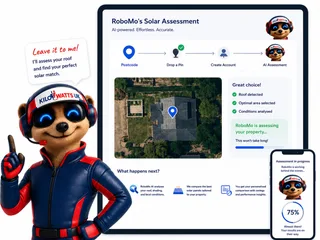
Simply enter your postcode, drop a pin on your roof, create your free account and let RoboMo™ analyse your property to find the best solar panels for your home.

You don't have to think
RoboMo™'s AI analyses your roof and does all the hard work.

Accurate & tailored
AI-powered assessment based on your roof, location, and conditions.

Best options, maximum savings
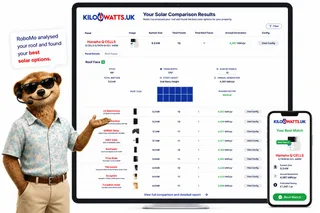
Compare top solar panels for the best performance and value.

Simple, fast & effortless
Provide a few details, sit back and watch your results unfold.
STEP 1
Choose Home, Business or Industrial
Enter your postcode to start your assessment.
STEP 2
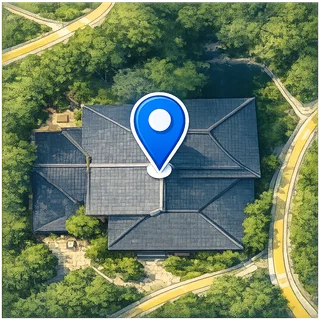
Drop a pin on your roof
STEP 3

Create your free account
STEP 4

Sit back and watch RoboMo™ work
RoboMo™ analyses your roof and builds your personalised solar comparison.

Step 1
Enter your postcode
Start designing your wind energy system in seconds.
Are you an installer, distributor or renewable energy business?
Kilowatts UK is expanding the Flower Turbines partner network across the UK.
Become A Flower Turbines PartnerKilowatts UK is an authorised representative
Flower Turbines
Compact vertical-axis turbines built for real UK sites, not just open farmland.
They start in light wind, sit in a small footprint, and are bird-safe by design. Cluster them as a bouquet and the group performs better together than the same turbines standing alone. Enter your postcode for a location-based generation estimate. Figures use area weather data and will differ if buildings, trees or hills sit in the way.
Starts in light UK wind
Built to generate in typical UK wind, not only open farmland.
Small rooftop or ground footprint
Compact towers for roofs, yards and tight sites.
Bird-safe slow rotation
Slow vertical-axis spin, bird-safe by design.
Bouquet clusters raise output
Grouped turbines outperform the same units standing alone.

STEP 2

Choose a location
STEP 3

Place your cluster
Tap the map where you want the turbine cluster to go.
STEP 4

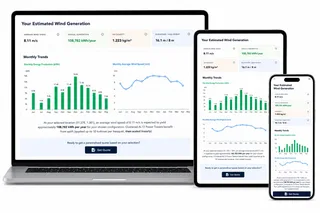
Instant generation forecasts
Compare different turbine layouts and see annual generation forecasts instantly.
STEP 5

No commitment required
Explore different configurations before deciding whether to request a quotation.
Related articles
FAQ
Need Help? RoboMo's Got Answers
Is Tunbridge Wells a good place for solar panels?
Southern England has a reasonable solar resource by UK standards, but a Tunbridge Wells postcode does not have a single expected yield. Orientation, pitch and shade matter more than the town name. High Weald gardens, chimneys, dormers and valleys often split a roof into smaller usable planes. A clear east-west pair of slopes can still be worth designing, while a heavily shaded south slope often is not.
What should a domestic solar installation include?
A typical grid-connected system includes modules, a mounting system matched to the roof covering, DC cabling, an inverter or hybrid inverter, AC isolation, generation metering and a connection arrangement with the distribution network operator. A battery or EV charger is optional and does not create extra solar energy. A heat pump does not change that logic: winter heating demand is high when rooftop generation is lowest, so an array should not be sold as if it will run the heating through January.
Which certificates and paperwork should I receive?
MCS certification is the route most households need if they later apply for the Smart Export Guarantee. It certifies the installation against scheme rules; it is not a performance guarantee, and current GOV.UK eligibility guidance should be checked rather than assumed from a quote. You should also receive an electrical installation certificate, evidence that Building Regulations work was notified through a competent-person scheme or building control, and a handover pack with commissioned inverter settings, any export limit, a layout drawing, shutdown steps and monitoring access. Product warranties and workmanship cover are separate from those documents.
Do I need planning permission in Tunbridge Wells?
Many rooftop arrays on houses in England can proceed as permitted development, but that is not a blanket permission for every address. National householder rules set conditions on projection and position relative to edges and the ridge, and they do not automatically cover every building type. Listed buildings, conservation areas, Article 4 directions, flats and non-house roofs can need consent or a different route. Tunbridge Wells Borough Council is the planning authority, and current notes should be checked for the specific address before a layout is treated as settled.
Who handles the grid connection?
Planning permission and grid connection are separate. In this part of Kent the regional distribution network operator is UK Power Networks, and the installer should confirm whether the job is a G98-style notification or a G99 application using the live connection process. Thresholds and the treatment of export limits change, so a remembered figure from an older job is not a safe substitute. Export limits, looped supplies, older service heads and consumer-unit issues can cap what is connected even when the roof would take a larger array.
Why can neighbouring houses get very different quotes?
A postcode check cannot price a system. On otherwise similar houses, cost usually moves with scaffold and access, tile or slate repairs, consumer-unit or tail upgrades, and work the supplier or UK Power Networks must complete before the system can be energised. Until those items are written as inclusions or exclusions, a figure is not a quote. Treat any headline price or generic South East yield that is not based on your roof and supply as marketing.
When is a Tunbridge Wells install a weak fit?
Stronger candidates are owner-occupiers with a sound, accessible roof, enough unshaded area and a supply that can be integrated without a disproportionate upgrade. Weaker cases include a roof shaded for most of the year, a covering near the end of its life, a flat with no right to alter the roof, a short lease, or a home due for re-roofing. Listed buildings can still be possible after a design and consent check, and some will not. Moderate cloud is not itself a reason to dismiss the town.
How should I compare installer proposals?
Ask each proposal to show the layout, assumed shade, what is excluded, and what would stop the job. If you want a certificate for the Smart Export Guarantee, ask who will be the MCS contractor and who will sign the electrical installation certificate. A sales company that cannot name the certifying installer, or cannot say whether the job is a notification or an application to UK Power Networks, has not finished the proposal. Do not assume a local grant is open; any funding should be verified on the day from the body that runs it.