Founder & Renewable Energy Author, kilowatts.uk


Founder & Renewable Energy Author, kilowatts.uk
Article
French defence funding does not make METAGENE a green UK alternative to electrolysers. Aluminium is a fuel until yield and recycling energy are published.
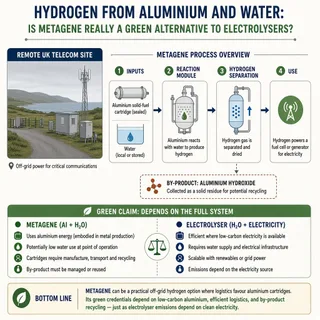
How metagene hydrogen work, typical output, costs and limits, and whether they have a future for UK homes, balconies and businesses.
Hydrogen from aluminium and water, in the form described by METAGENE, is not a buyable or demonstrated green alternative to electrolysers for UK homes or businesses. The October 2026 material is a French defence-innovation demonstrator, described as about technology readiness level 3 and aimed toward roughly TRL 5–6. It is not a UK trial, a domestic appliance, or a published lifecycle result. Whether the route could ever be low-carbon depends on yield, residue recovery, and the electricity used to make and regenerate the metal. None of those figures has been published in a form an independent reader can check. Until they exist, cylinders, batteries, or site electrolysis remain the options an engineer can specify and maintain.
A green label on the gas made at the point of use does not settle the question. Water is a reactant, not the energy source. The energy was spent earlier, when the aluminium and silicon were smelted or when spent solid was regenerated. Calling the output green hydrogen is a project claim unless that full loop is measured.
The funding details in circulation should be read as consortium claims, not as figures re-checked against a primary award letter on this page. As stated in accounts of the consortium announcement dated 27 October 2026, Novacium, Axel'One and AD-VENTA said they had secured nearly €1 million from French defence innovation bodies, the Direction générale de l'armement and the Agence de l'innovation de défense. The same accounts describe a 30-month programme that began on 1 September 2026, intended to move a solid-fuel hydrogen generator from about TRL 3 toward roughly TRL 5–6. This page cannot show the award notice, the eligible-cost schedule, or a DGA or AID project file. Treat the sum, the start date and the readiness target as what the consortium said, and look for those primary documents before relying on them in a specification or a carbon account. Public money of that kind, even if confirmed, is not evidence that the route is cheap, safe, or low-carbon, and it is not a grant for UK buyers. The stated concept uses a recyclable aluminium-and-silicon material that reacts with water in the presence of an activator, releasing hydrogen at the point of use. A longer-term idea is a compact high-pressure dispenser for remote civilian and military sites. None of that is an installer offering, a household product, or a supply chain in Britain. Anyone comparing it with an electrolyser still needs yield, regeneration energy, residue recovery, delivered cost and a full emissions boundary.
An aluminium hydrogen generator does not split water with site electricity in the way an electrolyser does. Aluminium, and in this concept silicon as well, reacts with water when an activator is present, and hydrogen comes off as a product of that chemical reaction. The useful hardware is a controlled reactor, not a bucket of scrap and a hose.
In practice the activator has to start and limit the reaction. Gas has to be dried and checked for purity, then used at low pressure in a fuel cell or engine, or compressed if the dispenser concept is ever built. Spent solid and process water leave the reactor and have to be stored, classified and moved. Dirty, saline or mineral-rich water can change the rate, foul the bed and contaminate the gas, so a laboratory result on clean water is not a coastal or farm result. Secondary descriptions of the project refer to a European patent application covering hydrogen production by chemical decomposition of water using metals or metalloids. The application number, the applicant named on the filing, and the status (published, pending, granted or withdrawn) are not available in the materials this article can check, so they are not cited here. A filing, if later confirmed on a patent register, would describe a claimed method. It would not publish a measured yield, a purity specification, or a route a UK installer can specify. Textbook aluminium–water chemistry is also not a METAGENE result. Fully converted pure aluminium has a theoretical ceiling on the order of one kilogram of hydrogen from roughly nine kilograms of aluminium, before silicon content, incomplete reaction, activator mass, hardware losses and the energy to make the metal again. Treat that only as a chemistry ceiling. Silicon in the solid fuel means the pure-metal figure does not transfer to this project, and no measured kilograms of METAGENE fuel per kilogram of hydrogen have been published.
The consortium split matches an early reactor, not a finished product. Novacium is associated with the solid fuel and the reaction concept, often described in coverage as a Novacium hydrogen reactor. Axel'One is a process-development platform, which is where residue handling, scale-up and repeatable operation would have to be shown. AD-VENTA brings fuel-cell and hydrogen-system experience, which matters because hydrogen a cell or engine cannot accept is not a power solution. TRL 3 is experimental proof of concept. Moving toward TRL 5–6 over about 30 months would mean a relevant environment and a more integrated demonstrator, not a catalogue item for UK islands or telecom estates. A 30-month duration from 1 September 2026 would, on the calendar alone, run into early 2029. That is arithmetic on the stated length, not a published completion date or a month-by-month schedule. Later milestones are things to watch, not commitments already made. Defence innovation funding in France, as described, sets the first users in view: remote civilian and military loads, not balconies or domestic cupboards. A high-pressure dispensing concept, if it is ever built, is specialist pressure-equipment work. It is a poor fit for an ordinary home. No domestic microgeneration pathway is described, and nothing in the announcement creates one.
Britain does have awkward sites. Island loads, telecom cabins, construction compounds, environmental monitoring, disaster response and defence locations often treat diesel deliveries or gas cylinders as a recurring logistics job. On-demand hydrogen could, in principle, avoid holding a stock of compressed hydrogen if the solid fuel, water and activator can be brought in more simply and the gas is made only when needed. That is a use-case argument, not a procurement case. Remote UK sites already run on cylinders, batteries, diesel, or a limited mix of renewables and storage. This announcement replaces none of those baselines. Solid fuel and reaction residue would still be transported, stored and recovered. Water quality, activator control, outdoor start-up, hydrogen purity and safe venting or compression would decide whether a unit is operable on a wet, salty or constrained site. A farm with an isolated pump, or a contractor with a temporary compound, should not redesign around a French laboratory project. If power capacity, water or planning already rules out electrolysis, a future solid-fuel generator might be worth a briefing after yield, residue classification and a service model exist. Until then the practical comparison is still cylinders, methanol fuel cells where they are already specified, batteries, or diesel, judged on delivered energy at the load.
When hydrogen is generated by consuming metal, the metal is functioning as a transportable fuel, more precisely as a solid hydrogen carrier. The on-site step releases hydrogen that was chemically available in the reaction between metal and water. It does not create energy, and it does not make the hydrogen renewable by itself. Recyclable is not the same as recycled on a short, local, low-carbon loop. Aluminium and silicon production are electricity-intensive. If smelting or regeneration uses fossil power, the hydrogen inherits that carbon even if the UK site looks clean. If regeneration is downcycling rather than a closed loop back to the same fuel, both the mass balance and the emissions boundary change. Avoiding a hydrogen cylinder moves the hazard and the energy account. It does not delete them. The device is still intended to produce hydrogen, possibly later at high pressure. Exclusion zones, ventilation and competent gas work would remain. “No cylinders on site” is not a safety approval.
No measured carbon intensity has been published for this fuel, so the cases below are a boundary sketch only. They are not METAGENE results, not a lifecycle assessment, and not figures a buyer can use. They show why the electricity mix and the fate of the residue can reverse a “green at the tap” claim without any change to the on-site hardware. If primary metal is smelted on a fossil-heavy grid, the hydrogen carries that upstream electricity even when the UK reactor uses little or no site power. The point-of-use step can look clean while the metal plant dominates the account. Transport of fresh solid and return of residue sit in the same sum, and they do not disappear because the gas was made on demand. If residue is regenerated back to the same fuel with low-carbon electricity and heat, and recovery is genuinely closed, the on-site reaction can look much cleaner. That conclusion holds only if activator manufacture, incomplete conversion, purge losses, water treatment and logistics are inside the same boundary. A renewable power contract at the smelter that does not cover those streams is not a full-loop result. If residue is downcycled into a lower-value product and fresh primary metal keeps entering, the system is metal consumption with a hydrogen by-product, not a circular carrier. In that case the carbon claim tracks new metal, not the absence of an electrolyser. Company wording that the fuel is recyclable does not choose among these three boundaries. Only a published mass balance and energy balance can.
Nothing published for this project is an assessment against British duties for flammable gas, pressure equipment or low-carbon hydrogen claims. Naming the regimes below is a checklist of missing evidence, not a finding that a future device would pass or fail them, and not a design code for a unit that does not exist on the UK market. Flammable hydrogen would still sit under the Dangerous Substances and Explosive Atmospheres Regulations 2002, usually called DSEAR. A competent person would expect a risk assessment, control of ignition sources, ventilation or containment, and hazardous-area thinking wherever gas can accumulate. That duty is about the site and the way gas is made, stored or vented. It is not waived because the hydrogen started as a solid. If the gas is held or moved as a pressure system, the Pressure Systems Safety Regulations 2000 would need to be considered, including whether a written scheme of examination is required for the vessels and protective devices actually installed. Placing pressure equipment on the Great Britain market is a separate conformity question under pressure-equipment regulations. A high-pressure dispenser concept would make that question central. A low-pressure laboratory reactor would not remove it if compression is added later. Northern Ireland market rules can differ, and no conformity file has been published for either case. For any comparison with cylinder hydrogen, guidance from the British Compressed Gases Association is the practical industry reference for storage, handling and siting. No published note maps this reactor, its purge method or a future dispenser against that guidance. Existing waste and water-discharge duties would also apply to spent solid and process water. Composition of the residue has not been published, so a waste code cannot be assumed from textbook aluminium hydroxide. The UK Low Carbon Hydrogen Standard is the evidence framework used in UK policy for whether a hydrogen production pathway is low carbon. Meeting it requires a greenhouse-gas method and data across the pathway that is being claimed. No such method, dataset or third-party check has been published for METAGENE. The project therefore cannot be treated as compliant with that standard, and French defence funding is not a substitute for it.
No independently verified METAGENE figures have been published for hydrogen yield per kilogram of solid fuel, overall efficiency, cost, purity, residue handling or recycling energy. Without those, a comparison with an electrolyser is not a calculation. Electrolyser electricity use is often discussed in tens of kilowatt-hours per kilogram of hydrogen at system level, and even that depends on technology and operating point. It is still the wrong boundary if metal production sits outside the METAGENE sum. The project would need to publish, and preferably have checked by someone who does not sell the fuel, at least the following before a UK specifier could treat it as a competitor to on-site electrolysis or to delivered cylinders.
Commercial cost in Britain is unknown. Do not treat French defence funding as a price signal, a grant for UK buyers, or proof of economy. A specifier should also expect a written interface, a fuel specification, a pressure rating, a purge method, a maintenance interval, and a named party who takes spent solid back. None of those is in the announcement.
An electrolyser makes hydrogen from electricity and water on site, so its carbon and cost track the power supply, the load factor and whether the hydrogen is stored. A solid carrier moves that energy upstream into metal production and brings mass back as residue. Cylinders move finished hydrogen and bring empties back. Batteries skip hydrogen entirely, which is often the simpler design when the load is electrical and the duty is within storage limits.
Methanol fuel cells sit in a similar logistics family to cylinders for some remote kits. A liquid fuel is delivered, and the site avoids making hydrogen from metal or from an electrolyser. They are not a METAGENE result. They show that hydrogen at the load is only one architecture. Where the end use is kilowatt-hours of electricity, a battery or a generator may remain the design an engineer can actually maintain. Hydrogen as an intermediate adds purity, purge and ventilation work that a company release does not remove. Installers should not be asked to quote this system. There is no published interface to design against. Spent solid and process water are not a minor by-product. If a demonstrator ever appeared in Britain, the first questions would be residue classification, water discharge, exclusion zones under DSEAR, pressure-system duties if gas is compressed, and who takes the spent solid back. Those questions are unanswered in public.
The only schedule in public view is the consortium’s stated 30-month aim to approach TRL 5–6 from a start on 1 September 2026. Through 2029, the credible signals are a measured yield with the fuel as made, a stated regeneration route, residue recovery rates, gas purity suitable for a named fuel cell or engine, and an independent energy balance that includes the metal loop. A patent number that can be opened on a register, with applicant and status, would clarify the intellectual-property claim. It would still not be a performance test. A further funding round or a laboratory photograph is not those signals. Ignore any implication that French defence money is a UK grant, that a patent is a carbon result, or that balconies and homes are a market. There is no domestic reactor to specify, no published UK trial, and no reason to treat this as a solar, battery or heat-pump decision. Organisations that already move hydrogen, or that cannot host electrolysis because of power, water or planning, are the only group for whom a later solid-fuel generator might be relevant. Even they should wait for the missing evidence rather than reserve a design around it. If you are sizing power for a building or a site today, measure the electrical load and the hours it must run, then compare storage and generation you can buy, service and insure. Ask whoever offers hydrogen, of any kind, for the emissions boundary, the pressure duties and the residue path in writing. Hydrogen from aluminium and water may become a remote-fuel option after those figures exist. On the October 2026 evidence, it is not a green alternative to electrolysers.
Solar comparison
Enter your postcode to assess your roof, compare solar options and connect with trusted UK installers.
Choose home, business or industrial, then enter your postcode. RoboMo maps the roof and ranks panel brands by fit.
1. Postcode Start the assessment for your property.
2. Pin the roof Mark the array on the map.
3. Compare RoboMo™ builds your options.

Battery ROI tool
Enter the day rate, off-peak rate and export rate. The calculator ranks batteries in the Kilowatts shop over 10 years. Home batteries also suit offices and small commercial sites.
Reading
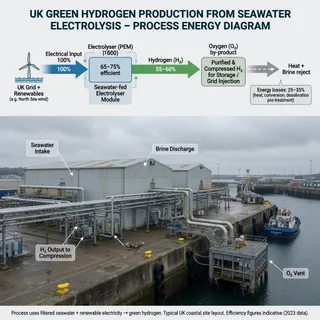
A seawater hydrogen system announced on 5 October 2026 does not push raw seawater through the cell. Waste heat pulls purified water out first.
Read article
Read article
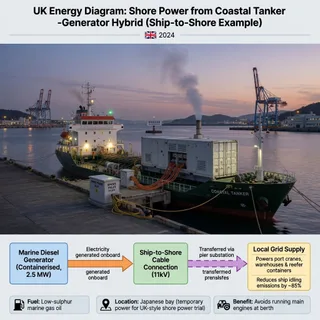
Japan’s Kikomaru tanker completed a short hydrogen-engine voyage, but HVO pilot fuel means it was not hydrogen-only. What UK ports should note.
Read article

How a solar diverter sends midday surplus into your immersion heater, why tanks heat from the top down, and whether it suits your UK home.
Read article
Write for Kilowatts.uk
Write it here under your own name. Sign in, put a profile up, and start a guide. Pay only if you want more links from your articles out to your own site.
Create a Kilowatts.uk account, or sign in if you already have one.
Put your name, photo and experience on a public author page.
Write a guide or a blog. Free authors can put one followed link to their own site in articles each month.
FAQ
Live help
Talk to RoboMo™ and get instant answers.
Live chat