


Wind plus battery for UK commercial sites: UK business guide
Published: 2026-09-29 05:28:09
Updated: 2026-10-02 23:52:30
Wind plus battery is credible for a UK commercial site only with usable rotor-height wind, planning and a connection. Storage cannot make wind firm power.
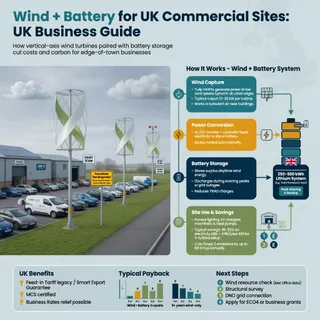
Wind plus battery for UK commercial sites - UK business guide
UK business guide Flower Turbines VAWT + storage
Is wind plus battery for UK commercial sites a credible option?
Wind plus battery is a credible option for a UK commercial site only where the wind at rotor height is strong enough to matter, planning and a distribution-network connection can be secured, and the business can use the electricity or store a finite amount of it. A battery does not create wind energy. It does not turn an intermittent generator into firm power. Exposure, how long the occupier will stay, noise, aviation and whether rooftop solar is the simpler on-site generator usually decide the case before a turbine model is chosen.
The question is commercial, not domestic. An office, warehouse, retail park or campus either has usable wind at the rotor, space away from neighbours, and a long enough occupation to test the case, or it does not. Small vertical-axis turbines are sometimes offered for built-up sites because they accept wind from any direction. That feature does not prove the yield, the noise case or the connection.
Treat the energy model, the planning case and the network application as three different jobs. A regional wind summary, a brochure city yield or an assumed support payment will not stand in for any of them. If those three jobs are not commissioned early, the quote is a product price, not a commercial wind project.
What the battery can and cannot do
A battery on a wind scheme stores a limited quantity of electricity that has already been generated or imported. It can raise the share of generation used on site, absorb a short export spike, or reduce a demand peak if it is controlled against the site load. Once it is full it cannot take a windy night. Once it is empty it cannot cover a calm period.
Usable capacity, in kilowatt-hours, is the energy the battery can actually cycle, not a headline nameplate. The power rating, in kilowatts, is how fast it can charge or discharge. A large energy store with a small power rating will not shave a sharp peak. A high power rating with little stored energy will not move an overnight windy spell into the working day. Round-trip losses mean less electricity comes back than went in. The loss figure should come from the specified equipment, not from a generic percentage.
Most storage paired with commercial wind is there for self-consumption or peak reduction. Island-mode backup is a separate design, with its own protection and changeover arrangements. It should not be assumed from a standard battery schematic. Storage also adds plant space, a fire-safety design and often a further question for the network operator. The fire strategy needs agreement with the designer, the insurer and building control, plus maintenance access, not only a single-line diagram.
Why the wind at rotor height decides yield
Yield depends on the wind at rotor height on that site, not on the idea that the UK is a windy country. Premises in towns, on retail parks and on business estates are often sheltered by buildings, trees and ground form. A warehouse yard that feels breezy at ground level can still be a poor rotor location if the flow is blocked or highly turbulent at the hub.
The energy available in the wind rises with the cube of wind speed, so a modest fall in average speed cuts the resource sharply. Turbine electrical output does not follow that cube across the whole power curve. Cut-in speed, the rated power cap, turbulence, availability and electrical losses all sit between the wind and the kilowatt-hours on a meter.
A usable model separates mean wind speed, the distribution of wind speeds, downtime and any curtailment caused by an export limit. A sales estimate based on a regional wind speed will not match generation at the real rotor. Nameplate power, in kilowatts, is not annual generation in kilowatt-hours. There is no honest national capacity factor that can be dropped onto every small commercial turbine.
Where Flower Turbines and other small VAWTs fit
A vertical-axis wind turbine rotates about an upright shaft and can accept wind from any direction without yawing. A horizontal-axis machine is the conventional propeller type and is normally pointed into the wind. Neither type is automatically better in turbulence. Turbulence can reduce output and increase fatigue for both, so a claim of being better in the city needs measured performance, not a category label.
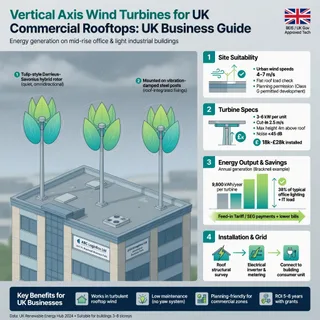
Flower Turbines are a branded range of small vertical-axis machines with a tulip-like rotor, sold singly or in a close group often called a bouquet. They are small commercial or urban machines, not utility-scale turbines. Rated power, noise, dimensions and mounting options have to come from the current manufacturer documents. Any claimed uplift from close spacing is a manufacturer claim until independent test evidence is in the pack. It should not be used in a planning or investment case before that check.
Quieter operation is also a measurement question. Ask for sound data at stated distances and wind speeds, and compare that with the limit the planning authority will actually apply. Whether a given model is suitable still depends on its size, noise evidence, foundation loads and published performance data, which a general guide cannot establish. Enquiries about that product class can start with Flower Turbines for businesses, then move straight to a site-specific resource and consent check. Rooftop mounting is a similar shortcut. Many small commercial turbines are more realistically treated as freestanding until a structural engineer has accepted the loads, vibration and fixings.
Planning, noise and the distribution-network agreement
Planning and connection usually decide whether a project can be built, and they are separate from the energy model. Non-domestic turbines commonly need planning permission, with noise, appearance, ecology, aviation and heritage as typical constraints. The route is not the same in England, Wales, Scotland and Northern Ireland, so permitted-development rights for non-domestic small wind should be checked for that nation rather than assumed.
Grid connection is agreed with the distribution network operator for that area. Smaller generation is often discussed under G98 and larger plant under G99, with export limitation sometimes handled under G100. Numeric thresholds and the current process must be confirmed for the site before equipment is ordered. An offer from one network area is not a template for another. Changing the inverter, adding solar, or altering the export cap can make the operator treat the job as a different proposal.
An export limit can restrict output even when the wind is available. Curtailment should be logged rather than discovered as an unexplained shortfall later. Whether export is allowed, at what limit, and on what commercial terms depends on the connection, the metering and the supply contract. Export income should not be written in as guaranteed revenue. On a tenanted office estate or retail park, a technically workable machine can still fail because the lease is short, the landlord will not accept foundations, or reinstatement is unclear. Screen aviation, links and ecology before the layout is fixed, and agree noise limits and a measurement method with the planning authority.
How this compares with commercial rooftop solar
Commercial rooftop solar is often the more straightforward on-site solar generator where there is a large unshaded roof and the daytime load can use the output. Wind plus storage is not automatically preferable. It is a weak alternative if the case only works with an optimistic urban yield, a high export price or an assumed grant. Installed costs, grant rates and payback are not stated here, because a national figure would be an invention. Questions about commercial solar panel cost for warehouses, offices or shops need their own sourced prices. Where both resources exist, the profiles can complement each other. In the UK, wind is often stronger overnight and in winter, while solar is weighted towards daytime and summer. That complementarity is real only if both sets of equipment, both resources and enough connection capacity are actually present. If the site already has solar, or is planning it, the network application has to describe the combined generation. A larger commercial scheme discussed under G99 is about that whole connection, including any export limit, not each technology in isolation. The useful comparison is about constraints, not a national winner against grid electricity. Solar versus a supply contract, and wind versus that same contract, both depend on the tariff, the export terms and how much generation the site can actually use. Those commercial terms should be read from the supply contract, not guessed in order to favour one technology.
Which premises are a clearer or weaker fit
The combination is more plausible where there is open exposure, space for rotors and separation from neighbours, a long occupation, and a demand profile that can use windy-period generation or justify storage. Some industrial estates, campuses and edge-of-town sites fit that description better than enclosed courtyards or tightly packed retail units. A business that already holds half-hourly consumption data, and that will remain on site long enough to test the case, is a clearer candidate than a short lease with no load records.
It is a weak fit where the wind resource is poor or unmeasured, where planning or aviation constraints are likely, where there is no space off the building, or where a large unshaded roof makes solar the simpler project. It is also a weak fit if the occupier needs silent, invisible plant. Storage does not remove the need for a connection agreement. A battery sized only in a sales conversation will not rescue a sheltered site.
Flower Turbines are one vertical-axis product, not a default answer to every commercial wind enquiry. A cluster layout still needs clearance for foundations, underground services, lifting and maintenance. On retail parks and car parks those items are often underestimated. Vibration isolation matters if a roof or podium fixing is proposed. Insurance should be asked whether the machine and the battery enclosure are acceptable before the layout is treated as settled.
How a credible project is actually assessed
The energy model, the planning noise case and the distribution-network application should be commissioned as separate pieces of work, then checked against each other. The designer is testing whether the rotor can see the wind, whether the structure and neighbours can live with the machine, and whether the network will accept the power when it appears. A manufacturer city-yield calculator is not that model. It should not be used as the financial case.
Commissioning should demonstrate both the turbine protection and the battery operating priority. Self-consumption, peak reduction and an export cap can conflict if they are not ordered deliberately. The battery may sit on the site alternating-current system rather than inside the turbine, but it still has to respect the same export limit and protection settings as the rest of the generation. Metering needs to show import, export and, where it is relevant, generation, or nobody can check the model later. A moving machine also needs a maintenance arrangement that rooftop solar owners often do not expect, including safe access when the rotor is stopped.
Before any order, the useful questions are about evidence rather than brand preference. If the answers are thin, the site is not ready to buy.
If those answers are missing, pause. A measured wind assessment, a planning pre-application view and written confirmation of the connection route are the steps that turn a brochure into a project, or that stop a weak site before deposits are paid.
Plan, Compare & Buy Renewable Energy Solutions
AI does the thinking.
You get the perfect solar match.
Use RoboMo™ to assess your property, compare available technologies and connect with trusted UK installers, suppliers and manufacturers.
Simply enter your postcode, drop a pin on your roof, create your free account and let RoboMo™ analyse your property to find the best solar panels for your home.

You don't have to think
RoboMo™'s AI analyses your roof and does all the hard work.

Accurate & tailored
AI-powered assessment based on your roof, location, and conditions.

Best options, maximum savings
Compare top solar panels for the best performance and value.

Simple, fast & effortless
Provide a few details, sit back and watch your results unfold.
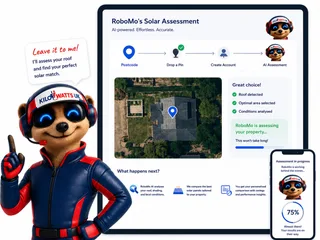
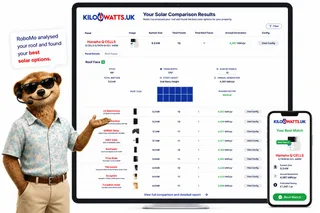
STEP 1
Choose Home, Business or Industrial
Enter your postcode to start your assessment.
STEP 2

Drop a pin on your roof
STEP 3

Create your free account
STEP 4

Sit back and watch RoboMo™ work
RoboMo™ analyses your roof and builds your personalised solar comparison.

Kilowatts UK is an authorised representative
Flower Turbines
Compact vertical-axis turbines built for real UK sites, not just open farmland.
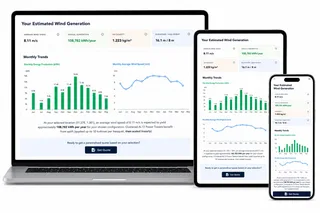
They start in light wind, sit in a small footprint, and are bird-safe by design. Cluster them as a bouquet and the group performs better together than the same turbines standing alone. Enter your postcode for a location-based generation estimate. Figures use area weather data and will differ if buildings, trees or hills sit in the way.
Starts in light UK wind
Built to generate in typical UK wind, not only open farmland.
Small rooftop or ground footprint
Compact towers for roofs, yards and tight sites.
Bird-safe slow rotation
Slow vertical-axis spin, bird-safe by design.
Bouquet clusters raise output
Grouped turbines outperform the same units standing alone.
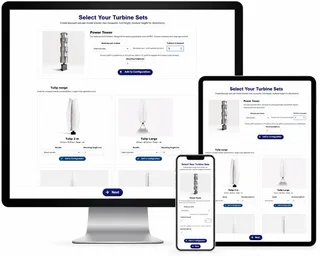
Step 1
Enter your postcode
Start designing your wind energy system in seconds.
STEP 2

Choose a location
STEP 3

Place your cluster
Tap the map where you want the turbine cluster to go.
STEP 4

Instant generation forecasts
Compare different turbine layouts and see annual generation forecasts instantly.
STEP 5

No commitment required
Explore different configurations before deciding whether to request a quotation.
Related articles
Mo's Mission Nominations
FAQ
Need Help? RoboMo's Got Answers
Is wind plus a battery a credible option for a UK commercial site?
It can be, but only where the wind at rotor height is strong enough to matter, planning and a distribution-network connection can be secured, and the business can use the electricity or store a finite amount of it. A battery does not create wind energy, and it does not turn an intermittent generator into firm power. Exposure, how long the occupier will stay, noise, aviation and whether rooftop solar is the simpler on-site generator usually decide the case before a turbine model is chosen. A regional wind summary, a brochure city yield or an assumed support payment will not stand in for an energy model, a planning case and a network application.
What can a battery do on a commercial wind scheme, and what can it not do?
A battery stores a limited quantity of electricity that has already been generated or imported. It can raise the share used on site, absorb a short export spike, or reduce a demand peak if it is controlled against the site load. Once it is full it cannot take a windy night, and once it is empty it cannot cover a calm period. Usable capacity in kilowatt-hours is the energy that can actually be cycled, the power rating in kilowatts is how fast it can charge or discharge, and round-trip losses should be taken from the specified equipment rather than a generic percentage. Storage also needs plant space and a fire-safety design agreed with the designer, the insurer and building control, and island-mode backup is a separate design that should not be assumed from a standard schematic.
Why does wind at rotor height matter more than a regional average?
Yield depends on the wind at rotor height on that site, not on the idea that the UK is a windy country. Premises in towns, on retail parks and on business estates are often sheltered by buildings, trees and ground form, so a yard that feels breezy at ground level can still be a poor rotor location if the flow is blocked or turbulent at the hub. The energy available in the wind rises with the cube of wind speed, so a modest fall in average speed cuts the resource sharply, although electrical output does not follow that cube across the whole power curve. Nameplate power in kilowatts is not annual generation in kilowatt-hours, and there is no honest national capacity factor that can be dropped onto every small commercial turbine.
Are Flower Turbines or other small vertical-axis turbines a good fit for built-up commercial sites?
A vertical-axis turbine can accept wind from any direction without yawing, but that feature does not prove the yield, the noise case or the connection. Flower Turbines are a branded range of small vertical-axis machines, sold singly or in a close group, and they are small commercial or urban machines rather than utility-scale turbines. Any claimed uplift from close spacing, and any claim of quieter operation, should be checked against independent test evidence and sound data at stated distances and wind speeds before it is used in a planning or investment case. Suitability still depends on size, noise evidence, foundation loads and published performance data. Rooftop mounting should not be assumed until a structural engineer has accepted the loads, vibration and fixings.
Do commercial wind turbines need planning permission and a network agreement?
Planning and connection usually decide whether a project can be built, and they are separate from the energy model. Non-domestic turbines commonly need planning permission, with noise, appearance, ecology, aviation and heritage as typical constraints, and the route is not the same in England, Wales, Scotland and Northern Ireland. Grid connection is agreed with the distribution network operator for that area. Smaller generation is often discussed under G98 and larger plant under G99, with export limitation sometimes handled under G100, but numeric thresholds and the current process must be confirmed for the site before equipment is ordered. An export limit can restrict output even when the wind is available, and export income should not be treated as guaranteed revenue.
How does wind plus battery compare with commercial rooftop solar?
Commercial rooftop solar is often the more straightforward on-site generator where there is a large unshaded roof and the daytime load can use the output. Wind plus storage is not automatically preferable, and it is a weak alternative if the case only works with an optimistic urban yield, a high export price or an assumed grant. Where both resources exist, wind is often stronger overnight and in winter while solar is weighted towards daytime and summer, but that complementarity is real only if both sets of equipment, both resources and enough connection capacity are actually present. If the site already has solar, or is planning it, the network application has to describe the combined generation. Installed costs, grant rates and payback are not national figures that can be stated in advance.
Which commercial premises are a clearer or weaker fit?
The combination is more plausible where there is open exposure, space for rotors and separation from neighbours, a long occupation, and a demand profile that can use windy-period generation or justify storage. Some industrial estates, campuses and edge-of-town sites fit that description better than enclosed courtyards or tightly packed retail units. It is a weak fit where the wind resource is poor or unmeasured, where planning or aviation constraints are likely, where there is no space off the building, or where a large unshaded roof makes solar the simpler project. On a tenanted estate, a short lease, a landlord who will not accept foundations, or unclear reinstatement can stop a technically workable machine. A battery sized only in a sales conversation will not rescue a sheltered site.
What should be checked before a wind-plus-battery system is ordered?
The energy model, the planning noise case and the distribution-network application should be commissioned as separate pieces of work, then checked against each other. A manufacturer city-yield calculator is not that model and should not be used as the financial case. Ask for wind data at the proposed rotor height and a speed distribution, and confirm with the distribution network operator whether G98, G99 or an export-limit arrangement applies before ordering. Commissioning should show both the turbine protection and the battery operating priority, because self-consumption, peak reduction and an export cap can conflict if they are not ordered deliberately. Metering needs to show import, export and, where relevant, generation, and a moving machine needs a maintenance arrangement that includes safe access when the rotor is stopped.