


How does solar installation work in the UK?
Published: 2026-10-07 01:15:25
Updated: 2026-10-06 18:16:27
A UK solar installation covers the survey, structural and electrical checks, mounting, inverter wiring, testing and grid paperwork before export.

How does solar installation work?
Understand how does solar installation work in the UK, with clear explanations, examples, and practical next steps.
How does solar installation work in the UK?
Solar installation means fixing photovoltaic modules to a suitable roof or a small ground array, wiring them through an inverter, and connecting that system so the property can use the electricity. Where the distribution network operator agrees, surplus power can also be exported. The job is not finished on the day the panels go up. Survey, structural and electrical checks, access, testing and grid paperwork all sit in the same piece of work.
In practice the sequence is similar on a house, a commercial building, a factory or a farm. What changes is roof structure, whether the supply is single-phase or three-phase, how much power the site uses while the sun is out, and whether the local network can take export. Smaller inverter connections are often handled under Energy Networks Association Engineering Recommendation G98. Larger or more complex connections usually fall under G99. Which document applies, and whether the step is a notification or an application, is set by the operator for that site and equipment list. Thresholds and forms change, so they are not a national shortcut.
A design that looks tidy on a satellite image can still fail once rafters, cable routes and the consumer unit are inspected. The disruptive part is often scaffolding and isolation of circuits, not the module count alone. Once materials and access are booked, a straightforward domestic roof is commonly finished over a small number of site days. Larger commercial and farm jobs take longer because design, access and network applications stretch the programme. Those timings are indicative only and depend on the site.
What is checked before any module is fitted
A proper survey is more than a tape measure of the roof. The installer needs orientation, pitch, usable area, and shading from chimneys, dormers, trees or neighbours, plus the condition of tiles, slate, metal sheet or flat-roof membrane. Brackets have to land in structure, such as rafters or purlins, not only in the covering. Wind and snow loading, and the age of the roof, decide whether the array is sensible before anyone prices a larger layout. On a flat roof, a ballasted frame still needs a structural view of the extra load. On a metal roof, clamps may avoid some penetrations, but the sheet and the purlins still have to be sound.
Electrically, the visit should cover spare ways in the consumer unit, earthing, a safe cable route through the loft or risers, and a place for the inverter with ventilation and later access. If there are no spare ways, or the board is obsolete, a consumer-unit change can become part of the job and lengthen the time circuits are off. If a battery is in scope, location, heat, fire separation and whether the chosen inverter can charge and discharge it all need naming before the kit is ordered. A home battery only fits the job if the design names the inverter, the protection and the cable routes.
Generation is then matched to how the building uses power, not to a generic south-facing assumption. A factory or farm with daytime plant load can use a larger share of what the array produces. A home that is empty on bright weekdays may export more of it. Export is not automatic, and it is not granted by the survey.
What happens on the roof and at the consumer unit
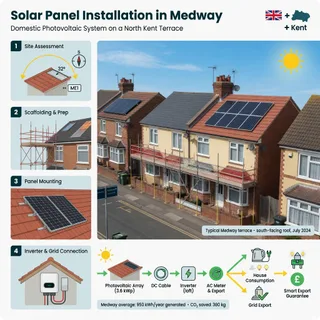
On the install days the roof is opened only as far as the fixing method requires. Rails or equivalent mounts are fixed into the structure, modules are clamped, and DC cables are routed so they are supported, labelled and able to be isolated. In a loft, those cables should stay identifiable and clipped, not lost under insulation where heat cannot escape. String layout follows the voltage and current limits of the inverter, not only how neat the array looks from the street. Heavy shade on one part of the roof can force a different grouping, or module-level electronics, even when the rest of the roof is clear.
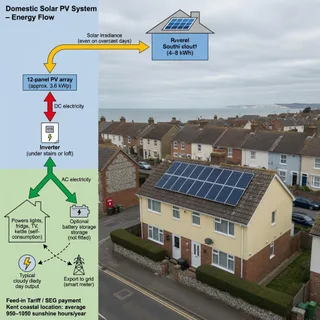
Indoors, circuits may be switched off while the AC side is connected. The inverter turns the array’s direct current into alternating current the building can use. DC isolators, AC isolation and clear labels exist so the system can be shut down safely years later, not only so the job can be signed off. The electrical design and test results should follow BS 7671, the IET Wiring Regulations, as applied by a competent person to that property. In England and Wales, notifiable electrical work in a dwelling is often handled through a competent-person scheme rather than a separate building-control application, but that route is not automatic. Scotland and Northern Ireland use different building-standards systems. Ask who, if anyone, notifies building control, and keep that note with the handover pack.
Metering and the import and export arrangement should already have been specified, because they decide what the inverter is allowed to do and how exported units are recorded. Homeowners often underestimate loft access, dust, and a scaffold that stays up longer than the electrical work. Where the scaffold stands on a pavement, a local permit can add time before the roof date. On a commercial or agricultural site the same tasks move into plant rooms, risers and yards, and any shutdown has to fit production or livestock routines. A cherry picker or crane can dominate the programme more than the number of modules.
How testing finishes a solar installation
Commissioning is the point at which the system is tested and left able to generate for the building. That includes the checks the designer specified, such as polarity and isolation, confirming the inverter settings, and proving that shutdown works as labelled. Handover should give you an as-built layout, those settings, and a plain shutdown procedure. Without that pack, a later roof repair or inverter swap becomes guesswork. Product warranties remain a manufacturer matter. They are not a prediction of how long a UK system will run without an inverter replacement. Inverters are commonly expected to need attention sooner than the modules, but no national lifespan should be assumed.
Notification or application to the distribution network operator is part of making export lawful and safe, not an optional extra after the roof looks finished. In broad terms, G98 is the route often used to notify a smaller inverter connection, and G99 is the route often used where an application is required before, or as a condition of, connection. Some jobs can generate for the building before export is agreed. Others should not be switched for export until the operator has responded. If the approval names a particular inverter or equipment list, changing that model afterwards can mean a new submission. Do not treat a generic online guide as the form for your area. Ask which operator covers the site, which process applies to this equipment, and what must stay unchanged.
An MCS certificate, where one is issued, records that a Microgeneration Certification Scheme member completed an installation to that scheme’s standards. It is not a description of every fixing on the roof, and it does not by itself prove the local network has accepted export. The Smart Export Guarantee is a separate arrangement. Ofgem sets the framework under which licensed suppliers that must participate offer an export tariff. The supplier sets the rate and the contract. Eligibility commonly depends on scheme evidence such as MCS, and on a meter that can record export, but you should confirm both with the supplier rather than assume payment starts on the install day. Two further points sit beside the technical handover, and neither is a price or a payback claim. In Great Britain, the supply and installation of many solar systems in residential accommodation has been zero-rated for VAT under rules in place since 2022, but that treatment depends on the property, what is included in the supply, and the law at the time of the contract. Northern Ireland can differ. Ask for the VAT treatment in writing on the quote. Separately, tell your buildings insurer before or as soon as the array is installed. Cover, excess and any conditions are a matter for that policy, not for the MCS certificate.
How a solar PPA differs from owning the array
A solar power purchase agreement is a contract, not a type of panel and not a stage of the roof work. Under a PPA a third party may fund and own the array and sell electricity to the site. The physical sequence of survey, mounting, inverter, testing and network steps is still required. What changes is who carries the capital cost, who may alter the roof later, and who is paid for the kilowatt-hours. A PPA does not remove the need to understand shutdown, roof penetrations, access rights or export limits, because the building still has to live with the array. Commercial cost, commercial return and any battery return are site calculations, not outputs of the installation method. A larger array is not automatically the better commercial result if export is limited, the roof needs replacement first, or the site cannot use the power while it is being generated. Savings track self-consumption and the tariff you actually pay or receive, not the bright-day reading on the inverter. The Smart Export Guarantee, where it is relevant at all, is a supplier contract for eligible export. It is not a reason to skip the question of who owns the modules. Sites weighing finance routes can compare commercial solar options separately from the roof sequence.
Overview
Contract terms are not standard across providers. This article cannot tell you whether a PPA is cheaper or safer than owning the system. It can only separate the building work from the commercial deal so the two are not treated as the same decision.
When this installation process is the wrong next step
The process above fits someone who can alter the roof and the electrical installation, and who wants to understand a conventional UK rooftop or small ground-mounted array. It is a poor fit if the real question is a quote, a named installer, or a promise that a given three-phase supply can take a stated array. Homeowners who need product choices rather than a process description can compare home solar options once the roof constraints are known. A three-phase incoming supply does not by itself mean a large array will be accepted. The operator looks at the local network, not only at the phases in the building. Planning and listed buildings, and a specific operator’s connection queue, need the local rules and a survey, not a general description. Listed buildings and some conservation areas can restrict visible panels or roof alterations. That is a consent question for the local authority, not a result this sequence can decide.
Renters, and anyone else who cannot authorise work to the roof or consumer unit, generally cannot commission a standard rooftop system themselves. A roof due for replacement, a covering in poor condition, or an unresolved structural defect should be dealt with before modules are fixed through it. Very heavy shade can make a neat full-roof layout a weak design even though panels still produce something in indirect light. Plug-in balcony kits and other plug-and-play products are not the same job as a roof array tied into the property wiring. They should not be used as a mental model for isolators, string design, Building Regulations routes or DNO paperwork.
What to confirm before you book the work
Book the survey before you book a module count. The useful record is the notes on structure, shade, cable route, consumer-unit space and inverter location, not only a layout drawing from above. If a battery might be added later, ask whether that needs a different inverter and different cable routes now. Measure a week of daytime electricity use if you can, and note whether the supply is single-phase or three-phase. That will not produce a national payback figure, because none is reliable without the site, but it stops the design being sized only to the roof.
Ask the installer to name the distribution network operator, to say whether this equipment list is a G98 notification or a G99 application, and to say what must stay unchanged if an approval names particular kit. Ask who submits that paperwork, who notifies building control if that applies in your nation, and what the handover pack will contain. Keep the owned-system conversation separate from any PPA conversation until those physical constraints are known.
Plan, Compare & Buy Renewable Energy Solutions
AI does the thinking.
You get the perfect solar match.
Use RoboMo™ to assess your property, compare available technologies and connect with trusted UK installers, suppliers and manufacturers.
Simply enter your postcode, drop a pin on your roof, create your free account and let RoboMo™ analyse your property to find the best solar panels for your home.

You don't have to think
RoboMo™'s AI analyses your roof and does all the hard work.

Accurate & tailored
AI-powered assessment based on your roof, location, and conditions.

Best options, maximum savings
Compare top solar panels for the best performance and value.

Simple, fast & effortless
Provide a few details, sit back and watch your results unfold.
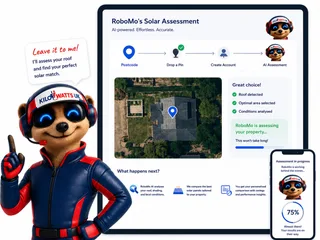
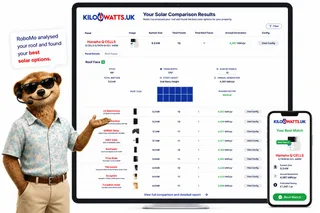
STEP 1
Choose Home, Business or Industrial
Enter your postcode to start your assessment.
STEP 2
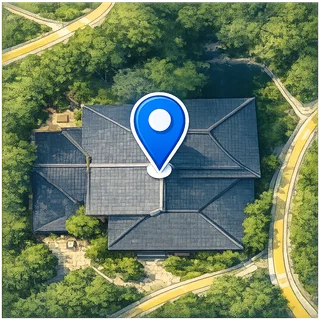
Drop a pin on your roof
STEP 3

Create your free account
STEP 4

Sit back and watch RoboMo™ work
RoboMo™ analyses your roof and builds your personalised solar comparison.

Step 1
Enter your postcode
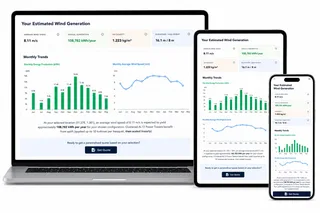
Start designing your wind energy system in seconds.
Are you an installer, distributor or renewable energy business?
Kilowatts UK is expanding the Flower Turbines partner network across the UK.
Become A Flower Turbines PartnerKilowatts UK is an authorised representative
Flower Turbines
Compact vertical-axis turbines built for real UK sites, not just open farmland.
They start in light wind, sit in a small footprint, and are bird-safe by design. Cluster them as a bouquet and the group performs better together than the same turbines standing alone. Enter your postcode for a location-based generation estimate. Figures use area weather data and will differ if buildings, trees or hills sit in the way.
Starts in light UK wind
Built to generate in typical UK wind, not only open farmland.
Small rooftop or ground footprint
Compact towers for roofs, yards and tight sites.
Bird-safe slow rotation
Slow vertical-axis spin, bird-safe by design.
Bouquet clusters raise output
Grouped turbines outperform the same units standing alone.
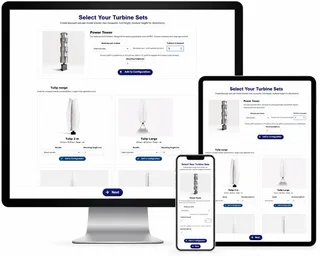
STEP 2

Choose a location
STEP 3
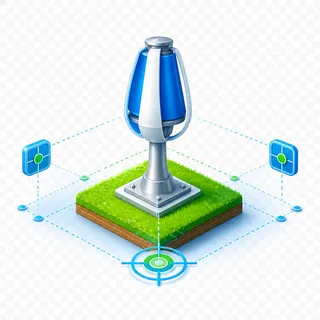
Place your cluster
Tap the map where you want the turbine cluster to go.
STEP 4

Instant generation forecasts
Compare different turbine layouts and see annual generation forecasts instantly.
STEP 5

No commitment required
Explore different configurations before deciding whether to request a quotation.
Related articles
FAQ
Need Help? RoboMo's Got Answers
What does a solar installation actually involve?
A solar installation means fixing photovoltaic modules to a suitable roof or a small ground array, wiring them through an inverter, and connecting the system so the property can use the electricity. Where the distribution network operator agrees, surplus power can also be exported. The job is not finished when the panels go up: survey, structural and electrical checks, access, testing and grid paperwork all sit in the same piece of work.
What is checked before any panels are fitted?
A proper survey covers orientation, pitch, usable area and shading, plus the condition of the roof covering and whether brackets can fix into rafters, purlins or another structural member. Electrically, the installer should confirm spare ways in the consumer unit, earthing, a safe cable route and a ventilated place for the inverter. If a battery is included, its location, heat, fire separation and the inverter that will charge it should be named before kit is ordered. Export is not automatic and is not granted by the survey.
How long does a solar installation take?
Once materials and access are booked, a straightforward domestic roof is commonly finished over a small number of site days, but that is indicative only and depends on the site. Scaffolding, circuit isolation and, where the scaffold stands on a pavement, a local permit can add time. Larger commercial and farm jobs usually take longer because design, access and network applications stretch the programme.
Do I need planning permission or listed-building consent?
This installation sequence cannot decide consent. Listed buildings and some conservation areas can restrict visible panels or roof alterations, and that is a question for the local planning authority. A survey and the local rules are needed before you treat the roof work as straightforward.
What is the difference between G98 and G99?
In broad terms, Energy Networks Association Engineering Recommendation G98 is often the route used to notify a smaller inverter connection, while G99 is often used where an application is required before, or as a condition of, connection. Which document applies, and whether the step is a notification or an application, is set by the operator for that site and equipment list. Thresholds and forms change, so ask which operator covers the site and what must stay unchanged if the approval names particular equipment.
What should I receive when the system is commissioned?
Commissioning is when the system is tested and left able to generate for the building, including checks such as polarity and isolation, inverter settings and a labelled shutdown. Handover should include an as-built layout, those settings and a plain shutdown procedure. Product warranties remain a manufacturer matter and are not a prediction of how long the system will run without an inverter replacement.
Does an MCS certificate mean I can export and get paid?
An MCS certificate, where one is issued, records that a Microgeneration Certification Scheme member completed an installation to that scheme’s standards. It does not describe every fixing on the roof and does not by itself prove the local network has accepted export. The Smart Export Guarantee is a separate supplier arrangement: eligibility commonly depends on scheme evidence such as MCS and on a meter that can record export, but you should confirm both with the supplier rather than assume payment starts on the install day.
How is a solar PPA different from owning the array?
A solar power purchase agreement is a contract, not a type of panel or a stage of the roof work. A third party may fund and own the array and sell electricity to the site, but survey, mounting, inverter, testing and network steps are still required. You should still understand shutdown, roof penetrations, access rights and export limits, and read the contract term and what happens if you sell or re-roof. This is not a statement that a PPA is cheaper or safer than owning the system.