


How does solar electricity work?
Published: 2026-08-17 16:37:06
Updated: 2026-08-20 03:01:04
Solar electricity uses photovoltaic panels to turn daylight into direct current electricity.
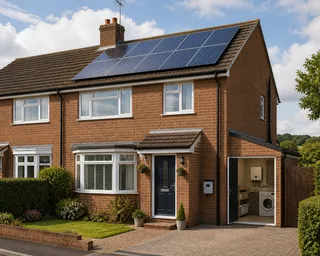
How does solar electricity work?
Understand how does solar electricity work in the UK, with clear explanations, examples, and practical next steps.
How solar electricity works in a UK home
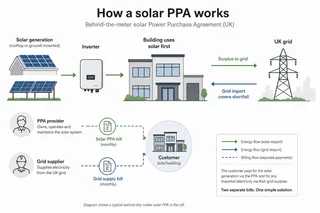
Solar electricity uses photovoltaic panels to turn daylight into direct current electricity. An inverter then converts this into alternating current for your home. In a typical UK solar PV system, the property uses available solar electricity first, imports from the grid when solar output is not enough, and may export surplus electricity when generation is higher than demand. For a broader primer, see this guide to solar PV basics.
The key factors are roof suitability, shading, system design, inverter choice, household electricity use, metering, export arrangements and whether a battery is included. Solar PV works from light rather than heat, so it can generate in cloudy UK weather, but output changes a lot by season and time of day.
In simple terms, the process is:
- Daylight reaches the solar PV panels.
- The panels generate direct current electricity.
- The inverter converts it into household alternating current.
- Your home uses available solar power before importing from the grid.
- Any surplus can be exported or stored if suitable equipment is installed.
What happens inside a solar panel
A solar PV panel is made up of photovoltaic cells, usually sealed behind protective glass. When daylight reaches those cells, it creates an electrical flow. Stronger light generally produces more electricity, although panel temperature, shading, cable design and inverter behaviour all affect the final output.
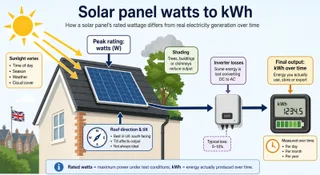
This is different from solar thermal technology, which uses solar energy to heat water. Solar electricity means solar photovoltaic generation, often shortened to solar PV. The system’s size is commonly described in kilowatts peak, while the electricity it generates over time is measured in kilowatt-hours.
The panel is only one part of the installation. The mounting rails, roof fixings, DC cabling, isolators, inverter, monitoring equipment and consumer unit connection all matter because they determine how safely and efficiently the electricity reaches the building. If you are comparing module options, Kilowatts lists a range of home solar panels used in residential designs.
From roof to socket: the main components
A domestic solar PV system is a small generating system fitted into a building. The panels produce DC electricity on the roof, but most UK household appliances use AC electricity. The inverter is the bridge between the roof array and the home’s wiring.
The inverter also has an important safety role. Standard grid-connected inverters are designed to operate within permitted voltage and frequency settings. Most ordinary grid-tied systems shut down during a power cut so they do not feed electricity into the local network while engineers may be working. Backup power is not automatic and needs equipment designed for that purpose.
The main components are usually:
Solar panels
These generate DC electricity from daylight.Mounting system
This fixes the panels to the roof structure and must suit the roof covering.Inverter
This converts DC electricity into AC electricity for the property.Consumer unit connection
This allows solar power to supply circuits in the home.Monitoring and metering
This shows generation, import, export and sometimes battery behaviour.Optional battery or diverter
This can store or redirect surplus solar electricity for later use.
How your home uses solar electricity first
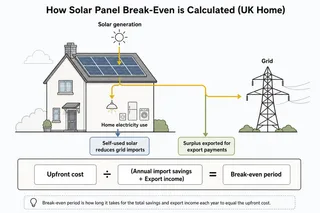
When your panels are generating and the home is using electricity at the same time, solar electricity normally supplies the property before power is imported from the grid. If the fridge, router, background loads and a washing machine are running during daylight, solar generation can reduce the amount drawn from your supplier at that moment.
A simple example helps. If the solar system is producing 2 kW at a particular moment and the home is using 0.7 kW, the home can be supplied by the solar system. The remaining 1.3 kW would need to be stored, diverted or exported if there is nowhere else for it to go. If clouds pass and solar output falls to 0.4 kW while the home still needs 0.7 kW, the property would import the shortfall from the grid.
Solar savings are not only about annual generation. They also depend on when electricity is used. A home that can run flexible appliances, EV charging or water heating during daylight may use more of its own solar electricity than one where most demand happens after sunset.
What happens to surplus solar electricity
Surplus solar electricity is not automatically stored by the house. Unless there is a battery, immersion diverter or another controllable load designed to use it, surplus generation is normally exported to the grid through the property’s metering and connection arrangement.
In the UK, export payments are commonly discussed through the Smart Export Guarantee and supplier export tariffs. Eligibility, rates and metering requirements vary by supplier, so check the chosen supplier’s requirements before assuming export income. A smart meter is often needed for measured export, but the exact arrangement should be confirmed rather than assumed.
A battery changes the timing of solar use rather than creating extra generation. It can store some electricity that might otherwise be exported, then release it later when the home needs power. This can improve self-consumption, but it adds cost, space requirements, compatibility checks and some energy losses during charging and discharging.
What affects how much electricity solar panels produce
Solar PV output is site-specific. Two houses with the same number of panels can produce different results because of roof orientation, pitch, shading, location, panel layout, inverter design and electricity use. A largely unshaded south-facing roof is often favourable in the UK, but east-west roofs can still work well because they spread generation across more of the day. For more detail on expected output, read this guide to solar generation levels. Installers should look beyond the obvious roof face. Chimneys, dormers, trees, neighbouring buildings, aerials and roof valleys can cast shade at particular times of day or year. Even partial shading can affect a string of panels depending on the inverter design and whether optimisers or microinverters are used.
| Factor | Why it matters | What to check early |
|---|---|---|
| Roof condition | Panels are usually intended to stay in place for many years | Whether the roof needs repairs before installation |
| Direction and pitch | These affect when and how strongly panels generate | Main roof faces and whether a split array makes sense |
| Shading | Shade can reduce output and complicate design | Chimneys, trees, dormers and neighbouring buildings |
| Electricity use pattern | Solar is most valuable when used on site | Daytime loads, flexible appliances and EV charging habits |
| Inverter location | Poor siting can affect access, cable runs and ventilation | Loft, garage, utility space or external-rated options |
| Grid connection | Export limits can shape the system design | DNO process, inverter capacity and proposed export level |
Do solar panels work on cloudy days and in winter
Solar panels do work on cloudy days because they use daylight rather than heat. Output is lower when the light is weaker, so a dull winter day will not perform like a bright summer day. The system can still generate electricity if there is enough daylight.
Winter is different for three main reasons. Days are shorter, the sun is lower in the sky, and weather conditions are often less favourable. A UK solar PV system will usually generate much more electricity in summer than in winter, so it should not be judged only by a single day’s app reading. This seasonal pattern is covered further in the guide to solar panels in winter.
This seasonal pattern matters when planning batteries and setting expectations. A battery may fill regularly in summer but less often in winter if there is not much surplus solar to store. The right design should reflect annual behaviour, not only the best-looking days.
Will solar panels power the whole house
Solar panels can cover part of a home’s electricity use. At certain moments they may supply most or all of the property’s demand. Across a full year, most grid-connected UK homes still rely on the grid at night, in winter, during high-demand periods, or when solar output is low.
Whether a system feels powerful in practice depends on both the solar array and the loads in the home. A kettle, oven, electric shower, heat pump, EV charger or tumble dryer can draw far more power than background household equipment. If several high-load appliances run at once, the home may import from the grid even while the panels are generating.
System design should start with actual electricity use rather than roof area alone. Annual consumption, half-hourly smart meter data, planned EV charging, heat pump use, daytime occupancy and future appliance changes can all alter the right design. If you are at the early sizing stage, this guide explains how many panels a UK home may need.
Why the inverter and grid connection matter
The inverter sets an important part of how the system behaves. It converts panel output into grid-compatible electricity, tracks the operating point of the panels, and applies protection settings required for safe grid connection. A hybrid inverter can also manage a compatible battery, while an AC-coupled battery has its own inverter equipment.
For UK grid connection, installers normally deal with the local Distribution Network Operator, often shortened to DNO. Smaller straightforward systems may be notified under a simpler route, while larger or higher-export systems may need an application before connection. Installers commonly refer to ENA G98 and G99 processes, but the correct route depends on inverter capacity, export design and local network requirements.
Export limits can affect the final proposal. In some cases, a system may be configured to limit how much power is exported to the grid. That does not necessarily stop the home using solar electricity on site, but it can influence inverter settings, battery value and whether adding more panels is worthwhile.
UK rules and standards to know
Solar PV is a building and electrical installation, rather than a consumer appliance. Homeowners should not try to assess roof structure, electrical safety or grid connection requirements themselves. A competent installer should design and install the system in line with relevant UK electrical requirements, manufacturer instructions and the requirements of the local network operator.
MCS certification is commonly important in the UK solar market because many export tariff arrangements and consumer protections expect installation by an MCS-certified contractor using eligible products. MCS is not the same thing as planning permission or a DNO approval, but it is a key framework to understand when comparing installers and export options. Kilowatts explains the role of MCS for solar in more detail.
Building regulations, roof loading, fire safety guidance, electrical certification, DNO notification or application, and supplier export requirements can all affect a real project. The exact requirements depend on the property, system size, inverter arrangement, roof type, location and whether batteries or backup circuits are included.
MCS certification
Check whether the installer and products are appropriate for your intended export tariff and documentation needs.DNO process
Ask whether the system will follow the relevant G98 or G99 route and whether any export limit is expected.Electrical certification
Confirm what certificates and handover documents will be provided after installation.Building considerations
Ask how roof condition, loading, fixings, access and any planning constraints have been assessed.
What installers check before recommending solar PV
A good solar survey is more than a quick look at the roof from the pavement. The installer needs to understand the roof structure, roof covering, safe access, cable routes, inverter location, consumer unit arrangement, earthing and bonding, metering, and any constraints around planning or building type.
They also need to check how the design behaves as a system. Multiple roof faces may need separate inverter inputs or module-level electronics. A battery may need a suitable location, compatible equipment and manufacturer-specific installation conditions. Bird protection, scaffolding, roof repairs and fire access considerations may also affect the practical scope.
Before accepting a proposal, it is worth asking how the installer has handled these points:
Roof survey
Ask whether roof condition, fixing method and shading have been assessed properly.Electrical connection
Ask whether the consumer unit, cable route and isolators are included in the design.DNO process
Ask what notification or application route applies and whether export limits are expected.Monitoring
Ask what the app will show and whether it measures generation, import, export and battery flow.Battery readiness
Ask whether the system can support a battery later if you are not fitting one now.
How solar, batteries and the grid work together
Solar panels generate electricity when daylight is available. A battery can store some surplus for later, and the grid supplies the home when solar and stored energy are not enough. The best arrangement depends on the property’s daily demand, tariff, export arrangement, available space and how much control the homeowner wants over energy use. For a separate explanation, see how a home battery works.
A battery is often most useful where there is regular surplus solar during the day and meaningful electricity use later. It may be less compelling where daytime use is already high, roof generation is modest, or there is very little surplus to store. Battery sizing should be based on realistic generation and load patterns, not simply on wanting the largest capacity available.
Solar diverters are another option where a home has a suitable hot water cylinder. They can send surplus electricity to an immersion heater rather than exporting it. This can be useful in the right property, but it is not the same as a battery because it stores energy as heat rather than electricity.
Common misunderstandings about solar electricity
The most common misunderstanding is that solar panels need hot weather. They do not. They need light, which is why they can work in the UK, although output varies strongly by season, cloud cover and roof conditions.
Another misunderstanding is that a solar PV system automatically keeps the lights on in a power cut. Most standard grid-tied systems shut down when the grid goes off for safety. If backup power is important, it must be discussed at design stage because it affects equipment choice, wiring, battery arrangement and which circuits can be supported.
A third misunderstanding is that the biggest roof array is always the best answer. More panels can increase generation, but only if the roof, inverter, grid connection, budget and usage pattern support the decision. A well-designed smaller system can sometimes be a better fit than a larger system constrained by shade, export limits or poor self-consumption.
How to decide whether solar PV suits your property
Solar PV is usually most attractive where there is a sound roof, reasonable unshaded space, a practical inverter location and some electricity use during daylight hours. It can also work well for homes that can shift appliances, EV charging or water heating into sunny periods.
It may be harder to justify where the roof is heavily shaded, due for replacement, structurally unsuitable, very small, or subject to ownership and permission issues. Flats, rented properties, listed buildings and some conservation area homes may need extra checks before any proposal can be treated as realistic.
The next practical step is to gather your annual electricity use, recent bills, any smart meter data, roof photos if safe to provide, and details of planned changes such as an EV, heat pump or battery. A competent installer can then design around the real property rather than giving a generic answer, and you can compare home solar options before deciding how to proceed.
Plan, Compare & Buy Renewable Energy Solutions
AI does the thinking.
You get the perfect solar match.
Use RoboMo™ to assess your property, compare available technologies and connect with trusted UK installers, suppliers and manufacturers.
Simply enter your postcode, drop a pin on your roof, create your free account and let RoboMo™ analyse your property to find the best solar panels for your home.
You don't have to think
RoboMo™'s AI analyses your roof and does all the hard work.

Accurate & tailored
AI-powered assessment based on your roof, location, and conditions.

Best options, maximum savings
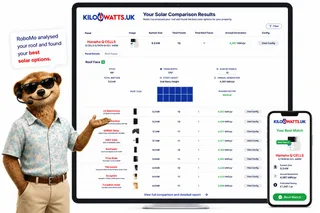
Compare top solar panels for the best performance and value.

Simple, fast & effortless
Provide a few details, sit back and watch your results unfold.
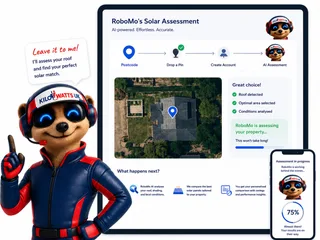
STEP 1
Choose Home, Business or Industrial
Enter your postcode to start your assessment.
STEP 2
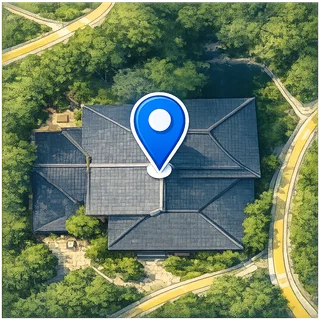
Drop a pin on your roof
STEP 3

Create your free account
STEP 4

Sit back and watch RoboMo™ work
RoboMo™ analyses your roof and builds your personalised solar comparison.
Step 1
Enter your postcode
Start designing your wind energy system in seconds.
Are you an installer, distributor or renewable energy business?
Kilowatts UK is expanding the Flower Turbines partner network across the UK.
Become A Flower Turbines PartnerKilowatts UK is an authorised representative
Flower Turbines
Compact vertical-axis turbines built for real UK sites, not just open farmland.
They start in light wind, sit in a small footprint, and are bird-safe by design. Cluster them as a bouquet and the group performs better together than the same turbines standing alone. Enter your postcode for a location-based generation estimate. Figures use area weather data and will differ if buildings, trees or hills sit in the way.
Starts in light UK wind
Built to generate in typical UK wind, not only open farmland.
Small rooftop or ground footprint
Compact towers for roofs, yards and tight sites.
Bird-safe slow rotation
Slow vertical-axis spin, bird-safe by design.
Bouquet clusters raise output
Grouped turbines outperform the same units standing alone.
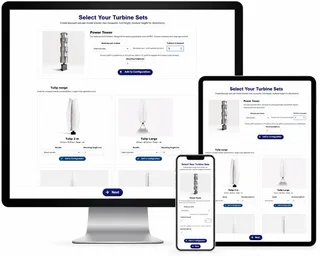
STEP 2

Choose a location
STEP 3
Place your cluster
Tap the map where you want the turbine cluster to go.
STEP 4

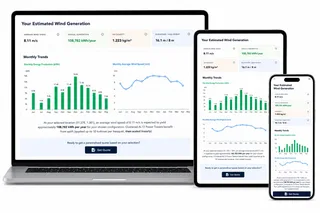
Instant generation forecasts
Compare different turbine layouts and see annual generation forecasts instantly.
STEP 5
No commitment required
Explore different configurations before deciding whether to request a quotation.
Related articles
FAQ
Need Help? RoboMo's Got Answers
How does solar electricity work in a UK home?
Solar PV panels turn daylight into direct current electricity. An inverter converts this into alternating current that your home can use. Your property normally uses available solar power first, then imports from the grid when the panels are not producing enough.
Do solar panels work on cloudy days in the UK?
Yes, solar panels work from daylight rather than heat, so they can generate on cloudy days. Output is lower when light levels are weaker, especially in dull winter weather. Generation varies by season, time of day, roof direction and shading.
What happens to electricity I do not use?
Surplus solar electricity is usually exported to the grid unless you have a battery, immersion diverter or another load set up to use it. Export payments depend on your supplier’s tariff and requirements, such as suitable metering. You should confirm the export arrangement before assuming any income.
Will solar panels power my whole house?
At some moments, solar panels may supply most or all of your home’s electricity demand. Across the year, most grid-connected UK homes still use the grid at night, in winter or during high-demand periods. Large appliances such as kettles, ovens, electric showers, heat pumps and EV chargers can quickly exceed solar output.
Do I need a battery with solar panels?
A battery is optional, not automatic. It can store some surplus solar electricity for later use, which may increase how much of your own generation you use. It also adds cost, space requirements, compatibility checks and some energy losses, so it should be sized around your actual usage pattern.
What affects how much electricity my solar panels generate?
Output depends on roof direction, pitch, shading, location, panel layout, inverter design and the weather. A largely unshaded south-facing roof is often favourable, but east-west roofs can also be useful because they spread generation across the day. Even partial shading from chimneys, trees or nearby buildings can reduce performance.
Why does the inverter matter?
The inverter converts the panels’ DC electricity into AC electricity for your home. It also manages how the panels operate and includes safety functions for connection to the electricity network. Hybrid inverters can manage compatible batteries, while some battery systems use separate inverter equipment.
What should I check before choosing a solar installer?
Ask how the installer will assess roof condition, shading, fixing method, cable routes, inverter location and the consumer unit. Check what DNO notification or application process applies and whether any export limit is expected. It is also sensible to ask about MCS certification, electrical certificates and the handover documents you will receive.