


Off-balance-sheet solar for UK corporates: UK business guide
Published: 2026-09-29 01:01:09
Updated: 2026-10-01 03:51:51
Off-balance-sheet solar for UK corporates is not a sales label. Whether the deal stays off the balance sheet is for your auditor, not the term sheet.
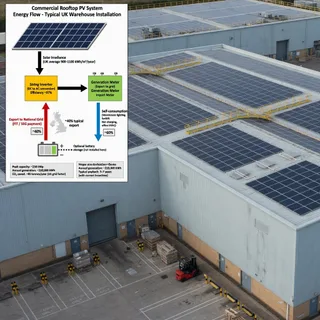
Off-balance-sheet solar for UK corporates - UK business guide
UK business guide B Solar accounting treatment no invented IFRS
What off-balance-sheet solar means for a UK corporate
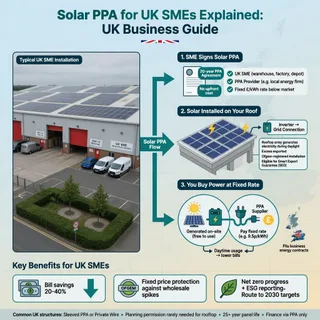
Off-balance-sheet solar for UK corporates is a procurement route in which another party owns and finances the plant, and the business buys the electricity rather than the asset. The common form is an on-site power purchase agreement. The label is not an accounting result. Whether the contract stays off the balance sheet depends on the reporting framework, often IFRS or FRS 102. It also depends on control, term, price and end options. This guide does not make that judgement. Roof life, site control, daytime load and the network connection decide whether a funder will offer terms.
The corporate is usually the host and the offtaker. It gives access to a roof or a piece of land, and it agrees to take power generated on that site. The funder, or a developer backed by a funder, owns the modules, inverters and related plant. A roof or land lease to a developer is a different bargain. There the business may receive rent rather than, or as well as, a power price. That can suit a landlord with little on-site load. It is a poor description of a warehouse, office or shop that wants to cut its own import.
Direct ownership, hire purchase and many leases are separate arrangements. Paying nothing on day one does not, by itself, keep a solar contract off the balance sheet. If the funder owns the plant, that asset will usually sit on the funder's balance sheet. The host's reporting is a different question. It is answered from the contract the host actually signs, not from the sales name of the deal.
How an on-site PPA differs from the corporate owning the array
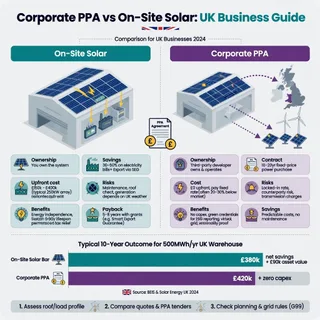
An on-site power purchase agreement is a contract to buy electricity from equipment someone else owns on your site. Ownership is a decision to fund, control and retain the plant. The two routes can look similar on a roof. They diverge on who takes price risk, who maintains the system, who may alter the roof, and what each party can claim at the end of the term. Under a typical third-party arrangement the installer often contracts with the funder, while the corporate is the offtaker and the roof host. Scope, warranties and who may instruct variations need to be clear in both the works contract and the power purchase agreement or roof agreement. A performance promise given to the funder does not automatically compensate the host for lost savings. If generation is down, the host may simply import more from its supplier, at the supplier's rate, unless the contract says otherwise. Ownership gives the corporate control of alterations and of the asset itself. It also puts maintenance, inverter replacement and end-of-life condition on the owner, unless a separate operations contract moves some of that work. Neither route is universally cheaper. A fair comparison uses that site's import tariff, standing charges and time-of-use shape, set against the draft contract price, indexation, downtime and export terms. There is no reliable national cost figure in this guide for a warehouse array. What changes a quote is the roof, the load behind the meter, and the network offer.
Is off-balance-sheet solar for UK corporates an accounting outcome?
Yes. The arrangement is off the balance sheet only if that is the result of applying the entity's reporting framework to the signed contract. It is not a feature of the panels, and it is not something a term sheet can promise in advance. IFRS 16 brought many leases onto the lessee's balance sheet. Whether an on-site solar power purchase agreement is a lease is a judgement for the company and its auditor. This article does not make that judgement, and it does not set out a numerical test from the standards.
The questions turn on an identified asset, who controls its use, how long the arrangement runs, how the price is set, and what happens if the host can buy the plant, extend the term or require removal. A purchase option, a renewal that is likely to be exercised, or a removal duty that is more than incidental can change the analysis. So can a price that looks like a repayment schedule rather than a charge for power. The signed documents matter more than a slide that uses an accounting label as a product feature.
Groups add a further split. A parent may report under IFRS while a subsidiary uses another framework, including FRS 102. The same physical array can therefore be discussed differently in group accounts and in entity accounts. Wanting a cleaner balance sheet is not itself an accounting policy. Before anyone treats the deal as off the balance sheet, the draft contract should go to the auditor, with the current text of the standards the entity actually uses. Updates and agenda decisions move. They should be read in the current source, not summarised from a sales pack.
What decides whether a funder will offer terms on a UK site
A funder still needs a usable site and a credible offtaker. Roof or ground condition, remaining life of the covering, structural capacity, shading, orientation and safe access decide whether a contract is offered at all. Occupation length matters as much as roof area. A short lease, or a freeholder planning redevelopment, often cannot support the term a funder needs to recover capital. That term is negotiated. It is not stated here as a UK norm.
Landlord consent is a practical gate, not a formality after heads of terms. Alterations clauses, roof warranties and dilapidations should be read before a corporate treats a proposal as viable. A power purchase agreement does not create consent the lease withholds. Tenants who cannot promise quiet access for the full term will struggle to close, even on a large roof. Credit strength matters as much as the building. The funder takes customer risk as well as generation risk.
Daytime load is the other half of the offer. Warehouses with packing or refrigeration running through the day, offices with a steady weekday base, and shops open through daylight hours are the patterns usually discussed. Low daytime use can mean no offer even where the roof is large, because too much of the generation would depend on export. Export revenue is not the same product as on-site offtake. Who receives it, and on what price, has to be in the contract. Planning is also separate from the network offer. Permitted-development limits for non-domestic solar should be taken from current official guidance for that site, not assumed because a funder is involved.
How a commercial solar G99 connection changes the programme
Larger commercial connections are commonly handled under the Energy Networks Association G99 process rather than G98. The correct route depends on capacity and on the distribution network operator, not on a marketing category. Constraints, export limits and new metering can delay a scheme or cut its size. Ordering panels before the network offer is known is a common way to strand equipment against a limit the site cannot use.
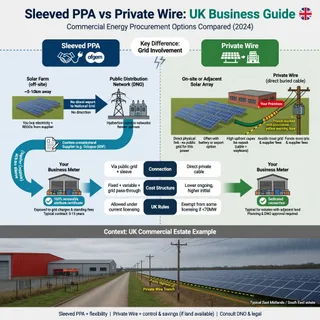
Supplying the host on one site is not the same as selling electricity to other customers. Licence and exemption questions are not settled in this guide. They need current official guidance and, where the structure is unusual, legal advice. A retail park or a multi-let office adds shared roofs, wayleaves and more than one occupier. Metering has to support host billing and any export settlement the contract assumes. Shared landlord supplies, tenant risers and shutdown windows are easy to under-scope, and they move both the connection date and the date a funder will pay.
The electrical design has to match the network offer and the offtake together. Export limitation, existing switchgear and the host's ability to take power during operating hours should sit in the same programme as landlord consent and structural sign-off. A G99 application left until after financial close, or until modules are already committed, is late. The distribution network operator's timetable is not the funder's timetable.
How to compare commercial solar with grid electricity for a UK business
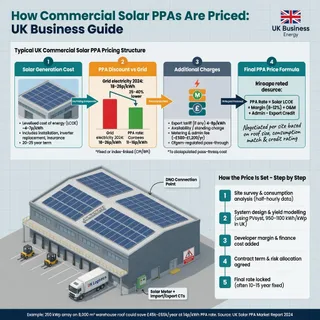
Compare the contract price with that site's grid import, not with a national average. The relevant import is the tariff the site actually pays, including standing charges and the time-of-use shape of the load the solar would displace. A lower unit rate does not prove a lower site electricity cost. The result depends on the price path, how much generation is used on site, export terms, standing charges that do not fall with the array, and hours when the plant is down.
Indexation is the clause finance and procurement both need to read. A price that starts below today's import can cross it if the index and the import tariff move differently. Downtime, deemed-generation wording and any minimum-take clause change the risk again. Typical discounts, contract lengths, minimum sizes and credit hurdles are negotiated. They move with power prices, interest rates and site quality. They are not stated here as UK standards.
Owned-system cost, annual yield and payback are also site-specific, and they are not written here as averages. For a warehouse, the quote moves with structural capacity on a lightly loaded roof, remaining membrane life against the proposed term, and how much daytime load sits behind the same meter as the array. For an office, roof plant, shading from taller neighbours and a lease that ends before the funder's term are the usual brakes. For shops, shared roofs and split occupation matter as much as equipment price.
What stays with the host even if the asset sits elsewhere
Third-party ownership does not move every operational risk off the host. The host still gives access, still has a roof or a yard the plant sits on, and still has insurer, landlord and safety duties that the contract does not erase. An accounting outcome, if that is what the auditor later confirms, does not remove those duties. Insurance conditions for non-domestic rooftop photovoltaic systems should be checked with the insurer. This guide does not state a fire rule.
Renewable claims follow the contract and the certificate position, not the marketing name of the deal. Certificates may be kept, transferred or retired under the wording. Export revenue may sit with the funder, the host or a split. None of that should be assumed from a phrase such as green power. If a sustainability report will rely on the arrangement, the certificate path needs to be explicit before signature. Current official practice should be read from current guidance, not from a brochure.
Tax, VAT and business rates are separate tests from the accounting label. An arrangement can be off the balance sheet and still have tax or rates effects, or the reverse. The owner of the plant may be the party in a position to consider capital allowances. The host should not assume that it can. VAT on commercial on-site power purchase agreements, and the business-rates treatment of rooftop plant, need primary sources and the company's own tax advisers. No rate, relief or exemption is stated here. End-of-term purchase, extension or removal feeds both the commercial bargain and the accounting review. Those options should be priced, not left as a sentence in a schedule. Removal has a cost, a programme and a roof-reinstatement question. A purchase price that is nominal, or that is set so exercise is likely, is exactly the sort of clause an auditor will ask to see. Assignment and change of control matter if the corporate may be sold during the term. A buyer of the business may inherit the offtake, or may find the funder's consent is required.
When third-party solar is a weak fit
The route suits UK corporates and other non-domestic occupiers that want on-site generation without funding the asset, and that can offer credible offtake or a clear right over the roof or land. It is a weak fit where the occupier wants the plant on its own books, for control of alterations or for an ownership-based tax position that must be checked with a tax adviser. It is also a weak fit for short leases, roofs near the end of their life, sites the business expects to leave, and connections the network cannot accommodate on a workable timetable.
A minimum size for third-party finance is not stated here and should not be guessed. Some roofs are large and still unfinanceable because the membrane will not last the term, because asbestos or access makes the works unsafe, or because the offtaker's credit does not support the customer risk. Businesses that can fund the system should compare a third-party contract with ownership on price risk, maintenance, end of term, tax and accounting together. Choosing the route only to dress the balance sheet, before the contract is reviewed, is the mistake this topic most often attracts.
Commercial rooftop solar for UK offices, and solar for retail parks and shops, fail in similar ways when site control is shared. A single tenant cannot grant a funder a right the landlord has not given. A disposal planned inside the term is a funding problem even if the roof is new. In those cases ownership, a shorter scheme the corporate funds itself, or waiting until the estate position is clear, is often the more honest programme. None of those alternatives is automatically cheaper. They are clearer about who holds the asset.
What to settle before a term sheet is treated as firm
Treat the term sheet as a list of open risks, not as evidence that the accounting, the roof or the connection is done. Financial close waits on structural sign-off, a roof-warranty position that survives the fixings, and a network offer that matches the design. Large warehouse roofs are often lightly loaded. Structural sign-off is a funding condition, not paperwork after the event. Penetrations that can void a roof warranty, asbestos, edge protection and crane access should be settled before a price is treated as firm.
The clauses auditors and funders both read are the same ones estates and finance should mark up early. Price, indexation, downtime, assignment and end-of-term options decide more of the outcome than a headline discount to today's import. Metering must be able to support host billing. Insurer conditions should be confirmed rather than assumed. If the corporate is a tenant, landlord consent and dilapidations need a written path, not a hope that the landlord will agree later.
A corporate that wants a decision, rather than a label, can do three things in parallel. Measure daytime import on the meter that would sit behind the array. Ask estates for the unexpired lease, the roof warranty and any redevelopment plan. Ask the funder for the draft end-of-term and assignment clauses, not only the opening unit rate. With those in hand, the comparison with owning the plant is a commercial judgement. The balance-sheet wording is a question for the standards and the auditor, and it should stay that way until they have seen the contract.
Plan, Compare & Buy Renewable Energy Solutions
AI does the thinking.
You get the perfect solar match.
Use RoboMo™ to assess your property, compare available technologies and connect with trusted UK installers, suppliers and manufacturers.
Simply enter your postcode, drop a pin on your roof, create your free account and let RoboMo™ analyse your property to find the best solar panels for your home.

You don't have to think
RoboMo™'s AI analyses your roof and does all the hard work.

Accurate & tailored
AI-powered assessment based on your roof, location, and conditions.

Best options, maximum savings
Compare top solar panels for the best performance and value.

Simple, fast & effortless
Provide a few details, sit back and watch your results unfold.
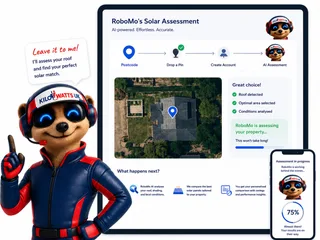
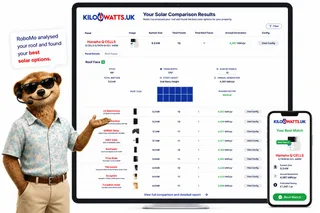
STEP 1
Choose Home, Business or Industrial
Enter your postcode to start your assessment.
STEP 2

Drop a pin on your roof
STEP 3

Create your free account
STEP 4

Sit back and watch RoboMo™ work
RoboMo™ analyses your roof and builds your personalised solar comparison.

Kilowatts UK is an authorised representative
Flower Turbines
Compact vertical-axis turbines built for real UK sites, not just open farmland.
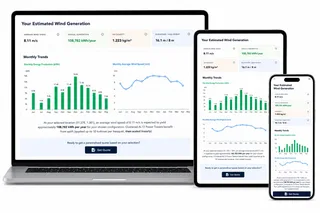
They start in light wind, sit in a small footprint, and are bird-safe by design. Cluster them as a bouquet and the group performs better together than the same turbines standing alone. Enter your postcode for a location-based generation estimate. Figures use area weather data and will differ if buildings, trees or hills sit in the way.
Starts in light UK wind
Built to generate in typical UK wind, not only open farmland.
Small rooftop or ground footprint
Compact towers for roofs, yards and tight sites.
Bird-safe slow rotation
Slow vertical-axis spin, bird-safe by design.
Bouquet clusters raise output
Grouped turbines outperform the same units standing alone.
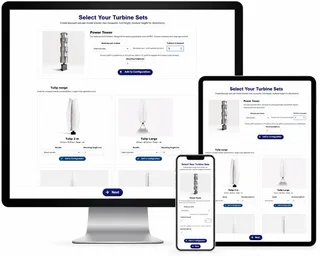
Step 1
Enter your postcode
Start designing your wind energy system in seconds.
STEP 2

Choose a location
STEP 3

Place your cluster
Tap the map where you want the turbine cluster to go.
STEP 4

Instant generation forecasts
Compare different turbine layouts and see annual generation forecasts instantly.
STEP 5

No commitment required
Explore different configurations before deciding whether to request a quotation.
Related articles
Mo's Mission Nominations
FAQ
Need Help? RoboMo's Got Answers
What does off-balance-sheet solar mean for a UK corporate?
It is a procurement route in which another party owns and finances the plant, and the business buys the electricity rather than the asset. The common form is an on-site power purchase agreement, with the corporate as host and offtaker. A roof or land lease, where the business may receive rent, is a different bargain and can suit a landlord with little on-site load. The label is not an accounting result. Whether the contract stays off the balance sheet depends on the reporting framework and the signed terms.
Is an on-site solar PPA automatically off the balance sheet?
No. Paying nothing on day one does not, by itself, keep a solar contract off the balance sheet. The result depends on applying the entity's framework, often IFRS or FRS 102, to the signed contract, including control, term, price and end options. Whether the agreement is a lease is a judgement for the company and its auditor, not a feature a term sheet can promise. A parent and a subsidiary may also report the same array differently if they use different frameworks.
How does a third-party PPA differ from the corporate owning the array?
Under a typical third-party arrangement the funder owns the modules, inverters and related plant, and the corporate buys the power and gives site access. Ownership instead means the business funds, controls and retains the plant, and usually carries maintenance and end-of-life condition unless an operations contract moves that work. The routes diverge on price risk, who may alter the roof, and what each party can claim at the end of the term. A performance promise to the funder does not automatically compensate the host if generation is down. Neither route is universally cheaper, and a fair comparison uses that site's import tariff against the draft contract.
What decides whether a funder will offer terms on a UK site?
A funder needs a usable site and a credible offtaker. Roof or ground condition, remaining covering life, structure, shading, access and occupation length all affect whether terms are offered. Landlord consent, alterations clauses and roof warranties should be read first, because a power purchase agreement does not create consent the lease withholds. Credit strength matters as much as the building. Low daytime load can mean no offer even on a large roof, if too much of the generation would depend on export.
How does a commercial network connection affect the timetable?
Larger commercial connections are commonly handled under the Energy Networks Association G99 process rather than G98. The correct route depends on capacity and on the distribution network operator, not on a marketing category. Export limits, constraints and new metering can delay a scheme or cut its size, so ordering equipment before the network offer is known can strand it. Supplying one host site is not the same as selling electricity to other customers, and licence questions need current official guidance. The network operator's timetable is not the funder's, and an application left until after financial close is late.
How should a business compare a PPA price with its grid electricity?
Compare the contract price with the import tariff that site actually pays, not with a national average. Include standing charges and the time-of-use shape of the load the solar would displace. A lower unit rate does not prove a lower site cost, because indexation, on-site use, export terms, downtime and standing charges that do not fall with the array all change the result. A price that starts below today's import can later cross it if the index and the import tariff move differently. Discounts, contract lengths and credit hurdles are negotiated, and they are not UK standards.
What stays with the host if someone else owns the plant?
Third-party ownership does not remove the host's access, insurance, landlord or safety duties. Insurance conditions for non-domestic rooftop photovoltaic systems should be checked with the insurer, and this guide does not state a fire rule. Renewable certificates and export revenue follow the contract, not the marketing name of the deal. Tax, VAT and business rates are separate from any accounting label, and the host should not assume it can claim capital allowances on plant it does not own. Purchase, extension, removal and change-of-control terms should be priced before signature, because they affect both the bargain and the accounting review.
When is third-party solar a weak fit for a UK corporate?
It is a weak fit where the occupier wants the plant on its own books, for control of alterations or for an ownership-based tax position that must be checked with a tax adviser. A short lease, or a freeholder planning redevelopment, often cannot support the term a funder needs. Tenants who cannot promise quiet access for the full term will struggle to close, even on a large roof. Direct ownership, hire purchase and many leases are separate arrangements, and none is settled by a no-upfront-cost label. Planning and the network offer are also separate, and permitted-development limits should be taken from current official guidance for that site.