


Commercial solar for retail in the UK
Published: 2026-07-18 18:17:02
Updated: 2026-07-26 18:20:54
Find out commercial solar for retail in the UK, including costs, what affects price, and how to choose an installer.
Commercial solar for retail in the UK
Commercial solar for retail can be a strong investment where a shop, supermarket, retail warehouse, garden centre, convenience store, or shopping centre has high daytime electricity use and suitable roof space. For UK retailers, the business case usually depends on electricity consumption, roof condition, ownership or lease terms, grid connection capacity, installation cost, export value, and how much solar generation is used on site rather than exported.
Retail buildings often suit solar because trading hours overlap with daylight generation. Lighting, refrigeration, tills, IT systems, air conditioning, ventilation, escalators, lifts, cold rooms, back-office loads and EV chargers can all create useful daytime electricity demand.
The best retail solar projects are not simply the largest systems. They are systems sized around the actual load profile of the store, designed around roof constraints, and checked early for electrical capacity, planning, fire, insurance, landlord consent and Distribution Network Operator requirements. This guide focuses on UK commercial solar panels for retail buildings, including practical checks for shops, supermarkets, retail parks, shopping centres and large-format stores.
Short summary for retail decision makers
For many UK retailers, commercial solar is most attractive when the site has a long operating future, high daytime consumption and a roof that is not due for major work. A freehold supermarket with refrigeration and a large flat roof is usually a stronger candidate than a short-lease high-street shop with poor roof access and shaded roof space.
A typical retail solar PV system may range from around 10 kWp for a smaller shop to more than 1 MWp for a large retail or distribution-linked site. UK commercial solar output is often around 800 to 1,000 kWh per kWp per year, depending on location, roof design, orientation, shading, system losses and maintenance.
Payback is usually driven more by avoided grid imports than by export income. Export payments can help, including through Smart Export Guarantee tariffs where eligible, but exported electricity is normally worth less than electricity bought from the grid. A practical early screening for retail solar is:
Which retail sites suit solar best
Retail solar works best where solar generation is consumed directly by the business during the day. Refrigerated retailers can be particularly suitable because refrigeration creates a steady load, often including evening and overnight demand.
- Supermarkets and food stores with refrigeration.
- Convenience stores with long opening hours.
- Retail warehouses with large, relatively unshaded roofs.
- Garden centres with daytime lighting, pumps, café, refrigeration or back-office loads.
- DIY, homeware and furniture stores with large roof areas.
- Shopping centres with landlord-controlled common loads.
Smaller high-street shops can still be suitable, but the practical issues are often harder. Roof access may be shared, ownership may be unclear, the building may be listed or in a conservation area, and the electrical supply may have limited spare capacity. The lease length can also be a bigger issue because commercial solar is a long-life asset. A useful way to think about suitability is to compare energy use with practical property constraints: Retail parks where roofs, landlord supplies and tenant supplies are clearly understood. Larger stores adding customer or fleet EV charging.
How commercial solar works for a retail building
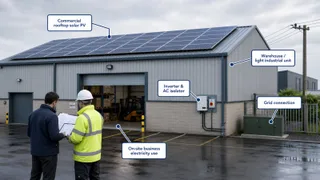
A retail solar PV system converts daylight into electricity on site. The panels produce DC electricity, inverters convert it to AC electricity, and that power is used by the store before any surplus is exported to the grid where export is allowed.
A well-designed system should be integrated with the building’s electrical infrastructure rather than treated as a bolt-on roof product. The designer needs to understand the main incoming supply, metering, distribution boards, cable routes, roof access, inverter locations, fire strategy, export arrangements and operational constraints.
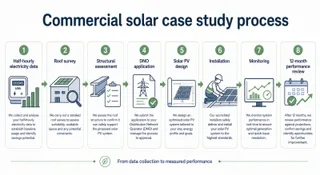
For larger retail sites, the installer may need to submit a G99 application to the Distribution Network Operator. Smaller systems may fall under G98, but many commercial retail projects need grid approval before installation. If the local network cannot accept full export, the project may need export limitation equipment and a G100-compliant export limitation scheme. The process normally follows this sequence: Review electricity bills and half-hourly demand data where available. Screen the roof using drawings, satellite imagery and site information. Check ownership, lease terms, roof warranties and landlord consent. Survey the roof, structure, access and electrical intake. Model generation, self-consumption, export and payback. Confirm DNO route under G98, G99 and, where needed, G100. Check planning, fire, insurance and operational requirements. Finalise design, contract, programme and installation method. Commission the system and provide handover documents. Monitor performance and maintain the system.
Typical system sizes, output, and cost ranges
Retail solar system sizes vary widely because stores differ in roof area, electricity load and electrical capacity. A small independent shop might use a 10 kWp to 30 kWp system, while a supermarket or retail warehouse may use 100 kWp to 500 kWp or more. Very large retail, warehouse-linked or multi-building sites can exceed 1 MWp where the roof, grid connection and demand profile support it.
Typical UK annual generation is often around 800 to 1,000 kWh per kWp. This is a broad planning assumption, not a substitute for site-specific modelling. A shaded roof in northern Scotland will not perform the same as an unshaded, well-oriented roof in southern England.
Indicative annual generation examples: Commercial rooftop solar in the UK often falls within broad installed cost ranges of around £700 to £1,200 per kWp for smaller systems and around £500 to £900 per kWp for larger commercial systems. These figures are only indicative. They should not be treated as a quotation because access, roof works, electrical upgrades, grid requirements and installation hours can materially change the cost. As broad examples, a 30 kWp retail system might be roughly £25,000 to £40,000 before VAT and project-specific works, while a 100 kWp system might be roughly £60,000 to £110,000 before VAT and project-specific works. Costs can increase where the project needs:
- Roof repairs or re-covering.
- Structural strengthening.
- Asbestos surveys or controls.
- Scaffolding, cranes, edge protection or netting.
- Out-of-hours installation to avoid trading disruption.
- New switchgear, meters or distribution boards.
Long or complex cable routes. Fire stopping and compartmentation works. DNO studies, export limitation or connection upgrades. Specialist monitoring, controls or landlord metering.
What affects payback for retail solar
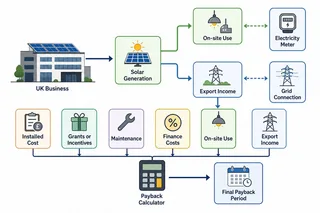
Commercial solar payback in the UK is often around 4 to 9 years, but the range can be wider depending on the site, finance route and electricity prices. Retailers should be cautious of proposals that calculate savings from annual consumption alone without matching generation to half-hourly demand.
The main payback drivers are:
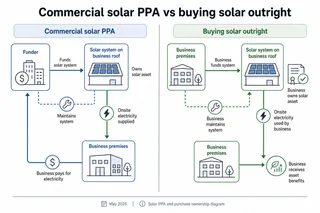
Self-consumption: The more solar electricity the store uses directly, the stronger the usual business case. Electricity price: Higher imported electricity prices increase the value of each unit avoided. Export value: Export income helps, but it is usually less valuable than avoided grid import. Installation complexity: Roof works, access requirements and electrical upgrades can materially change payback. DNO constraints: Export limits, connection upgrades or application delays can affect the final design. Finance structure: Asset finance, hire purchase, leasing or a power purchase agreement changes cash flow and ownership benefits. A system sized around the daytime baseload can sometimes perform better financially than a larger system that exports heavily. This is especially important where export rates are low, the DNO limits export capacity, or the site’s weekend and seasonal load varies significantly. A retailer comparing proposals should ask for the financial model to show at least: Maintenance and replacements — Inverters, monitoring equipment, inspections, cleaning and fault response should be allowed for. Lease length — A short lease or break clause can undermine a project even where the technical case is strong.
Roof, access, and building constraints
A commercial solar survey should start with the roof, not the panel count. Modern commercial solar panels typically need around 4.5 to 6 square metres per kWp of panel area. Flat roofs often need more total roof area because rows must be spaced to reduce shading and because safe access zones must be retained.
Retail roofs often contain rooflights, vents, flues, parapets, cold-room condensers, air handling units, mansafe systems, drainage routes, signage supports and access zones. These can reduce usable area and create shading that is not obvious from satellite imagery.
Fragile roof materials, asbestos risks and old roof coverings need particular care. UK dutyholders also need to consider legal duties around work at height and asbestos management before intrusive works or rooftop installation. If a roof is close to replacement, installing solar first can be a false economy because the panels may need to be removed and refitted later. Flat roof systems may be ballasted or mechanically fixed. Ballasted systems avoid roof penetrations but add weight. Mechanically fixed systems can reduce ballast but may affect roof warranties and require approval from the roof manufacturer or landlord. A good retail roof survey should consider:
- Roof covering type, age and remaining life.
- Structural loading and wind uplift.
- Rooflights and fragile surfaces.
- Asbestos-containing materials where relevant.
- Roof drainage and maintenance access.
- Plant, vents, condensers and shading.
Safe access for installation and future maintenance. Landlord, managing agent and roof warranty requirements. Fire routes, compartment lines and smoke ventilation. The effect of installation on customer areas and service yards.
Choosing the right layout for a retail load profile
South-facing solar arrays usually give the highest annual generation in the UK, but they are not always the best layout for retail. East-west layouts can be useful because they spread output across more of the trading day and can sometimes fit more capacity on a flat roof.
For example, a south-facing layout may produce a stronger midday peak, while an east-west layout may better support morning opening loads and late-afternoon trading. The best answer depends on the retailer’s half-hourly consumption, export value, roof geometry and DNO constraints.
Shading needs careful modelling. Parapets, signage, roof plant, nearby buildings, trees and neighbouring units can affect production. Even partial shading can reduce output if the string design is poor. Optimisers or microinverters may help on complex roofs, but they add cost and extra components. They should be specified because the design needs them, not because they sound more advanced. Key design choices include: South-facing versus east-west orientation. Tilt angle and row spacing on flat roofs. String inverter, optimiser or microinverter architecture. DC and AC cable route length. Inverter location and ventilation. Fire service access and isolation. Export limitation and monitoring controls. Future roof maintenance access. Space for future battery or EV charging integration.
Batteries for retail solar
Batteries are not automatically required for commercial solar in retail. Many retail sites achieve a good result with solar alone because daytime consumption is already high.
A battery may help where there is evening trading, export limitation, peak demand charges, variable load, time-of-use tariffs, or a desire to store midday surplus for later use. It can also help manage demand peaks if the control strategy is designed properly.
Commercial batteries are more site-specific than solar panels. Installed costs can vary widely, often around £400 to £900 per kWh, depending on scale, duration, chemistry, controls, safety requirements and installation complexity. Battery warranties usually depend on years, cycles and retained capacity. A standard solar and battery system does not necessarily provide backup power during a grid outage. Backup operation needs additional design, switching, protection, earthing arrangements and load separation. For retailers with refrigeration, tills, alarms or essential IT loads, backup requirements should be defined before the battery is specified. Batteries are most worth investigating where:
- The store exports a large amount of midday solar generation.
- The site trades into the evening.
- The supply contract has time-of-use charges.
- Demand peaks create material charges.
- The DNO restricts export capacity.
- The retailer wants resilience for selected critical loads.
They may be less attractive where the retailer already uses most solar generation during the day, has a simple tariff, has limited space for safe battery installation, or cannot justify the additional maintenance and control complexity. EV charging is adding new peaks to the site load.
UK government support, export payments, and policy to monitor
The Smart Export Guarantee may provide payments for exported electricity from eligible low-carbon generators, including solar PV, but rates are set by suppliers and vary. For many retail projects, SEG or export income is a secondary part of the business case rather than the main reason to install solar.
Capital allowances may be relevant where solar qualifies as business plant and machinery. The Annual Investment Allowance may allow qualifying expenditure to be deducted, subject to tax rules and the company’s position. Retailers should take tax advice rather than relying on a solar quotation for tax treatment.
England has business rates exemptions for eligible on-site renewable energy plant and machinery until 2035. Business rates treatment can vary by nation and property circumstances, so local advice is sensible before investment approval. There is no general UK grant that covers all private retail solar installations. Some local authority or regional business grants may exist from time to time, but they are usually time-limited, competitive and eligibility-based. Retailers should verify any grant directly with the public body or scheme administrator before including it in a board paper or finance model. Policy areas worth monitoring include: DESNZ solar and net zero policy. Ofgem Smart Export Guarantee rules. Distribution Network Operator connection processes. HM Treasury tax treatment and capital allowances. Valuation Office Agency business rates treatment in England. Devolved planning and rating rules in Scotland, Wales and Northern Ireland. Local planning policy for heritage, conservation and visual impact. Fire, insurance and electrical safety guidance for rooftop PV.
Planning, landlords, and leasehold issues
Many rooftop commercial solar installations may be permitted development if they meet the relevant conditions, but planning should never be assumed. The rules differ across the UK, and listed buildings, conservation areas, national parks, world heritage sites and visually sensitive locations can need closer assessment.
Ground-mounted solar, solar carports and canopy structures are more likely to involve planning considerations. Retail sites with prominent rooflines, heritage neighbours, complex signage, shared service yards or customer-facing elevations may also need careful review.
Leasehold properties need landlord consent before installation. A licence for alterations may be required, and the lease may restrict roof works, external appearance, electrical alterations, access, signage or plant. Repairing obligations also matter because the landlord and tenant need to agree who is responsible for the roof condition before and after solar is installed. Short leases can weaken the business case. If the retailer may relocate or has a break clause, ownership, removal rights, reinstatement, compensation, roof access and finance obligations need to be settled before contracts are signed. Important lease questions include: Who owns the roof and who controls access? Is the roof demised to the tenant or retained by the landlord? Does the lease allow plant, electrical alterations and rooftop equipment? Is a licence for alterations required? Who receives the electricity savings and any export income? Who maintains the system and who insures it? For shopping centres and retail parks, the metering structure can be as important as the roof. Landlord supplies, tenant supplies, common-area loads, private wire arrangements, service charges and export income allocation all need to be understood before financial savings are assigned. What happens if the roof needs repair? What happens at lease expiry, break clause or assignment? Does the finance provider need security over the asset? Are other tenants, managing agents or funders involved?
Fire, insurance, and retail operations
Retail sites are public-facing buildings, so installation planning must protect customers, staff, stock and trading operations. Work areas may need segregation, deliveries may need to avoid customer times, and electrical shutdowns may need to happen outside opening hours.
Insurers may ask for design information before works start. This can include array layout, inverter positions, cable routes, isolator locations, roof construction details, fire separation measures, fire service access and maintenance arrangements. Some insurers have specific expectations for rooftop solar on commercial buildings, so early notification is sensible.
Good design should reduce unnecessary internal DC cable runs where practicable, use correctly specified isolators, provide clear labelling for firefighters, and supply accurate as-built drawings. The site fire risk assessment should be reviewed after installation, and maintenance arrangements should be documented. Refrigerated retailers need particular care during shutdowns. Cold rooms, freezers, tills, alarms, emergency lighting and IT systems may need temporary arrangements or carefully planned outage windows. Operational planning should include: Customer and staff segregation. Service yard access and delivery timing. Out-of-hours lifting, craning or scaffold works. Temporary shutdown plans. Refrigeration protection and temperature monitoring. Emergency lighting, alarms and tills. Fire alarm interfaces where relevant. Noise, dust and housekeeping. Store manager communication. Handover and staff awareness.
How to compare retail solar installers
A retail solar installer should be able to explain both the commercial model and the practical installation constraints. A proposal based only on panel numbers and a headline payback is not enough for most retail sites.
When comparing installers, look for evidence of technical competence, retail installation experience, appropriate accreditations, clear insurance cover and transparent modelling assumptions. The installer should be willing to explain what could make the project unsuitable, not only what makes it attractive.
Data quality: The installer should request half-hourly electricity data where available and model self-consumption. Roof assessment: The survey should consider structure, roof condition, rooflights, plant, access, drainage and warranties. Electrical checks: The design should check supply type, import capacity, switchgear, metering, spare ways and cable routes. Grid process: The installer should explain whether G98, G99, export limitation or DNO upgrades may apply. Planning and lease checks: The proposal should identify landlord consent, planning and permitted development risks. Fire and insurance: The installer should provide information suitable for insurer review and fire risk assessment updates. A strong installer will also discuss what could make the project unsuitable. That might include poor roof condition, severe shading, a short lease, low daytime demand, constrained switchgear, costly grid upgrades, planning restrictions, or landlord refusal. Before appointing an installer, retailers should request: Operational planning — The programme should account for trading hours, customer access, service yards and shutdown windows. Financial modelling — Assumptions for self-consumption, export, degradation, O&M and electricity prices should be visible. Handover quality — Commissioning documents should include test certificates, grid paperwork, warranties, drawings and O&M manuals. Monitoring and aftercare — The system should include performance monitoring and a clear route for fault response.
Common mistakes to avoid
The most common retail solar mistakes happen before installation, usually during sizing, survey or contract approval. These are avoidable if the project is treated as a building and energy project rather than only a panel purchase.
Oversizing the system without checking half-hourly demand. Assuming all roof space is usable. Ignoring rooflights, HVAC plant and parapet shading. Failing to check roof life before installation. Forgetting landlord consent and lease restrictions. Assuming batteries are always needed.
A good feasibility study should identify these issues early, before the retailer commits to a design, finance package or installation date. Treating export payments as the main business case. Leaving the DNO application too late. Not notifying insurers where required. Assuming solar will provide backup power in a power cut. Comparing quotes only on cost per kWp. Ignoring seasonal trading patterns. Forgetting maintenance access after installation. Missing the effect of roof warranties. Using tax or grant assumptions without professional confirmation.
Suitability by retail type
Different retail formats have different strengths and risks. A qualitative comparison can help frame the early decision before a detailed survey.
Supermarkets and food retailers often have strong suitability because refrigeration and long opening hours create steady electricity demand. The roof may still be complex because of condensers, vents, rooflights, service access and insurer requirements.
Retail warehouses can also be strong candidates because they often have large roofs and predictable trading patterns. The main checks are usually roof condition, structural capacity, DNO capacity, landlord consent and access for safe installation. Shopping centres can offer large opportunities, but metering and ownership can be complex. Landlord supplies, tenant supplies, common-area loads, private wire arrangements and export income allocation all need to be understood. Garden centres can be good candidates where daytime loads include lighting, cafés, pumps, refrigeration, offices and customer EV charging. Seasonal demand should be modelled carefully because summer generation may not always align with winter electricity use. Small high-street shops may have simpler electrical loads but more complicated property constraints. The roof may be shared, access may be difficult, and the lease may not justify a long payback period. Convenience stores can work well where refrigeration and long opening hours create a steady load. However, the roof may be small, the electrical intake may be constrained, and installation may need to avoid trading disruption in a compact public-facing site.
Next steps for a retail solar project
The right first step is to gather enough information for a meaningful feasibility assessment. That usually means recent electricity bills, half-hourly consumption data if available, roof drawings or access information, lease details, and any planned roof works.
A site survey should then check the roof, structure, access, electrical intake, metering, cable routes, inverter locations, planning constraints, fire requirements and grid connection route. Only after that should the final system size and financial model be treated as reliable.
A sensible project sequence is: Gather electricity bills, MPAN details and half-hourly data where available. Confirm whether the site is freehold, leasehold or managed by a landlord. Check roof age, condition, warranties and any planned refurbishment. Complete a desktop solar and shading assessment. Arrange a site survey covering roof, structure, access and electrical systems. Model solar generation against the retail load profile. Commercial solar for retail can reduce grid electricity use and improve long-term energy resilience, but it is not suitable for every site. The best outcome comes from matching the system to the building, the trading profile, the lease, the grid connection and the retailer’s investment priorities. Check DNO requirements and likely export position. Review planning, landlord, fire and insurance requirements. Compare installer proposals on design quality, not just headline price. Approve the final specification, programme, finance route and handover requirements.
Sources and official guidance used
UK Government guidance on the Smart Export Guarantee and supplier export payments. Planning Portal guidance on solar panels and permitted development in England. Energy Networks Association information on G98, G99 and G100 connection requirements. UK Government guidance on capital allowances and the Annual Investment Allowance. UK Government and Valuation Office Agency guidance on business rates relief for green plant and machinery. Health and Safety Executive guidance on working at height and asbestos management.
Institution of Engineering and Technology guidance, including the IET Code of Practice for Grid-connected Solar Photovoltaic Systems and IET electrical installation guidance.
Plan, Compare & Buy Renewable Energy Solutions
AI does the thinking.
You get the perfect solar match.
Use RoboMo™ to assess your property, compare available technologies and connect with trusted UK installers, suppliers and manufacturers.
Simply enter your postcode, drop a pin on your roof, create your free account and let RoboMo™ analyse your property to find the best solar panels for your home.

You don't have to think
RoboMo™'s AI analyses your roof and does all the hard work.

Accurate & tailored
AI-powered assessment based on your roof, location, and conditions.

Best options, maximum savings
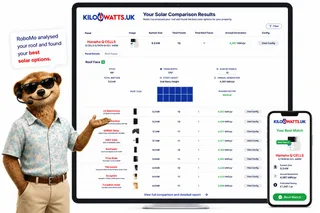
Compare top solar panels for the best performance and value.

Simple, fast & effortless
Provide a few details, sit back and watch your results unfold.
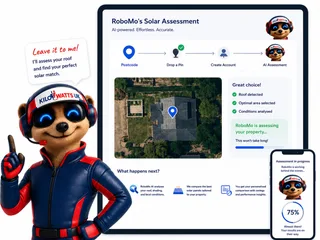
STEP 1
Choose Home, Business or Industrial
Enter your postcode to start your assessment.
STEP 2
Drop a pin on your roof
STEP 3

Create your free account
STEP 4

Sit back and watch RoboMo™ work
RoboMo™ analyses your roof and builds your personalised solar comparison.

Kilowatts UK is an authorised representative
Flower Turbines
Compact vertical-axis turbines built for real UK sites, not just open farmland.
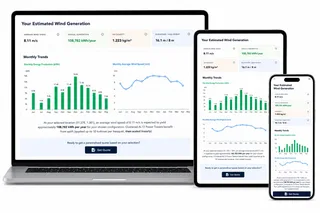
They start in light wind, sit in a small footprint, and are bird-safe by design. Cluster them as a bouquet and the group performs better together than the same turbines standing alone. Enter your postcode for a location-based generation estimate. Figures use area weather data and will differ if buildings, trees or hills sit in the way.
Starts in light UK wind
Built to generate in typical UK wind, not only open farmland.
Small rooftop or ground footprint
Compact towers for roofs, yards and tight sites.
Bird-safe slow rotation
Slow vertical-axis spin, bird-safe by design.
Bouquet clusters raise output
Grouped turbines outperform the same units standing alone.
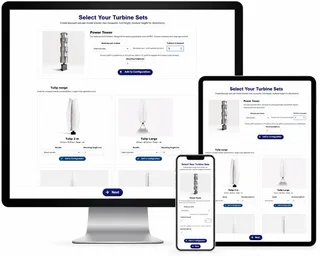
Step 1
Enter your postcode
Start designing your wind energy system in seconds.
STEP 2

Choose a location
STEP 3

Place your cluster
Tap the map where you want the turbine cluster to go.
STEP 4

Instant generation forecasts
Compare different turbine layouts and see annual generation forecasts instantly.
STEP 5

No commitment required
Explore different configurations before deciding whether to request a quotation.
Related articles
Mo's Mission Nominations
FAQ
Need Help? RoboMo's Got Answers
Is commercial solar suitable for retail businesses in the UK?
Commercial solar can be suitable for UK retailers with high daytime electricity use, suitable roof space, and a long-term interest in the site. Supermarkets, convenience stores, retail warehouses, garden centres and shopping centres often have strong potential because lighting, refrigeration, tills, ventilation, air conditioning, lifts, escalators and EV chargers use power during daylight hours. Suitability depends on the roof condition, lease or ownership position, electrical capacity, planning constraints, DNO requirements and how much generated electricity can be used on site.
Which retail sites benefit most from solar panels?
Retail sites with steady daytime electricity demand usually benefit most. Supermarkets and food stores are often strong candidates because refrigeration creates a consistent load, while retail warehouses can work well because they often have large roofs. Garden centres, shopping centres and convenience stores can also be suitable. Smaller high-street shops may still benefit, but shared roofs, short leases, shading, heritage restrictions and limited access can make projects harder to justify.
How much do commercial solar panels cost for a retail site?
Commercial rooftop solar costs vary by system size, roof type, access, electrical works and grid requirements. As a broad guide, smaller UK commercial systems may cost around £700 to £1,200 per kWp, while larger systems may be around £500 to £900 per kWp. A 30 kWp retail system might be roughly £25,000 to £40,000 before VAT and site-specific works, while a 100 kWp system might be roughly £60,000 to £110,000 before VAT and project-specific costs. A detailed site survey is needed before treating any cost estimate as reliable.
What is the typical payback period for retail solar panels?
Many UK retail solar projects have a payback period of around 4 to 9 years, although this can be shorter or longer depending on electricity prices, self-consumption, installation complexity, finance costs, export value and maintenance assumptions. Payback is usually strongest when the retailer uses most of the solar electricity on site rather than exporting it. A proposal should model generation against half-hourly electricity demand where possible, not just annual consumption.
How much electricity can a retail solar PV system generate?
UK commercial solar output is often around 800 to 1,000 kWh per kWp per year, depending on location, roof orientation, shading, panel layout and maintenance. For example, a 30 kWp system may generate around 24,000 to 30,000 kWh per year, while a 100 kWp system may generate around 80,000 to 100,000 kWh per year. Site-specific modelling is important because roof shape, shading from plant or nearby buildings, and local weather conditions can significantly affect output.
Should a retail solar system be sized to cover all electricity use?
Not necessarily. A retail solar system should usually be sized around the site’s actual daytime load profile, roof constraints and grid connection position. A system that is too large may export a high proportion of its generation, which can reduce financial returns if export payments are lower than the cost of imported electricity. In some cases, a smaller system with high self-consumption can deliver a better payback than a larger system that exports heavily.
Do retail solar panels need DNO approval?
Many commercial retail solar installations need approval from the local Distribution Network Operator before they are connected. Smaller systems may fall under G98, while larger systems commonly require a G99 application. If the network cannot accept the full export capacity, the project may need export limitation equipment and a G100-compliant export limitation scheme. The DNO route should be checked early because it can affect system size, cost and installation timescales.
Can a leasehold retail property install solar panels?
A leasehold retail property may be able to install solar panels, but landlord consent is usually required. The lease may restrict roof works, external plant, electrical alterations, access rights or changes to the building appearance. A licence for alterations may also be needed. Retailers should confirm who controls the roof, who receives the savings and export income, who maintains and insures the system, and what happens at lease expiry, assignment or a break clause.
Do commercial solar panels need planning permission for retail buildings?
Many rooftop commercial solar installations may be permitted development if they meet the relevant conditions, but planning permission should not be assumed. Rules differ across the UK, and listed buildings, conservation areas, national parks, world heritage sites and visually sensitive locations need closer assessment. Ground-mounted solar, carports and canopy structures are more likely to require planning consideration. Retailers should check planning requirements before committing to installation.
Is roof condition important before installing solar on a shop or supermarket?
Yes. Roof condition is one of the most important checks before installing commercial solar. If the roof is near the end of its life, installing panels first can be a false economy because the system may need to be removed and refitted for roof repairs. A survey should consider roof age, covering type, structural loading, wind uplift, rooflights, drainage, asbestos risks, roof warranties, plant equipment, safe access and future maintenance routes.
Do retail solar panels require a battery?
A battery is not always needed. Many retail sites use enough electricity during the day to benefit from solar alone. A battery may be worth considering where the site exports a lot of midday generation, trades into the evening, has time-of-use tariffs, faces peak demand charges, has export restrictions, or wants resilience for selected loads. A standard solar and battery system does not automatically provide backup power during a grid outage, so backup requirements must be designed separately.
Can solar panels keep a retail store running during a power cut?
Standard grid-connected solar PV systems normally shut down during a power cut for safety reasons. If a retailer needs backup for refrigeration, tills, alarms, emergency lighting or IT systems, this must be designed specifically with suitable batteries, switching, protection, earthing arrangements and load separation. Backup capability should be discussed at feasibility stage rather than assumed after the solar system has been specified.
Can retail businesses get paid for exported solar electricity?
Retailers may be able to receive export payments through a Smart Export Guarantee tariff or another export arrangement, subject to eligibility and supplier terms. Export rates vary and are normally lower than the cost of buying electricity from the grid. For most retail projects, the strongest savings come from using solar electricity on site, with export income treated as a secondary benefit.
Are there grants or tax incentives for commercial solar in retail?
There is no universal UK grant for all private retail solar installations. Some local authority or regional grants may be available from time to time, but they are usually limited, competitive and eligibility-based. Capital allowances may be relevant where solar qualifies as business plant and machinery, and business rates exemptions for eligible on-site renewable energy plant and machinery apply in England until 2035. Retailers should confirm tax, rating and grant assumptions with professional advisers or the relevant public body before relying on them.
What should retailers ask a solar installer before appointing them?
Retailers should ask for a detailed survey, site-specific generation model, self-consumption estimate, roof loading assessment, mounting design, electrical single-line diagram, DNO application route, programme, method statement, warranty schedule, operations and maintenance plan, and handover pack contents. A good installer should explain roof risks, lease issues, planning considerations, fire and insurance requirements, shutdown planning, export assumptions and monitoring arrangements, not just provide a headline cost per kWp.
What are the common mistakes to avoid with retail solar?
Common mistakes include oversizing the system without checking half-hourly demand, assuming all roof space is usable, ignoring roof condition, overlooking landlord consent, leaving the DNO application too late, relying too heavily on export income, assuming batteries are always needed, failing to notify insurers, and comparing installers only on price. A proper feasibility study should identify these issues before the retailer commits to a design, finance package or installation date.